UNESCO counts 273 million children and young people out of school (UNESCO, 2024 data). Many who do go to school still fall behind. UNESCO reports that 70% of 10-year-olds in low- and middle-income countries cannot understand a simple text (UNESCO, 2024).
When I looked at learning apps, I kept seeing the same three problems: they cost money, they need fast internet, or they are full of ads. Students also give up quickly when practice feels like homework.
So I asked a simple question: what if studying felt like a game, and the game itself was about making the world better? That became Bloom. You learn, you earn leaves, and you use them to bring a sad, grey village back to life.
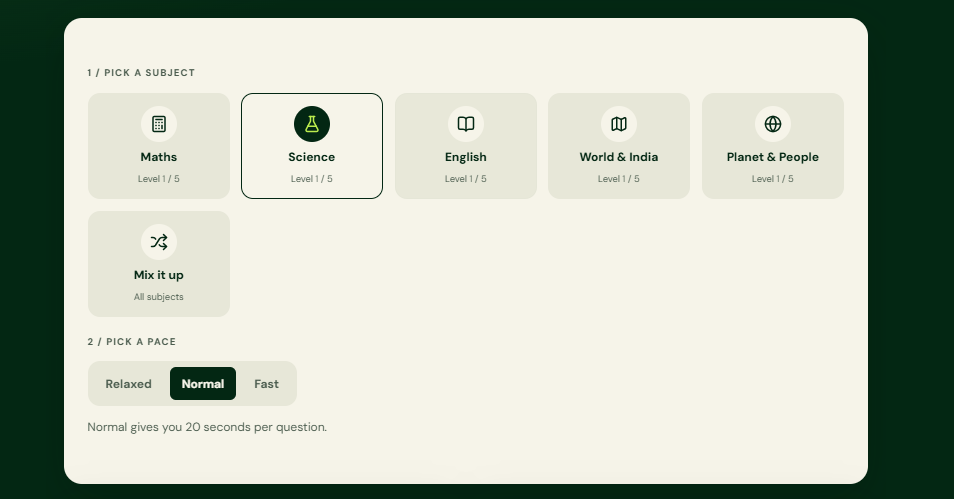
- 5 subjects: Maths, Science, English, World & India, and Planet & People (SDGs, waste, climate, kindness, online safety, health). A Mix it up mode blends them all.
- 168 hand-written questions in four subjects. Every question comes with a short explanation.
- Endless maths. The game makes fresh problems every time: 15 problem types over 5 levels, from simple sums to equations, powers, percentages and discounts in rupees.
- Learning from mistakes. A wrong answer shows the right one and the reason why, so every mistake still teaches something.
- Adapts to each student. Three right answers in a row raise that subject's level. Two wrong in a row lower it.
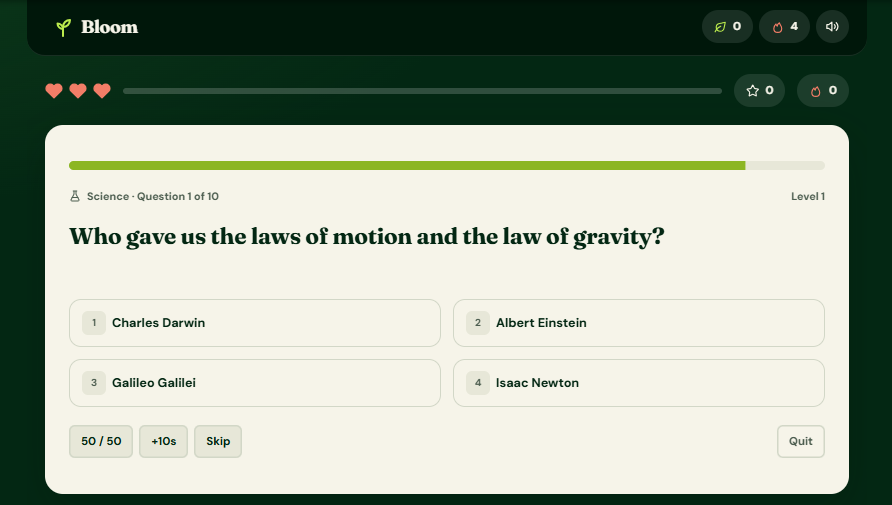
- Game feel: 10-question rounds, 3 hearts, a timer with 3 speeds, streaks, time bonuses, and 3 power-ups (50/50, +10 seconds, Skip).
- A village to rebuild. Leaves buy 10 buildings: trees, a clean water tap, a school, solar panels, a library, a clinic, a wind turbine, a community garden, a recycling centre and bike lanes. Each one shows a real fact, such as World Bank data on schooling or UN data on water. As you