-
-
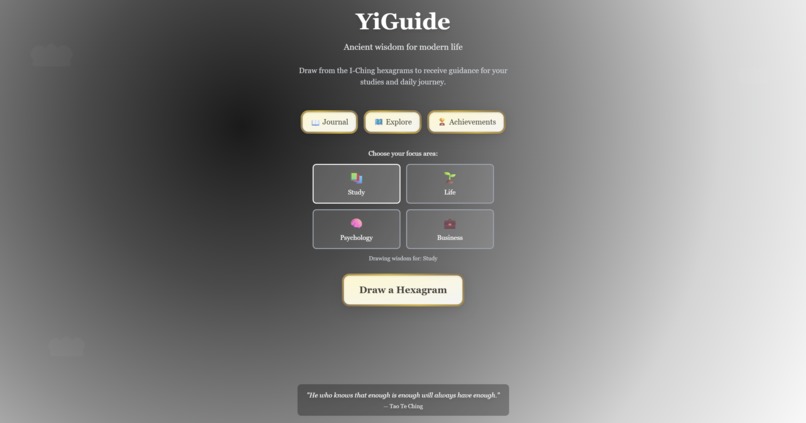
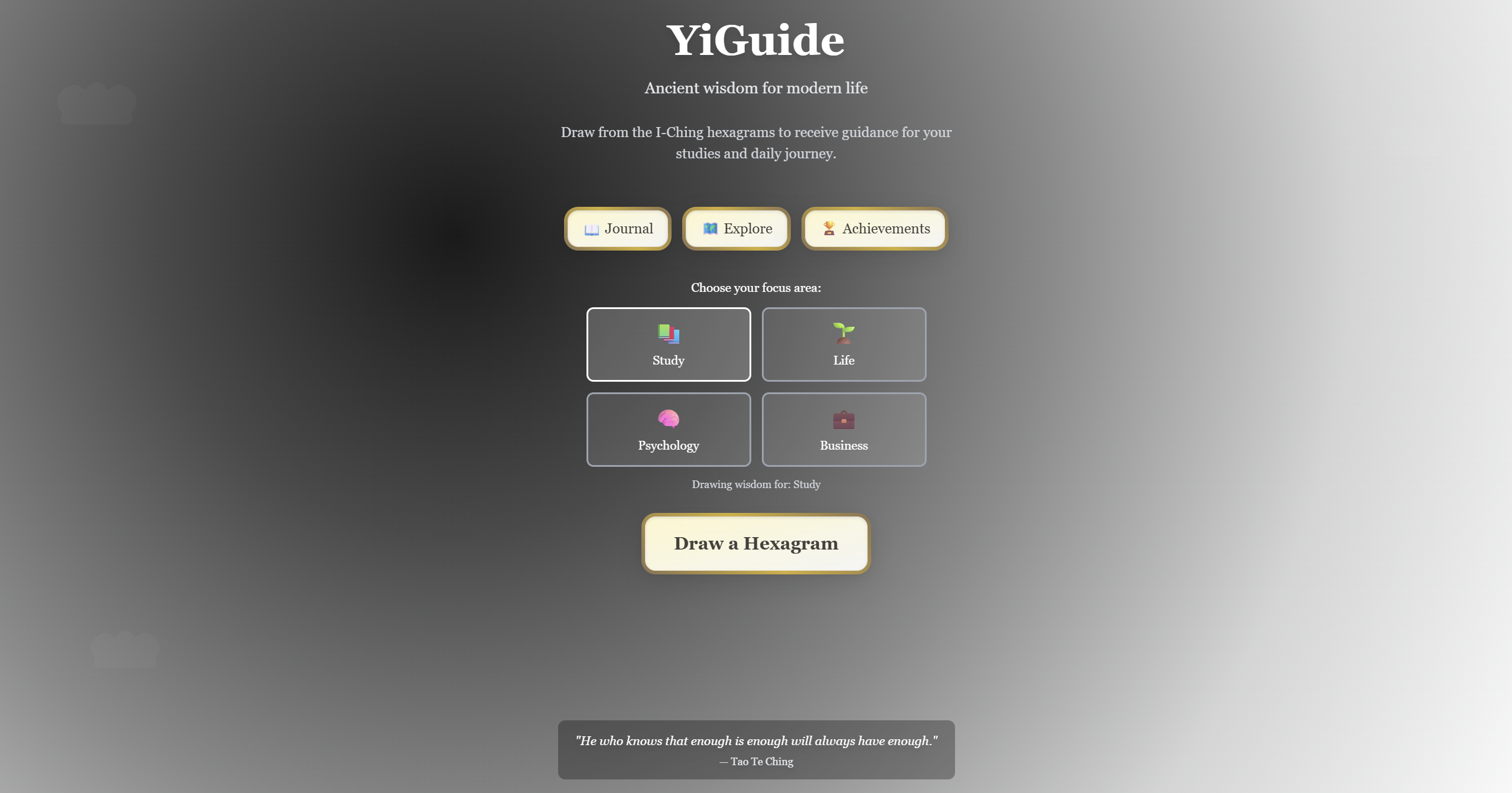
Front Page
-
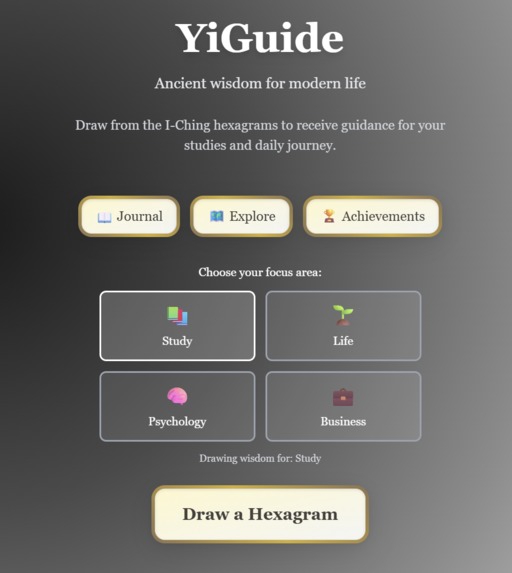
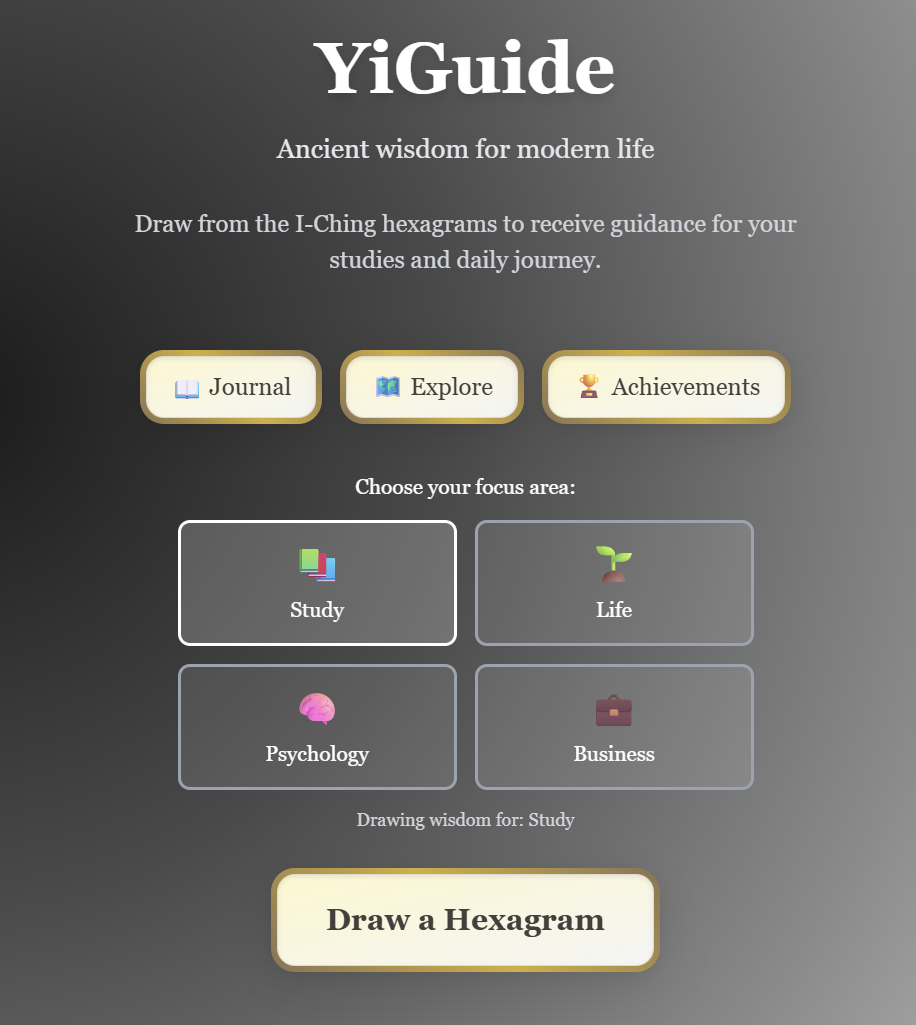
Main functions
-
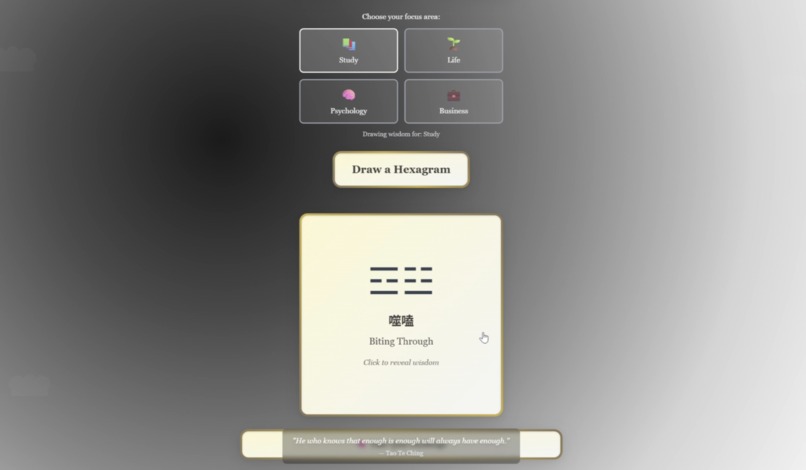
Hexagram choice
-

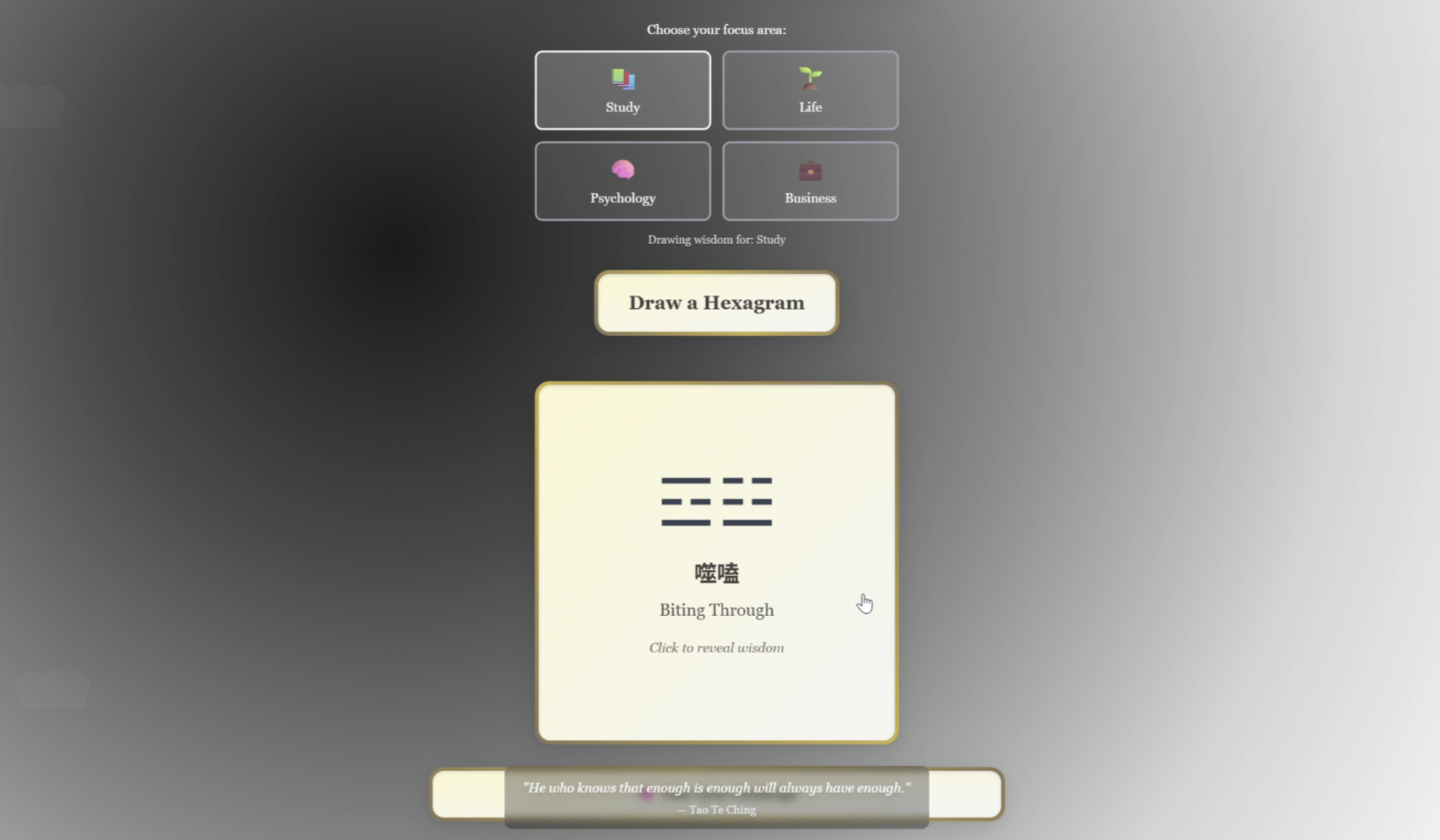
Quote section
-
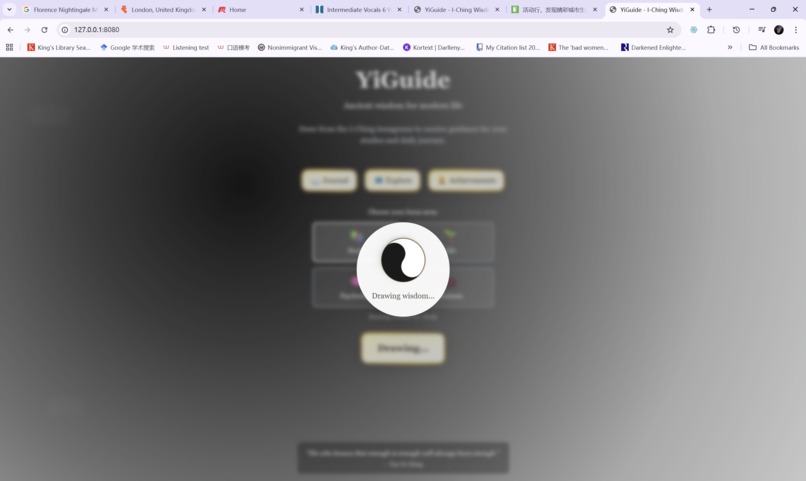
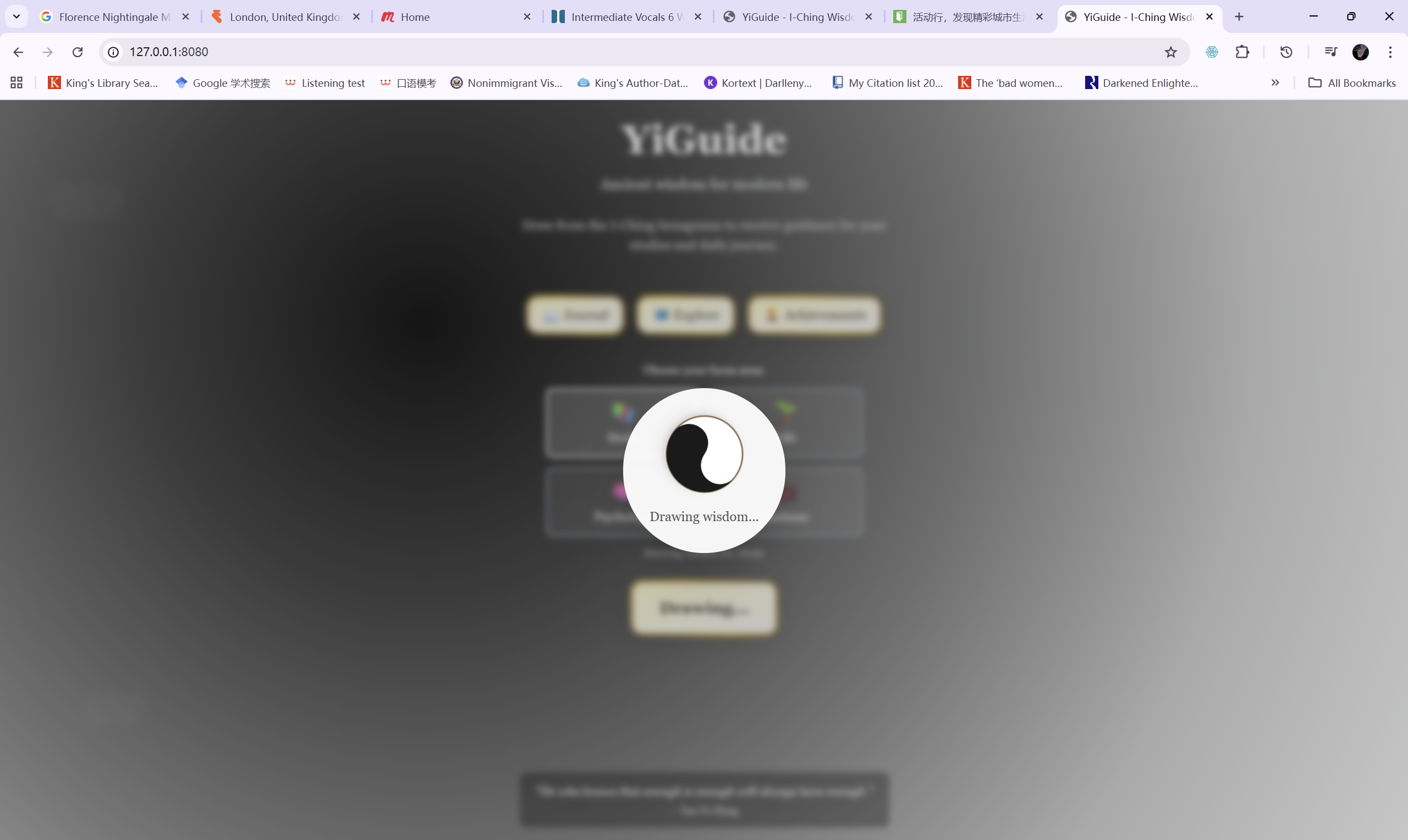
Processing...UI of Taichi
-
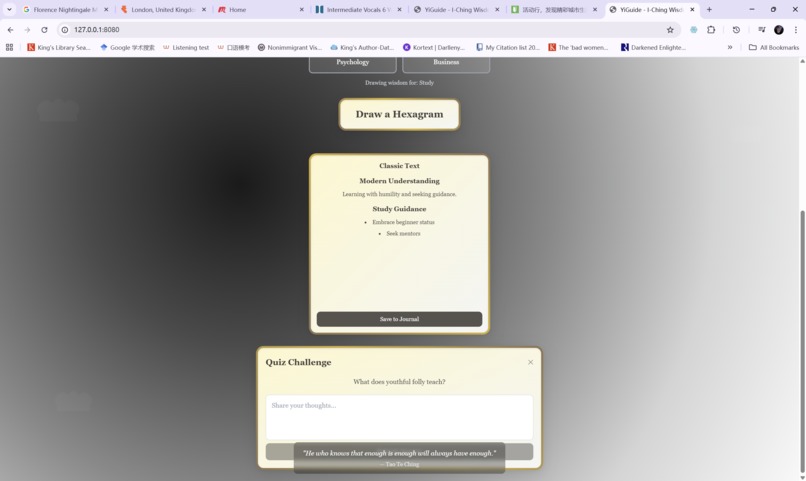
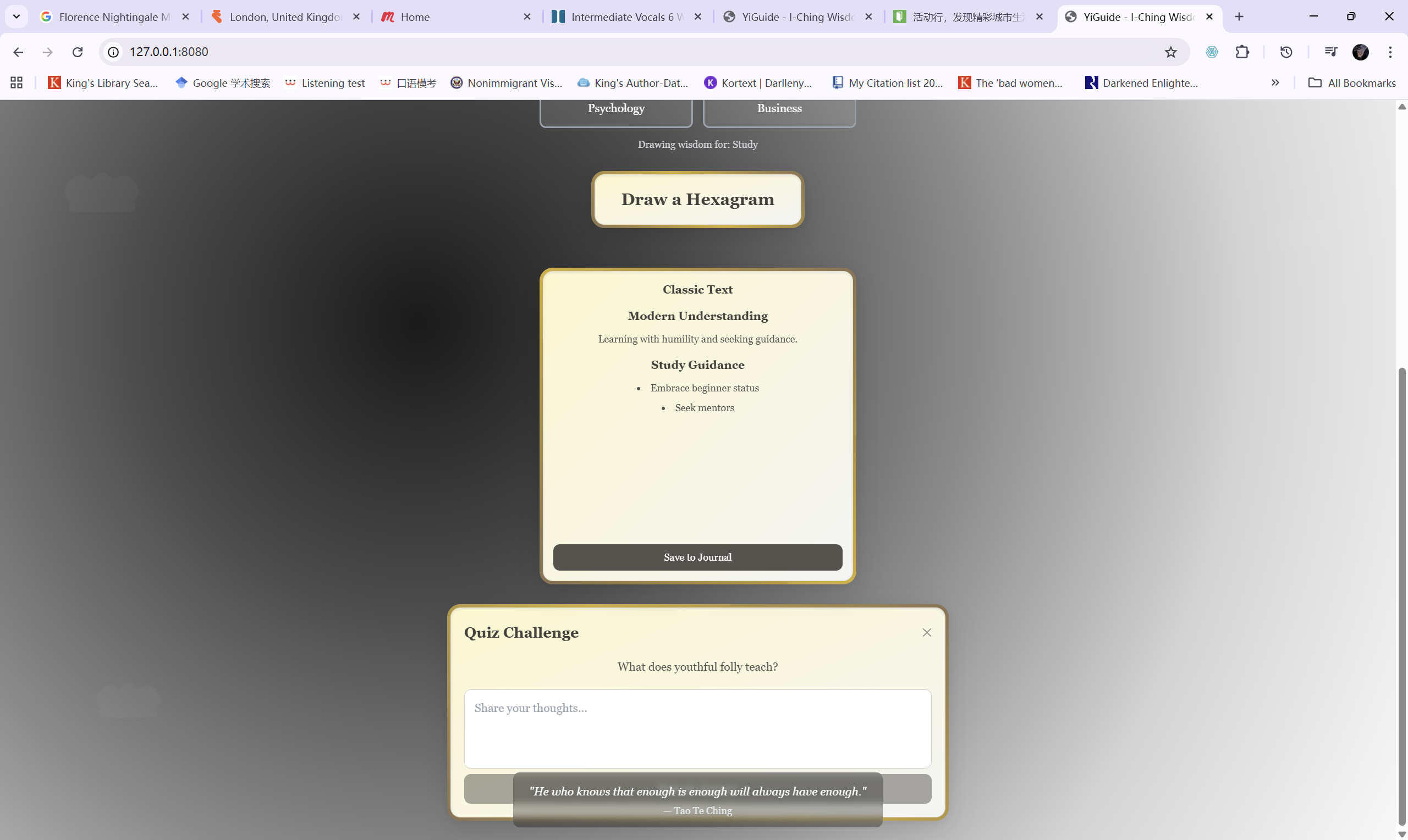
Hexagram explanation with pop quiz/mini-task for reflection
-
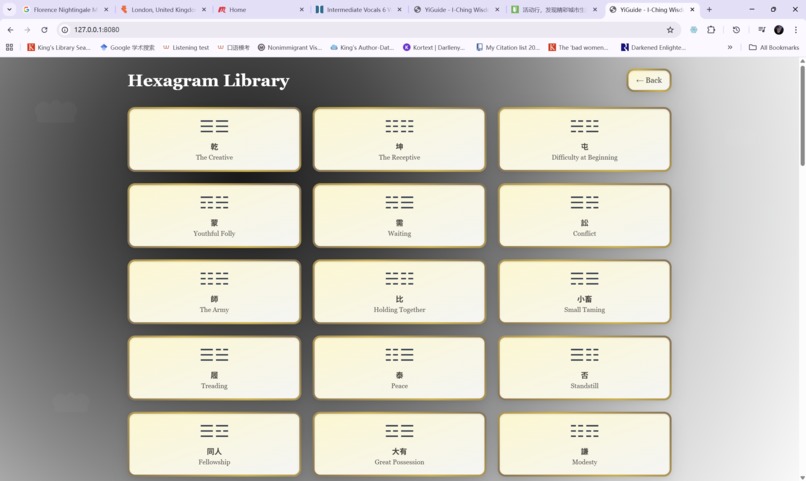
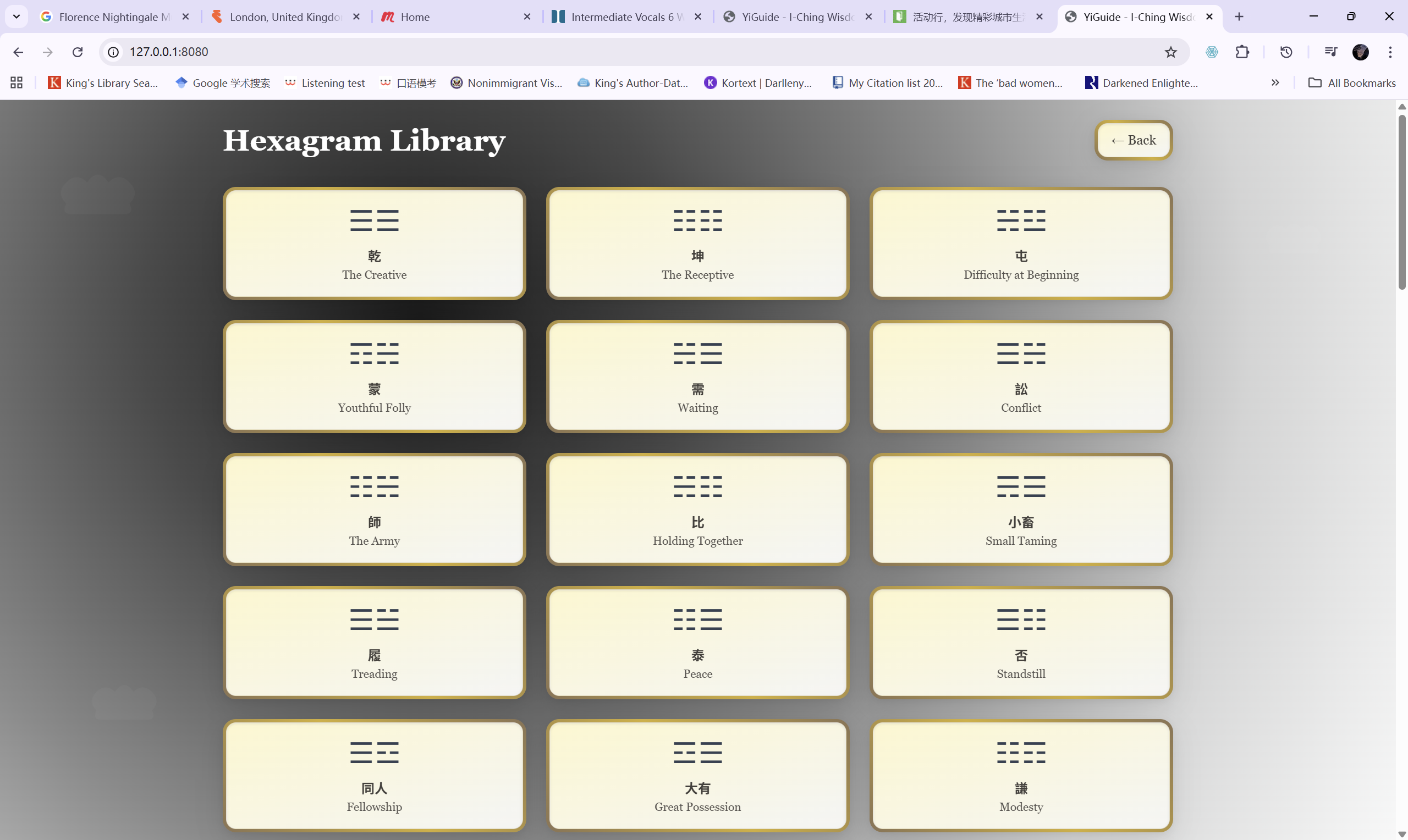
Hexagram library 1
-
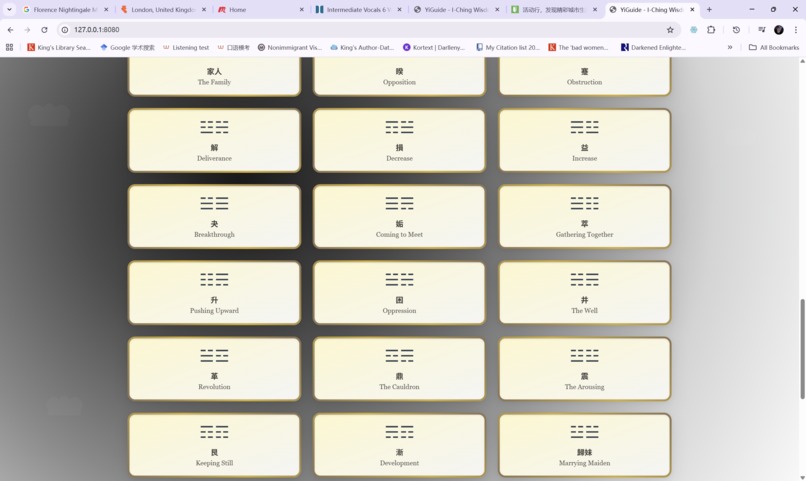
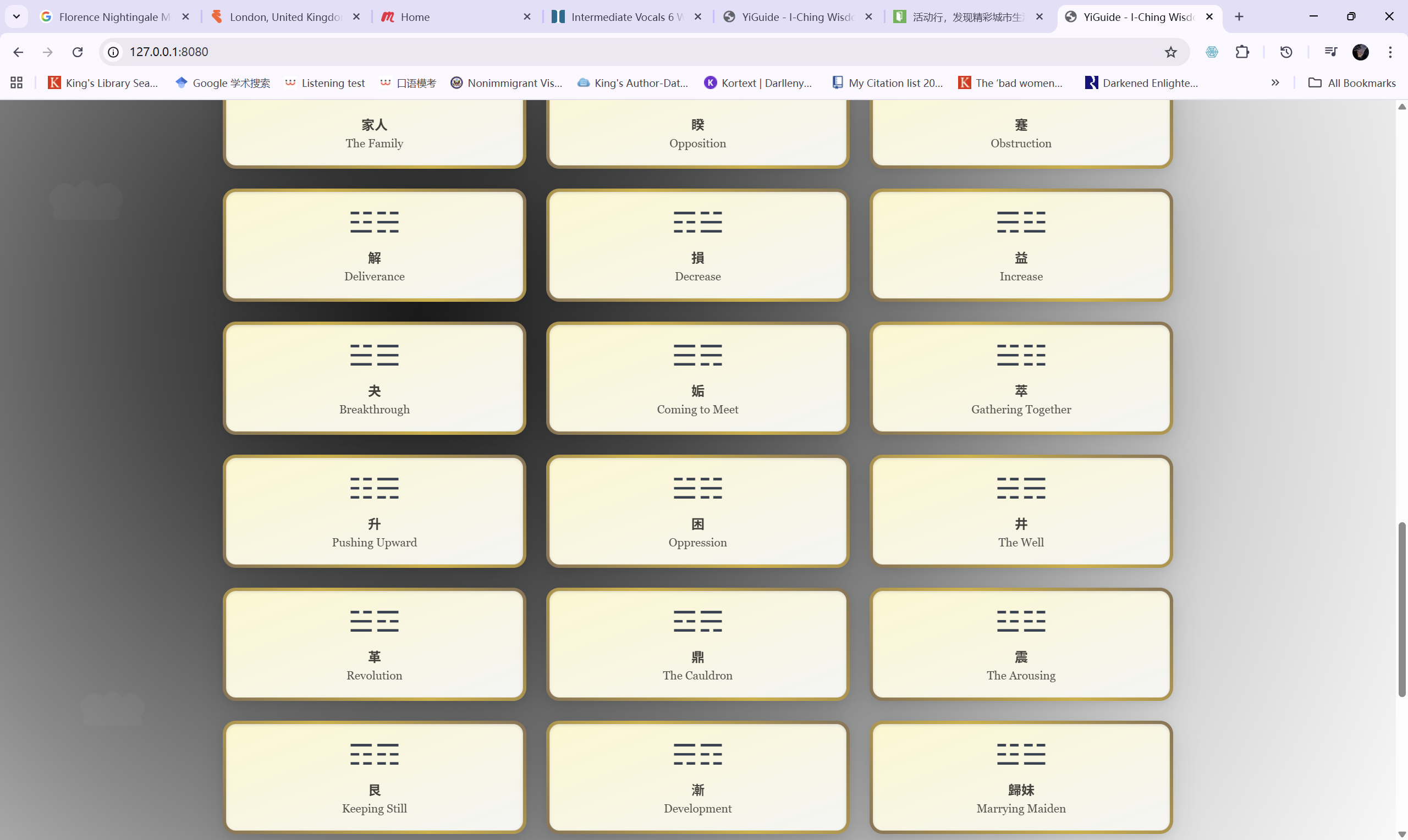
Hexagram library 2
-
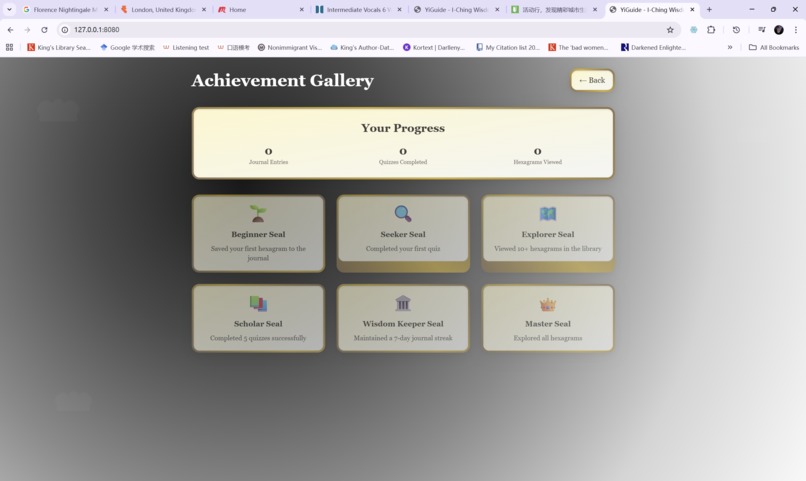
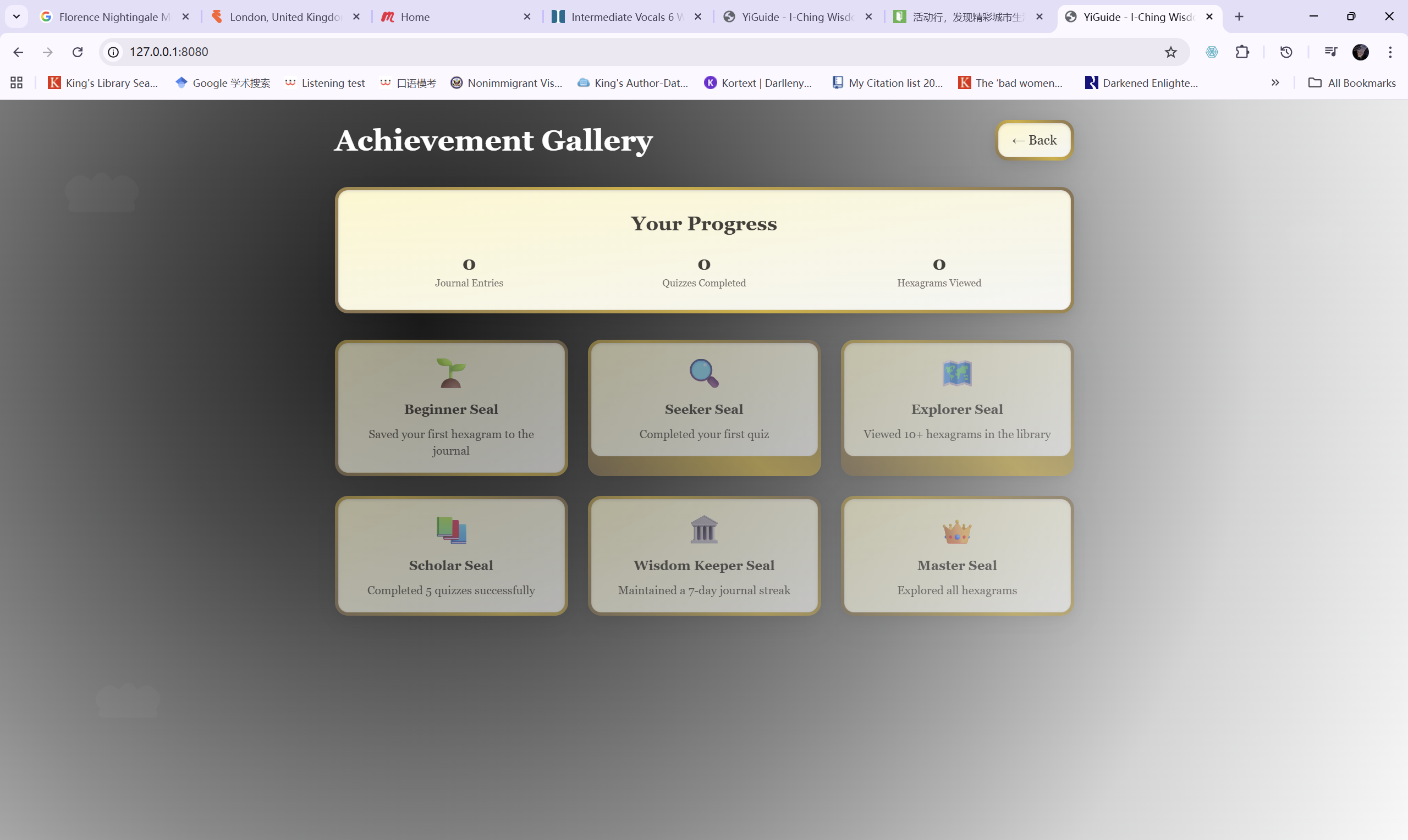
Immersive Gamification of Achievement section (new user
-
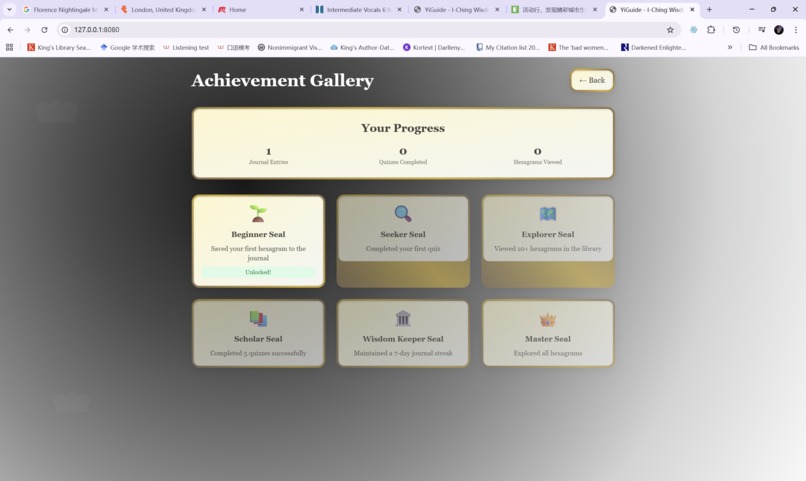
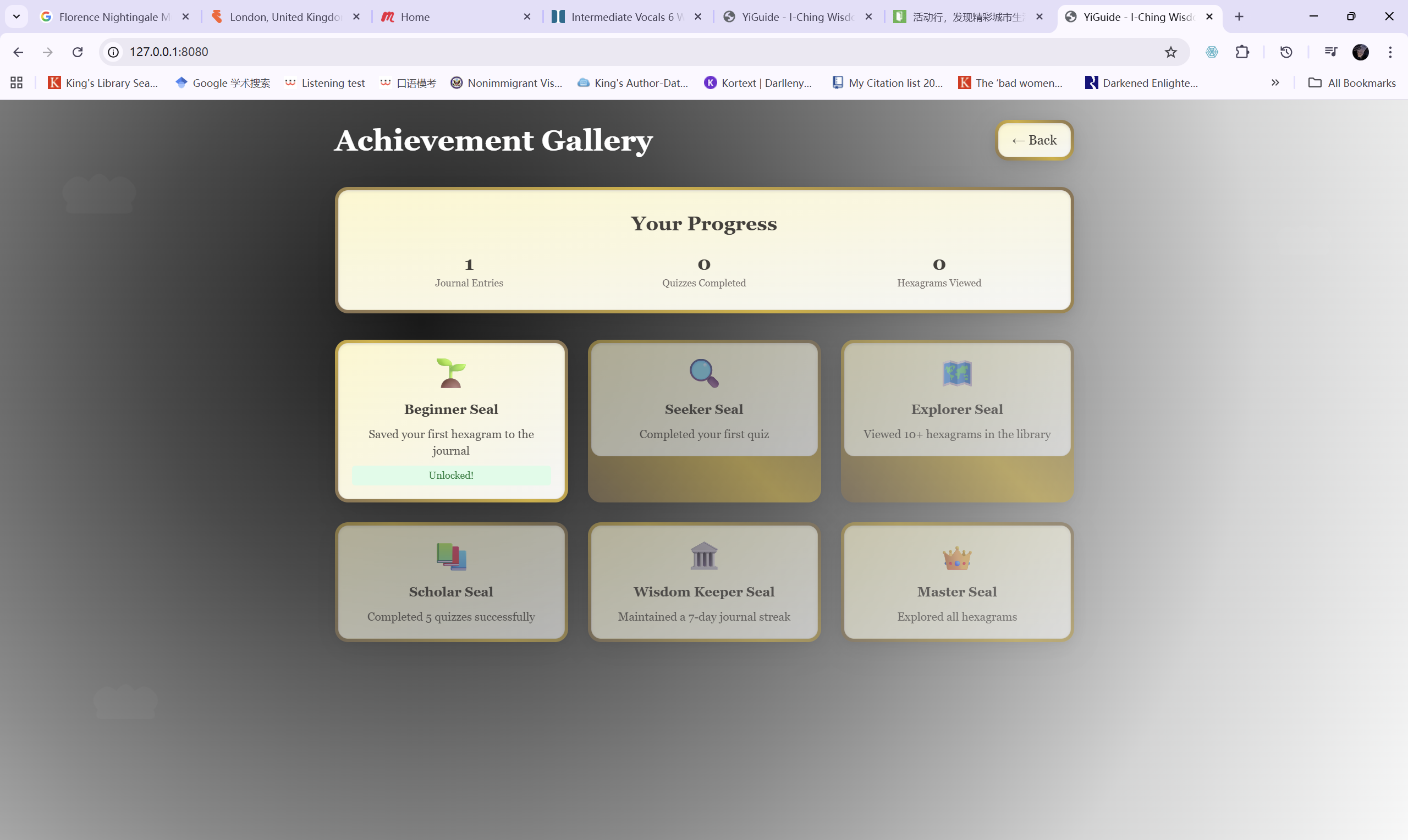
Immersive Gamification of Achievement section (receive one badge

/Inspiration
The I-Ching, or Book of Changes, is among humanity’s most enduring classics. For over two millennia, its sixty-four hexagrams have functioned not only as divinatory symbols but as structured models of resilience, adaptation, and ethical reflection. Across Confucian, Daoist, and even Enlightenment traditions, the I-Ching has provided a framework for grappling with uncertainty, cultivating wisdom, and understanding the dynamics of change.
In contemporary society, however, this heritage is too often marginalized—treated as esoteric curiosity rather than a pedagogical resource of global significance. We were motivated by a central question: what if such ancient symbolic systems could be reimagined as contemporary educational platforms?
YiGuide was born from the conviction that cultural heritage should not remain static. Instead, it can serve as a living resource for critical inquiry, reflective learning, and intercultural dialogue in the 21st century. Our project embodies a commitment to cultural sustainability, bridging philosophy and technology, while advancing the broader educational mission of cultivating not only skills but also critical consciousness, intercultural literacy, and social responsibility.
/What it does
YiGuide reinterprets the symbolic logic of the I-Ching as an interactive digital learning environment.
Thematic focus: Users begin by selecting a domain—Study, Life, Psychology, or Business—through which the I-Ching’s wisdom is contextualized into a specific dimension of personal and professional development.
Hexagram draw: An animated draw reveals a hexagram through a rotating Taiji motif and a flippable card. The front displays the hexagram’s symbol and title; the reverse provides both a classical interpretation and a modernized practical application.
Active pedagogy: Each draw integrates a mini reflection task or quiz, transforming abstract symbols into prompts for critical thinking and personal engagement.
Learning record: Reflections and advice are stored in a personal Journal, producing a longitudinal record of intellectual and personal growth.
Curricular depth: An explore library presents all sixty-four hexagrams as a structured curriculum of cultural literacy, allowing learners to study the I-Ching systematically.
Immersion and motivation: Aesthetic and gamified features—including Taoist cloud motifs, daily inspirational quotes, and symbolic “achievement seals”—deepen user immersion while fostering sustained participation.
Together, these elements make YiGuide not a fortune-telling tool, but a culturally rooted educational platform that blends heritage with contemporary design.
/How we built it
YiGuide was scaffolded through Kiro’s spec-to-code development paradigm. Hexagram archetypes were modeled in structured JSON specifications, which allowed Kiro to generate React components, animations, and state logic directly from descriptive inputs.
Frontend framework: React with TailwindCSS for responsive, mobile-first design.
Animations: Framer Motion to deliver smooth card flips, rotating Taiji effects, and subtle aesthetic transitions.
Persistence: Browser localStorage for lightweight journaling and achievement tracking.
Content modeling: Hexagram interpretations, reflection tasks, and achievement triggers structured as data-driven modules.
This process illustrates how AI-assisted IDEs like Kiro can operationalize cultural archetypes into functional educational applications, compressing the gap between symbolic specification and executable code.
/Challenges we ran into
Cultural integrity vs. accessibility: Preserving the symbolic richness of the I-Ching while translating it into language and tasks intelligible to contemporary learners.
Pedagogical design: Developing interactivity—quizzes, journals, gamified seals—without reducing the experience to trivial entertainment.
Technical orchestration: Coordinating animations, state management, and persistent storage into a lightweight prototype suitable for open deployment.
/Accomplishments that we’re proud of
Reframing an ancient philosophical text into a contemporary digital learning tool with pedagogical integrity.
Building a functional prototype that combines cultural heritage, interactive pedagogy, and aesthetic immersion.
Demonstrating how Kiro accelerates spec-driven development, turning cultural concepts into operational features with remarkable efficiency.
/What we learned
The importance of cultural translation: philosophical traditions can be adapted into digital pedagogy without losing depth, if framed with care.
The centrality of engagement design: interactivity, reflection, and immersion are crucial for sustaining learning beyond novelty.
The potential of AI-assisted IDEs: tools like Kiro can not only speed development but also encourage more ambitious, experimental educational projects.
/What’s next for YiGuide
YiGuide is an initial proof of concept. Future directions include:
Expanding into comparative modules linking the I-Ching with Western classics, fostering global dialogues in philosophy and education.
Applying the framework to mental health, resilience training, and leadership education, where symbolic models of change can support personal development.
Incorporating community features, enabling learners worldwide to share reflections, interpretations, and achievements.
Deploying YiGuide as an open educational resource, advancing cultural sustainability in digital learning ecosystems.
Ultimately, YiGuide aspires to be part of a broader movement that integrates cultural wisdom with technological innovation, ensuring that traditions of the past remain active forces for reflection, resilience, and ethical growth in the present and future.
Built With
- framer-motion
- javascript
- json
- kiro
- localstorage
- react
- tailwindcss
- vite


Log in or sign up for Devpost to join the conversation.