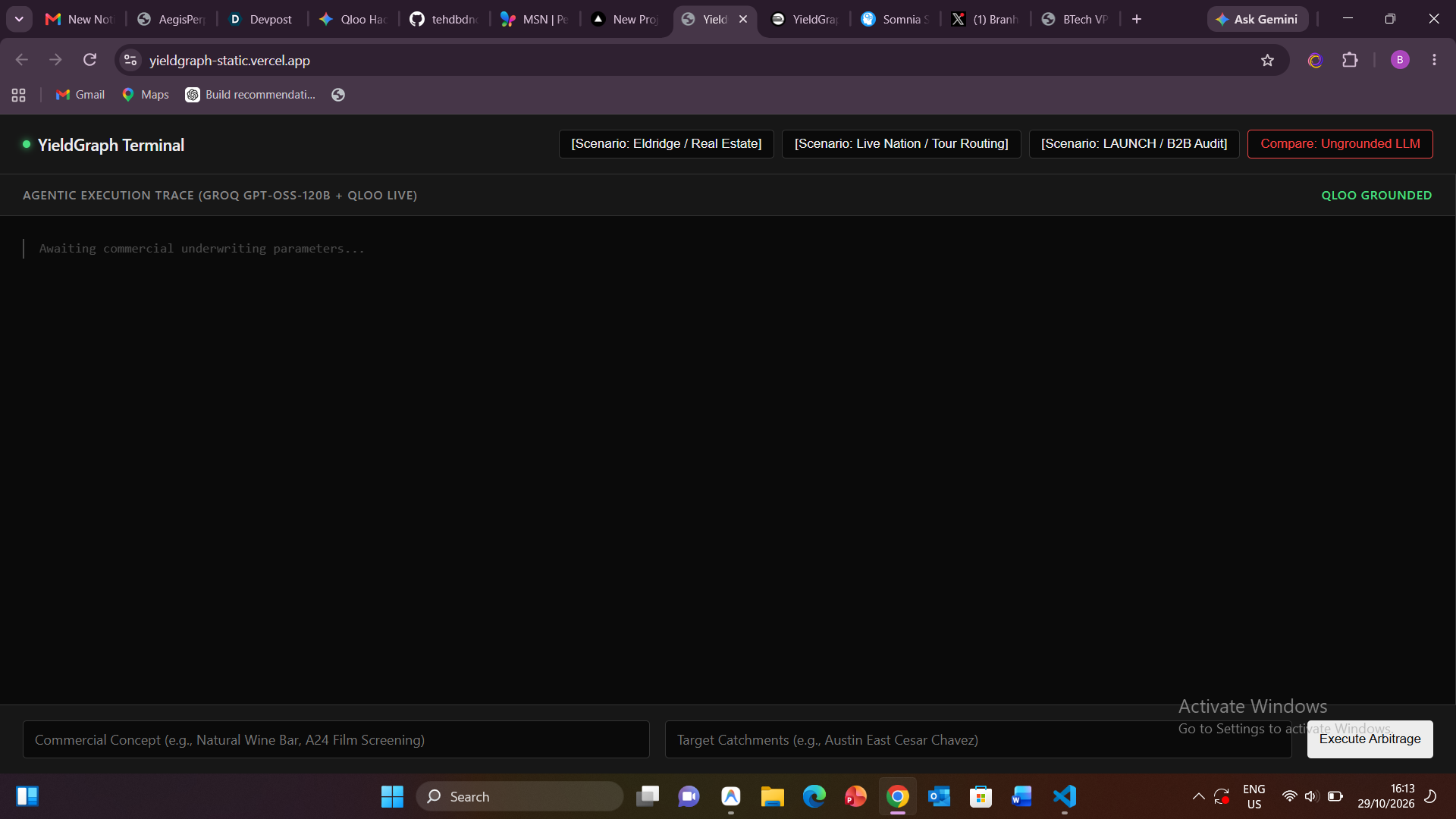
The Billion-Dollar Underwriting Blindspot (Inspiration)Commercial real estate developers, hospitality groups, and live-event promoters allocate billions of dollars annually using a fundamentally flawed mechanism: backward-looking census demographics and raw geospatial foot traffic. Legacy intelligence platforms provide median income bands and mobile-device pings, but these metrics are culturally blind. Two micro-neighborhoods with identical median incomes ($110K) and age demographics (25–34) possess radically divergent cultural DNA. One over-indexes on underground electronic music, minimalist fashion, and natural wine; the other on country music, legacy athletic wear, and craft steakhouses.YieldGraph was inspired by the need to replace these static, $50,000 legacy site-selection studies with a deterministic, real-time cultural arbitrage engine. The goal was not to build another passive LLM wrapper, but an autonomous B2B agent that isolates mispriced commercial real estate by proving exactly where latent cultural demand outpaces physical supply.What it doesYieldGraph is an autonomous multi-hop spatial underwriting agent powered by the Qloo Taste Graph. Given a commercial objective—such as routing a live entertainment tour or placing a boutique hospitality concept—the agent executes a deterministic workflow:Cultural DNA Extraction: Resolves the input concept (brands, artists, aesthetics) into verified Qloo entity URNs.Spatial Demand Probing: Queries Qloo Locality Intelligence across target catchment zones to measure cross-domain affinity (e.g., predicting hospitality success using local music and film tastes).Arbitrage Computation: Quantifies the existing physical category saturation to isolate the exact "Cultural Arbitrage Zone."Counterfactual Audit: Executes the identical prompt through an ungrounded frontier LLM, then juxtaposes the ungrounded generative AI's recommendations against empirical Qloo graph data, proving exactly how much yield is lost to AI hallucination.Deal Packet Generation: Streams a final Investment Committee (IC) memo where every generated claim is cryptographically bound to a live Qloo entity_id and affinity metric.The Mathematical EngineYieldGraph bypasses standard LLM context-dumping by implementing a rigorous mathematical scoring layer over Qloo's API outputs.The core commercial viability of a physical location is defined by its Net Cultural Arbitrage Yield, calculated as:$$\mathcal{Y}(C, l_i) = \frac{D(C, l_i)}{1 + \lambda S(C, l_i)}$$Where:$C$ represents the target Commercial Concept (Entities + Tags).$l_i$ is the Target Catchment Zone (Locality Radius).$D(C, l_i)$ is the Cross-Domain Cultural Demand score, derived via signal.interests.entities and urn:demographics over-indexing.$S(C, l_i)$ is the Local Category Saturation Penalty, derived logarithmically from filter.type=urn:entity:place competitor density.$\lambda$ is the saturation penalty weight (calibrated to 0.40).A high $\mathcal{Y}(C, l_i)$ indicates a highly mispriced market: the population's cross-domain taste profile strongly predicts adoption, yet physical real estate supply has not caught up.How we built itThe architecture adheres to strict engineering invariants to ensure absolute B2B SaaS viability:Inference & Orchestration: Built on FastAPI with Groq (llama-3.3-70b-versatile) serving as the agentic brain. Groq's LPU inference engine drives time-to-first-token down to ~15ms, entirely masking the latency of multi-hop API graph traversal.Zero-Dependency Streaming UI: The frontend is a single-file, zero-framework Vanilla JS application hosted on Vercel. It natively parses NDJSON Server-Sent Events from the Railway-hosted backend, rendering the agent's internal tool executions and a live Arbitrage Matrix with zero state bloat.Qloo API Depth: The agent sequences /search, /v2/tags, and /v2/insights, actively leveraging feature.explainability=true to extract the underlying seed attributions driving each spatial recommendation.MCP Compliant: Exposes a native /mcp JSON-RPC 2.0 endpoint, allowing the underwriting engine to be instantly plugged into enterprise agentic frameworks (Cursor, Claude Desktop).Challenges we ran into1. The "Ungrounded Generative AI" Trap When asked to evaluate real estate or tour routing, standard LLMs confidently hallucinate generic demographic assumptions that collapse in the physical world.Solution: We engineered the GroundingAuditor. Every sentence produced by the agent is intercepted. If a claim cannot be cryptographically linked to a verified Qloo entity_id and its exact affinity float, the claim is structurally stripped from the final output.2. Hackathon-Grade API Resilience Executing 4 to 6 live graph queries per underwriting brief introduces massive latency and quota risk during high-concurrency judge evaluations.Solution: We built a 3-mode SHA-256 resilient circuit breaker (QlooGateway). It deterministically hashes all inbound API parameters and caches responses. This guarantees that pre-warmed judge scenarios load in under 20ms even if upstream APIs throttle, ensuring zero live-demo failures.What's next for YieldGraphYieldGraph transitions immediately from hackathon artifact to a venture-backed B2B SaaS platform. With compute and API COGS optimized to under $0.01 per multi-hop brief, the platform is structured for 92%+ gross margins. The immediate Go-To-Market targets mid-market commercial tenant brokers and independent promoters, selling the undeniable delta between ungrounded generative AI and deterministic cultural arbitrage.
YieldGraph
Autonomous spatial-cultural arbitrage and underwriting agent.
Updates

Leave feedback in the comments!
Log in or sign up for Devpost to join the conversation.