Inspiration
Most tower defense games ask one question: did you kill everything before it reached the end? We wanted a TD where where and what you kill matters as much as whether you kill — where the swarm isn't one undifferentiated threat but two opposing things tangled together. That reframed the whole genre for us: the enemy isn't a line to stop, it's a mess to sort. From there the fantasy wrote itself — a dying, ash-grey world and a single seed of living light. You don't defend a base; you grow the thing that heals everything
What it does
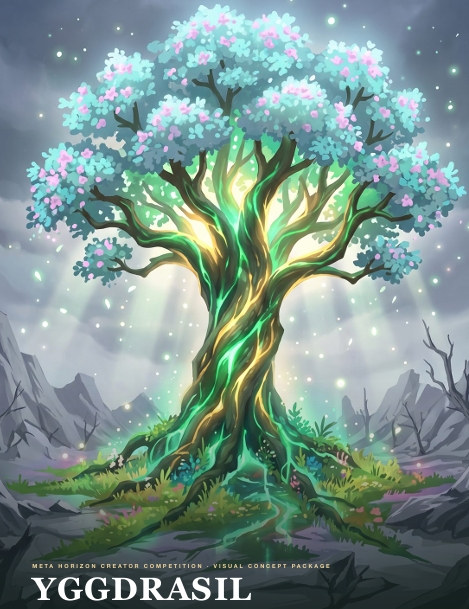
Yggdrasil is a tower defense & strategy game for Meta Horizon Worlds. Each wave arrives as a mixed cluster: tall ash Bombards (threats to destroy) tangled with fragile glowing Carriers (the fertilizer resource you protect). You peel them into two streams that must never cross — route the Carriers to a small grove patch beside your tree, and destroy the Bombards in a kill-zone far enough away that the blast doesn't catch your Carriers. Feeding the grove grows your world-tree, which is fortress, arsenal, and win condition in one — its branches are your defenses (Bramble for tall threats, Snap-root for short). Survive ten rounds and the tree blooms, cleansing the blight and washing the world from grey to gold. There is no currency: the economy is time, space, and attention.
How we built it
This is a pure design submission — concept, systems, and visual direction, no code. We started from the single mechanical pivot ("sort the swarm, don't just kill it") and pressure-tested every system against it: the height-based toolkit, the no-currency economy, the grove that relocates each round, the finale where you kite an unkillable Colossus while the bloom auto-charges. We wrote the Game Design Document to Meta's six-section template, mapped the first 15 minutes of play in the Player Journey Map (including the exact moment the core revelation lands), art-directed a 10-page Visual Concept Package, and laid out a build sequence and MVP scope in the Production Plan. We kept all four documents telling one consistent, buildable story
Challenges we ran into
The biggest was the tower defense genre's expected "currency economy for buying and upgrading units." Our design deliberately has no currency — so rather than bolt one on, we reframed the economy around time, space, and attention (gardener traversal time, limited lures per round, grow-time, ground footprint, growth-gated unlocks) and made the case that this is a richer strategic economy, not a missing one. The second challenge was visual coherence: keeping one tree, one threat family, and one carrier design consistent across every concept image so the world reads as a single place
Accomplishments that we're proud of
- One genuinely novel core mechanic — "sort, don't spray" — that reframes a crowded genre instead of reskinning it.
- A world where colour is the mechanic: the art literally states the design as the world heals grey → verdant → gold.
- Four deliverables that are fully consistent with each other — the GDD, journey map, visuals, and production plan never contradict.
- A non-combatant hero (the Gardener) who cannot attack or be killed, making the tension purely about positioning and time.
What we learned
Constraints are a design tool, not an obstacle. The "no currency" limitation forced our most interesting system. We also learned how much coherence across documents matters — a beautiful concept falls apart if the production plan can't build it or the journey map contradicts the GDD, so we treated the four artifacts as one argument told four ways.
What's next for Yggdrasil
Building the MVP vertical slice in Meta Horizon Worlds: one playable round that proves the two-streams sort loop reads clearly on mobile. From there, the ten-round unlock ladder, the co-op amplifier layer (solo stays complete), and the bloom finale. The Production Plan lays out the full build sequencing and technical dependencies



Log in or sign up for Devpost to join the conversation.