Inspiration
Most of what we want to learn isn't a school subject. It's "make good cocktails for my party Saturday" or "don't get ripped off buying a used car." For that you get a generic course or a chatbot answer you forget by Tuesday. Duolingo makes learning stick, but only for languages. We wanted that for anything, built around your reason for learning. "Poko" comes from poco a poco, little by little.
What it does
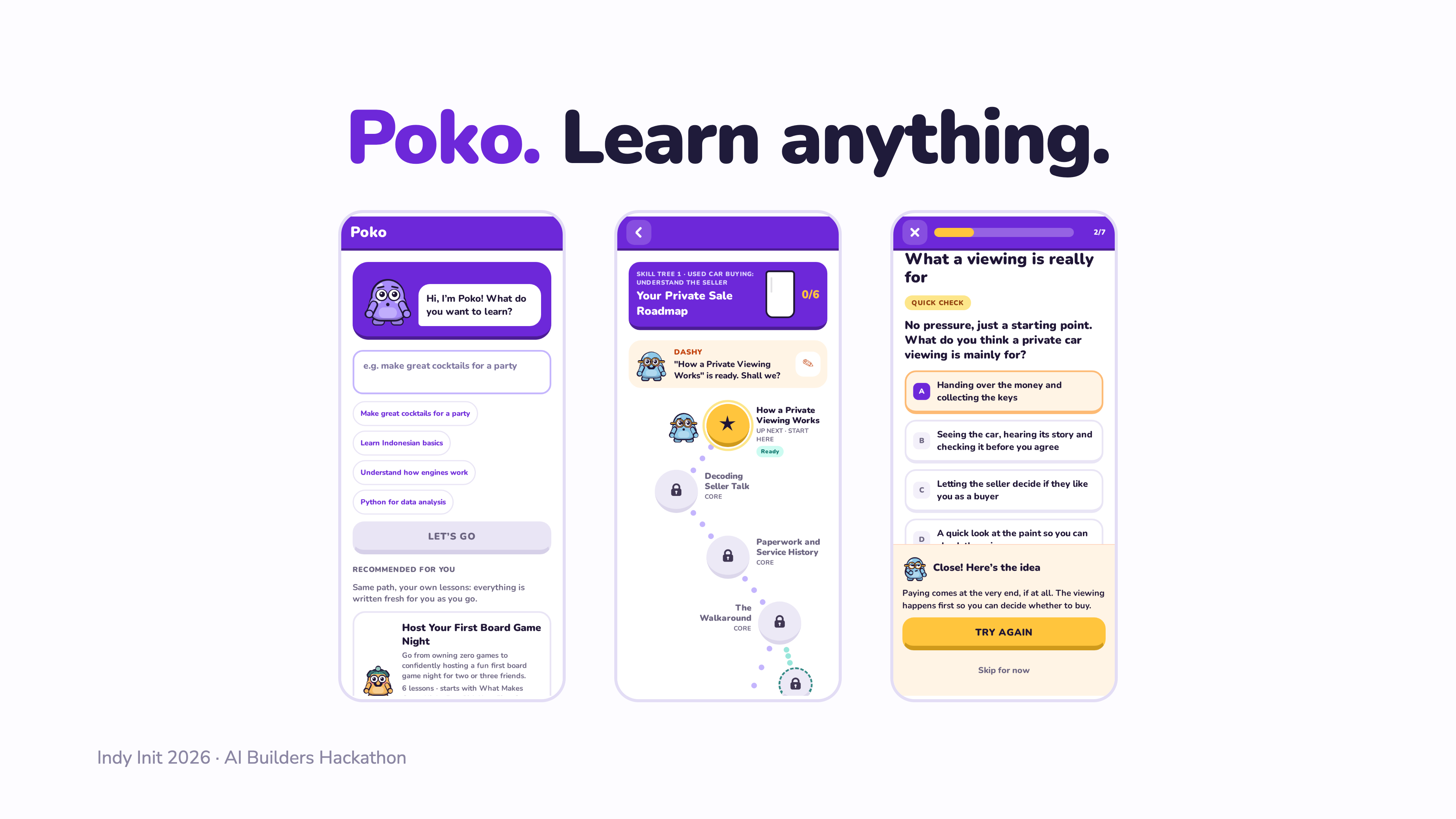
Tell Poko what you want to learn. Poko, a companion who gets a new costume for every course, asks up to four quick questions and builds a personalized course:
- A winding skill path of lessons, with optional side branches
- Interactive slides built from nine components (diagrams, ratio bars, multiple choice, fill-in-the-blank, match-pairs and more)
- Wrong answers explain themselves and let you retry. No lives, no penalties.
- The first lesson is ready when you arrive, and the next ones are written ahead of time
- Celebrations, a streak, and "Learn something different" to reshape a course without losing progress
- Courses other learners built, ready to start
Every goal is safety-screened twice. If a goal is refused, Poko declines and nothing is stored.
How we built it
- Expo + React Native + TypeScript client, installable on an iPhone home screen
- Hono + Drizzle + SQLite server. It's the only place the API key lives.
- Claude Opus 5.5 plans courses and writes lessons; Claude Haiku 5.5 screens goals. Every output is structured JSON, checked against a shared Zod contract before it's stored or shown.
- Scoring and unlocking are plain code, never the model
- Claude Code as our software factory: one shared session, sub-agents in separate worktrees, and GitHub Issues as the only record
- Playwright runs full generated journeys and checks accessibility
Challenges we ran into
- Structured-output limits: our slide schema was too big for the API's grammar, so we built a fallback to prompt-guided JSON. It still validates everything and retries once, feeding back the errors.
- Wait time: we split planning from lesson writing, prefetch upcoming lessons, and use fast mode. Time to the first lesson went from about 60 s to 49 s.
- A lesson could open before it was unlocked. Because lock state is computed on every read, never stored, the fix was in one place.
- Playful, not loud: our first design was too serious and the second too neon.
Accomplishments that we're proud of
- The full loop works live in any subject. Nothing is canned.
- No generated HTML or code anywhere: model output is always data
- Built in one day: 82 commits, 44 issues, 26 PRs, 143 passing tests
- Lessons are reusable, so a completed lesson counts in every course that has it
- No paid infrastructure beyond the API key
What we learned
- Define contracts first: validated output is output you can build a UI on.
- Store facts and derive state. That made reuse free and bugs easy to fix.
- Let the model write and let code decide.
- Agents need written context, and fewer tools beat more tools.
- Time to the first lesson matters more than anything else.
What's next for Poko: Learn Anything #23
- Native iOS and Android testing, then the app stores
- Public hosting and accounts that sync across devices
- Measuring real cost per course
- More slide components and voice input
Built With
- drizzle
- expo.io
- hono
- node.js
- react-native
- sqlite
- zod


