-
-
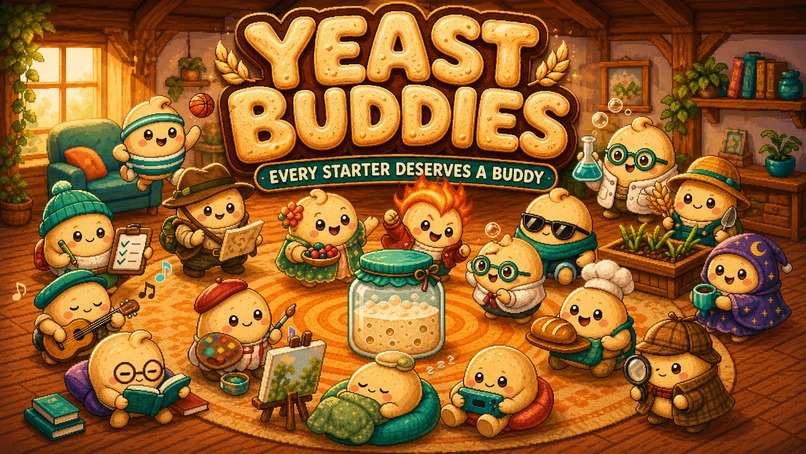
Game Title
-
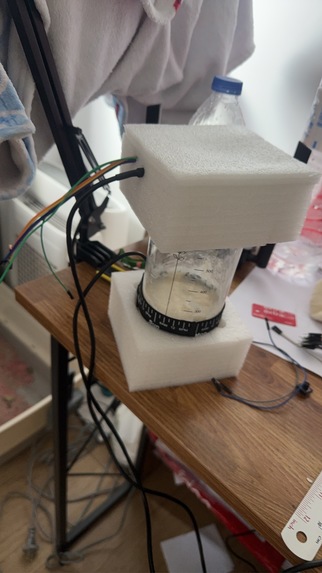
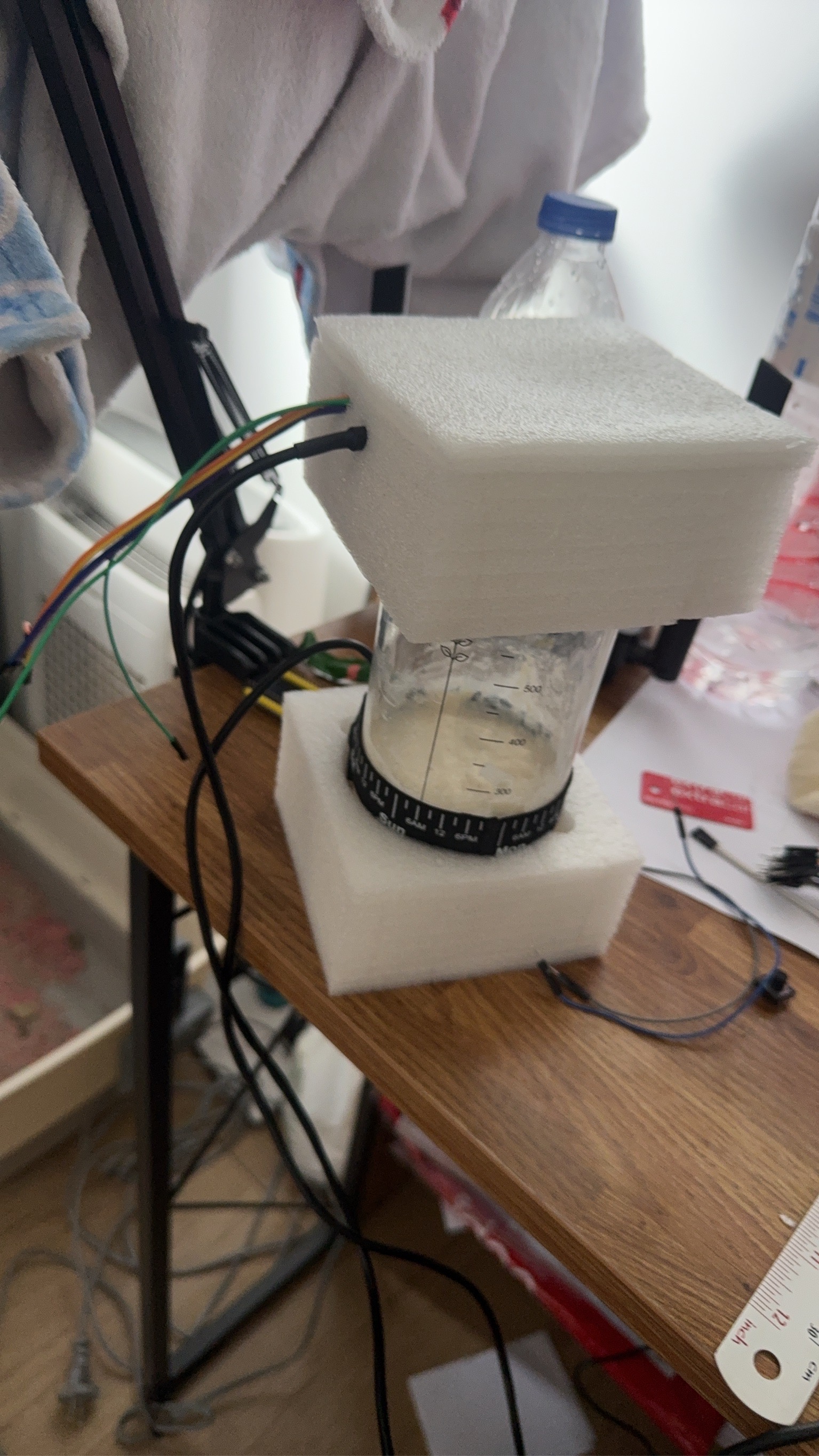
Hardware i build linking the yeasts parameters using an IOT to yeastbuddies
About the Project
Inspiration
Sourdough has been getting more popular in Thailand recently. I kept seeing new bakeries, cafés selling sourdough, and more people trying to make their own starter at home.
The problem is, making a starter is quite confusing for beginners. You mix flour and water, wait, feed it, smell it, stare at it for a long time, and somehow you need to understand if it is healthy, hungry, sleeping, or ready to bake.
Because I study biotechnology, I already knew that sourdough is not just flour and water. It is actually a living community of yeast and bacteria.
This made me think:
What if taking care of a sourdough starter felt more like raising a pet?
A lot of people also want a pet, but they may not have enough time, space, or money to take care of one. A sourdough starter is smaller, quieter, and will probably not destroy your sofa.
It still needs food, grows over time, develops its own routine, and at the end you can turn it into bread.
That is how Yeast Buddies started.
What Yeast Buddies Does
Yeast Buddies turns your real sourdough starter into a digital pet.
The app guides complete beginners through making their first starter, one simple task at a time.
Instead of giving users a lot of scientific words, the app turns starter activity into easy moods and reactions. The pet can feel cold, cozy, sleepy, hungry, or excited depending on its temperature, feeding history, sound activity, and what the user sees inside the jar.
As the real starter grows, the pet can:
- move through different evolution stages
- develop its own unique personality
- give daily feeding instructions
- explain why it might be quiet or bubbly
- remind users to mark the starter height
- ask how much it grew compared to the marker
- help users understand the rise and fall cycle
- prepare the user for their first bake
After the starter becomes established, the user can choose a care routine based on how often they want to bake.
- Everyday Buddy, (1:1:1): for people who bake very often
- Flexible Buddy, (1:2:2): for people who bake some days
- Sleepy Fridge Buddy, (1:5:5): for people who bake only sometimes
The app explains the lifestyle choice first because “I bake only sometimes” is much easier to understand than asking a beginner to immediately choose (1:5:5).
How I Built It
This was my first full-stack project, so honestly most of the technical stuff was very alien to me at the beginning.
My background is more on biology and wet lab work, not software, electronics, wiring, and debugging why a screen suddenly decide to stay completely black.
The hardware prototype uses an ESP32 with:
- one temperature probe on the jar cap
- one temperature probe on the side of the jar
- a microphone to detect possible fermentation sound events
- a BME sensor for extra environmental information
- an OLED screen that can switch between temperature, microphone, and environmental data
The app does not automatically measure how tall the starter becomes. Instead, the user places an elastic band, tape, or washable marker at the starter’s starting height after feeding.
During the daily check, the user records if the starter:
- stayed near the line
- rose a little
- doubled
- rose and already fell
- grew above half of the jar
This also keeps the user involved with the real starter instead of just looking at data on a phone.
The software combines the physical sensor readings with the user’s daily observations, feeding history, visible growth, temperature, and microphone activity.
These information are then used to decide the pet’s current mood, evolution stage, and possible personality.
Learning to Use ChatGPT and Codex
One of the biggest things I learnt from this project was how to use ChatGPT and Codex more efficiently.
At first, I sometimes asked things like:
“Can you build this whole thing?”
The result was usually too much code, too many features, and something breaking in a place I did not even understand.
Later I learnt that AI works much better when I explain:
- what the system already has
- what needs to change
- which sensors are important
- what should be removed
- how the user should experience the feature
- what error I am currently seeing
I started breaking the project into smaller pieces, testing each part, and giving clearer instructions.
Codex helped me turn my ideas, sketches, and very messy notes into an actual full-stack project. I still needed to make the decisions, test the features, fix problems, and decide what made sense scientifically, but it made the build possible for someone who had never made a full-stack application before.
I am really proud about this because before the project, I could not imagine myself connecting hardware, frontend, backend, biology, and a digital pet in one system.
What I Learned
The main thing I learnt is that building with AI does not mean the AI magically builds everything correctly.
You still need to understand what you are trying to make.
I learnt how to:
- explain technical problems more clearly
- break a large project into smaller tasks
- connect sensors to an app
- work with frontend and backend code
- decide which data is useful and which data is just interesting
- simplify biology for beginners
- avoid making claims that the hardware cannot actually prove
- design the app around what the user needs, not what looks technical
- test features instead of trusting that the code should work
My biotech background helped me understand the yeast, bacteria, fermentation, and temperature part.
But the electronics and software part was a completely new world.
In a way, this project made me become a translator between biology and engineering. Sometimes also a translator between myself and the error messages.
Challenges I Faced
The first challenge was understanding what the sensors can really detect.
Temperature is useful because it directly affects how quickly the starter ferments.
The microphone was much more complicated.
I wanted it to detect fermentation sounds, but the microphone can also hear:
- people talking
- the table moving
- the spoon hitting the jar
- fans
- traffic
- me touching the device for no reason
There was a point where I was not sure if I detected active fermentation or just detected myself moving the jar.
Another challenge was building the hardware.
Before this project, words like GPIO pins, pull-up resistors, sensor addresses, soldering, and breadboards were not really part of my normal biotech life.
My first solder joints did not look like professional electronics. They looked more like tiny silver potatoes stuck on a board.
There was also many moments where something did not work and I had no idea why.
For example, when the OLED screen stayed black, the problem could be:
- wrong code
- wrong wiring
- wrong pin
- wrong sensor address
- not enough power
- a loose cable
- or the screen just did not feel like working that day
The microphone was also not appearing properly in the app at one point. Sometimes one temperature probe worked and the other one did not. Sometimes the hardware worked, but the frontend did not show the data.
This taught me that “it does not work” is not really a useful debugging description.
Another challenge was the app design.
My first version had too many scientific details, graphs, sensors, and parameters.
I slowly realized that a beginner does not care about seeing every possible measurement. They mainly want to know:
“Is my starter okay, and what should I do next?”
That changed the whole direction of the app.
Instead of making a complicated laboratory dashboard, I focused more on daily checks, simple explanations, visible height marking, moods, evolution stages, and one clear next action.
Scope was also a big problem.
At the start, I wanted:
- automatic growth tracking
- weight tracking
- pressure tracking
- humidity analysis
- sound detection
- personality prediction
- baking prediction
- different starter species
- evolution paths
- probably a whole Pokémon game inside the jar
I had to remove some things and focus on what was actually possible for the prototype.
What I Am Proud Of
I am proud that Yeast Buddies is not only a sensor dashboard and it is not only a cute pet character.
The real starter is the physical body of the pet.
The app helps the user look at it, understand it, feed it, and slowly learn what is happening inside.
A kid might first think:
“[Name] looks sleepy today.”
But later they can understand that the room might be colder, the starter may still be young, or the microorganisms inside are still changing.
I also like that the starter does not just become “healthy” or “unhealthy.”
It grows through different stages, builds its own personality, and slowly finds a routine based on how the real starter behaves.
For me, this is what makes the project exciting.
It takes biotechnology, which can sometimes feel difficult and far away, and turns it into something people can actually raise, watch, understand, and care about.
And at the end, you can eat the experiment.


Log in or sign up for Devpost to join the conversation.