-
-
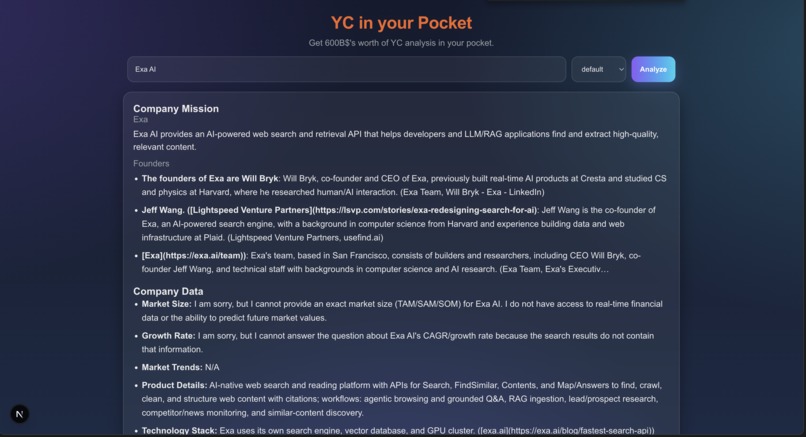
What it looks like
-

Cool photo


What inspired us
We kept hearing the same pain point from founders, investors, and builders: there’s too much noise and not enough signal. Great teams often get overlooked, due diligence takes too long, and context is scattered across documents, blogs, GitHub, and social media. We sought a pragmatic AI copilot that could scout startups, understand markets, and synthesize concise, defensible insights quickly. That idea became our multi‑agent “VC Analyst.”
How we built it
System design
- Multi‑agent backbone: We composed specialized agents—
founder_agent,product_agent,market_agent,integration_agent, andvc_scout_agent—each with focused tools and prompts, orchestrated through a shared interface inVC_Analyst/adk_agents/. - API layer: A lightweight FastAPI service in
VC_Analyst/api.pyexposes endpoints for running analyses and streaming results to the UI. - Data ingestion:
VC_Analyst/ingestion_tools.pyhandles fetching, cleaning, and normalizing heterogeneous sources (web, docs, structured datasets), with careful rate limiting and parsing. - Frontend: A Next.js app (
frontend/src/app/*) for a clean analyst workspace—submit a startup, view agent threads, and inspect synthesized reports. - Quality gates: Pytest suite in
VC_Analyst/tests/for agent contracts and scoring logic; type checks viapyrightconfig.json.
- Multi‑agent backbone: We composed specialized agents—
Scoring and synthesis
- Each agent outputs normalized signals; we aggregate them into a composite score and a structured memo. Composite score: Sstartup = wfF + wpP + wmM + wiI Where: F = founder strength; P = product quality; M = market attractiveness; I = integration/traction signals; and w* are calibrated weights.
- We complement numeric scoring with evidence‑linked bullets (citations and quotes) to preserve interpretability.
Engineering choices
- Clear agent boundaries with tool‑centric design to avoid prompt sprawl.
- Deterministic preprocessing for sources (deduplication, canonicalization) to make outputs reproducible.
- Simple, observable pipelines before clever ones—logs, test doubles, and fixtures over silent magic.
- Blended Gemini ADK with Pydantic and used OpenAI's GPT-5 as the model of choice due to the model having the highest preference for tool usage.
What we learned
- Agent specialization > one big model: Narrow, well‑tooled agents produce more trustworthy, composable outputs than a single do‑everything prompt.
- Evidence beats vibes: Traceable citations dramatically improve user trust, reviewability, and our own debugging speed.
- Data hygiene compounds: Small wins in ingestion (URL normalization, content dedup) meaningfully reduce hallucinations and contradictions downstream.
- Tight UI loops matter: Fast, readable drafts with clear uncertainty flags make humans faster and the product stickier.
Challenges we faced
- Messy web data: Unstructured pages, bot walls, and inconsistent schemas required layered fallbacks and resilient parsing in
ingestion_tools.py. - Score calibration: Balancing (w_f, w_p, w_m, w_i) so that exceptional founders don’t mask weak markets (and vice versa) took iteration, backtests, and reviewer feedback.
- Prompt drift: As tools changed, prompts subtly degraded. We added test fixtures and regression tests in
VC_Analyst/tests/to catch semantic regressions. - Latency vs. depth: Full‑context analyses are slow; we introduced progressive disclosure—quick summary first, deeper dives on demand—plus streaming responses.
- UX for uncertainty: Communicating confidence without overwhelming users pushed us to standardize labels, caveats, and “what would change our mind” sections.
Impact and next steps
- Today: A repeatable, explainable pipeline that scouts startups, rates them with transparent criteria, and drafts investor‑ready memos.
- Next: Active learning on analyst feedback, richer integrations (GitHub, Crunchbase‑like sources), and portfolio‑level dashboards (risk, overlap, trend deltas).
- Future: Once we get access to richer integrations, make a neural network based on successful and failed cases to predict other companies' success rate.
Why this matters
Great diligence isn’t about being loud; it’s about being transparent, fast, and fair. By combining specialized agents, clean data, and an opinionated UI, we transformed noisy research into actionable recommendations. In my experience with VCs, they consistently discuss optimizing two key aspects: sourcing and quantitative analysis. The issue with quantitative analysis is that any algorithm or ML model requires extensive backtesting to hold up in any form of extrapolation. Sourcing is inherently difficult because you'd effectively have to scrape the entire internet for the information VCs need. Combine this with the different theses that VCs have, it is tough to tackle software-wise. I think this sets a framework both for sourcing (you can automate company input because of the ingestion protocol) and quantitatively lays the groundwork for quantifying founder alignment.
- One‑line takeaway: A multi‑agent VC analyst that surfaces the right startups, explains why they matter, and shows its work, allowing any investor, start-up entrepreneur, 600B$ level advice for a couple of cents per pull.
Built With
- fastapi
- google-adk
- jupyter-notebooks
- nextjs
- openai
- python


Log in or sign up for Devpost to join the conversation.