-
-
Header
About the Project
Inspiration
Most startup ideas fail not because of poor engineering, but because of weak validation. Founders often rely on intuition, limited peer feedback, or biased online opinions. The project was inspired by the need for a structured, repeatable system that simulates real market criticism before any code, capital, or hiring decisions are made. The goal was to build an automated “stress engine” that behaves like a room full of diverse potential customers and experts rather than a single AI chatbot.
What It Does
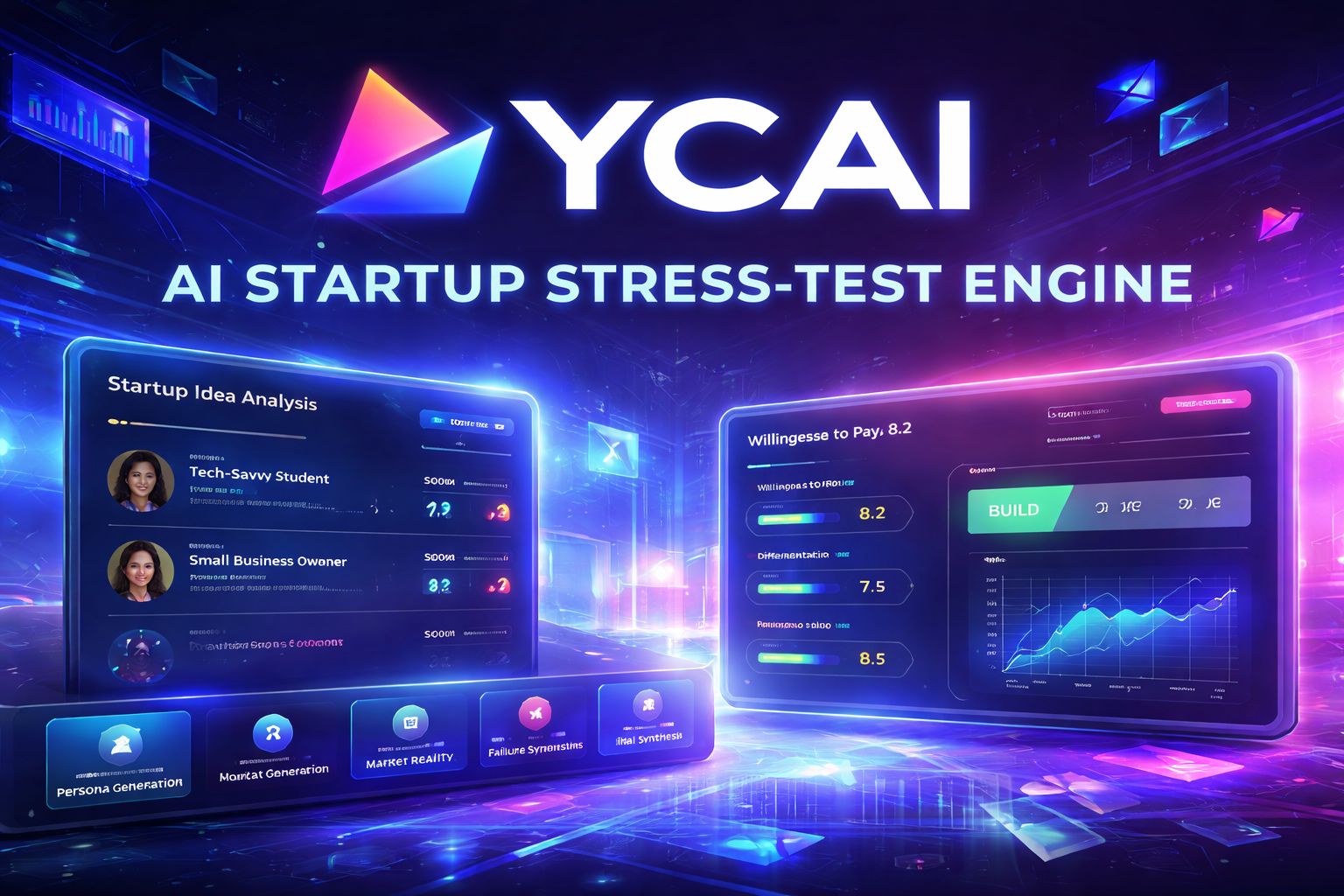
The system ingests a raw startup idea and subjects it to multi-persona evaluation, adversarial debate, and expert synthesis. Instead of producing generic feedback, it generates structured objections, feature demands, pricing resistance, and behavioral insights. The output is not a paragraph of advice but a decision-oriented report with confidence scores, risk vectors, and feature prioritization.
Conceptually, the process approximates:
[ Decision = f(Persona\ Diversity,\ Conflict\ Intensity,\ Market\ Signals,\ Expert\ Synthesis) ]
How It Was Built
The architecture is modular and pipeline-driven:
- Idea Parser
- Extracts problem, target user, and value proposition.
- Converts unstructured text into structured fields.
- Persona Generator
- Produces 8–12 highly detailed personas with demographic, behavioral, and psychological traits.
- Diversity is enforced through constraint sampling to avoid homogeneity.
- Persona Simulation Layer
- Each persona is assigned an isolated language model instance with a fixed system prompt.
- They evaluate the idea independently to prevent cross-contamination of opinion.
- Debate Engine
- Personas are exposed to each other’s viewpoints.
- Iterative rounds simulate disagreement, trade-offs, and feature conflicts.
- Variance and convergence metrics are tracked.
- Advanced Reasoning Layer
- Invoked only when disagreement entropy or idea complexity crosses thresholds.
- Performs synthesis, contradiction resolution, and failure scenario modeling.
- Expert Aggregator
Compresses all dialogue into actionable outputs:
- Feature priority matrix
- Pricing tolerance bands
- Risk probabilities
- Build / Pivot / Drop recommendation
- Monetization and Access Control
- Subscription and tier management integrated through an external billing service.
- Advanced reasoning and deeper persona counts gated behind higher tiers.
What Was Learned
- Simulated diversity is more valuable than raw model intelligence.
- Constrained randomness produces more realistic persona distributions.
- Cost control is a first-class engineering problem in multi-agent AI systems.
- Debate loops quickly explode in token usage without hard caps.
- Users prefer quantified outputs over descriptive paragraphs.
Challenges
Runaway Compute Costs Multi-persona debates scale non-linearly. Hard limits, caching, and conditional routing were required.
Persona Redundancy Early versions generated superficially different but cognitively identical personas. Constraint matrices and trait orthogonality solved this.
Opinion Convergence Too Quickly Models tended to agree. Injecting adversarial prompts and penalty weighting for premature consensus improved realism.
Signal vs Noise Large volumes of dialogue produced diminishing returns. Statistical compression and weighted scoring replaced raw transcript analysis.
UX Complexity Exposing the full pipeline overwhelmed users. The interface was reduced to staged views: Idea → Personas → Debate → Verdict.
The final system functions as an automated pre-mortem and validation lab, converting intuition into structured evidence before real-world execution.
Built With
- and
- cloud
- dedalus)
- deployment
- flowglad-billing
- k2
- llm-apis-(openai
- node/fastapi
- on
- postgresql
- redis
- typescript-and-python-with-react/next.js
- vector-db
- vercel/aws


Log in or sign up for Devpost to join the conversation.