Inspiration
AI tutors can sound convincing while still missing the most important question: did the learner actually understand?
Yasmin started from a practical education problem. A learner may say “yes,” repeat a phrase, or get one answer right while still carrying the misconception into the next exercise.
We wanted Yasmin to behave more like a careful teacher: explain, listen, notice confusion, change strategy, verify the concept, and remember the learning evidence for the next session.
What it does
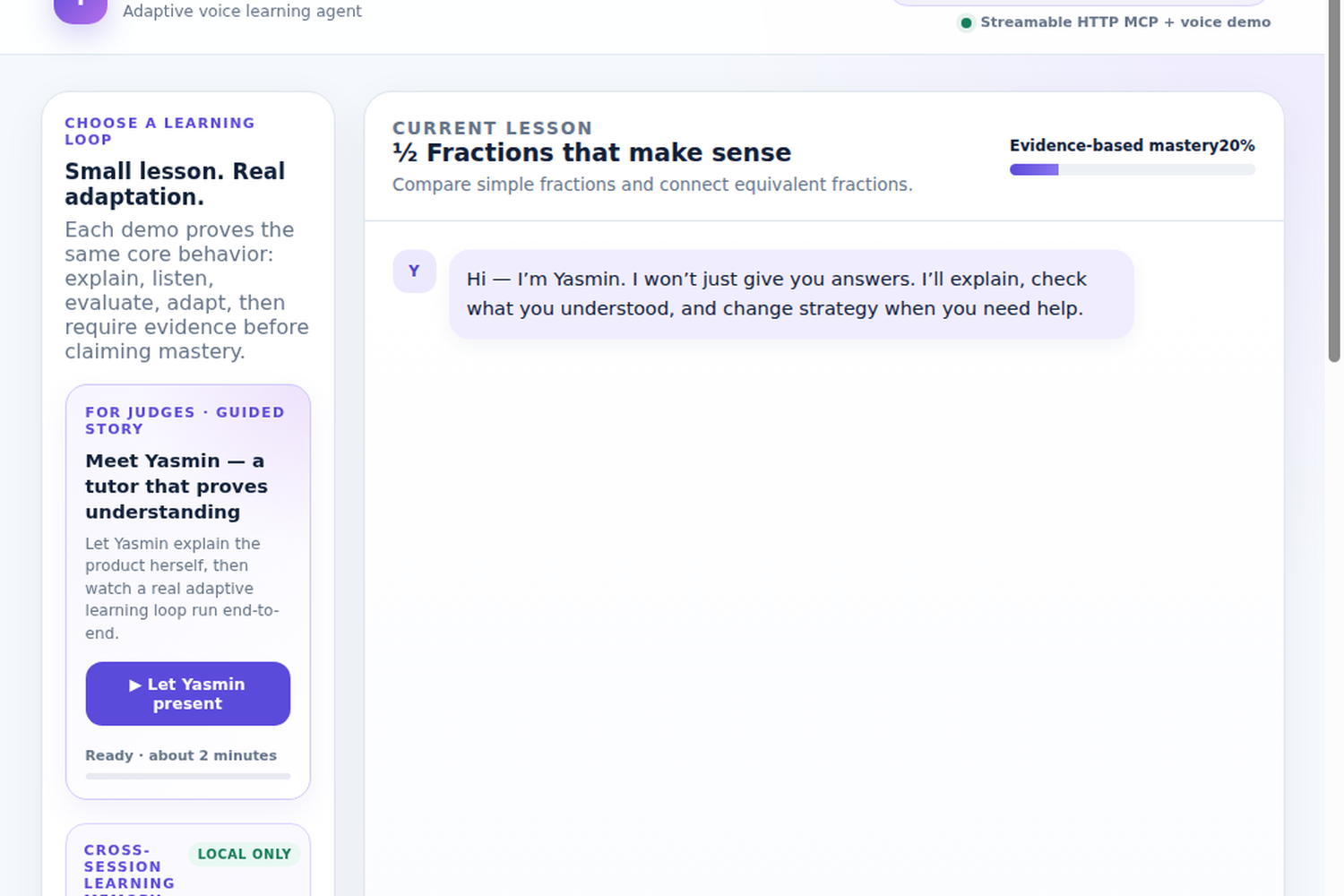
Yasmin Voice Tutor is a voice-first adaptive learning agent built for the Alexa+ track.
Its learning loop is:
plan → explain → listen → evaluate → adapt → verify → remember → plan again
During a lesson, Yasmin can:
- explain a concept using concrete examples;
- detect confusion or uncertainty;
- switch teaching strategy instead of repeating the same wording;
- give hints without immediately revealing the answer;
- collect multiple pieces of learning evidence;
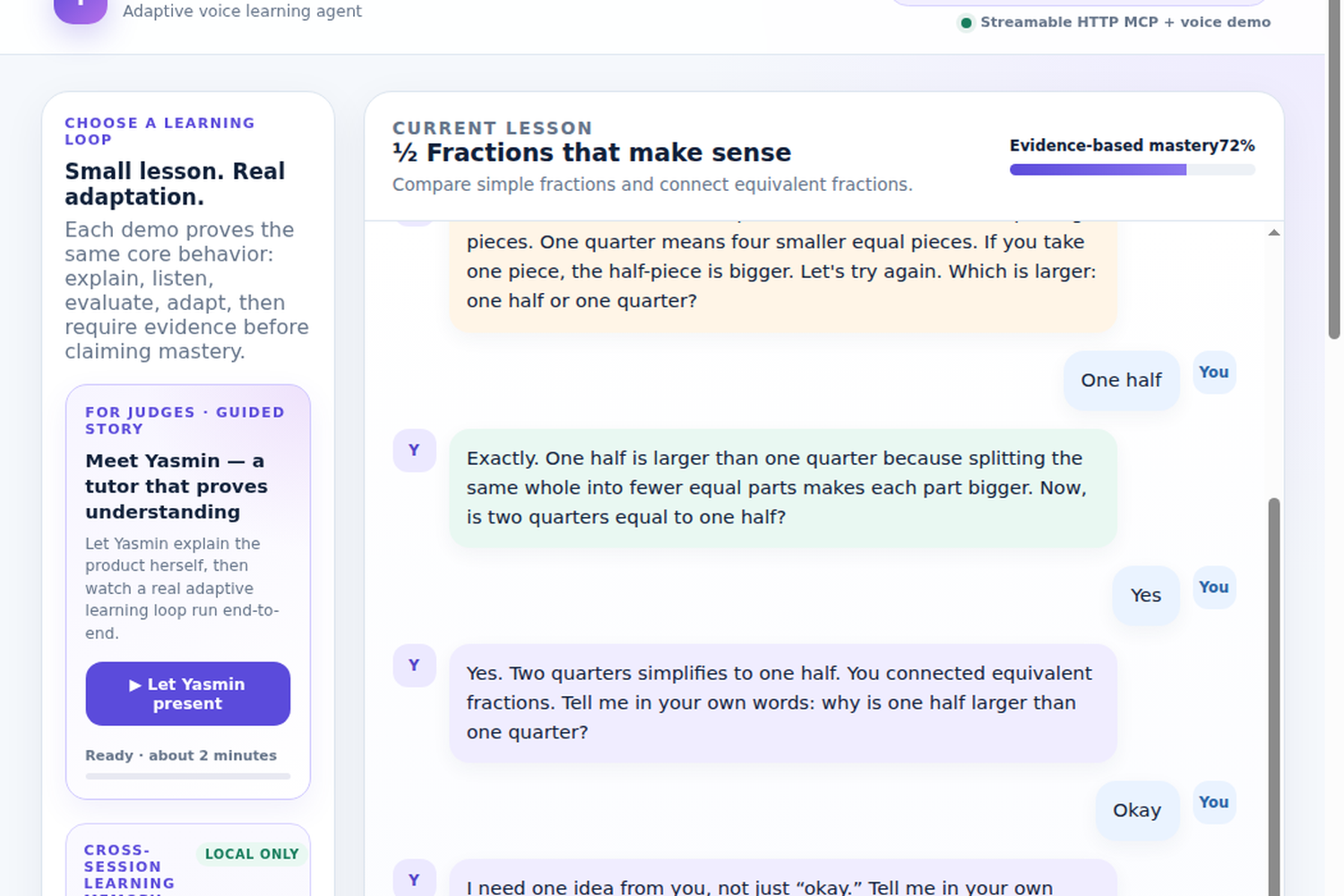
- reject weak mastery signals such as “okay” or generic agreement;
- ask the learner to explain the concept in their own words;
- evaluate that explanation against a transparent concept rubric;
- identify which concept evidence is present and which is still missing;
- remember compact mastery metadata across sessions;
- use previous evidence to decide what should be taught next.
The Agent Control Room makes the agent's teaching strategy, evidence and next decision visible to the reviewer.
The signature moment
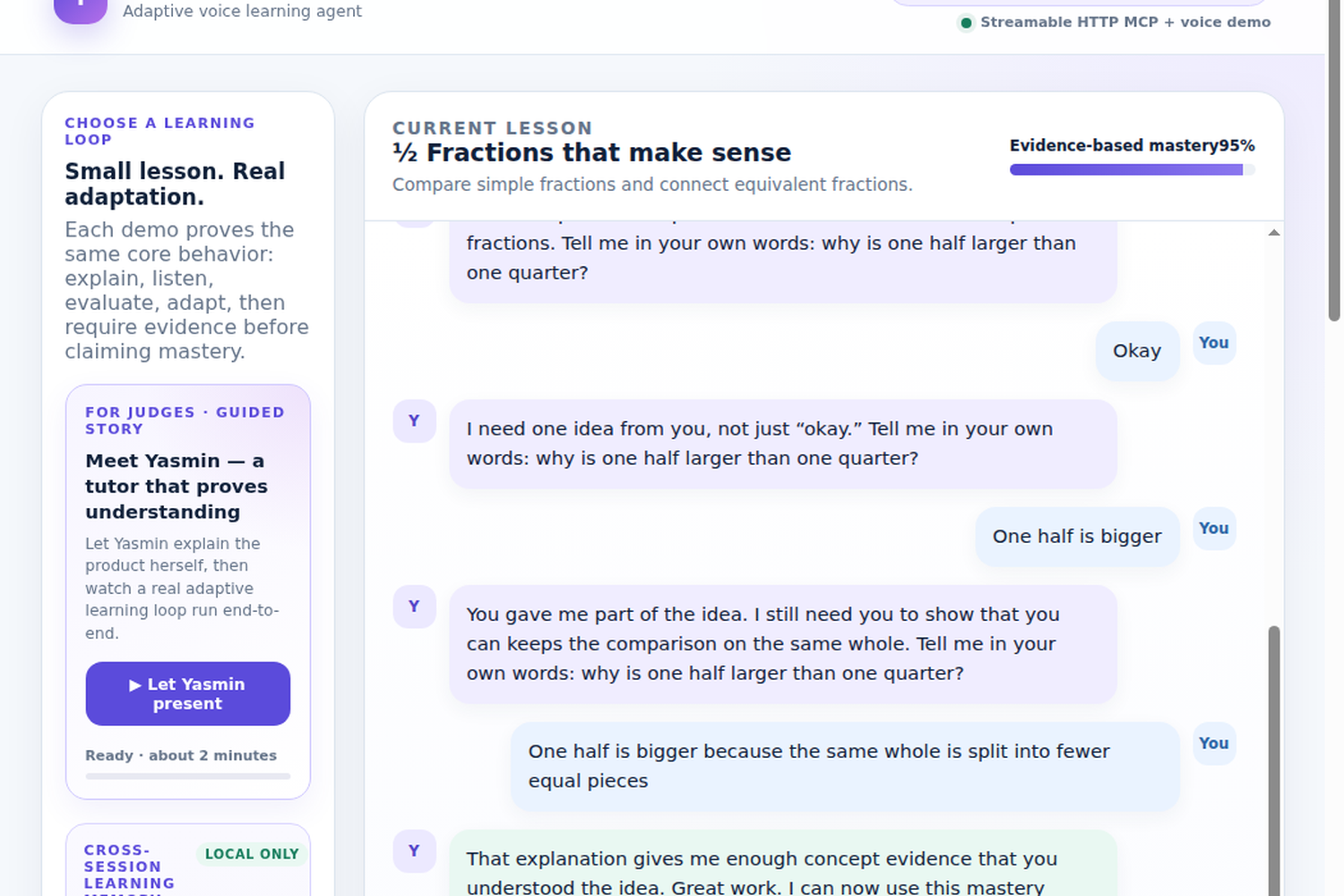
After passing two concept checks, the learner says:
“Okay.”
Yasmin does not mark the lesson as mastered.
Agreement is not evidence of learning.
Yasmin asks the learner to explain the concept in their own words. Only when the explanation contains enough concept evidence does the learning loop complete.
That small behavior captures the central idea behind Yasmin:
Conversation is not evidence of understanding.
How we built it
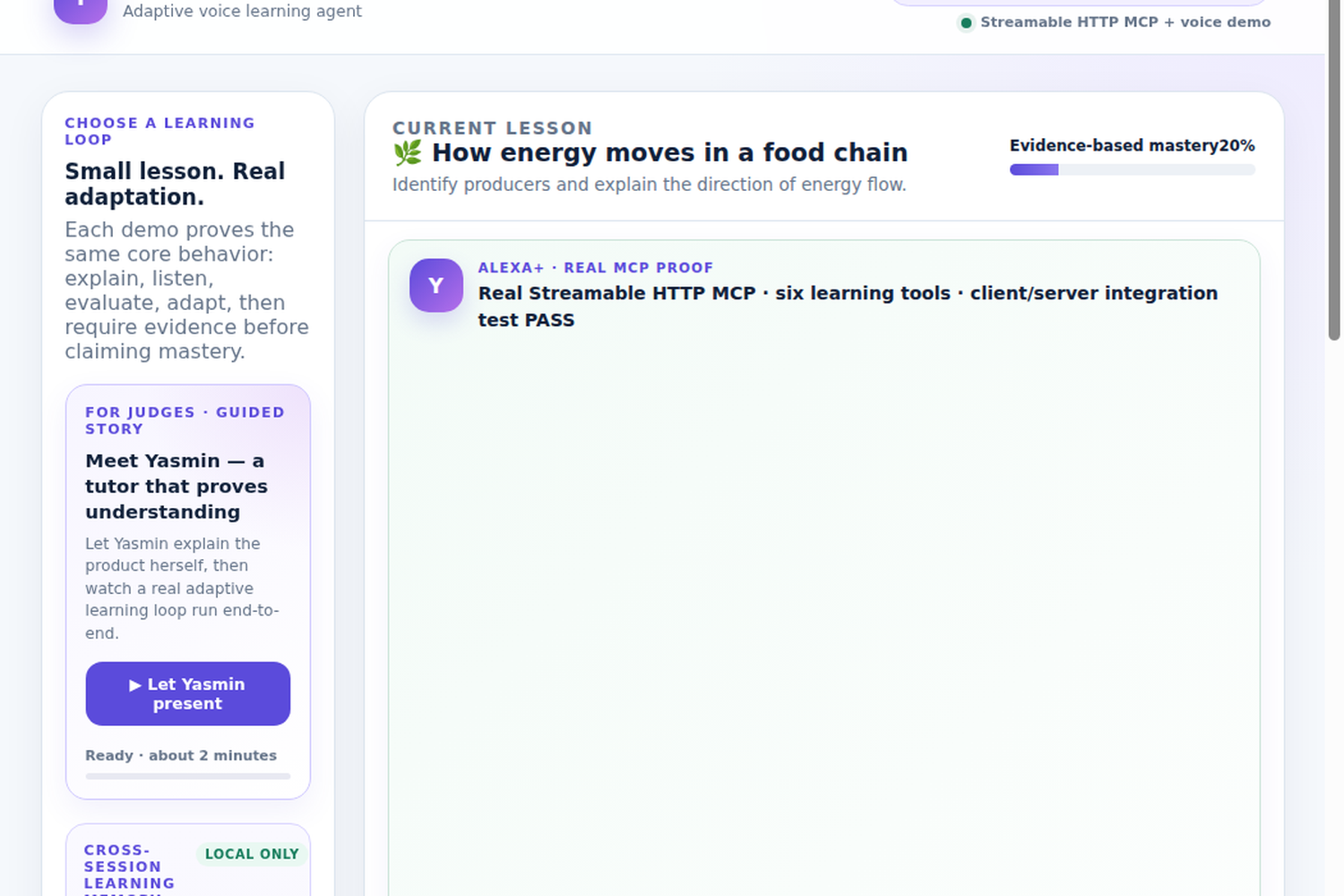
The competition layer is a lightweight Node.js learning runtime with a self-hosted Model Context Protocol (MCP) server using Streamable HTTP.
The Alexa+ MCP layer exposes six learning tools for:
- listing learning loops;
- planning the next session from previous evidence;
- starting a stateful learning session;
- processing learner turns;
- reading the current learning state;
- reading the compact learner profile.
The browser judge experience adds:
- typed and voice interaction;
- spoken tutor responses;
- evidence-based mastery display;
- visible planner/evaluator decisions;
- concept-rubric evaluation;
- cross-session learning memory;
- a one-click Presenter Mode where Yasmin explains and demonstrates the project herself.
The learning profile stores compact mastery information rather than the child's voice recording or conversation transcript.
Cross-session intelligence
A tutoring session should not start from zero every time.
Yasmin remembers compact evidence such as:
- best mastery reached;
- whether the concept was completed;
- number of evidence points;
- whether additional support is needed;
- the last teaching strategy used.
That memory changes what happens later.
A weak concept can trigger repair. An unseen concept can trigger new learning. Completed concepts can move the learner toward the next lesson or later review.
Challenges we ran into
One major challenge was deciding what the tutor should remember.
Saving full transcripts would have been easy, but a transcript is not the same thing as learning state and is a poor default for a child-focused product.
We therefore separated conversational content from compact learning evidence.
Another challenge was making adaptation visible to judges. If an AI silently changes internal instructions, the reviewer only sees another response. We built the Agent Control Room so the strategy, evidence state and next decision can be inspected directly.
We also replaced a simplistic reflection heuristic with a transparent concept-rubric evaluator. A long answer alone is not treated as proof of understanding.
Accomplishments that we're proud of
- Built a real Streamable HTTP MCP surface for the Alexa+ track.
- Created stateful learning sessions across MCP tool calls.
- Added cross-session mastery memory and next-session planning.
- Implemented fail-closed mastery instead of rewarding generic agreement.
- Added concept-rubric evaluation with matched and missing evidence.
- Made Yasmin herself present the judge demo.
- Added deterministic learning-engine tests.
- Added a real MCP client/server integration test.
- Built an automated judge-video pipeline using the actual application.
- Kept the competition architecture reusable for the main Yasmin learning app.
Verification
The complete competition suite passed on a GitHub-hosted Ubuntu 24.04 runner with Node.js 22.
The verification includes:
- learning-agent tests;
- Presenter Mode tests;
- cross-session memory tests;
- runtime planning tests;
- submission consistency validation;
- real MCP client/server integration testing.
What we learned
The biggest lesson was that an agentic education product is not defined by how many answers an AI can generate.
The important part is the control policy around those answers:
When should the tutor explain?
When should it wait?
When should it change representation?
What counts as evidence?
What should be remembered?
What should happen next?
MCP also gave us a clean separation between the conversational surface and the reusable learning runtime.
What's next
Next steps for Yasmin include:
- bringing the evidence-first memory model fully into the Android product;
- expanding from focused judge lessons to curriculum-linked learning graphs;
- adding spaced-review scheduling;
- adding parent-visible evidence summaries without exposing raw child conversations;
- evaluating teacher-authored explanation strategies across subjects;
- improving production voice quality and multilingual support.
Significant update during the hackathon
The broader Yasmin education concept existed before this hackathon.
During the competition window, this submission added the dedicated Alexa+ layer:
- MCP learning runtime;
- six learning tools;
- cross-session mastery memory;
- Agent Control Room;
- Presenter Mode;
- smart next-session planning;
- concept-rubric evidence evaluation;
- automated competition testing;
- real MCP integration testing;
- automated judge-media generation;
- a reusable learning-agent architecture intended to flow back into the main Yasmin product.
Privacy
The competition demo requires no child account.
Its learning profile stores compact mastery metadata and does not retain the learner's voice audio or raw conversation transcript.
Demo scope
The included lessons are intentionally small and deterministic so judges can reproduce the agent's decisions. They demonstrate the learning architecture and are not presented as a complete curriculum.
Public source
https://github.com/corepilotlabs/odoo18-business-apps/tree/yasmin-amazon-2026
What it does
How we built it
Challenges we ran into
Accomplishments that we're proud of
What we learned
What's next for Yasmin Voice Tutor
Built With
- alexa+
- css3
- express.js
- html5
- javascript
- mcp
- node.js
- webspeechapi
- zod

Log in or sign up for Devpost to join the conversation.