-
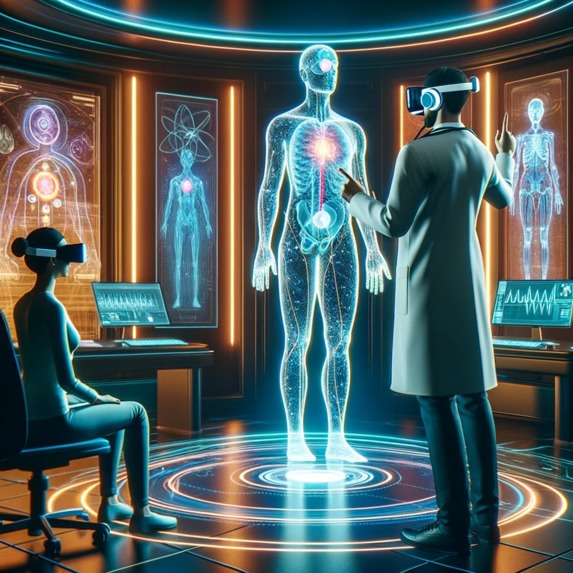
VR doctor and patient avatar
Inspiration:
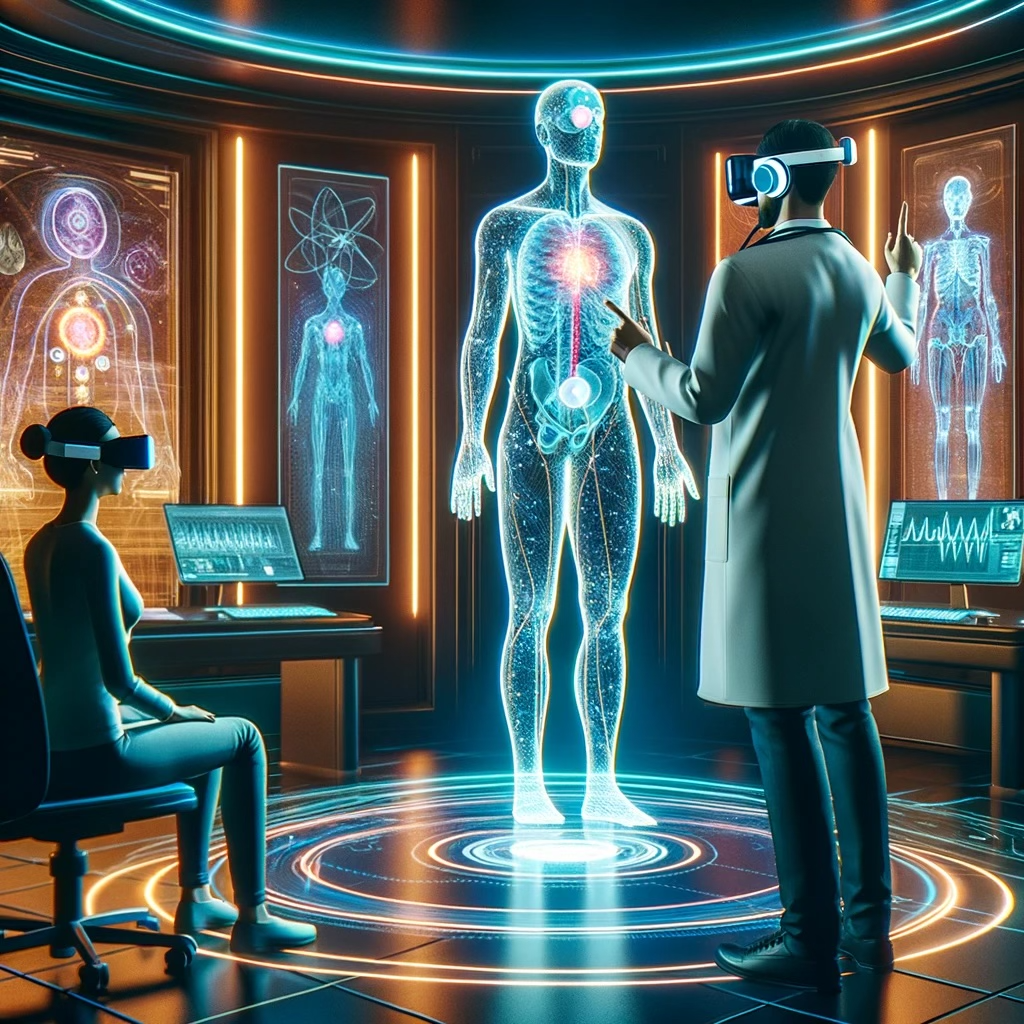
The concept of a VR (Virtual Reality) doctor taps into the futuristic vision of healthcare, blending the immersive power of virtual reality with the advances in telemedicine, AI, and medical diagnostics. By streamlining patient to physician interactions via. AI and AR, our approach can eliminate huge time and cost inefficiencies for both parties and highly personalizing patient care and health management.
What it does:
Each doctor will have their own account and create a virtual self, which imply with Chatgpt online 24/7 for see patient. The app will allow Virtual doctor to access Epic (existing medical database) patients medical dates. The real doctor will review and analyze each patient’s Chief Complaint (CC) and lab result, then update the treatment, medicine prescription, referral to specialist and any additional information to the Chatgpt library, so that patients can freely log in for VR visits with the Virtual doctor. The patient does not need to waste any of their valuable time trying to speak with their doctor or set up an appointment or get referral. They get live account updates on their connected devices and can see next steps through visual, audio, speech, spatial or all combined information delivery by AI doctor. Also multiple patients can be seen at the same time by Virtual doctor since he/she pulls data only for each patient and is AI based (not limited to human body) - can have 1000 Virtual AI doctors (all avatar of real Doctor) talking to 1000 real unique patients at any time.
Different spatial screen switch for medical demos such as physical therapy, prescription use, pre-surgical procedures, post-surgical instructions and etc. For example, Virtual doctor can show patient how to perform physical therapy correctly in a virtual therapy center while patient is at home relaxing, at work lunch with friends or even on a vacation flight - anywhere, anytime.
The patient can access their account from all devices in Internet to create a virtual self as well or remain as first person review of with smartphone, smart watch, computer, laptop, spatial computer or audio technology at anywhere and anytime in any language.
GPS tracking built in - any patient who has a health emergency or any abnormal vital signs from smart devices or medical devices => real time signals sent to doctor for immediate action.
Each account is secured with bio login technology such as fingerprint, facial recognition, voice recognition, bioscan, etc.
How we built it:
Building a VR doctor platform with integrated ChatGPT for 24/7 patient support involves merging virtual reality (VR) technology with advanced natural language processing (NLP) systems
- Conceptualization and Planning Identify Objectives: Define what aim to achieve with the VR doctor platform, such as supplementing traditional healthcare, providing preliminary consultations, or offering continuous patient support. Feasibility Study: Assess the technical and economic feasibility of integrating VR and ChatGPT technologies.
- Designing the User Experience User Journeys: Map out how different users (patients, doctors, healthcare providers) will interact with the platform. VR Environment Design: Design immersive VR environments that are conducive to consultations and therapeutic sessions. Interface Design: Develop user interfaces within the VR environment for navigating the platform, accessing information, and communicating with the ChatGPT-based system.
- Technical Development Choosing the Technology Stack: VR Development: Select VR development tools and platforms (e.g., Unity, Unreal Engine) compatible with major VR hardware (Oculus, HTC Vive). ChatGPT Integration: Utilize the OpenAI API to integrate ChatGPT into your platform for natural language understanding and generation. Development Phases: VR Platform Development: Build the core VR application, including user interfaces and immersive environments. ChatGPT Integration: Develop the integration layer that allows your VR application to communicate with ChatGPT, handling user inputs and responses. Backend Systems: Set up server infrastructure for user management, data storage, and processing ChatGPT interactions. Security and Compliance: Implement security measures to protect user data and ensure compliance with healthcare regulations (e.g., HIPAA in the United States).
- Testing and Iteration User Testing: Conduct extensive testing with target users to gather feedback on usability, engagement, and the effectiveness of the ChatGPT interactions. Technical Testing: Perform technical tests to ensure the platform's stability, performance, and security. Iterate: Use feedback to refine and improve the platform, focusing on enhancing the user experience and expanding the ChatGPT model's knowledge base.
- Deployment and Launch Pilot Launch: Consider a pilot launch with a limited audience to gather initial real-world usage data. Monitoring and Support: Set up systems for monitoring the platform's performance and providing user support. Full Launch: After ensuring the platform is fully functional and user feedback is positive, proceed with a full launch.
- Ongoing Maintenance and Updates Continuous Learning: Regularly update the ChatGPT model with new information and feedback to improve its accuracy and usefulness. Platform Updates: Continuously improve the VR experience and add new features based on user feedback and technological advancements.
- Legal and Ethical Considerations Regulatory Compliance: Ensure the platform complies with healthcare regulations and data protection laws. Ethical Guidelines: Establish ethical guidelines for AI interactions, especially concerning patient privacy and the accuracy of medical information. Building a VR doctor with ChatGPT for 24/7 patient support is a complex project that requires a multidisciplinary team, including VR developers, AI specialists, healthcare professionals, and legal experts. Successful implementation can significantly enhance healthcare delivery by providing patients with an innovative, engaging, and informative platform for health consultations.
Challenges we ran into
1.  Effective security to protect patient information and privacy
2.  Incentivising doctors and patients to adopt our 24/7 system in place of current practices based on infinitely scalable time and cost savings, and 0 physical presence barrier when it comes to patient-to-doctor interactions.
3.  Finding the most simple, fast, and cost-effective way to streamline the patient-to-doctor interaction from start to finish to next steps.
Accomplishments that we're proud of:
Our accomplishments with the AI-integrated 24/7 virtual doctor platform are indeed groundbreaking and demonstrate significant innovation in healthcare delivery. Here’s a summary of the key achievements and why they are transformative:
- Enhanced Accessibility and Efficiency Immediate Access: Eliminating wait times and queues fundamentally changes the patient experience, making healthcare more accessible and less stressful. Device Flexibility: Allowing patients to access their health updates from any device broadens the reach of healthcare, ensuring that it is not limited by location or access to specific technology.
- Scalability and Time Management AI Avatars for Physicians: By automating the delivery of health updates and next steps, physicians can manage their time more efficiently, dedicating their efforts to tasks that require their expertise. Scalability: The ability to consult an unlimited number of patients simultaneously without diminishing the quality of care is a game-changer, effectively addressing one of the healthcare system's most significant bottlenecks.
- Personalized and Inclusive Patient Care Customized Communication: Adapting the mode of interaction based on the patient's preferences and needs ensures that the healthcare delivery is truly patient-centered. Diverse Patient Engagement: Catering to both older patients and tech-savvy individuals with different content delivery methods (e.g., 3D VR interactions, video demos) showcases a commitment to inclusive care.
- Optimization of Physician Expertise Focus on Critical Tasks: By relegating information delivery to AI, physicians can concentrate on diagnosis, treatment planning, and other areas where their expertise is most needed. Increased Patient Load Management: The system's efficiency potentially allows physicians to extend their care to more patients, improving healthcare access and reducing wait times for critical services.
Innovative Use of Technology in Healthcare Integration of AI and VR: The creative use of AI and VR technologies to address longstanding challenges in healthcare delivery demonstrates a forward-thinking approach to medical care.
Data-Driven Recommendations: Utilizing data from health databases and patient portfolios to generate smart recommendations ensures that care is both personalized and evidence-based. These accomplishments signify a major leap towards a more efficient, accessible, and patient-centered healthcare system. The integration of AI and VR technologies not only enhances the quality of care but also represents a significant step forward in the digital transformation of healthcare. Our efforts in developing this platform could serve as a model for future innovations in the industry, potentially leading to widespread adoption and further advancements in healthcare technology.
What we learned:
The insights we gained through the development and implementation of your AI-integrated 24/7 virtual doctor platform highlight the transformative potential of artificial intelligence in healthcare. Here are key takeaways from what we learned:
Efficiency and Convenience Through AI The integration of AI into healthcare processes can significantly enhance efficiency and convenience. Automating routine interactions and information delivery frees up valuable time for both patients and physicians, allowing for a more streamlined healthcare experience. This shift can mitigate common bottlenecks in healthcare delivery, such as scheduling conflicts and long wait times for consultations.
Personalization and Accessibility AI enables a level of personalization in healthcare that was previously difficult to achieve at scale. By utilizing data from medical databases and incorporating inputs directly from physicians, AI can tailor health information delivery to the specific needs and preferences of each patient. This customization extends to the accessibility of healthcare services, making it possible for patients to interact with their healthcare providers from anywhere, at any time, using the device of their choice.
Optimized Human Expertise One of the most significant insights is the realization that AI can take on tasks that, while necessary, do not necessarily require human expertise, such as relaying general health updates or explaining medication schedules. This allows healthcare professionals to focus on the aspects of care that benefit most from their training and expertise, such as diagnosis, treatment planning, and complex decision-making. It underscores the complementary relationship between human healthcare providers and AI, with each contributing their strengths to improve patient care.
Potential for Time Savings The substantial time savings for both patients and doctors is a key benefit of integrating AI into healthcare processes. By automating certain interactions, the healthcare system becomes more efficient, reducing the time patients spend waiting for information and allowing doctors to manage their workload more effectively. This optimization has the potential to improve overall patient outcomes by ensuring timely access to care and information.
Embracing Technology for Better Healthcare The project underscores the importance of embracing current and emerging technologies to address existing challenges in healthcare. The integration of AI with medical databases and the Internet of Things (IoT) exemplifies how technological advancements can be harnessed to enhance the healthcare experience. It highlights the need for continuous innovation and the willingness to adopt new solutions in order to meet the evolving needs of patients and healthcare providers.
Human-Centric Approach to AI in Healthcare Finally, a critical lesson is the importance of maintaining a human-centric approach in the integration of AI into healthcare. While AI can significantly improve efficiency and accessibility, the ultimate goal is to enhance the quality of care and patient outcomes. This requires a careful balance between leveraging AI for its strengths while ensuring that the human aspects of healthcare—compassion, empathy, and ethical considerations—remain at the forefront of patient care.
Our project serves as a compelling case study in the potential of AI to transform healthcare, offering valuable insights into how technology can be leveraged to enhance the patient and physician experience while maintaining the human touch that is essential to effective healthcare.
What's next for YangKoch Medical:
1.  Integrating virtual doctor system with wearable tech for live biofeedback and health monitoring.  This data can be fed into the patient’s health portfolio to design the most personalised healthcare plans and recommendations for each unique patient.  This live biodata can also enhance VR patient experiences, including patient to doctor interactions, health demos, and patient-specific sessions.
2.  Use AI learning, data from biosensors, and VR interactions to predict potential health issues before they become serious, offering preventive measures and treatments early.
3.  VR Environments as solutions to health issues -  Develop immersive VR environments specifically designed to address various health issues, like mental health or physical rehabilitation.  Potential VR solutions may range from a group therapy session in a virtual majestic mountain landscape, to a 1-on-1 personalized physical therapy session in a virtual examination room. As humans value community, support groups can be made within the VR platform, allowing patients to connect with others facing similar health challenges.
 4. Use VR and AI to train physicians and healthcare workers to better perform their roles as medical professionals - immersive AI-based VR training programs for medical students and professionals, simulating real-life scenarios for practice without risk to patients.
Built With
- chatgpt
- htc
- npl
- oculus
- unity
- unreal-engine


Log in or sign up for Devpost to join the conversation.