Inspiration
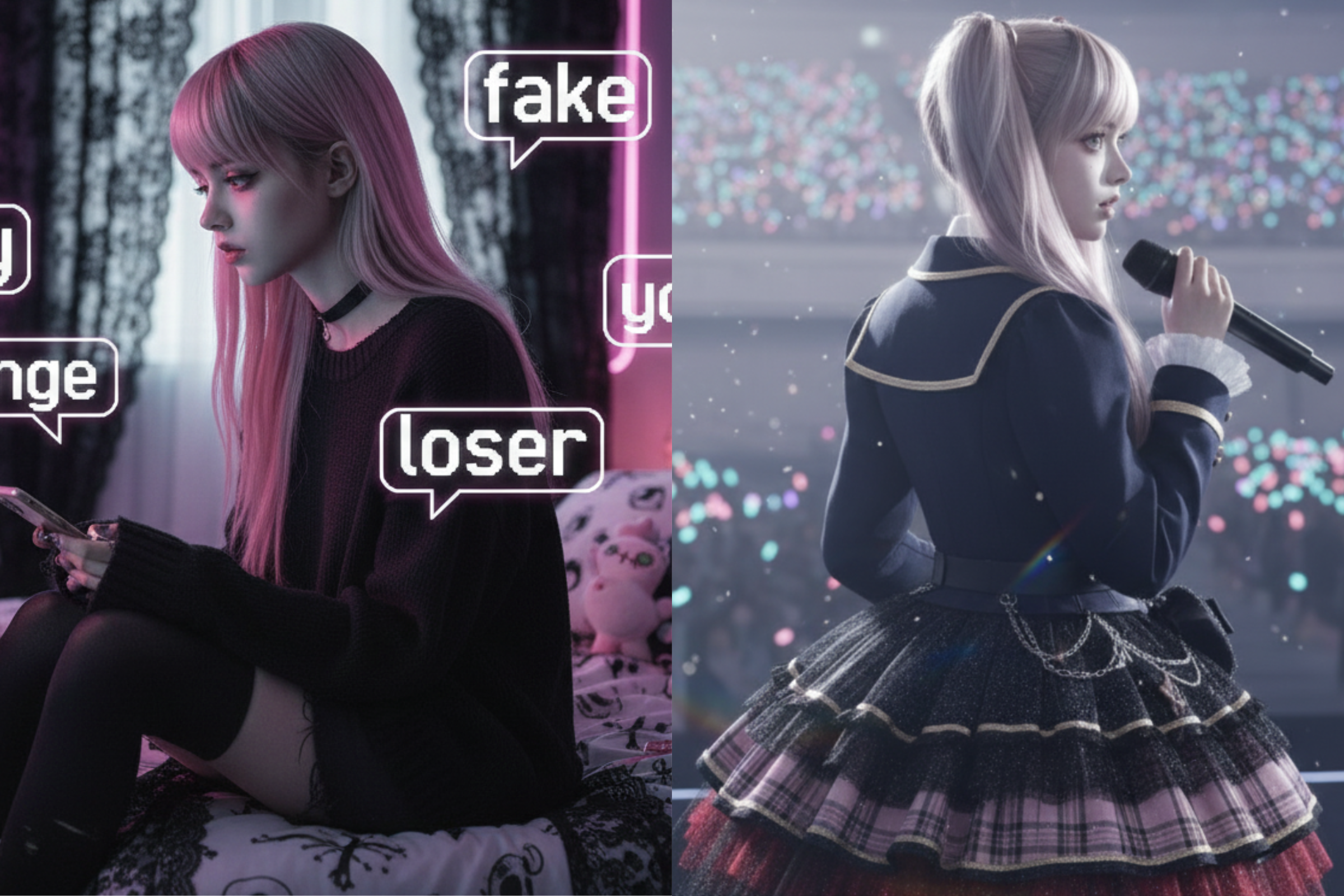
The project was inspired by the duality of yami-kawaii culture—cute, pastel, and dreamy on the surface, yet quietly holding themes of emotional struggle and vulnerability. We wanted to capture the contrast between an influencer’s polished online persona and the overwhelming pressure, loneliness, and identity distortion happening behind the screen. The idea was to let her inner world—glitches, neon storms, breaking glass, childhood memories—manifest visually through AI VFX in a way only AI-driven filmmaking can express.
What it does
This project visualizes the psychological journey of a famous creator whose online identity begins to collapse under constant scrutiny. Through yami-kawaii stylized scenes, it depicts her hair losing color from stress, comments attacking as light beams, her body cracking like glass, and eventually her recovery as she reconnects with her offline self. The film culminates in a euphoric Tokyo Dome performance and ends with a quiet, healed smile in a soft white room.
How we built it
We first established the core character design and produced consistent start frames for each major scene to maintain a unified yami-kawaii tone. Using image-to-video and video-to-video AI tools, we layered complex VFX: neon storms inside her chest, glitching facial expressions, holographic child-self appearances, pastel stage lighting, and high-speed running shots. We constructed the narrative as a progression from façade → decay → collapse → reconnection → rebirth, refining prompts to ensure stable facial identity and coherent emotional continuity.
Challenges we ran into
Maintaining a consistent face, makeup, and yami-kawaii color palette across dozens of scenes was extremely difficult. Small prompt changes could distort facial features or alter the art style entirely. Fast-motion sequences risked stretching the face or losing the pastel tone. Balancing large-scale environments—like a full Tokyo Dome—with delicate, photoreal textures also required careful tuning. And because the story deals with emotional stress, we had to stylize the metaphors without becoming overly graphic or violating safety constraints.
Accomplishments that we're proud of
We successfully kept the heroine’s identity consistent while expressing intense emotional states through AI-driven visuals. The neon-storm inside, glass-cracking effects, holographic child-self, and dome-running shots all retained the yami-kawaii tone while staying cinematic and expressive. We also managed to turn abstract feelings—pressure, burnout, healing—into readable visual metaphors that feel lyrical rather than literal.
What we learned
We learned how sensitive AI models are to micro-changes in style prompts, lighting cues, and camera distance. Building “anchor frames” first dramatically improves consistency across scenes. We also discovered that emotional storytelling benefits greatly from AI’s ability to render metaphors directly—letting psychological states live onscreen as storms, glitches, and pastel dreamscapes. And above all, we learned the value of carefully balancing aesthetic beauty with emotional honesty.
What's next for Yami Kawaii Nove
We plan to evolve this project by transforming the protagonist into a fully realized AI influencer, capable of appearing in social content, livestream-style snippets, and interactive narrative posts. In parallel, we aim to produce a short AI film centered on her story, expanding the emotional arcs introduced in the music video while keeping the yami-kawaii aesthetic at its core.
Beyond the character’s evolution, our goal is to share the charm of yami-kawaii culture with a global audience and demonstrate how AI-driven VFX can unlock visual styles and emotional storytelling that were previously impossible. Ultimately, we hope to grow this into a multi-platform experience that blends creativity, identity, and healing—inviting viewers worldwide to feel the softness, chaos, and beauty of this new digital art form.
Built With
- gemini
- hailuo
- kling
- premiere
- suno


Log in or sign up for Devpost to join the conversation.