-
-
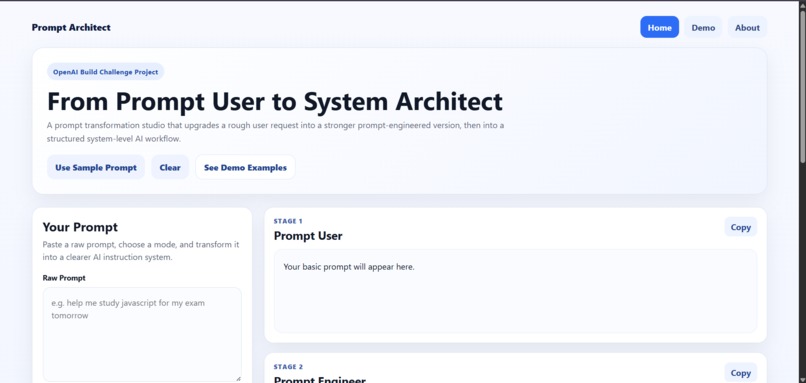
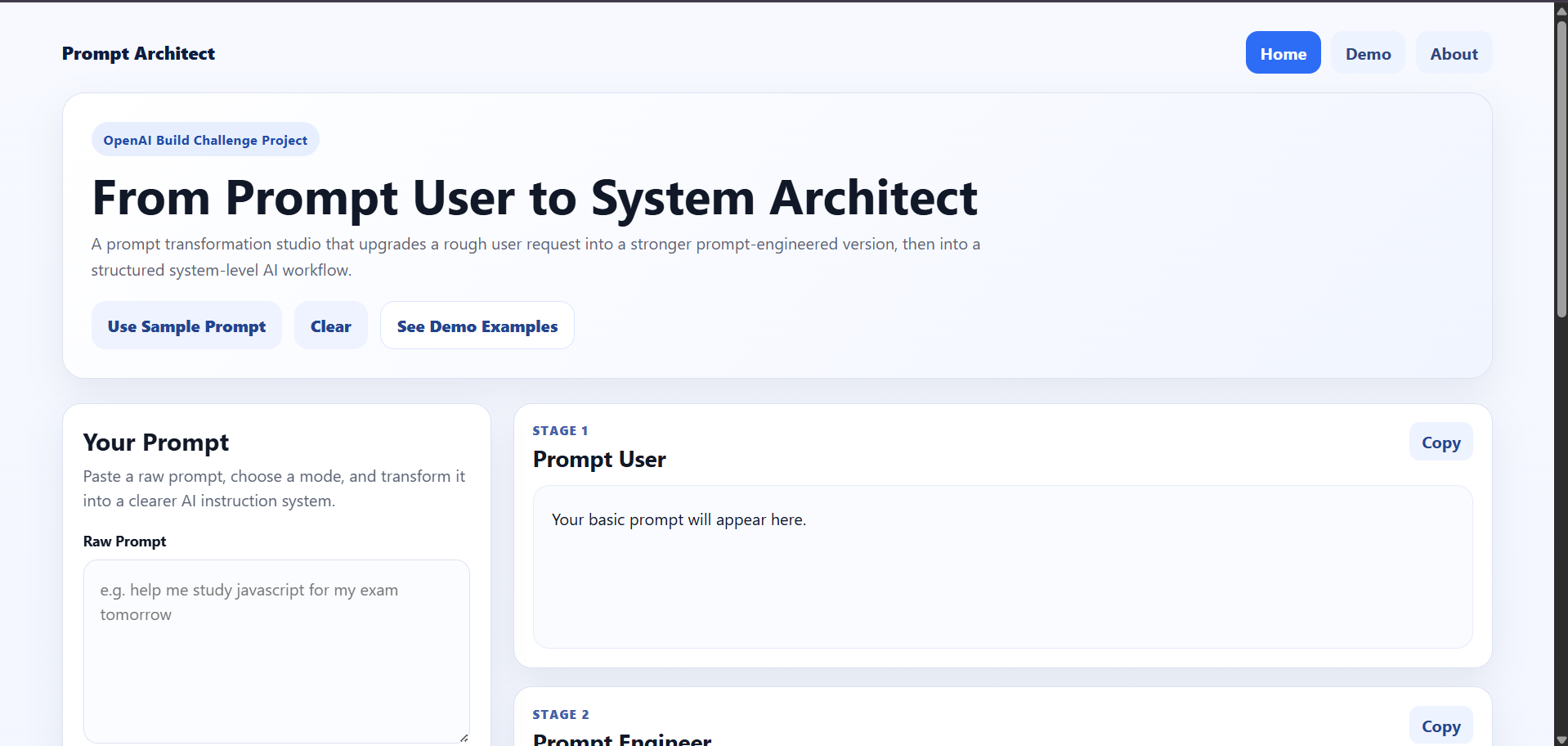
This is the website
Inspiration
What it does# About the Project
Inspiration
This project was inspired by the idea that most people can use AI tools, but far fewer understand how to design with AI. There is a big difference between casually typing prompts and intentionally structuring instructions, constraints, and workflows so that an AI system behaves reliably. We wanted to explore that shift — from being just a prompt user to thinking like a system architect.
What it does
From Prompt User to System Architect is a project that demonstrates how prompting can evolve into system-level thinking. Instead of treating AI as a simple chatbot, the project frames it as a system that can be guided through role definition, context layering, rules, workflows, and iteration.
The goal is to help users understand that strong AI outputs do not come only from clever prompts, but from designing the surrounding structure: what the model knows, what constraints it follows, how tasks are broken down, and how outputs are refined.
How we built it
We built the project by combining structured prompting principles with an interactive workflow that shows the progression from a single user prompt to a more complete system design. The project focuses on prompt engineering concepts such as instruction hierarchy, task decomposition, context management, and iterative refinement.
The experience was designed to make these concepts easier to understand in a practical way, so users can see how a raw request can be transformed into a clearer and more reliable AI system setup.
Challenges we ran into
One of the main challenges was making the idea understandable without oversimplifying it. “System architecture” can sound highly technical, but the project needed to stay accessible to people who are still learning how to use AI effectively.
Another challenge was balancing theory with usability. We wanted the project to explain deeper concepts like constraints, context, and workflow design, while still feeling concrete and engaging rather than abstract.
What we learned
Through this project, we learned that the quality of an AI experience depends heavily on the structure around the prompt, not just the prompt itself. We also learned how important clarity, iteration, and system thinking are when building AI-powered tools.
Most importantly, the project reinforced the idea that the future of AI literacy is not only about asking better questions, but about designing better systems.
What’s next
Next, we want to expand the project into a more interactive learning tool with guided examples, side-by-side prompt improvements, and visual breakdowns of how user prompts can evolve into full AI workflows. The long-term goal is to help more people move from simply using AI to understanding how to shape it intentionally.
How we built it
We built YAM as a full-stack web app that transforms a rough user prompt into a more structured AI instruction system. The frontend was built with HTML, CSS, and JavaScript, while the backend was built with Node.js and Express. The app lets users enter a raw prompt, choose a transformation mode such as Study, Coding, Essay, or Business, and then sends that request to an AI model through an API. The model returns three stages of transformation: the original user prompt, an improved prompt-engineered version, and a final system-architect version with clear goals, workflow, constraints, and output structure. We also added prompt scoring, prompt history, copy/download features, and extra pages like Demo and About to make the project feel like a complete polished product rather than just a single-page prototype.
Challenges we ran into
One of the biggest challenges was getting the AI to return structured output consistently. Because the frontend depended on receiving clean stage-by-stage results, even small formatting issues could break the display. We also ran into API issues such as quota limits, authentication errors, and debugging backend requests. Another challenge was handling nested response objects on the frontend, since at one point some outputs were rendering as [object Object] instead of readable text. On top of the technical side, we also had to think carefully about product design: how to make the transformation process understandable, visually clean, and useful for someone who may not know much about prompt engineering.
Accomplishments that we're proud of
We’re proud that we turned a simple prompt-improving idea into a complete interactive project with a strong concept behind it. Instead of only generating a better prompt, the app teaches users how prompts evolve from a casual request into a structured AI workflow. We’re also proud of the final polish of the project: the 3-stage transformation interface, the scoring system, the prompt history, the multi-page layout, and the demo examples that showcase different use cases. Most importantly, we built something that is both practical and educational — it doesn’t just produce an output, it explains the thinking behind the improvement.
What we learned
We learned that prompt quality is not just about better wording. A strong prompt often comes from better structure: defining the AI’s role, clarifying the objective, adding context, setting constraints, and designing the output format. We also learned that building AI products is as much about frontend and user experience as it is about the model itself. Reliable structured output, good error handling, and clear UI all matter a lot when turning an AI idea into a usable product. Finally, we learned how important it is to make invisible AI workflows visible, because showing the transformation process can teach users how to interact with AI more effectively.
What's next for YAM
The next step for YAM is to expand it beyond a prompt transformer into a more complete prompt-learning and workflow design platform. We’d like to add more transformation modes, side-by-side comparisons between stages, export options such as Markdown or PDF, and support for multiple AI model backends. We also want to introduce a teaching mode that explains why a prompt is good or weak in more depth, so beginners can actively learn prompt engineering rather than just copy the result. Longer term, YAM could evolve into a workspace where users save, organize, compare, and refine prompts for different tasks — turning prompt engineering into a more accessible and teachable skill for everyone.
Built With
- apis
- css
- html
- javascript
- openrouter
- openrouteservice

Log in or sign up for Devpost to join the conversation.