-
-
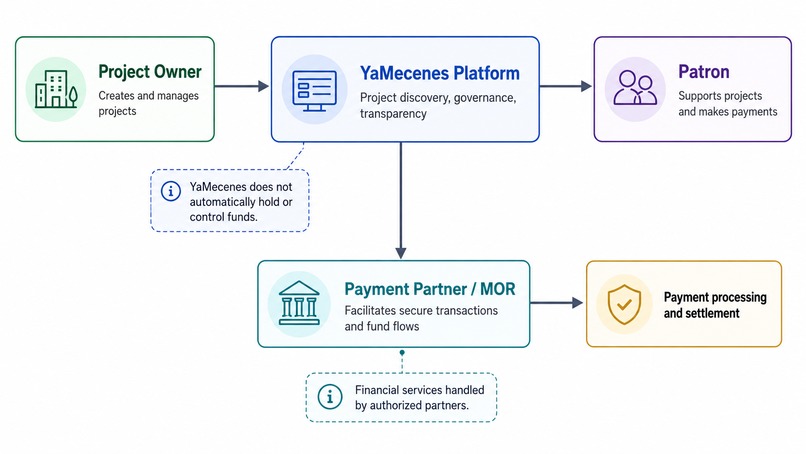
Platform payment architecture flowchart
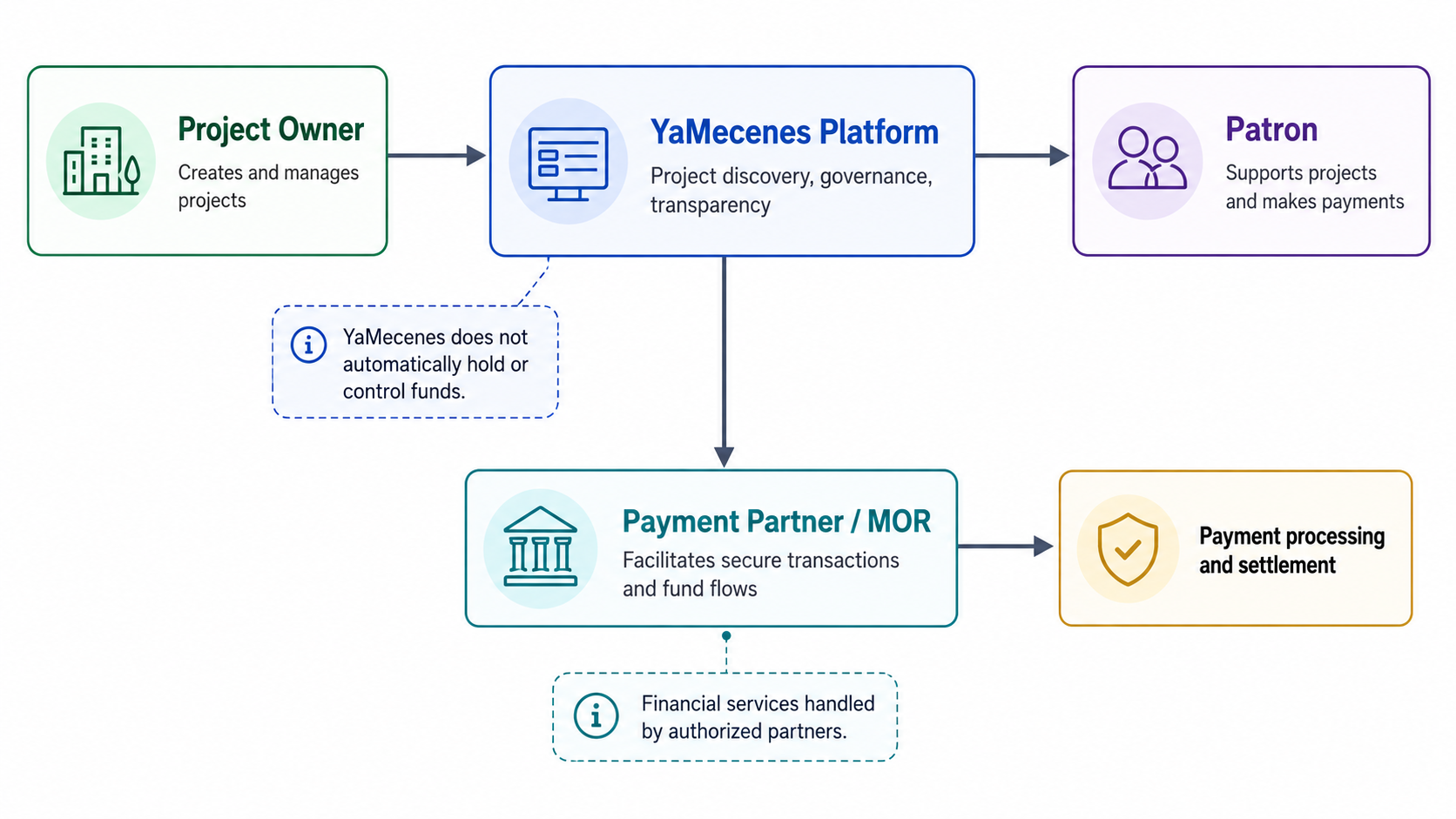
Inspiration# About YaMecenes
Inspiration
Promising ideas often struggle to find the right patrons. This challenge is particularly visible in regions where access to technology, trusted networks, and flexible payment infrastructure remains uneven.
Creators, researchers, entrepreneurs, associations, and community leaders may have valuable initiatives but face several obstacles simultaneously:
- Limited visibility
- Fragmented contribution methods
- Uneven access to mobile money and international payment options
- Low patron confidence
- Insufficient transparency
- Limited access to financial and governance expertise
YaMecenes is inspired by an African concept representing the elder patron: a respected person who recognises potential and helps an initiative grow.
We are not building a bank, fintech company, payment institution, or digital wallet. YaMecenes is designed as a bridge between project owners, potential patrons, communities, and qualified independent payment partners.
Our goal is to help initiatives explain their purpose clearly while giving potential supporters better visibility into project ownership, objectives, milestones, and contribution pathways.
What We Built
YaMecenes is a project-discovery and contribution platform with French and English interface content.
It provides a digital meeting place where creators, researchers, artists, entrepreneurs, organisations, families, and communities can present initiatives and connect with potential patrons.
The platform is designed to accommodate projects such as:
- Creative and cultural initiatives
- Research and innovation
- Entrepreneurship and local production
- Education and professional training
- Community infrastructure
- Health and carefully documented emergency initiatives
- Projects promoting employment and sustainable autonomy
Project owners can submit an initiative through an access-code-controlled process. A project can include its objective, description, location, category, responsible organisation, funding target, currency, milestones, expected impact, and autonomy plan.
The current model supports three contribution approaches:
- Direct contribution details supplied by the project owner
- Contributions processed through an independent payment partner or aggregator
- A mixed model combining both approaches
YaMecenes is designed to provide technology, project discovery, and governance support. It does not present itself as receiving, holding, safeguarding, or controlling contributed funds.
The current demonstration contains ten international example projects across Africa, Europe, Asia, the Middle East, and South America. These include applied water-filter research in Pune, energy-renovation training in Porto, circular textiles in Lille, solar irrigation in Saint-Louis, and community medical mobility in Goma.
Demonstration notice: All projects, organisations, amounts, and payment details shown in the demonstration are fictional test data. They do not constitute active fundraising appeals.
How We Built It
YaMecenes was developed through collaboration between human experience, GPT models, and Codex.
GPT Models Helped Us
- Clarify the product vision
- Improve positioning and terminology
- Define governance principles
- Separate the responsibilities of project owners, patrons, and payment partners
- Examine ethical and regulatory boundaries
- Develop clearer public communication
Codex Helped Us
- Analyse the repository
- Develop the Prisma and PostgreSQL data model
- Implement project-submission workflows
- Build project-discovery and detail interfaces
- Add access-code generation
- Implement administrative authentication and tools
- Create API routes
- Develop contribution and payment-state logic
- Track milestones
- Build backend payout workflows
- Support multisignature approval structures
- Add French and English interface content
- Debug, validate, and test production builds
Technology Stack
The application uses:
- Next.js
- React
- TypeScript
- Prisma
- PostgreSQL
- Tailwind CSS
- Vercel-compatible deployment architecture
- Neon-compatible database infrastructure
The production build passes successfully.
Challenges We Faced
Defining the Financial Boundary
One of our most important challenges was defining the boundary between a project-support platform and a regulated financial service.
We needed to ensure that YaMecenes did not suggest that it was acting as a bank, payment institution, custodian, or digital wallet.
The resulting architecture separates project discovery and governance from payment execution. Payment methods are intended to connect to specialised independent partners, while a contribution is counted only after provider confirmation.
Supporting Different Payment Realities
Potential users may rely on mobile money, cards, bank transfers, or international payment providers.
Building the platform around a single method would exclude many communities. We therefore designed a flexible contribution model that can represent direct, partner-managed, and mixed pathways.
The provider integrations currently operate as demonstration adapters. No payment provider is presented as active until official agreements, credentials, security review, and sandbox testing are complete.
Expanding the Platform’s Identity
Earlier versions were strongly centred on Congolese and Christian communities.
During development, we recognised that the underlying need was much broader. Creators, researchers, entrepreneurs, and organisations across countries and beliefs face similar problems when trying to make credible initiatives visible.
We expanded YaMecenes into an international and secular platform while retaining its African inspiration and commitment to community trust.
Improving Project Examples
We also reconsidered how projects should be presented.
Rather than glorifying permanent dependency, we began emphasising initiatives that build knowledge, production, employment, infrastructure, and long-term autonomy.
Examples include:
- Applied research on locally repairable water filters
- Cooperative poultry production supporting women-led households
- Professional training in energy-efficient renovation
- Circular-textile training and employment
- Solar irrigation for agricultural cooperatives
- Community medical mobility and preventive-health networks
Protecting Administrative Functions
Administrative statistics, project moderation, and access-code generation originally required stronger protection.
We introduced server-side authentication using a secure administrative session cookie while retaining API-key header access for authorised internal scripts.
What We Learned
We learned that inclusion is not achieved through translation alone.
It also requires:
- Flexible contribution models
- Respectful and non-exploitative language
- Clear separation of responsibilities
- Transparent project ownership
- Appropriate governance controls
- Categories reflecting different social and economic realities
- Honest communication about what is operational and what remains experimental
We also learned that AI can contribute differently at each stage of product development.
GPT models were especially useful for product thinking, contextualisation, governance, and communication.
Codex was especially useful for implementation, repository analysis, debugging, security improvements, and technical verification.
The most important lesson was that AI works best when human experience continues to define the purpose, ethical boundaries, and real-world direction of the product.
Current Status
The core prototype is implemented, and its production build passes successfully.
The current version includes:
- Public project discovery
- Project-detail views
- Public project statistics
- Access-code-controlled submissions
- Project targets and milestones
- Administrative authentication
- Project moderation tools
- Access-code generation and management
- Contribution records
- Payment-state handling
- Backend payout workflows
- Multisignature approval structures
- French and English interface content
Some operational and project-detail screens remain French-first, so the bilingual experience is not yet complete.
Payment-provider integrations remain demonstration adapters. Real payments are not active, and the current test projects are not active calls for contributions.
What’s Next
Our next priorities are:
- Complete end-to-end deployment testing
- Improve dedicated project URLs and sharing
- Display expected impact, autonomy plans, and evidence status more clearly
- Complete bilingual coverage
- Strengthen moderation and authentication
- Conduct security and privacy reviews
- Establish official relationships with qualified payment partners
- Test provider integrations in approved sandbox environments
- Develop clearer onboarding for project owners and patrons
- Expand the platform responsibly across regions and project categories
Long-Term Vision
Our long-term vision is to make YaMecenes a trusted international meeting place where credible initiatives can explain their work, demonstrate their potential, and connect with patrons who want to help them grow.
What it does
How we built it
Challenges we ran into
Accomplishments that we're proud of
What we learned
What's next for YA MECENES
Built With
- css
- gpt
- mobile
- neon
- next.js
- openai
- postgresql
- prisma
- react
- tailwind
- typescript
- vercel

Log in or sign up for Devpost to join the conversation.