Inspiration
As freshmen in college for the first time, we all experienced the pain of going over our budgets. It's surprising how much all our transactions add up to. So, we thought about how we could fix this problem and help our users stay within budget. We realized we could only help them stay within budget by discouraging spending and making them see the severe consequences of going over their budget.
Wouldn't you pause for a moment, if you knew that your pristine social media feed would be overtaken by a tool that would call you out for going over your budget and optionally display some of the transactions, that were definitely impulse decisions?
Yep, we leveraged the ultimate 21st-century tool - social media posts to discourage people from going over their budget.
You stay within your budget and your feed remains pristine, but exceed that budget and now you're immediately accountable to almost everyone you know. Now, that's a way to encourage people to avoid going over budget!
What it does
A user signs up for YBudge using Twitter OAuth and then proceeds to input their bank account log-in info and finally enters their maximum budget. YBudge then monitors their transactions and automatically sends out a tweet if they exceed their budget at any time.
How we built it
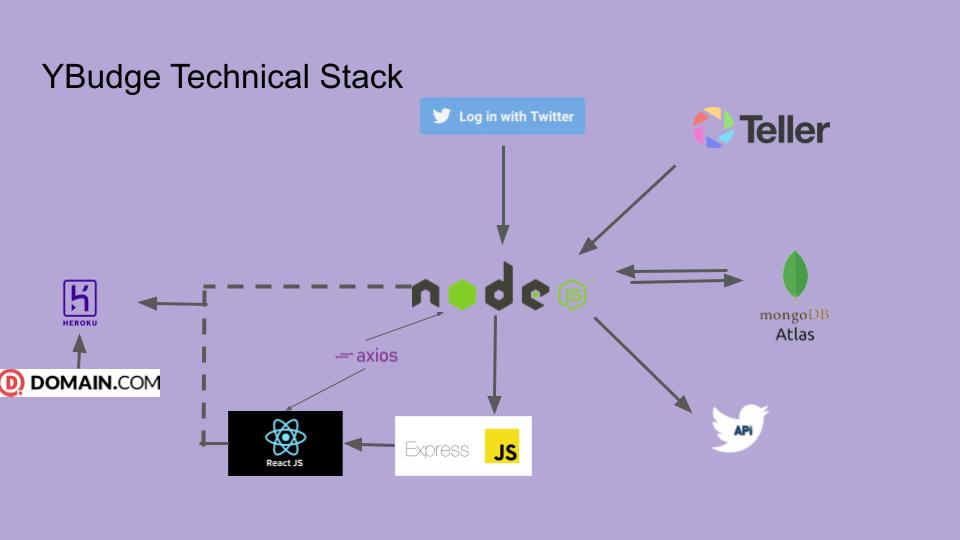
We used the MERN stack to build YBudge.
For their transaction data, we used the Teller API to allow users to connect their bank accounts and allow us to access their transaction history.
Additionally, we interfaced with the Twitter API to allow the user to give YBudge permission to tweet on their behalf through the user's Twitter account if they went over their budget.
Challenges we ran into
The biggest challenge we encountered was implementing Plaid or Teller APIs that would help us get bank account data from users. We would ask the user to sign into their bank account using third-party software such as Plaid or Teller. We encountered several issues while testing and implementing out this feature. We would ask for the front end to show up; however, it would not. In the end, we figured out a way to show up the frontend consistently. Additionally, our feature with Twitter API had trouble running when we called a post request to send a tweet out. After much frustration and troubleshooting, we realized that the issue was with the post request was that it was set to the URL of the frontend portion of the website rather than the backend.
Accomplishments that we're proud of
I'm particularly proud of our application's functionality. I'm proud of implementing Twitter Authentication, Twitter API for posting tweets, and Teller API for Banking data. Our team jumped out of our seats when we were able to sign up, get the data from the bank, and post the correct information to Twitter for the first time.
What we learned
Through the implementation of Y-budge, we have learned a lot about MERN Stack, Teller, Twitter Authentical API, Twitter API, and MongoDB. We have learned what can be done in 36 hours and the reward of completing a hackathon.
What's next for Y-Budge
For Y-budge, we plan to finish implementing the planned features that we brainstormed throughout the event. Some additional functionality that can be implemented is being able to post messages on multiple social media platforms.




Log in or sign up for Devpost to join the conversation.