Inspiration
Modern e-commerce architecture has shifted dramatically from monolithic platforms toward headless, composable ecosystems. The primary motivation behind this project was to architect a high-performance, developer-first platform that completely decouples the transactional commerce engine from the content management system (CMS). While dedicated commerce systems excel at handling cart mechanics, inventory, and fulfillment workflows, their internal content presentation layers are often rigid. Conversely, modern content platforms offer unmatched flexibility for layout composition but lack native transactional systems.
This project bridges that structural divide by seamlessly integrating Medusa—an open-source Node.js commerce engine—with PayloadCMS, an enterprise-grade, headless TypeScript CMS. The goal was to build an ultra-fast, content-driven digital storefront ecosystem where product data, marketing layouts, and high-frequency transactions flow harmoniously. What it doesThe platform serves as a unified backend-forward topology contained within a single workspace context, allowing developers to manage deep content management and e-commerce functionalities simultaneously. Dynamic Page Composition: Integrates collection arrays like Cards and Media to allow complete structural freedom over UI layouts. Robust Core Commerce: Leverages a transactional engine to handle regional pricing matrices, promotion frameworks, customer sessions, and fulfillment workflows. High-Availability Storage: Uses an automated fallback connection strategy that intelligently bridges local database environments with production storage clusters.
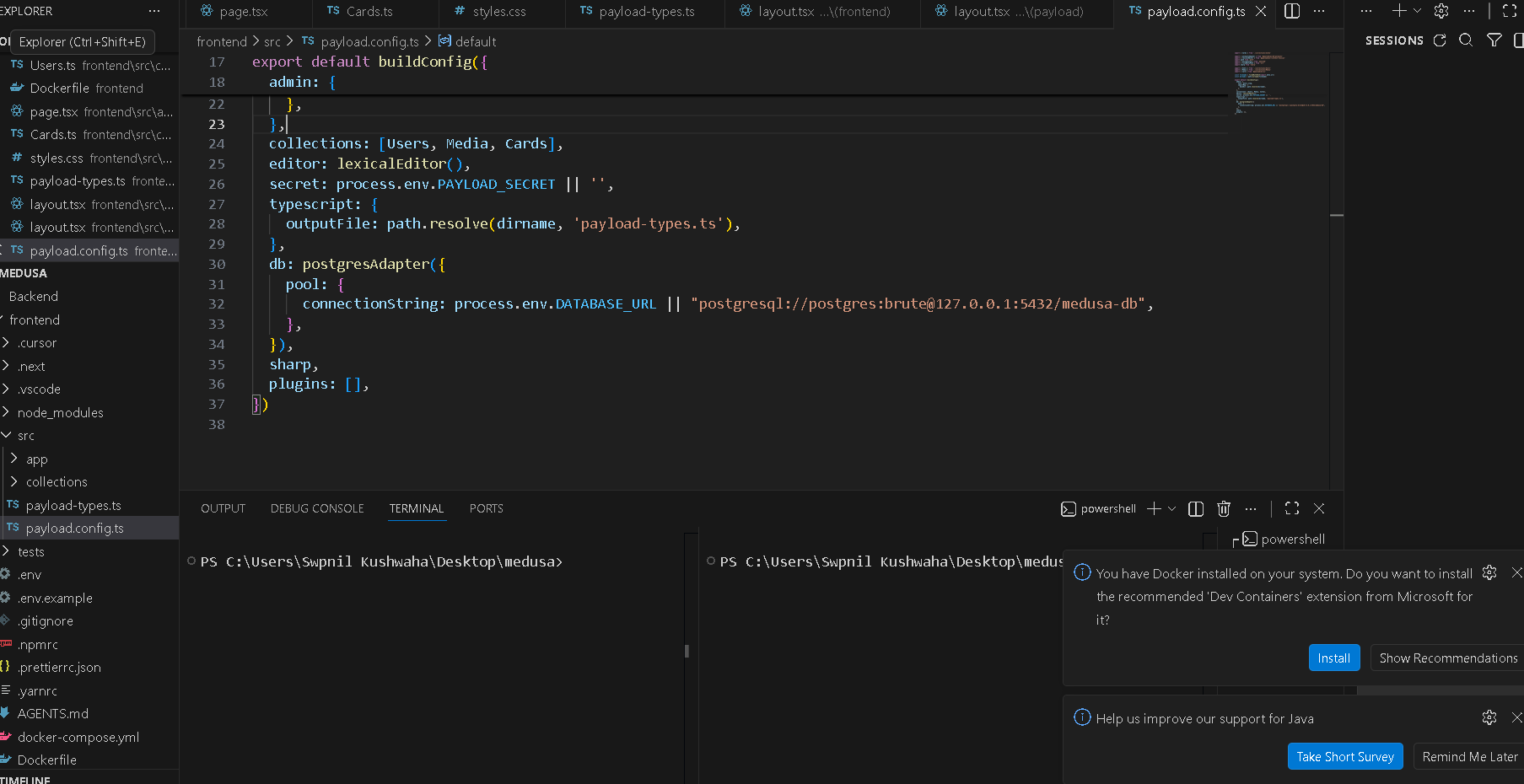
How we built itThe platform is written natively in TypeScript and orchestrates its frontend, backend commerce, and CMS layouts dynamically. Content Management Core: Built using PayloadCMS, configuring strict structural collections (Users, Media, Cards) and a lexicalEditor for rich data composition. Data Persistence: Powered by a high-availability PostgreSQL instance using the @payloadcms/db-postgres pooling adapter. As shown in Screenshot 2026-05-24 235537.png, the connection pool automatically defaults to a local instance (postgresql://postgres:[email protected]:5432/medusa-db) if no production environmental variable is defined. Type-Safe Ingress: Automated compilation scripts output explicit typings directly to a centralized definition schema (payload-types.ts) via path.resolve(__dirname, 'payload-types.ts') to enforce systemic validation. Challenges we ran intoMonorepo Environment Separation & Path Resolution: Running multiple independent processes concurrently across separate server environments (Next.js App Router threads alongside Payload lifecycles) caused recursive type-checking failures. This was resolved by forcing the CMS to compile independent, decoupled typings directly into a localized schema target via explicit resolution scripts. Shared Storage Cluster Isolation: Connecting multiple frameworks to a single PostgreSQL cluster introduces potential table synchronization bugs and runtime context locks. To solve this, explicit database configuration routing was isolated so that Medusa managed core transactional data through isolated migration strategies, while Payload routed structural layout schemas smoothly via independent connection pools. Accomplishments that we're proud ofZero-Lock Concurrency: Successfully configured a dual-framework backend layer talking to a unified PostgreSQL engine without encountering system blockages or schema conflicts. Deterministic Fallback Pipeline: Engineered an automated database pool adapter pattern that cleanly adapts system behavior from local development sandboxes straight to live deployment clusters seamlessly. End-to-End Compile-Time Safety: Maintained a fully unified, type-safe development pipeline where presentation layers and content models explicitly cross-validate before deployment. What we learnedDecoupled Topologies Enable High Scale: Isolating content presentation from order lifecycles ensures that scaling high-traffic marketing components won't interrupt high-throughput transactional checkout pathways. Rigorous Type Systems Save Time: Enforcing explicit, compile-time TypeScript design patterns across custom data structures completely removes runtime errors when rendering complex front-end UI structures. Declarative Setups Accelerate Productivity: Standardizing development steps using environment fallbacks drastically minimizes environment configuration overhead and onboarding friction. What's next for XyzDistributed Webhook Matrix: Implementing edge caching revalidation triggers so that any content update in PayloadCMS updates the live store instantly using global Next.js App Router webhooks. Advanced Multi-Tenant Regional Optimization: Extending the relational data mapping layers to support complex, localized storefront routing across multiple currencies and fulfillment centers natively. Full Containerization Production Deployments: Refining the underlying configurations to build lightweight Docker containers for smooth cloud native scaling.
Built With
- medusa
- payloadcms
- postgresql
- typescript


Log in or sign up for Devpost to join the conversation.