MemoryBank: Your AI Financial Assistant That Actually Remembers You
💡 Inspiration
Money isn't just about transactions - it's about patterns, habits, and decisions over time.
But most financial tools treat every choice in isolation:
- "Can I afford this?"
- "What's my balance?"
They don't know you. They don't remember.
We asked: What if your financial advisor actually remembered your spending habits, your impulses, your patterns - and used that to guide real decisions?
We built MemoryBank - an AI system that learns from your past to shape your future conversations.
🎤 What It Does
MemoryBank is a voice-based financial AI assistant that remembers you.
You can:
- Call your AI advisor in real time via Twilio
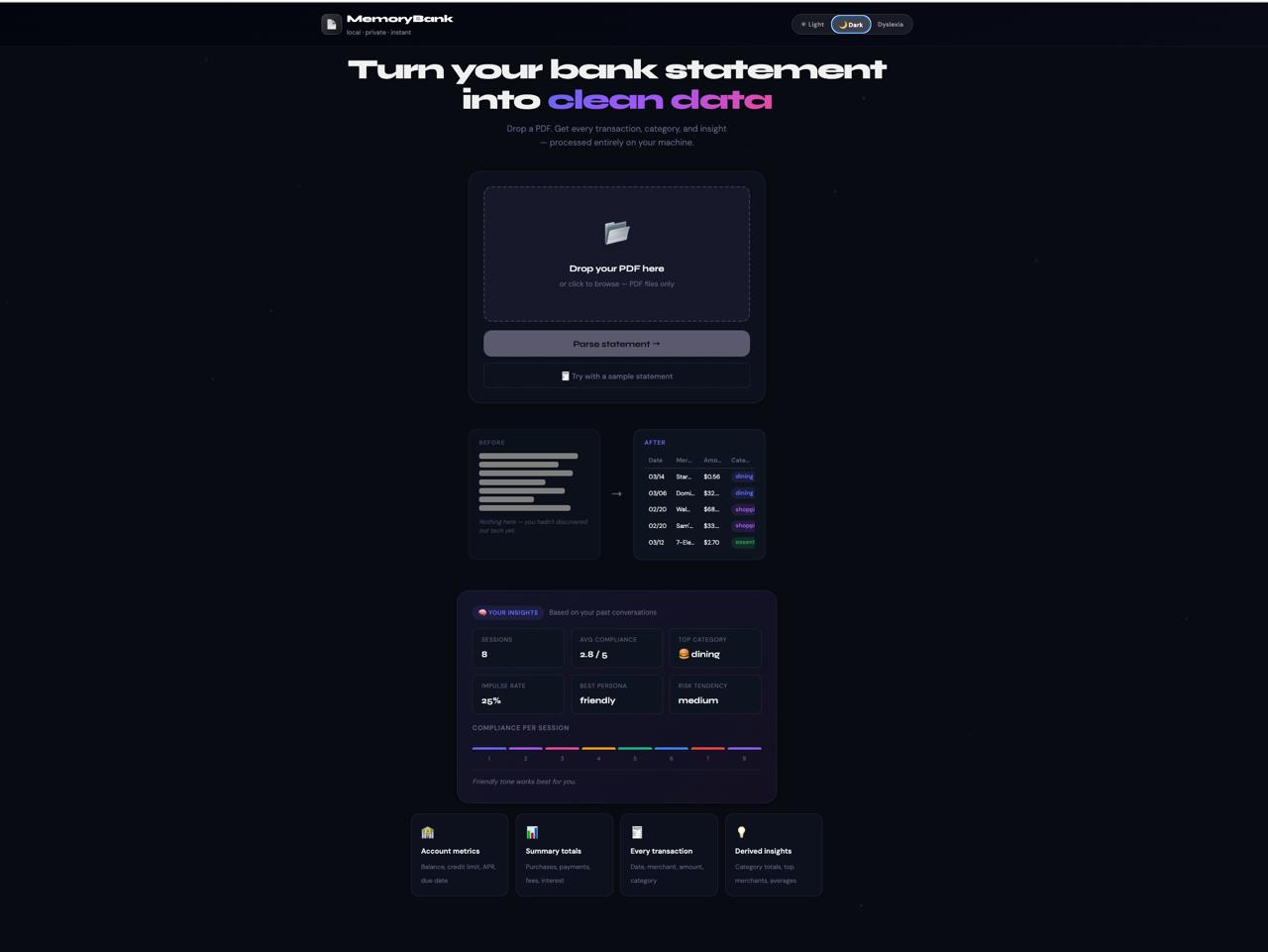
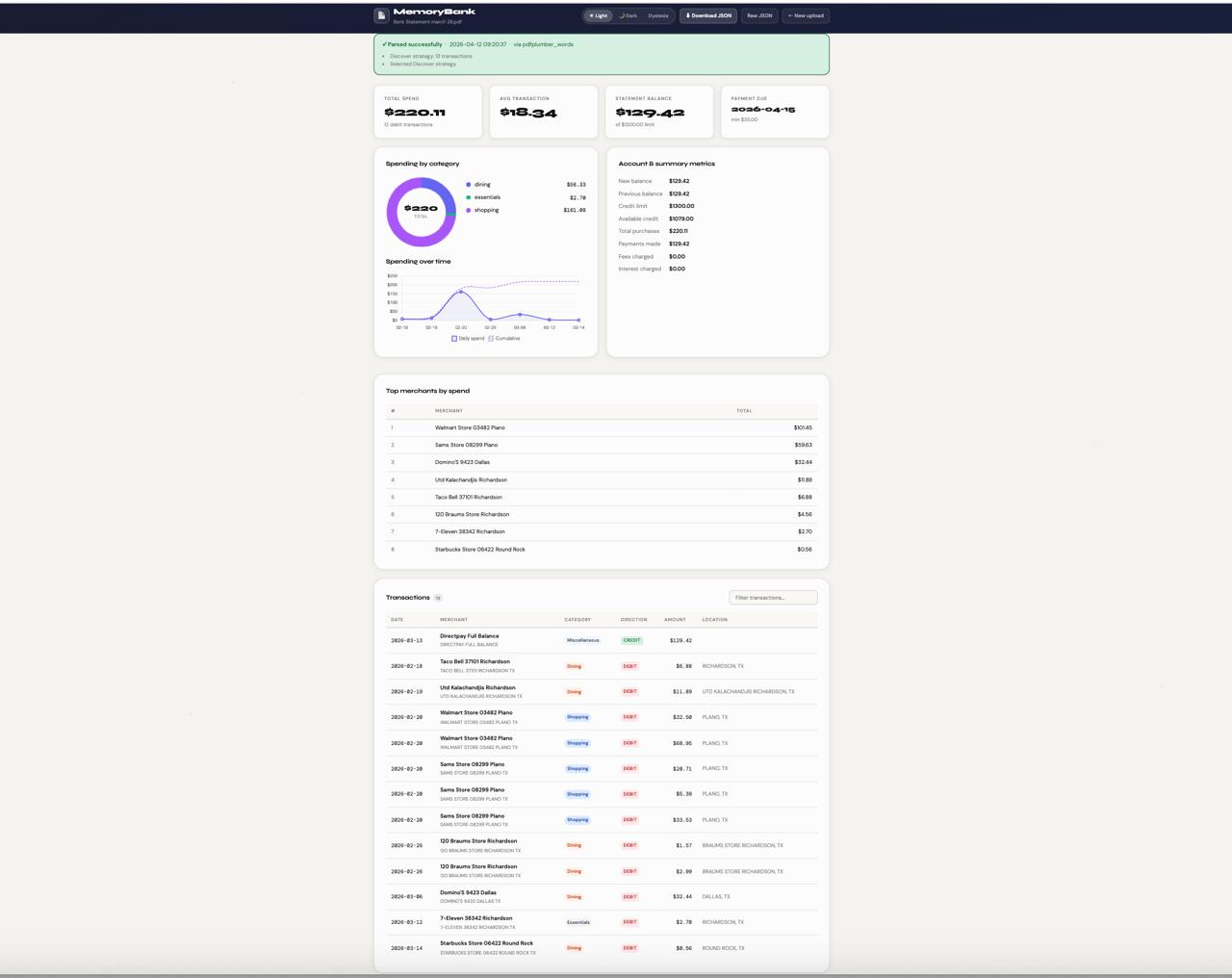
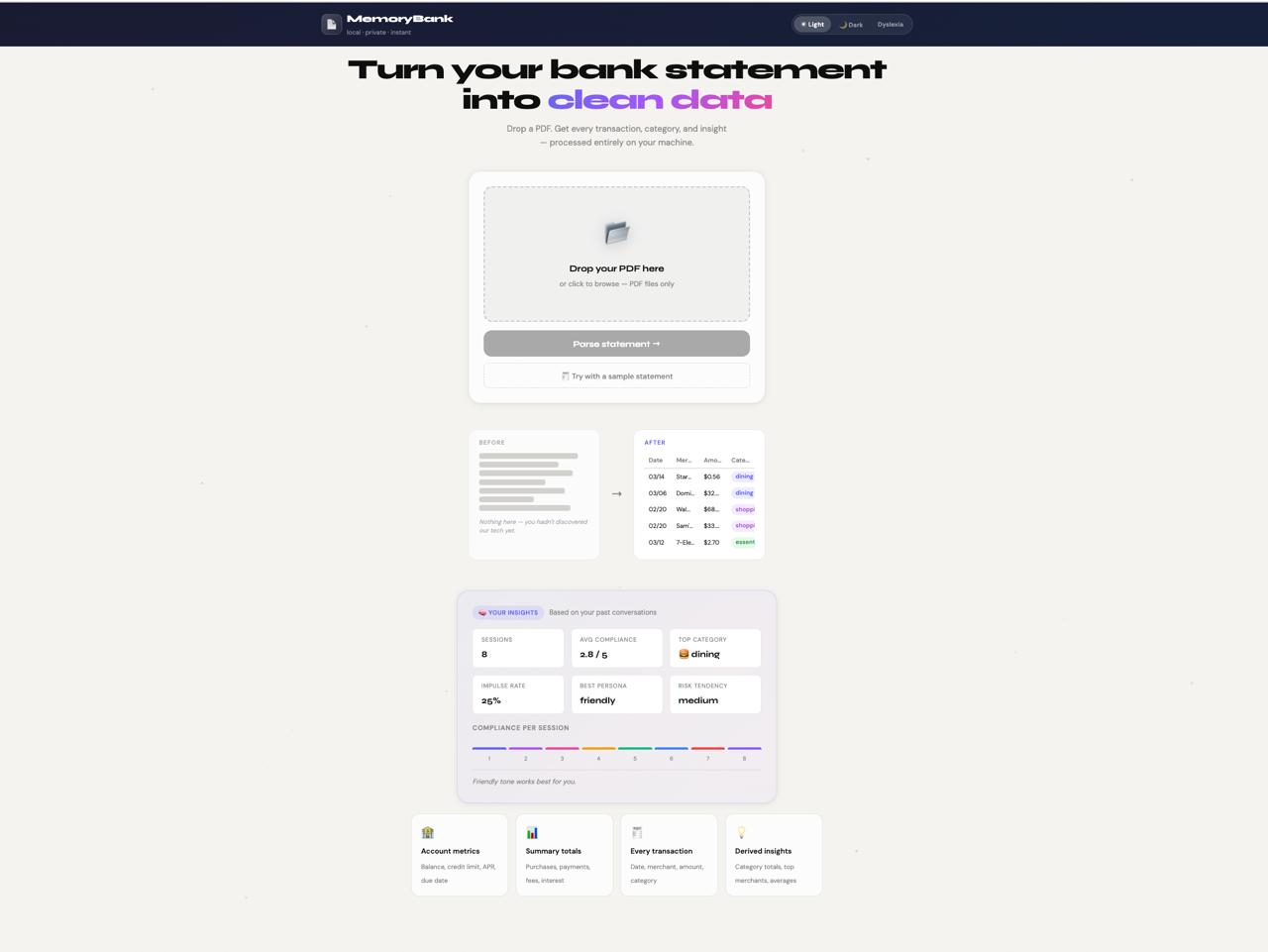
- Upload bank statements (PDFs) to build context
- Get personalized responses tailored to you
The system:
- Parses financial data into structured insights
- Tracks spending patterns and habits
- Remembers previous interactions and decisions
- Responds with context-aware, memory-driven advice
- Evolves with every call
The difference: Instead of "Can I afford this?" our system says "You can... but you've already hit that category 4 times this week."
🛠 How We Built It
We architected a lightweight backend pipeline:
- Data Layer: Bank statement PDFs are parsed into structured JSON (transactions, categories, balances)
- Voice Interface: Twilio handles incoming calls, speech recognition, and audio routing
- Memory & Context: We retrieve relevant financial history and behavioral patterns from stored profiles
- AI Brain: Google Gemini API generates conversational, context-aware responses with custom prompts for natural speech
- Voice Synthesis: Inworld TTS converts AI responses to expressive speech with emotional tags (pauses, emphasis, tone)
- Learning Loop: Post-call analysis extracts behavioral signals and updates memory for future interactions
Tech Stack:
- Flask (Python backend)
- Twilio (voice calls + speech recognition)
- Google Generative AI (Gemini)
- Inworld TTS (expressive text-to-speech)
- JSON-based memory storage
This creates a closed loop where the system becomes more personalized with every call.
🚧 Challenges We Ran Into
TTS Flexibility: We initially tried multiple text-to-speech solutions to support different personalities. We landed on Inworld TTS for its expressiveness and emotional tag support, allowing responses to sound natural and contextual.
Memory Architecture: Building true memory wasn't just storing data — we had to design a system that retrieves relevant historical context and integrates it into real-time conversations at scale. Structuring data for Gemini to reason over both current financials and past user behavior was non-trivial.
Real-time Conversation Flow: Managing multi-turn voice interactions with Twilio introduced complexity. Speech recognition inconsistencies, handling silence gracefully, and maintaining conversational rhythm required careful TwiML tuning and timeout management.
Context Quality: The AI's usefulness depends entirely on structured, relevant context. We spent significant time on parsing accuracy and contextual retrieval so Gemini could generate intelligent (not generic) responses.
Voice Naturalness: Making responses sound like talking to a friend - not a bot reading a script - required extensive prompt engineering to encourage short, natural language with emotional tags.
🏆 Accomplishments We're Proud Of
- Built a true memory-driven financial agent, not just a chatbot
- Achieved end-to-end voice integration with real-time processing
- Created a system that actually learns from behavior and uses it in reasoning
- Designed conversational AI that sounds natural, sassy, and helpful
- Successfully integrated parsing, behavioral tracking, memory, and real-time voice
📚 What We Learned
- Memory is the hardest part: Raw data isn't intelligence. Structuring context for AI reasoning takes the most engineering effort.
- Constraints breed creativity: Working within hackathon time limits forced us to pick the right tech stack and avoid over-engineering.
- Voice is hard: Real-time speech, natural pauses, and conversational rhythm matter way more than written interaction.
- Behavior > balance: Knowing your spending patterns is 10x more useful than just knowing your account balance.
- Prompt engineering is everything: Getting the AI to sound natural, concise, and personalized required extensive iteration on instructions.
🚀 What's Next
- Real-time budget alerts based on category thresholds
- Advanced behavioral scoring models
- Multi-user household financial coordination
- Transaction categorization improvements and auto-learning


Log in or sign up for Devpost to join the conversation.