-
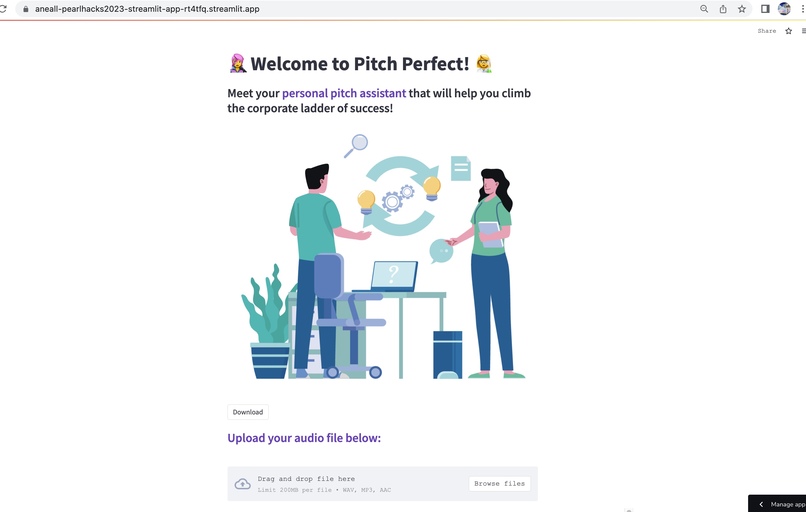
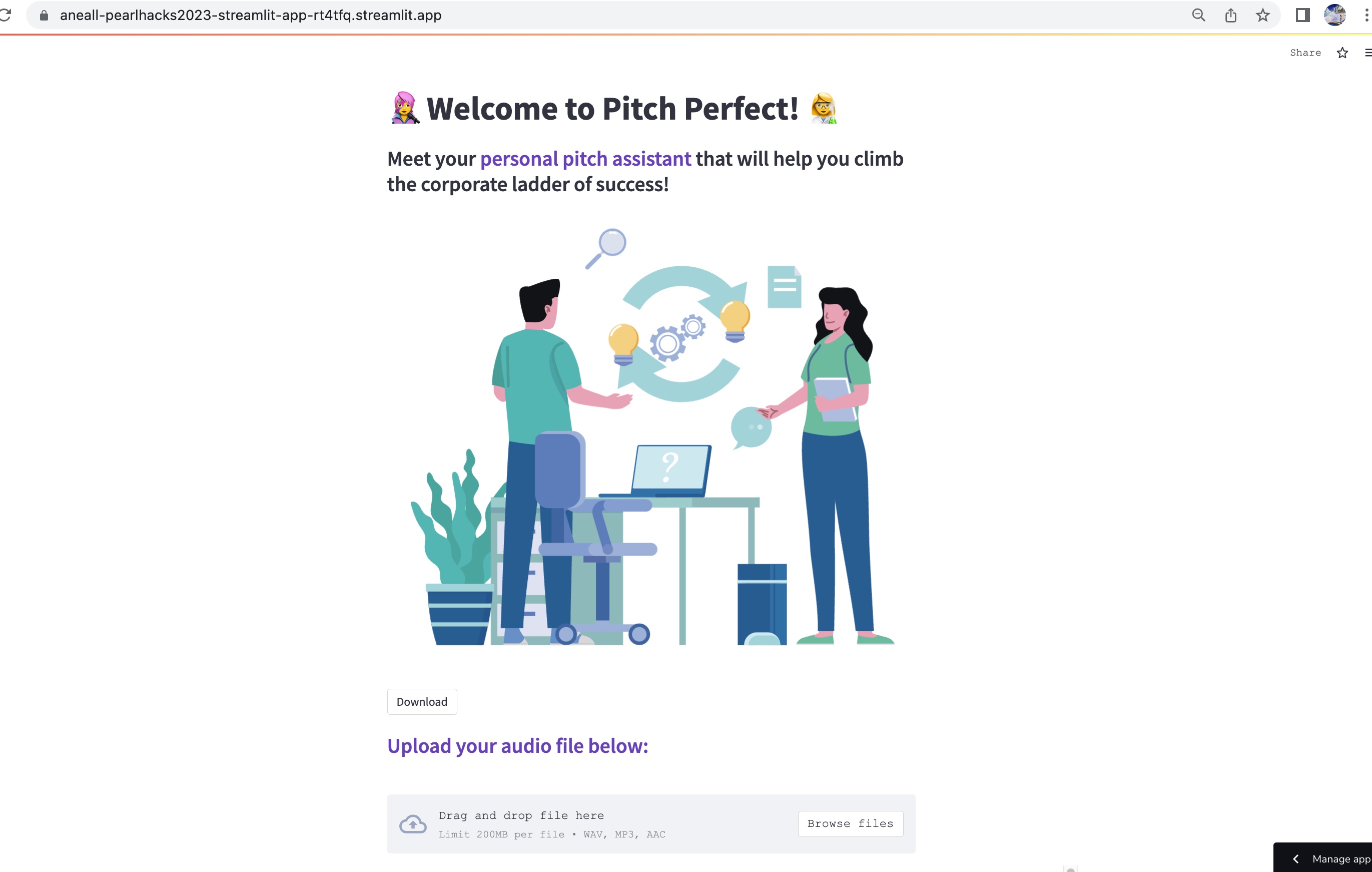
Current web-based application
-
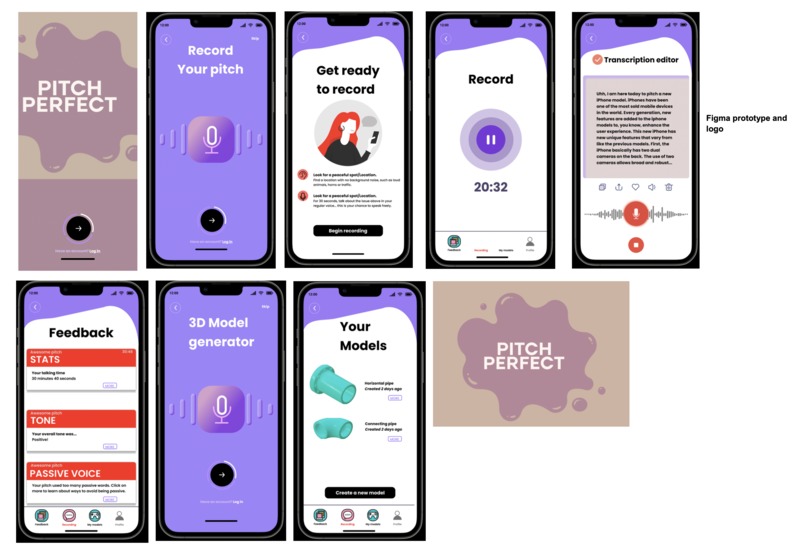
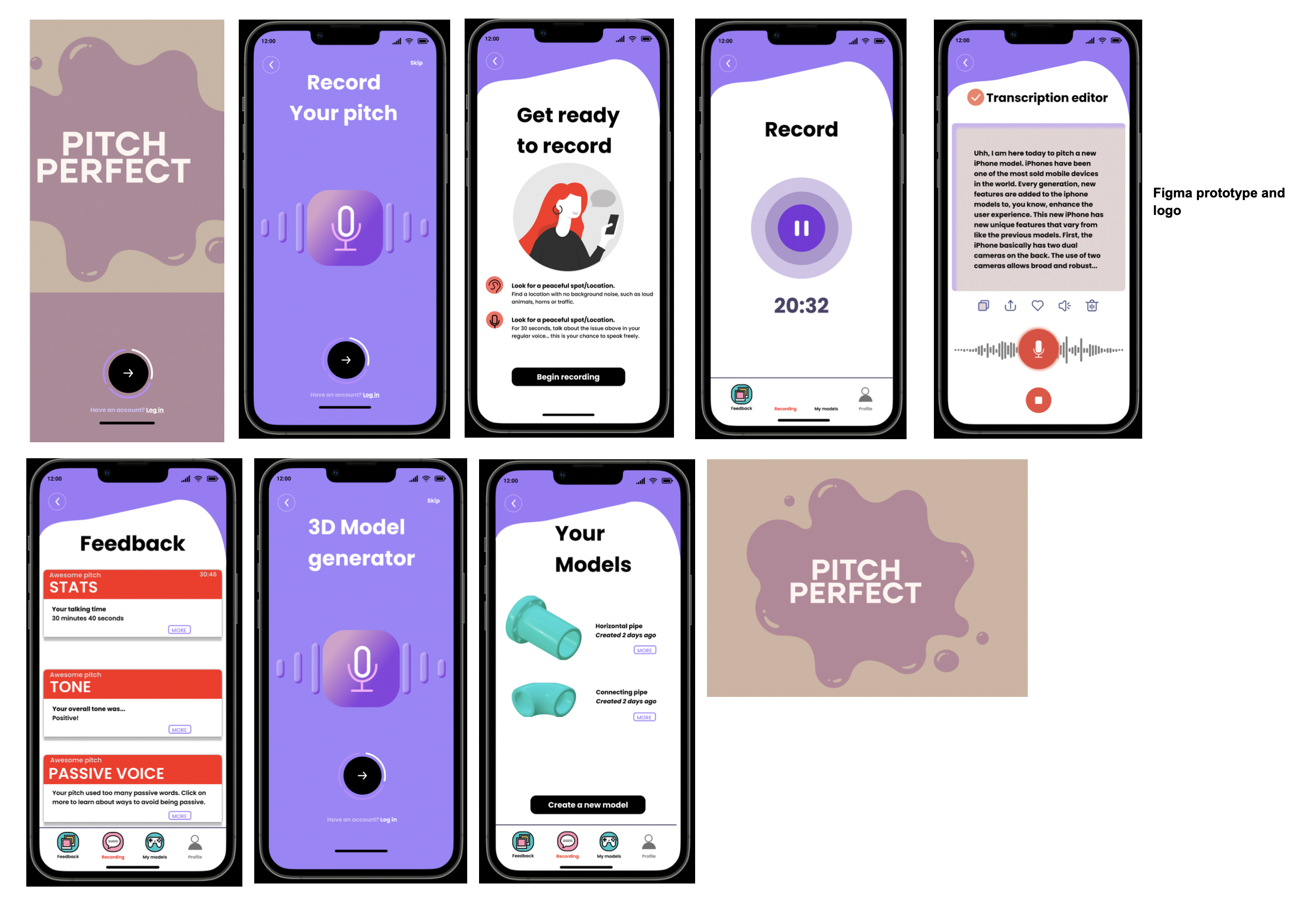
Figma for phase 2 (future iterations)
💥- How it all started
Most women and people of underrepresented gender minorities in the corporate world live under a glass ceiling. We have to work twice as hard to prove our worth-- our capabilities are put on trial at every turn. And let's be real… It’s hard to thrive in a workplace where you feel like an imposter. As women in STEM, we have all come across the debilitating fear of not being good enough, which is why we built Pitch Perfect. Pitch Perfect is a web app that allows you to practice your pitching and negotiation skills by providing dynamic, real-time feedback to improve it. Be it an important presentation, or quite literally pitching a crazy new idea, our app helps you climb the corporate ladder of success.
📖- What it does
The intention of Pitch Perfect is to make you a more confident and efficient presenter. Here is how we do that:
Record your pitch as a mp3 or wav file of up to 200 MB
Upload the file to Pitch Perfect
Get a semantic analysis of your recording to determine possible areas of improvement.
- Pitches are graded on their overall tone connotation (positive, negative or neutral), passiveness, speaker confidence (measured by lack of filler words) and formality.
- Bonus! Visual aids are known to make presentations more engaging. As a bonus feature, we incorporated Natural Language Processing based 3D models in our app.
- Hard to visualize? If you are doing a case study on the iPhone, say the word (iPhone) and PitchPerfect would generate a 3D model that matches your input!
- Phase two of the project will be about expanding this particular functionality.
And that’s it! You are one step closer to breaking that glass ceiling!
🔧 - How we built it
To build this software, we used the following programs:
Streamlit: To have your frontend and integrate it with our database Python: This was the backbone of our frontend and database construction for semantic analysis
- HTML and A-Frame (a JavaScript API for webXR): To get the 3D rendering up and running
- vaderSentiment-- This was the sentiment analysis tool that we used
- Figma: We used Figma to prototype what we call Phase 2 for this project.
Challenges we ran into
We ran into a few taxing challenges we had to overcome to have a MVP.
Integrating NLTK with Streamlit. The initial plan was to use NLTK for sentiment analysis. The audio input would be converted to text, which would then be tokenized so that it can be assigned meaning more easily. However, we ran into a few rogue python packages that could not validate our requests. The workaround was to use vaderSentiment instead, which served the exact same purpose.
Coming up with criterions to measure somebody’s tone We will be honest-- this project was partly an exploration of English and its grammatical structures. To measure somebody’s tone (how passive it is, for example), we had to create a dictionary of words that pertain to that tone. We sadly spent a great deal of time on PurdueOwl. If tested on the SAT now, we would all score 800s on EBRW.
Accomplishments that we're proud of
- Have an operational frontend and MVP demo that can be tried by the viewing public
- Have a robust Python algorithm that allows women and other underrepresented gender minorities in the corporate world to become more deliberate speakers.
- Gain familiarity with a platform (Streamlit) that we had not utilized before in a short period of time
- Pulling an all-nighter.
What we learned
Teju: PearlHacks 2023 was my very first hackathon, so it is safe to say that I learned a LOT over the past 24 hours. With the help of my teammates, I discovered many new technologies that have various functionalities such as streamlit, A-Frame, three.js, and more. It was eye-opening to be able to import all these different platforms onto our text editor to utilize their functionalities in innovative ways. This project required knowledge on many different topics such as front end, back end, graphic design, and even english language conventions. Being able to step foot inside each of these topics, and more, was astonishing for me.
Anika: This was my first time working with backend, and it was really exciting! Also my first in-person hackathon. I'm very interested in NLP so this project allowed me to explore that further and learn about whether it is something I would want to pursue in the future.
Ashley: Although I've already picked up a lot of skills through previous hackathons, working on PitchPerfect at PearlHacks led me to learn more about natural language processing and how I can code in Python while simultaneously creating UI elements – without needing to write code in HTML and CSS. I also learned how easy it is to implement HTML file components into Python code by using the Streamlit framework – which allowed our team to implement custom HTML code with A-Frame (a JavaScript API) into our project for 3D rendering.
What's next for Pitch Perfect
Just like how a great trip has a great itinerary, we envision PitchPerfects's future plans in phases.
PHASE 1: TYING IT ALL TOGETHER
Phase 1 involves the following goals:
- Expanding the types of tones detected as well as the the words associated with those tones.
PHASE 2: THE MOBILE APP
View the gallery to see this. Phase 2 involves the following goals:
- Creating a mobile app for iOS and Android of this service
- Making the recording more dynamic-- instead of taking a file input from the user, the app would let users directly record their pitch.
PHASE 3: THE BIG LEAGUES
Phase 3 involves the following goals:
- Give actual word suggestions to improve the pitch, depending on who the audience is.
- Possibly developing or using something like Dream Fusion that takes in a text input and uses 2D diffusion to render a 3D model based on a sparse set of 2D images. We didn’t have enough processing power to use such a functionality.
Built With
- aframe
- figma
- html
- javascript
- python
- streamlit


Log in or sign up for Devpost to join the conversation.