-
-
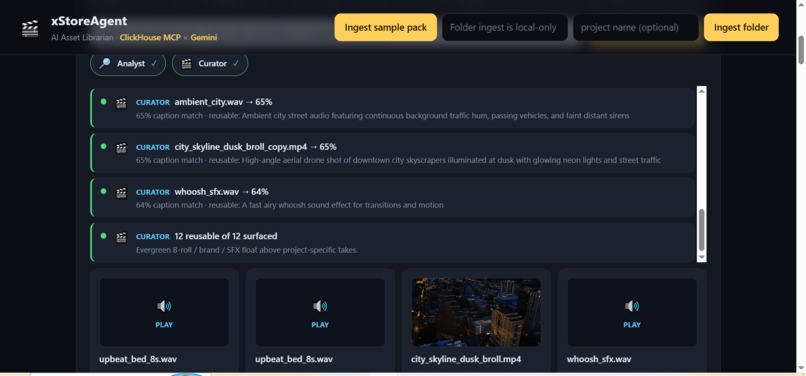
home page
-
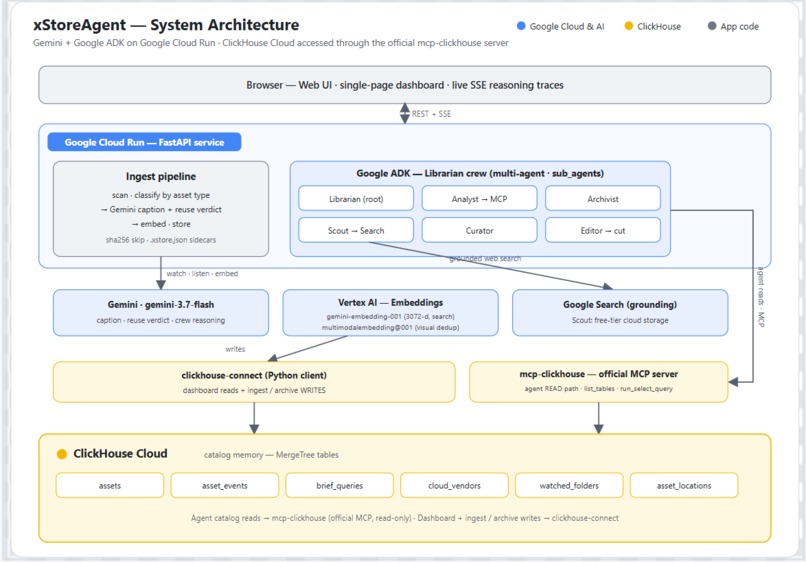
architecture
Inspiration
Every production has a graveyard of drives. B-roll from last year's city shoot, a
logo export in five folders, a whoosh SFX nobody can name, a slate still labeled
IMG_8841. Editors hunt for hours, then the producer pays to reshoot or
re-license something the team already owns — and the studio keeps paying to
store the duplicates.
The hackathon asked for an agent that unblocks a real media workflow, not a chatbot with a film-themed prompt. The bottleneck we kept hearing is not "write me a script." It is memory: the library has no brain. Filenames lie. Folders rot. ClickHouse is built for exactly the questions a production office asks at scale — how much waste, what can we reuse, what should we archive — if an agent is allowed to see the footage and speak SQL through ClickHouse's own MCP server.
xStoreAgent started from that one sentence: give the media library a Librarian.
What it does
xStoreAgent is a multi-agent Librarian for a film/video team's asset library.
Ingest — Gemini watches and listens. Point it at a folder (or click Ingest sample pack on the hosted demo). Gemini watches each video and hears each audio file — from the actual pixels and waveform, not the filename — writes a caption and tags, and issues a reusability verdict (evergreen B-roll vs. project-specific slate / rough cut / VO). ClickHouse Cloud stores the catalog: metadata, a caption embedding for cross-modal search, and a separate visual embedding for near-duplicate detection.
Ask in English. A Librarian orchestrator (Google ADK sub_agents) delegates
to a real crew — and you watch it happen live:
- 🔎 Analyst — every catalog question fires the official
mcp-clickhouseserver (list_tables,run_select_query). Duplicate waste is aGROUP BY content_hash; brief search is acosineDistanceJOIN against a stored brief vector, not a giant SQL literal pasted into the prompt. - 🗄️ Archivist — archives only after you approve. Reversible. Nothing is deleted.
- 🧭 Scout — grounded Google Search for free-tier cloud storage when the library is over plan, then a computed offload plan (reusable footprint × the top provider's free tier = % of overage cleared). Connect MEGA / Drive / Dropbox sync folders, organize a captioned pack, and offload reusable media.
- 🎬 Curator — why a hit belongs in the next cut, in a creator's voice.
- ✂️ Editor — Assemble a cut: an edit-ready storyboard (hook → establish → product → CTA) built from assets you already own, plus honest gaps still to shoot so you don't waste a day on footage you have.
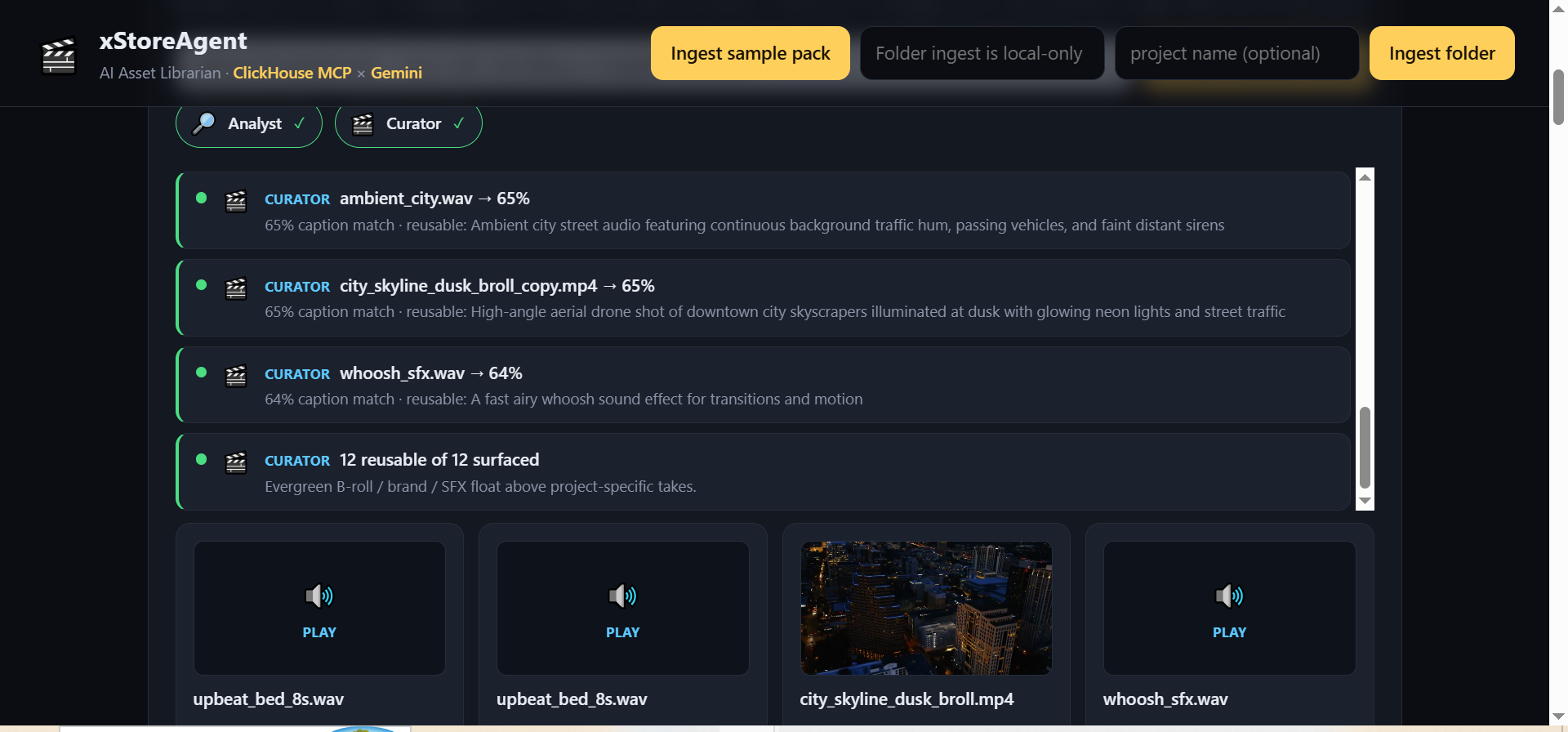
Search. "Surface reusable assets" streams live Analyst + Curator reasoning (embed brief → ClickHouse rank → reuse rationale), then cards with previews.
Memory that compounds. Re-ingesting the same bytes skips Gemini (sha256).
.xstore.json sidecars mean a later ingest of an organized cloud pack is
text-only — no second watch/listen, no wasted credits.
Real numbers. The hosted demo is seeded at production-shaped scale (~5,000 rows, ~1.1 TB, ~10% duplicates), so every impact figure is computed by a ClickHouse query, not mocked in the UI.
How we built it
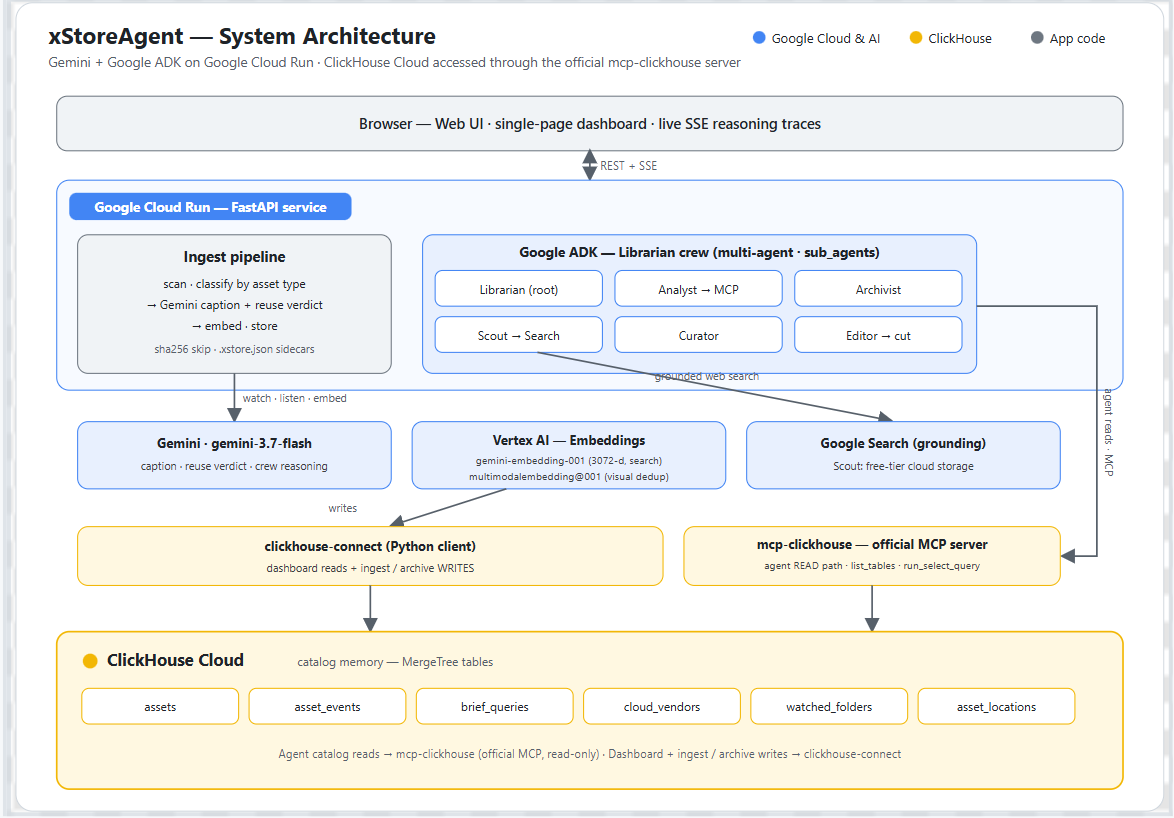
Google Cloud + Gemini. Gemini on Vertex AI — gemini-3.7-flash for the crew
and captions, gemini-embedding-001 (3072-d) for brief/caption search, and
multimodalembedding@001 for visual near-duplicate detection. The Librarian is a
Google ADK root agent with specialist sub_agents, so a hand-off (LLM-routed
transfer, not agent-as-tool) stays on the same event stream a judge can
watch. The whole app runs on Cloud Run.
ClickHouse track (the required partner path). Catalog reads from the agent
go through the official mcp-clickhouse server over stdio
(python -m mcp_clickhouse.main), wired in agent/clickhouse_mcp.py. That is
ClickHouse's own MCP server — not Grafana's, not SQL hidden inside a Python tool.
Dashboard grids and ingest/archive writes use clickhouse-connect because the
official MCP server is read-only; the split is deliberate and documented, and the
Analyst has no catalog-read tool except MCP so it can't bypass it.
Product surface. FastAPI + a single-page dashboard: live ingest crew trace, Librarian chat with delegation and MCP tool chips, reusability-ranked library, cross-modal reusable-asset search, an Assemble storyboard, a reclaim list, and the Storage Scout meter — every agentic path streamed over Server-Sent Events so the reasoning is visible, not hidden. Mixkit/Pexels demo media is trimmed to short 720p clips so Gemini can actually watch them without burning the credit budget.
Challenges we ran into
The partner MCP server is read-only. Track eligibility means "mcp-clickhouse
must fire at runtime," but the server can't INSERT. We kept writes on
clickhouse-connect without letting the Analyst cheat by reading the catalog in
Python — the Analyst has no catalog-read tool except MCP.
ADK delegation vs. "agent-as-tool." Tool-wrapped sub-agents hide their MCP
calls. Switching to sub_agents transfer keeps list_tables / run_select_query
on the same event stream, so the golden prompt is honest on camera.
The modality gap. Raw image/video embeddings ranked poorly against a text brief. We embed Gemini's captions for search (one text space for all modalities) and keep visual embeddings only for dedup — dramatically better relevance.
Video is the bill. Watching every clip costs credits. We cap inline media, skip known content hashes, write sidecars for text-only re-ingest, and seed ~5k analytics rows without embeddings so waste queries run at TB scale without recaptioning a whole archive.
EventSource vs. HTTP 400. Folder ingest used to fail as JSON and the UI only
showed "connection closed." Missing folders now stream as SSE errors, and a
successful ingest no longer gets clobbered by onerror.
Cloud Run can't see C:\. "Connect MEGA/Drive" is a local sync folder,
not OAuth from the container. The hosted UI is honest about that limit; the
Librarian and the full MCP path still run entirely on Cloud Run.
A meter that told the truth. Seeded at ~1.1 TB against an old 15 GB plan, the storage bar pinned at an absurd 7,405%. We moved to a realistic 1 TB tier and made the Scout emit a genuine offload plan that quantifies how much of the overage a free provider tier actually clears.
Accomplishments that we're proud of
- A complete product, not a notebook: ingest → memory → English Q&A → reuse search → assemble a cut → reclaim — with live reasoning traces on every agentic path.
- ClickHouse track eligibility visible on screen: Librarian → Analyst
delegation, then real MCP SQL (
GROUP BY content_hash,cosineDistance) — not a screenshot of a grid./api/healthprovesmcp.ok. - Gemini that watches and hears the sample clips; captions describe on-screen motion, not the filename.
- Human-gated archive — the agent never deletes on its own.
- Memory that compounds: hash + sidecars so the library gets smarter without paying to re-watch.
- Impact computed at scale — reclaimable GB and offload plans from real queries over ~1.1 TB of seeded catalog, not hard-coded UI numbers.
- A tight 3-minute story that maps onto all four judging axes (see
demo/SCRIPT.md).
What we learned
An agent for media is only as good as what it is allowed to see and query. Filenames are a lie; Gemini on the pixels and the waveform is the difference between a search box and a Librarian.
And "we use ClickHouse" is not a track submission — mcp-clickhouse has to fire
inside the agent loop, with list_tables visible, or Stage One can fail you in
thirty seconds. We learned to separate product reads (fast dashboard SQL) from
agent reads (official MCP), and to store brief vectors in a table so cosine
search is a JOIN instead of pasting a 3072-float literal into a prompt.
Finally: honesty reads better than theatre. Streaming the real pipeline as agent reasoning — including the gaps it still can't fill — is more convincing than a scripted demo.
What's next for xStoreAgent
- OAuth / official APIs for Drive, Dropbox, and MEGA so Cloud Run can offload without a desktop sync folder.
- Background watchers on connected folders (hash + sidecar only — no re-watching).
- Restore-from-cloud straight into an edit when the Editor's brief needs an offloaded shot.
- Per-show libraries and role-based archive rights for a real post house.
- Keep the ClickHouse Cloud service extended through the judging window so the hosted URL stays queryable.
Built for the crews who already shot the footage — they just can't find it.
Log in or sign up for Devpost to join the conversation.