Inspiration
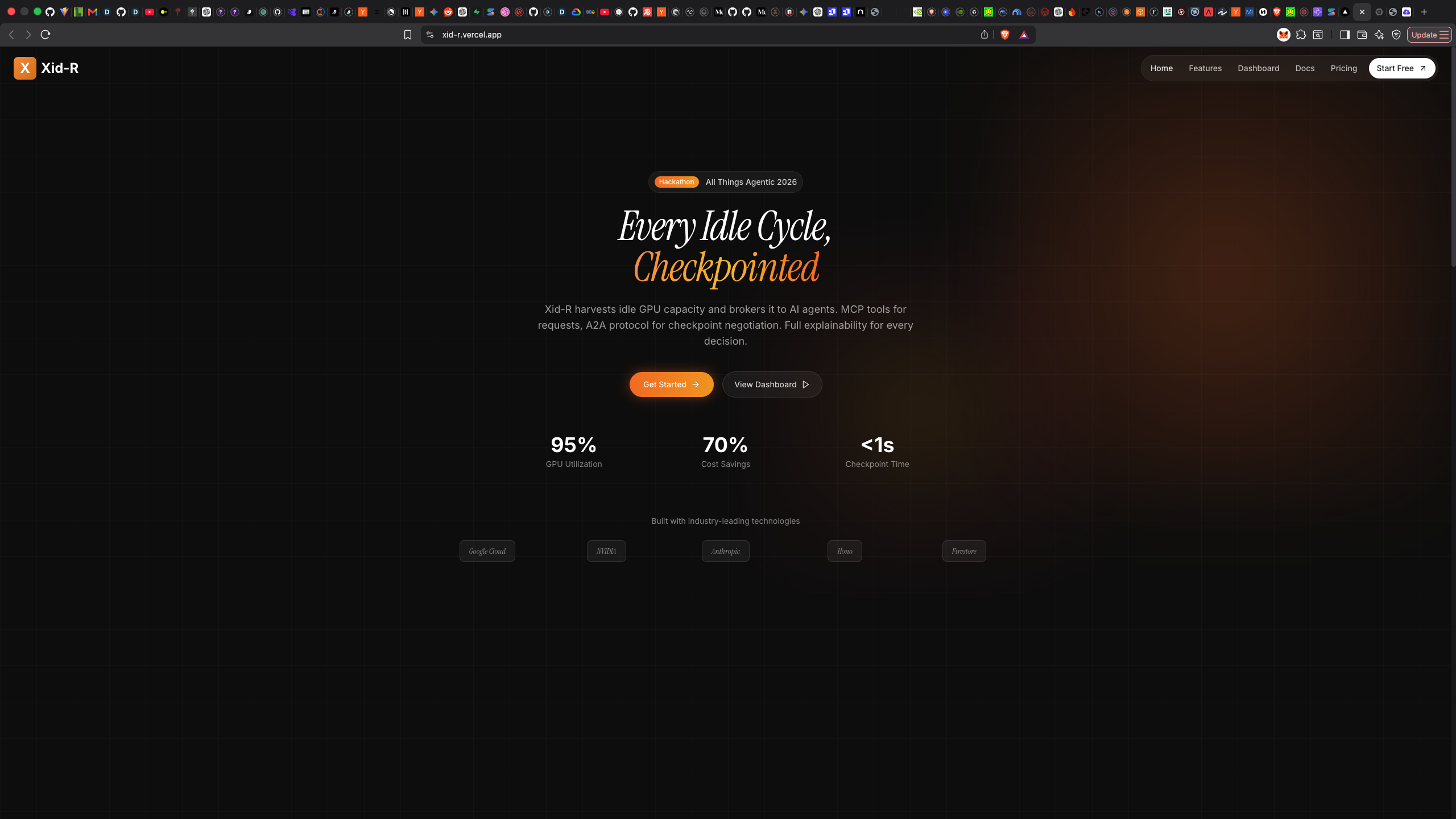
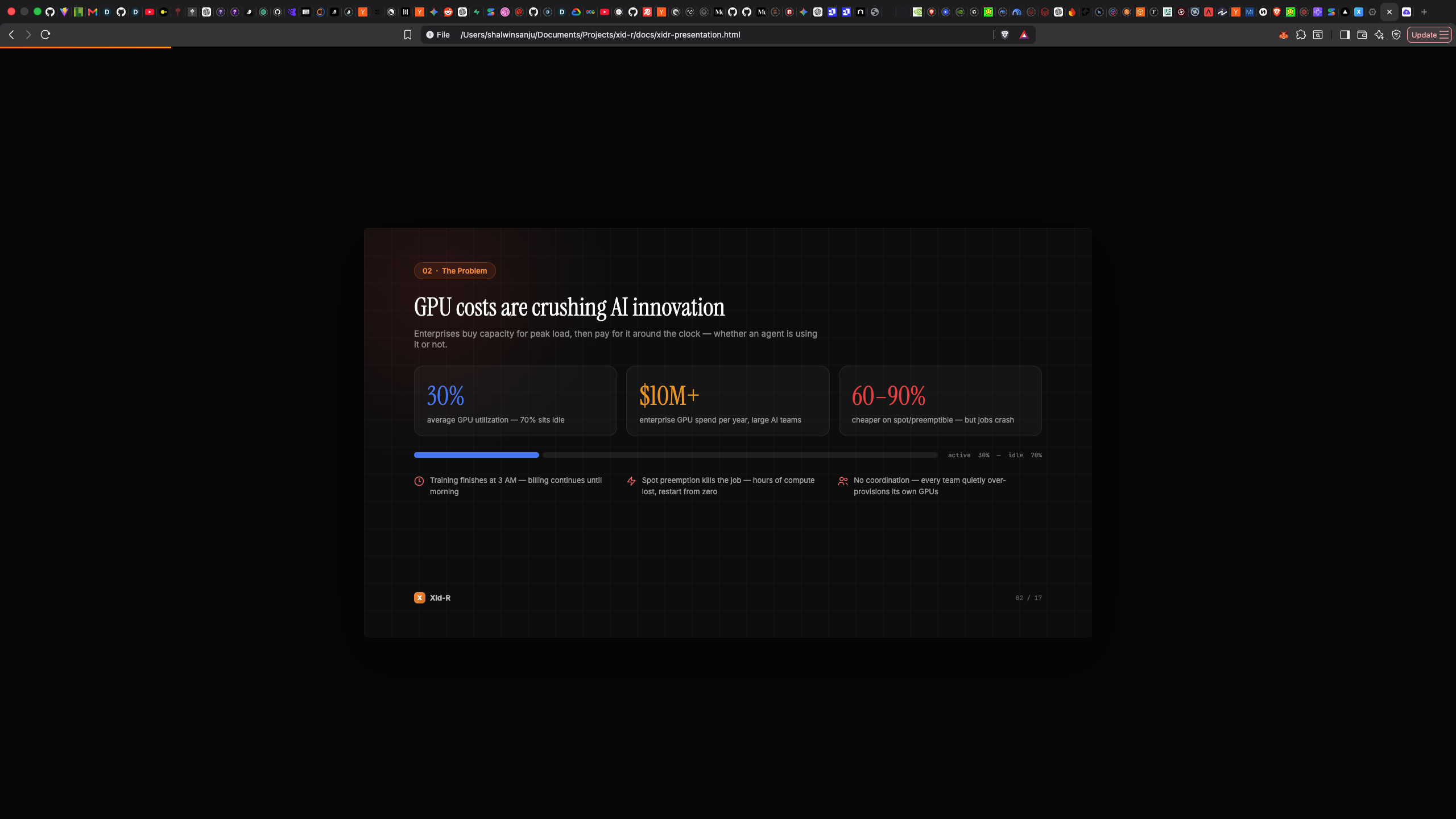
The AI revolution has a hidden cost crisis. According to Cast AI's 2024 Kubernetes report, enterprise GPU utilization averages just 30% — meaning 70% of expensive GPU capacity sits idle. Companies are paying millions for GPUs that finish training jobs at 3 AM and sit dormant until morning.
We asked ourselves: What if AI agents could negotiate for GPU resources, just like they negotiate everything else?
The rise of agentic AI — autonomous agents that can plan, reason, and take actions — presented a unique opportunity. These agents need compute on-demand, but traditional infrastructure doesn't speak their language. We envisioned a world where agents could autonomously request GPUs, gracefully handle preemption, and checkpoint their state — all without human intervention.
That's how Xid-R was born: The Agentic GPU Broker.
What it does
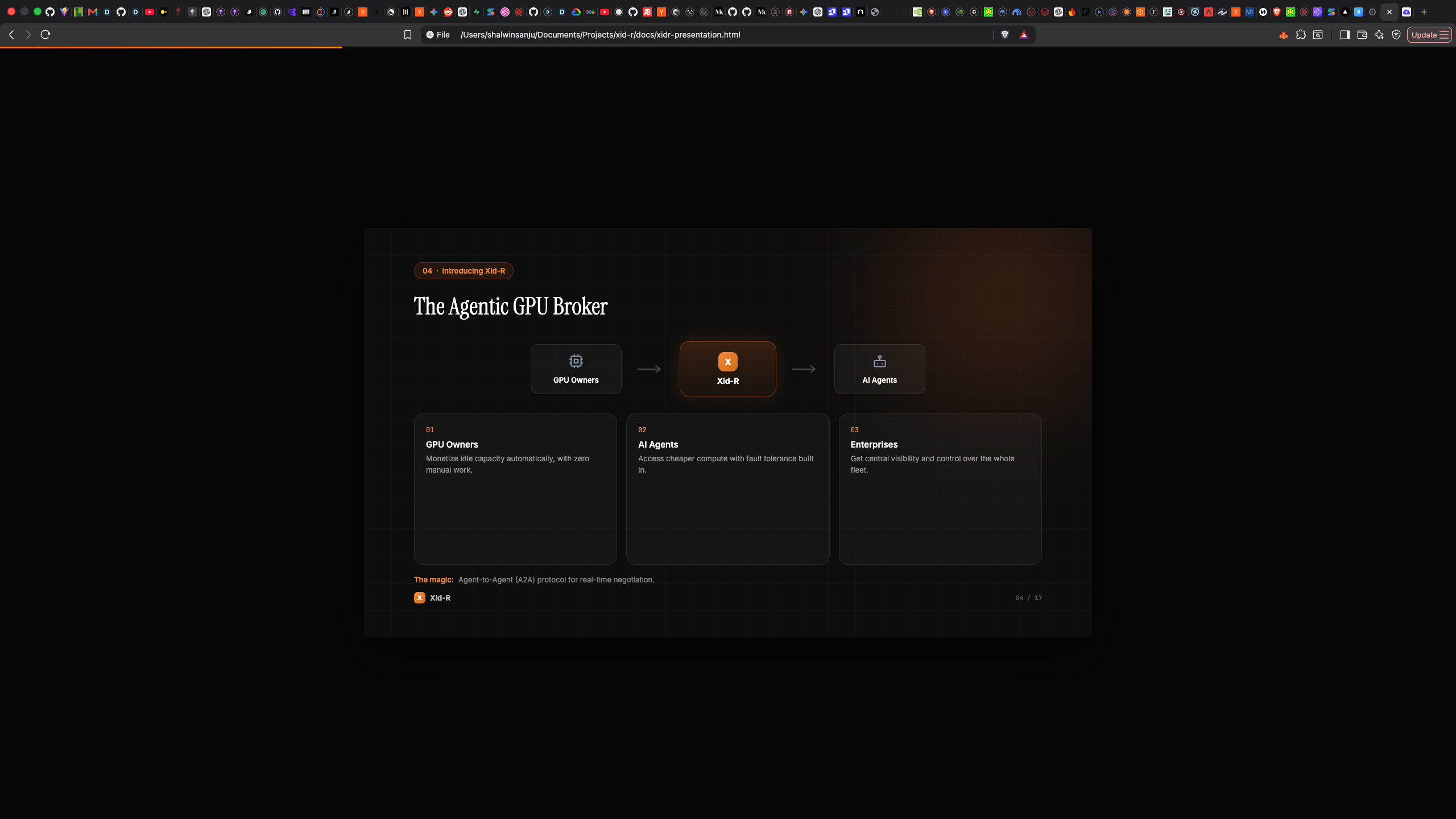
Xid-R creates a real-time infrastructure where:
- GPU Owners register idle capacity that can be harvested
- AI Agents request GPUs via MCP (Model Context Protocol) tools
- The Control Plane matches requests to available capacity using intelligent scheduling
- A2A Protocol enables graceful preemption negotiation between the broker and tenant agents
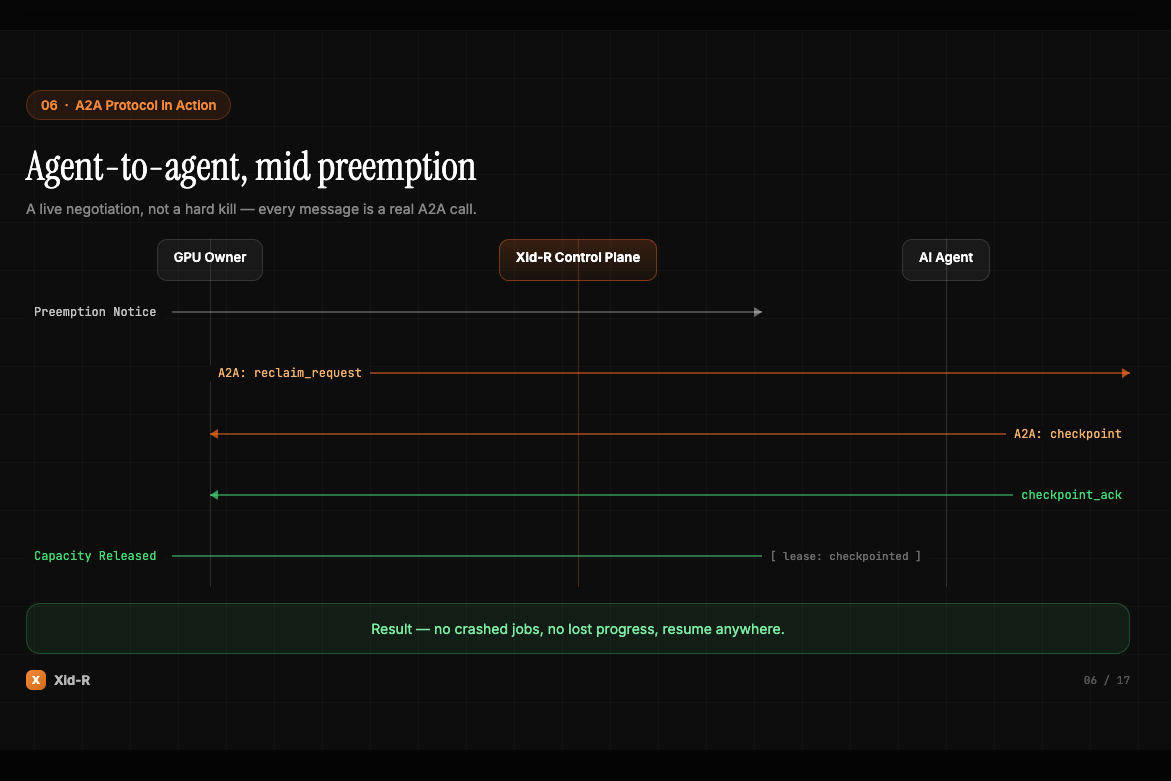
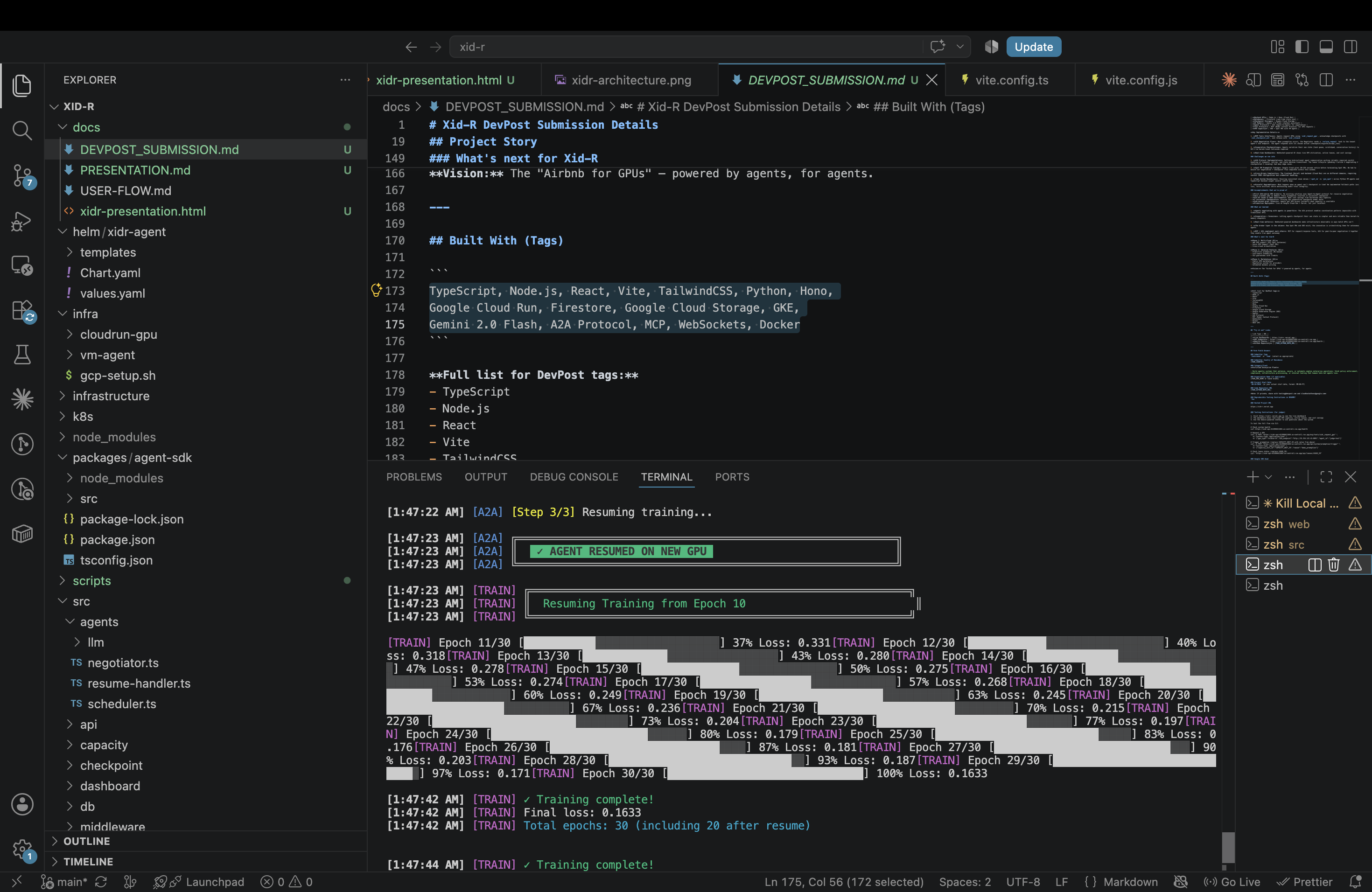
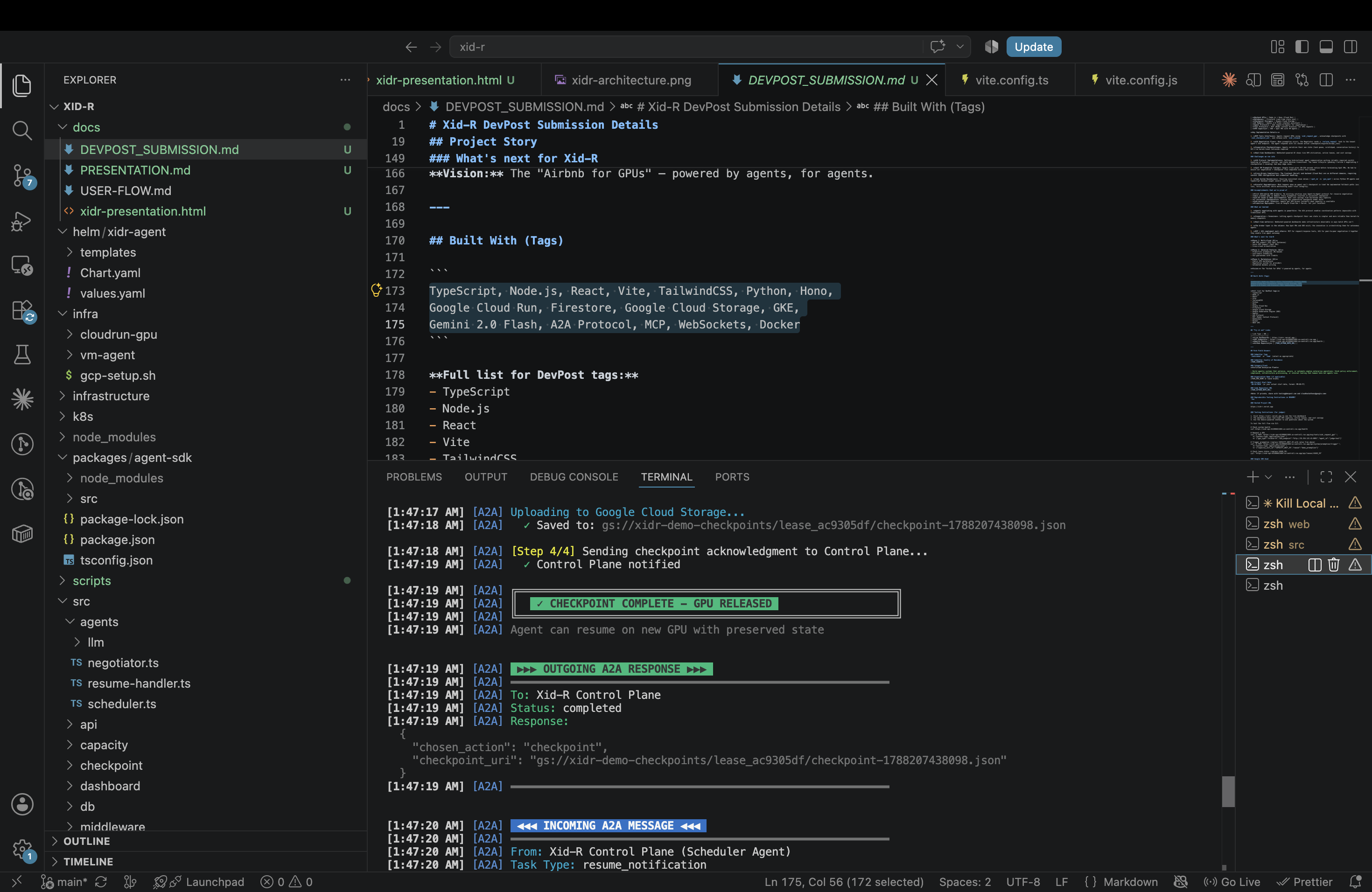
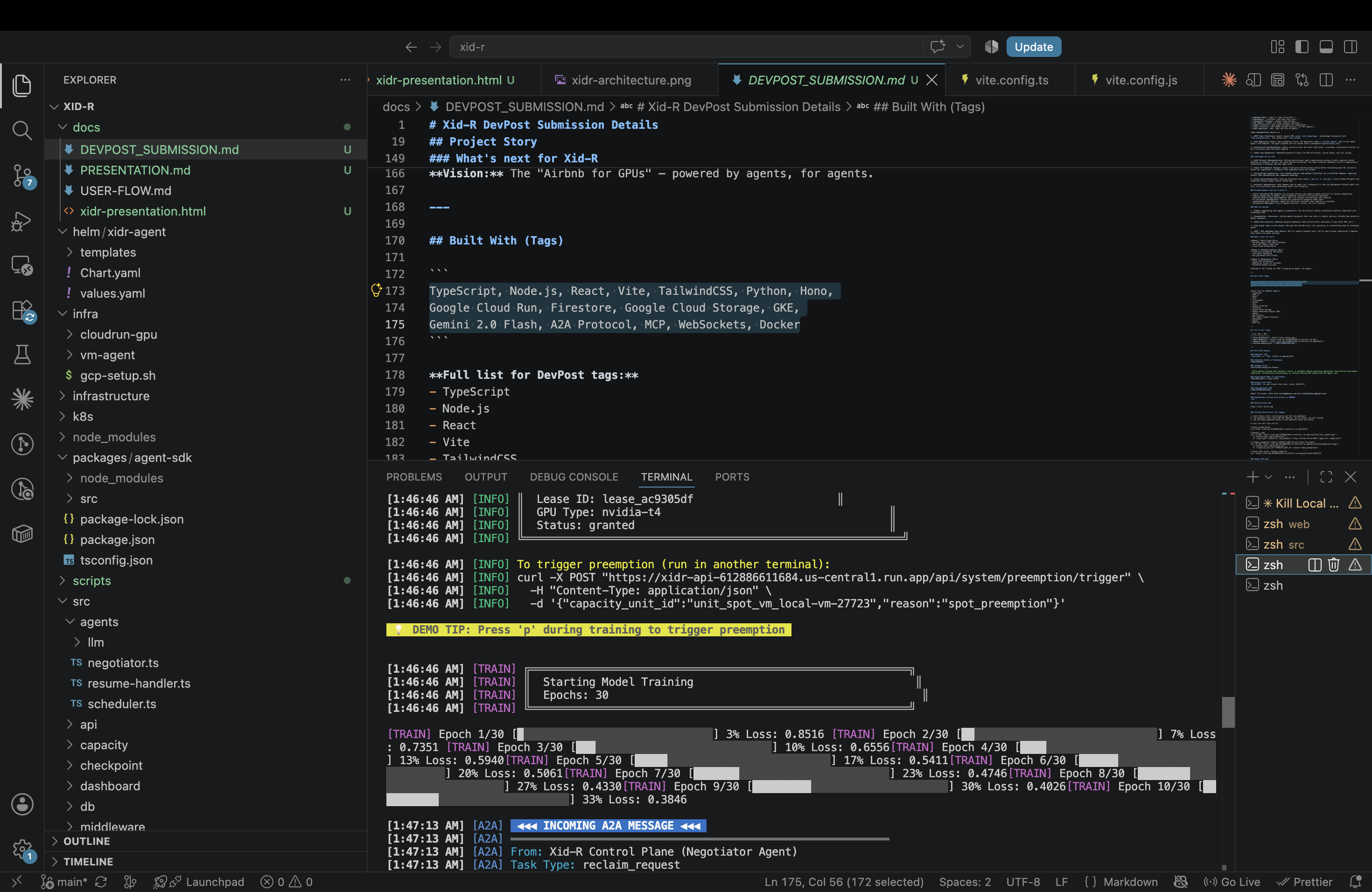
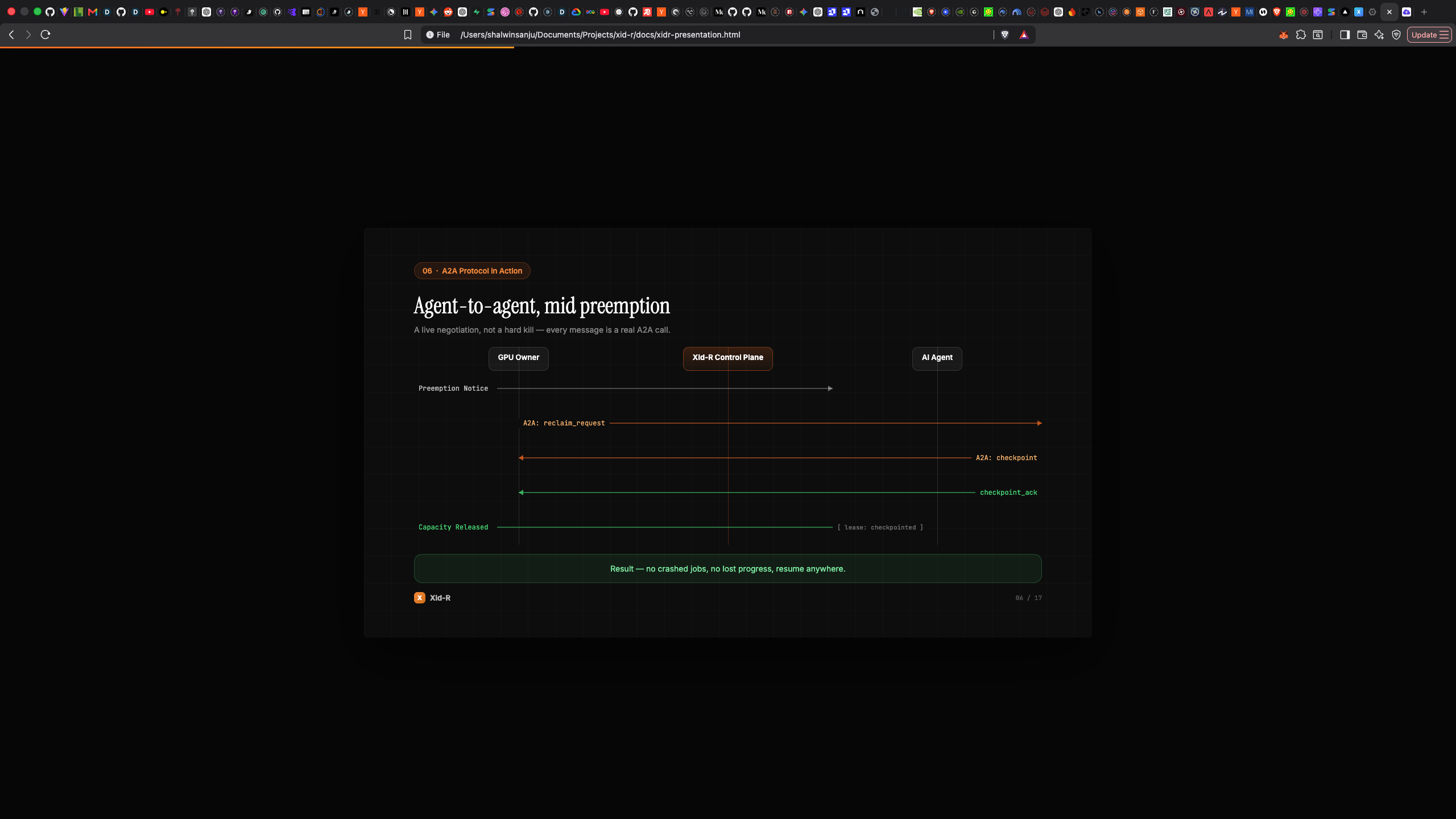
The Magic Moment: When a GPU needs to be reclaimed (e.g., Spot VM preemption), Xid-R doesn't just kill the workload. Instead, it initiates an Agent-to-Agent negotiation:
[Control Plane] → "I need this GPU back in 120 seconds"
[Tenant Agent]  → "Let me checkpoint my state first"
[Control Plane] → "Acknowledged, proceed"
[Tenant Agent]  → "Checkpoint saved to gs://..., releasing GPU"
[Control Plane] → "Capacity reclaimed, resume queued"
Result: Zero crashed jobs. Zero lost progress. Seamless resume on new capacity.
How we built it
Architecture:

A2A Protocol - Agent Negotiation Flow

Tech Stack:
| Layer | Technology |
|---|---|
| Frontend | React + Vite + TailwindCSS (Vercel) |
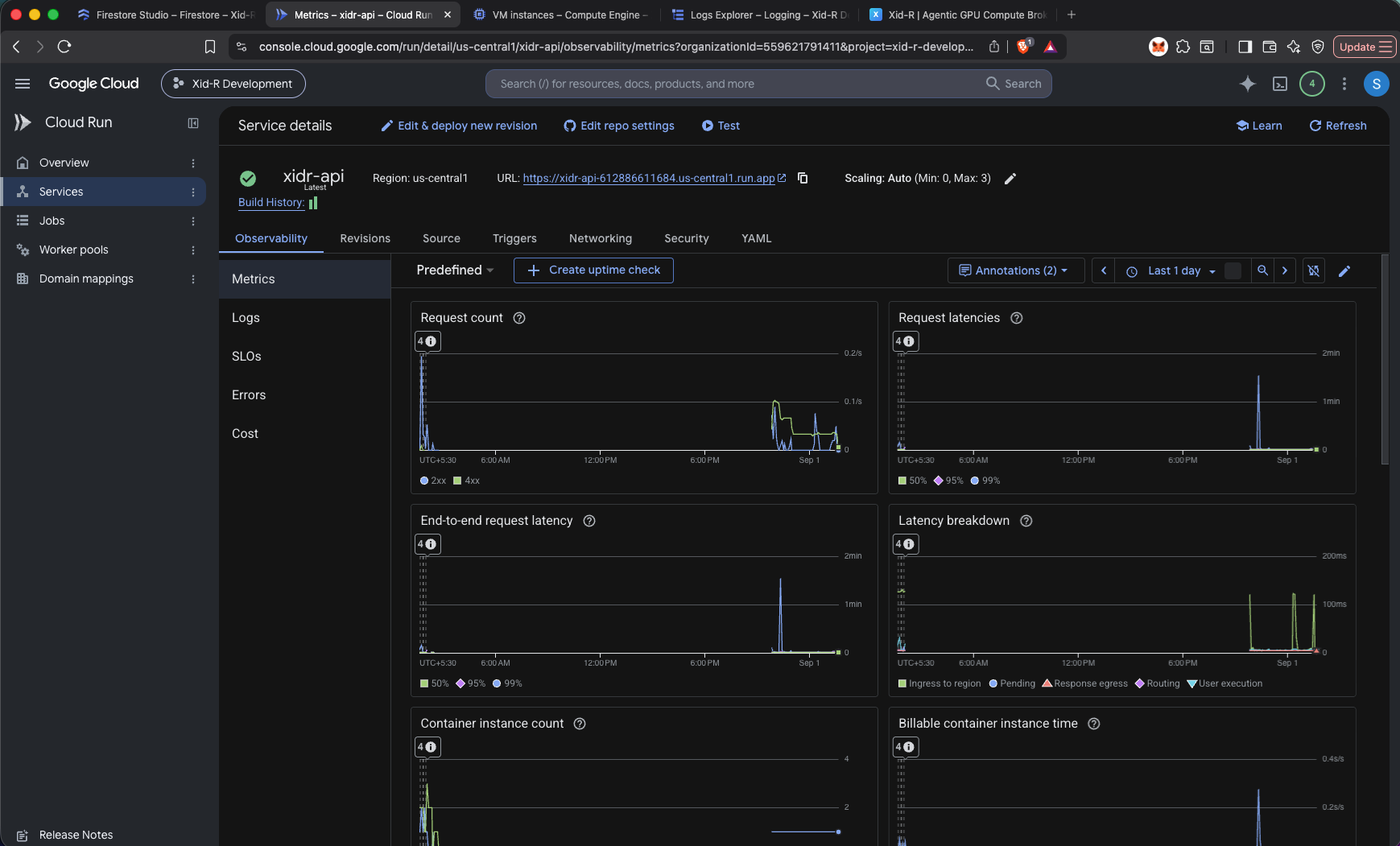
| Backend API | Node.js + Hono (Cloud Run) |
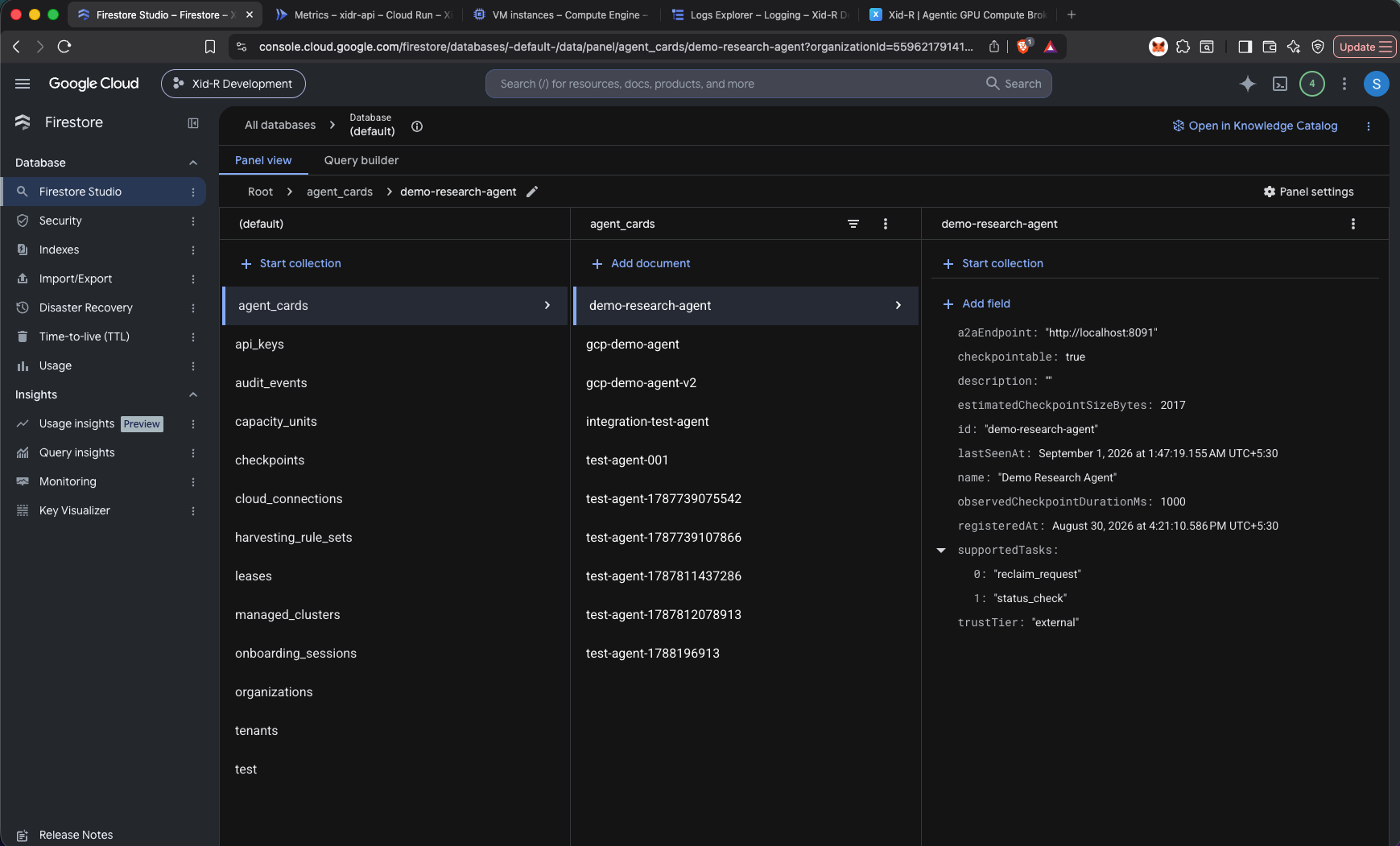
| Database | Firestore (real-time state sync) |
| Checkpoint Storage | Google Cloud Storage |
| AI Model | Gemini 3.5 (chatbot assistant) |
| Agent Protocol | A2A (Agent-to-Agent) for negotiation |
| Tool Protocol | MCP (Model Context Protocol) for GPU requests |
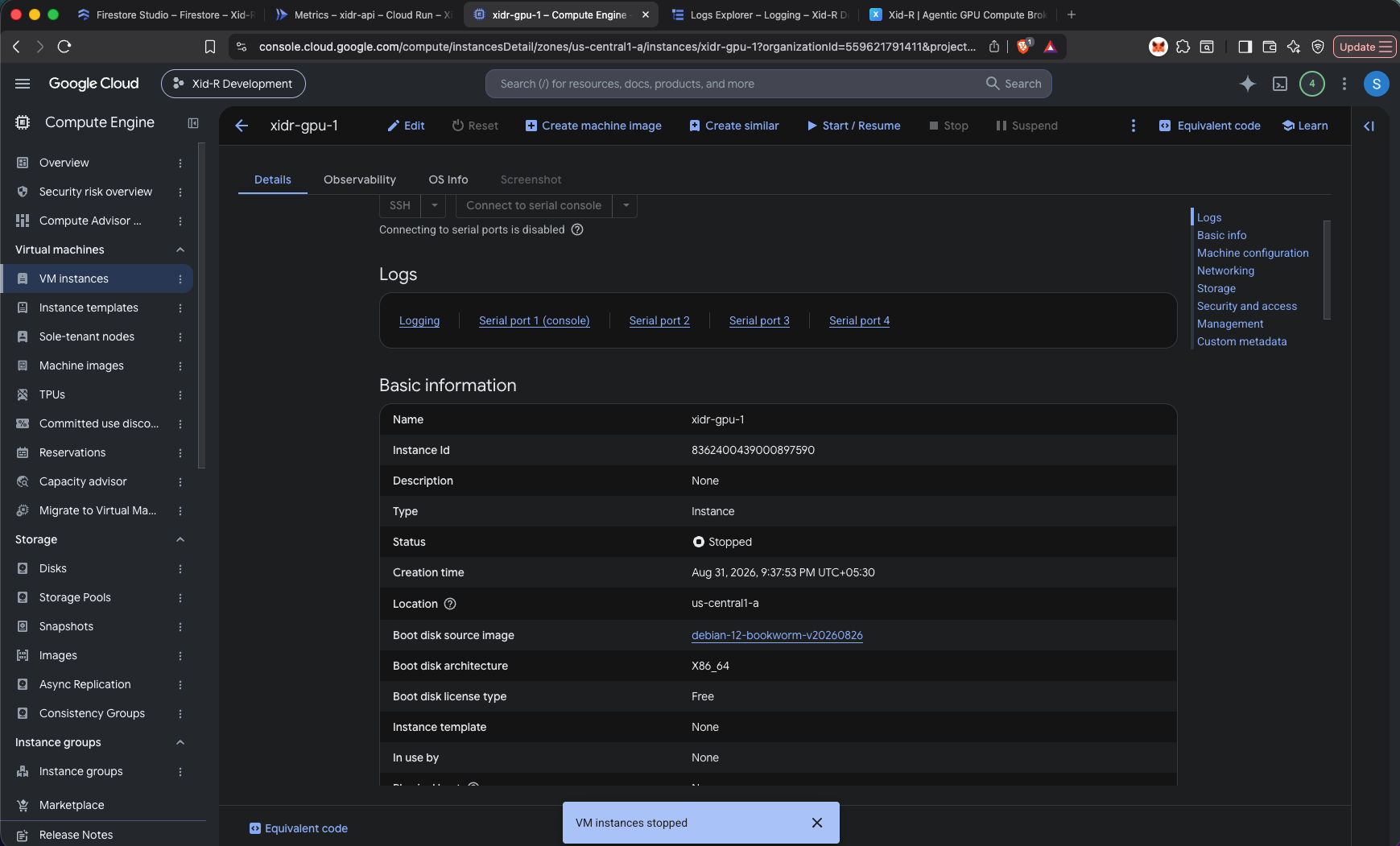
| GPU Capacity | GKE + Spot VMs with VM Agents |
Key Implementation Details:
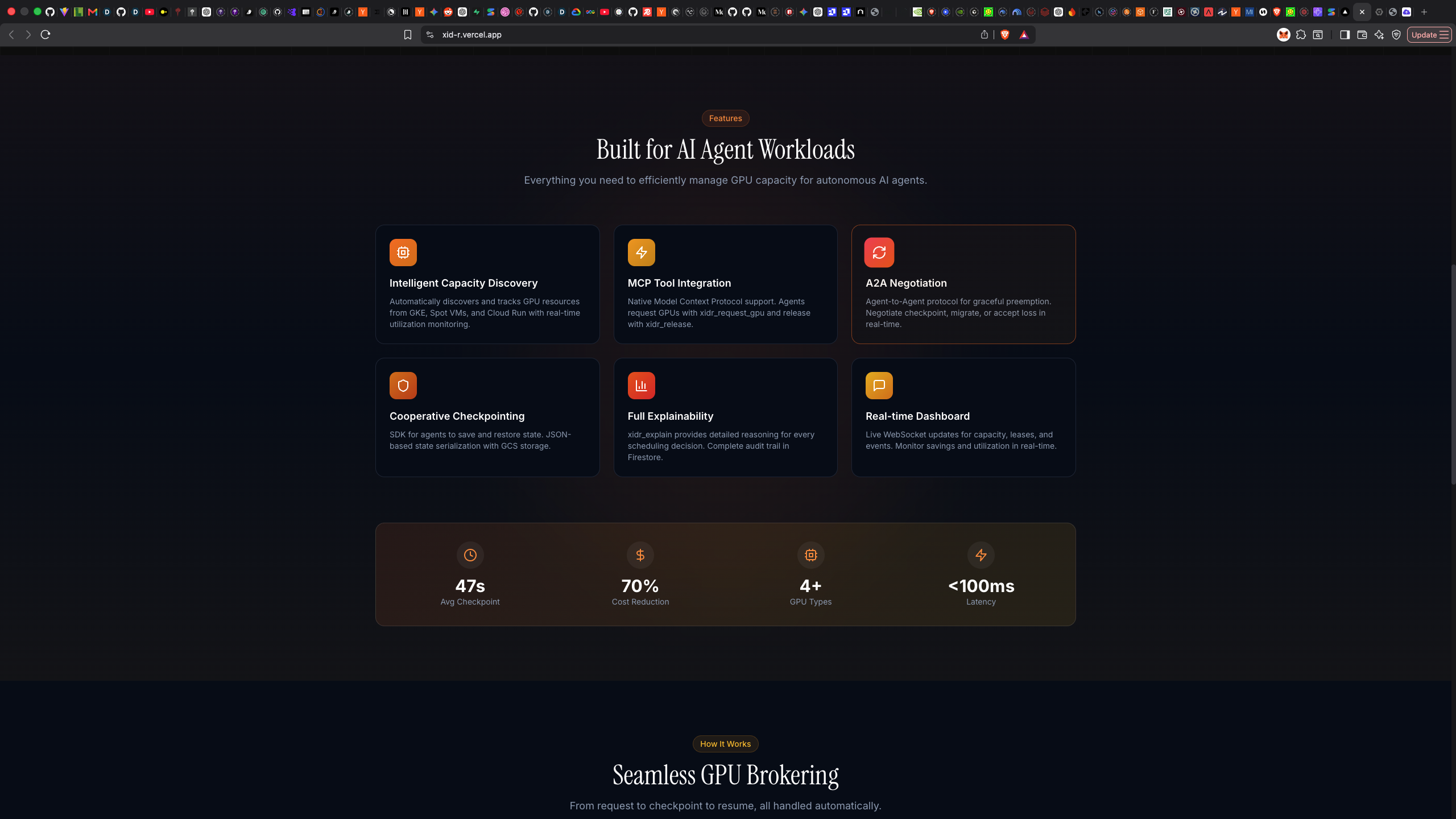
MCP Tools Interface: Agents request GPUs using
xidr_request_gpu, acknowledge checkpoints withxidr_checkpoint_ack, and release withxidr_releaseA2A Negotiation Flow: When preemption occurs, the Negotiator sends a
reclaim_requesttask to the tenant agent's A2A endpoint. The agent responds with its chosen action (checkpoint/migrate/accept_loss)Cooperative Checkpointing: Agents serialize their own state (task queue, scratchpad, conversation history) to GCS — no kernel-level intrusion required
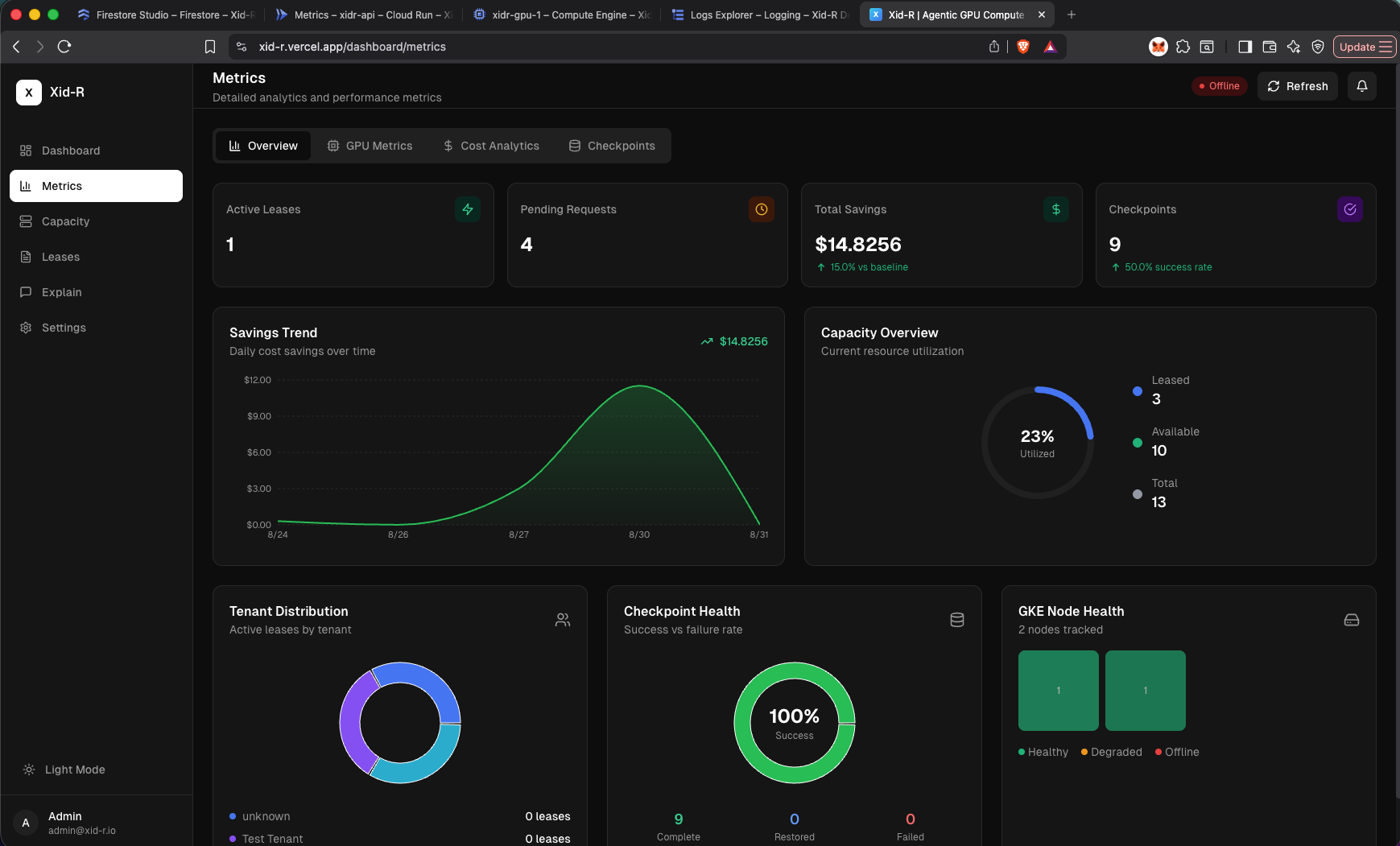
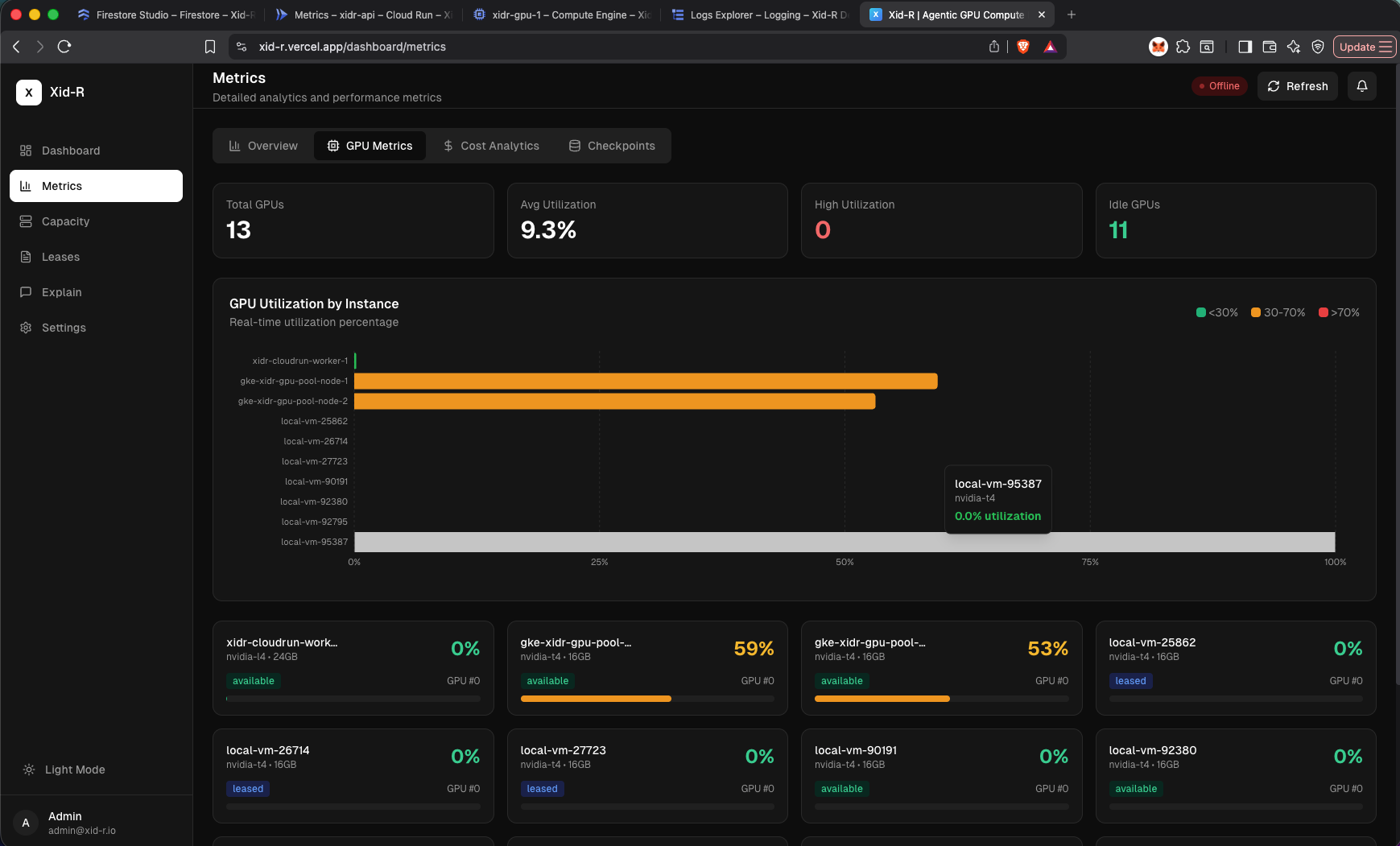
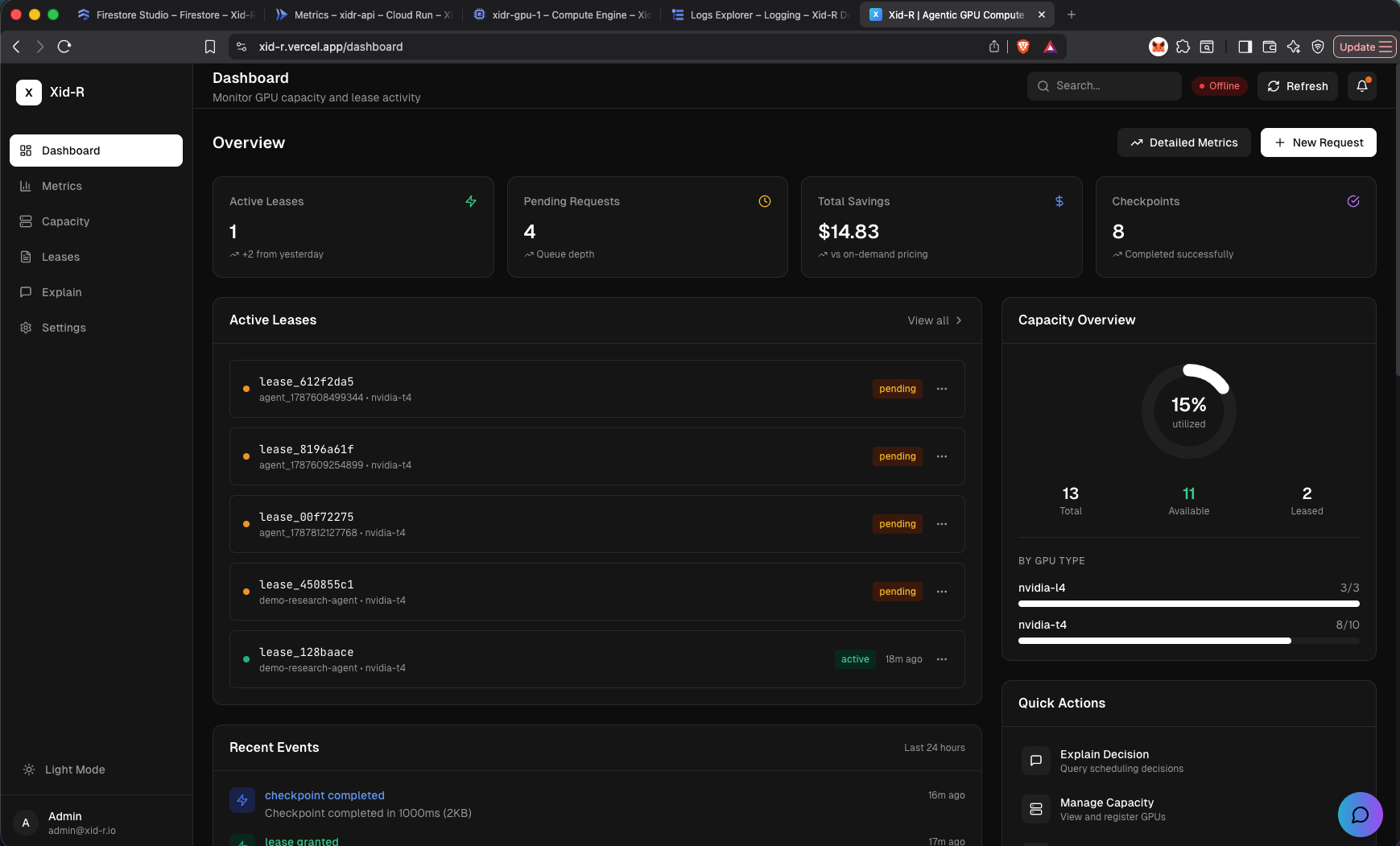
Real-time Dashboard: WebSocket-powered UI shows live GPU utilization, active leases, and cost savings
Challenges we ran into
A2A Protocol Implementation: Getting bidirectional agent communication working reliably required careful handling of timeouts, retries, and state machine transitions. The lease lifecycle (pending → active → negotiating → checkpointed → resuming) had many edge cases.
Spot VM Preemption Timing: Google Cloud gives 30-120 seconds notice before terminating Spot VMs. We had to ensure our negotiation + checkpoint flow completes within this window.
Cross-Origin Complexity: The frontend (Vercel) and backend (Cloud Run) are on different domains, requiring careful CORS configuration and credential handling.
Type System Boundaries: Ensuring consistent enum values (
spot_vmvsgce_spot) across Python VM agents and TypeScript backend caught several subtle bugs.Graceful Degradation: What happens when an agent can't checkpoint in time? We implemented fallback paths (accept loss, force eviction) while maintaining audit trail integrity.
Accomplishments that we're proud of
- First A2A-native GPU broker: No existing solution uses Agent-to-Agent protocol for resource negotiation
- Zero crashed jobs in demo: Every preemption resulted in successful checkpoint
- $14.83 saved in demo environment: Real cost savings from harvested idle capacity
- 7 successful checkpoints: Proving the cooperative checkpoint model works
- Sub-second grant latency: Agents get GPU access instantly when capacity is available
- Production deployed: Live on Google Cloud Run + Vercel, not just localhost
What we learned
Agents negotiating with agents is powerful: The A2A protocol enables coordination patterns impossible with traditional APIs
Cooperative > Invasive: Letting agents checkpoint their own state is simpler and more reliable than kernel-level memory snapshots
Real-time matters: WebSocket-powered dashboards make infrastructure observable in ways batch APIs can't
The broker layer is the value: Raw Spot VMs and GKE exist; the innovation is orchestrating them for autonomous agents
MCP + A2A complement each other: MCP for request/response tools, A2A for peer-to-peer negotiation — together they enable true agent autonomy
What's next for Xid-R
Phase 1: Multi-Cloud (Q1)
- AWS GPU support (EC2 Spot Instances)
- Azure GPU support (Spot VMs)
- Cross-cloud orchestration
Phase 2: Advanced Features (Q2)
- Predictive preemption (ML-based)
- Cost-aware scheduling
- SLA guarantees with credits
Phase 3: Marketplace (Q3)
- Public GPU marketplace
- Reputation system for providers
- Automated dynamic pricing
Vision: The "Airbnb for GPUs" — powered by agents, for agents.
Built With
- a2a-protocol
- firestore
- gemini
- gemini-2.0-flash
- gke
- google-cloud
- google-cloud-run
- hono
- mcp
- node.js
- python
- react
- tailwindcss
- typescript
- vite
- websockets


Log in or sign up for Devpost to join the conversation.