
Inspiration
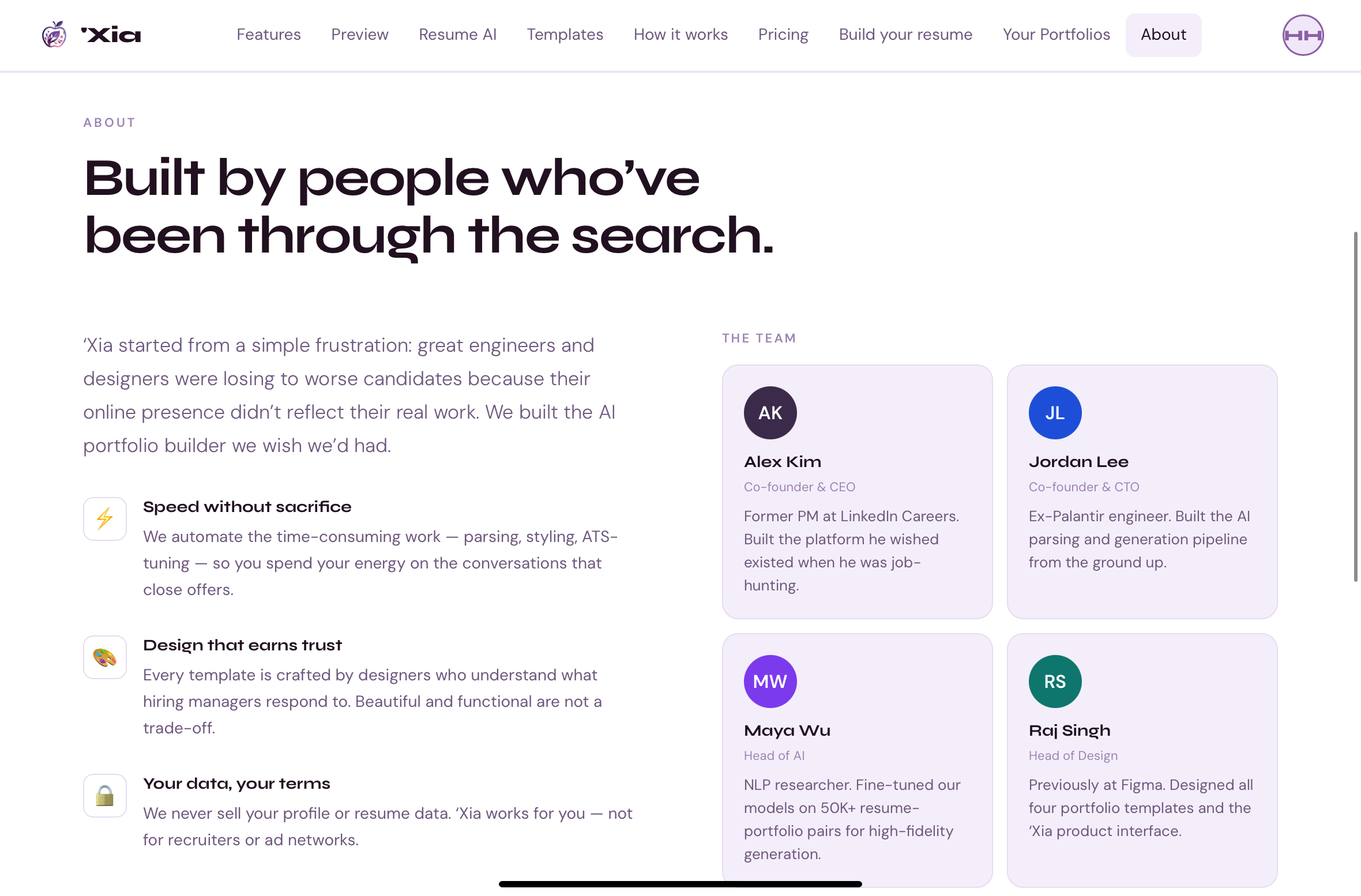
Every student and job seeker has lived some version of the same stressful summer: a browser with forty tabs open, a spreadsheet of half-finished applications, and a nagging sense that somewhere out there is a clearer path, they just can't see it. Resume advice is often generic, and the applicants who need structure most (first-generation applicants, students juggling school with jobs, or those outside major tech hubs) are the least likely to have access to personalized mentorship or professional branding.
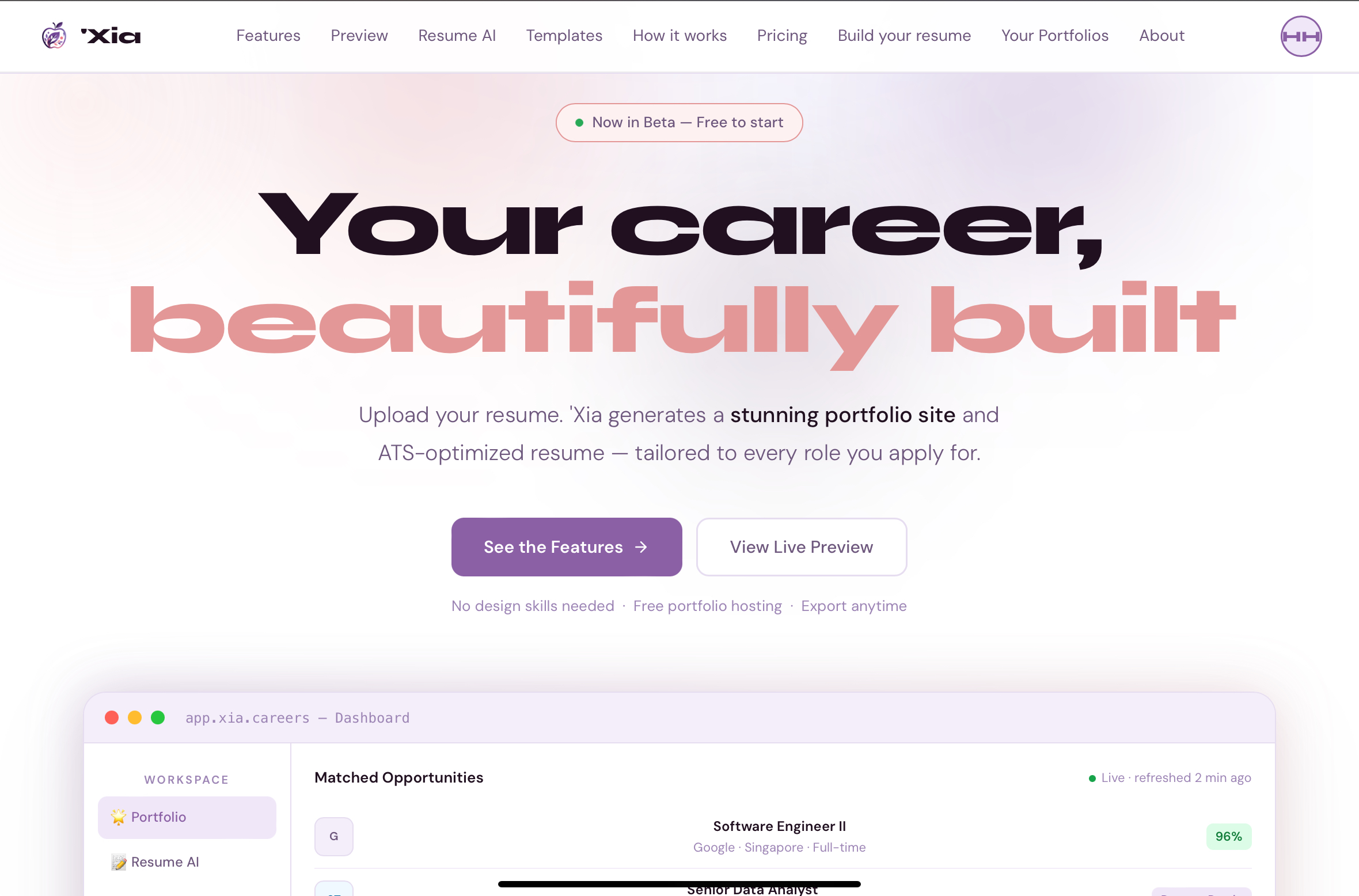
We built 'Xia around one core belief: every career journey deserves an optimized launchpad. 'Xia is an AI-powered Career Branding Engine designed to bridge the alignment gap by turning static professional profiles into tailored, high-impact career portfolios.
Problem Statement
Pain Point 1 — English-only tools penalise non-native applicants twice over
ASEAN job seekers are not a single-language market. Indonesia's national language is Bahasa Indonesia, taught and used across its school system, while Vietnam, Thailand, and the Philippines each run on their own national language plus regional dialects. Existing AI resume builders are built around English-first (and at best a handful of Western-language) writing assistance — Kickresume's own multilingual support, for instance, covers English, Spanish, French, Portuguese, and Italian, with no Southeast Asian language in the list. That leaves a student who writes fluently in Bahasa or Vietnamese with two bad options: write the resume in their working language and get worse AI suggestions, weaker grammar polishing, and lower ATS scores, or write in English and lose nuance, accuracy, and confidence in describing their own achievements.
The pain point isn't "no translation feature." It's that the resume becomes worse on two axes at once — content accuracy and ATS pass-through — depending on which language the student picks, with no tool optimised for either choice.
Pain Point 2 — ATS optimisation is tuned to a market ASEAN students aren't applying into
Every major competitor's ATS scoring and keyword logic is trained on the job market it was built for. Rezi's built-in job board, for example, only covers US-based tech roles, and its scoring assumptions follow that market. An ASEAN student applying to a Singapore bank, a Jakarta logistics startup, or a Bangkok manufacturing graduate programme is being scored against keyword and formatting norms lifted from a different hiring culture entirely — different qualification phrasing, different degree equivalencies, different recruiter expectations around photos, age, and visa/work-pass status, all of which carry real weight in ASEAN hiring but are invisible to a US-tuned ATS model. This is a quieter problem than "no Southeast Asia support," and that's exactly why it's worth naming directly: students don't know their resume is being optimised for the wrong market until after they've applied.
Pain Point 3 — Building a portfolio and tailoring a resume are still two separate, manual jobs
Across Resume.io, Kickresume, and Rezi, even where a personal-website or portfolio feature exists, it sits in a different part of the product from resume tailoring and ATS scoring — built by different teams, on different update cycles, with no single profile feeding both. A student manually re-enters the same experience twice, then manually keeps both in sync every time they apply to a new role or add a new project. For ASEAN students juggling coursework, part-time jobs, and applications to programmes across multiple countries simultaneously, that manual duplication is exactly the kind of time cost a five-agent autopilot is designed to remove — parse once, then let analyze-job, strategy, generate, and export chain automatically from one source of truth.
Competitor Research
Resume.io
• Strongest claim is generic outcome marketing (resumes reportedly making candidates more likely to be hired, with a modest pay-premium claim) rather than market-specific tailoring — no ASEAN-market or multilingual differentiation in its core pitch. • Positioned around simplicity and speed for a broad global English-speaking audience; no dedicated ATS logic tuned to non-Western hiring systems or job boards. • No portfolio/personal-site product comparable to 'Xia's live hosted portfolio — it stays a document generator.
Kickresume
• Has the broadest multilingual claim of the three, but its own stated language list is English, Spanish, French, Portuguese, and Italian — zero Southeast Asian languages, despite serving over 1.5 million users globally. • Strong all-in-one suite (resume + cover letter + personal website + interview prep + career map) — this is the closest analogue to 'Xia's breadth, and worth acknowledging rather than dismissing in the pitch. • Free tier is generous on templates but the AI writer and download polish sit behind Premium; no regional hiring-norm logic (visa status, local degree equivalency, ASEAN-market keyword sets).
Rezi
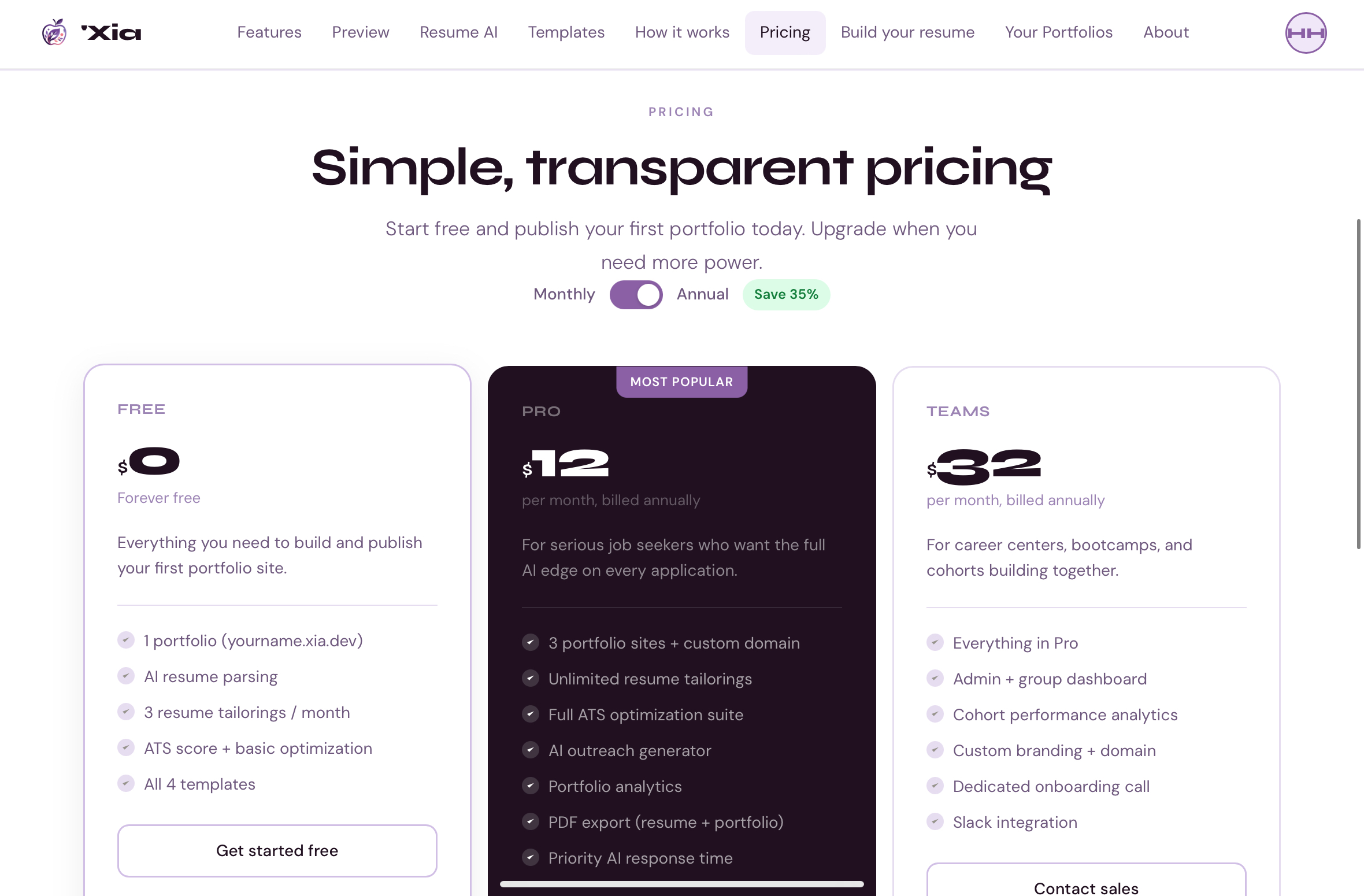
• Best-in-class ATS keyword scoring among the three — this is the bar 'Xia's ATS Optimization agent needs to clear, not just match. • Built-in job board exists but is explicitly scoped to US-based tech roles only — structurally excludes the ASEAN job market 'Xia is targeting. • Free plan is the most restrictive of the three (one resume, three lifetime downloads), which is a usability gap 'Xia's freemium tier can position against directly.
The gap, stated as one line per competitor none of the three treat ASEAN as a market with its own hiring norms, languages, or job-board ecosystem — they treat it as an edge case of a Western product. That's the open lane 'Xia is built to take, and it's a defensible claim because it's based on what each platform itself states publicly, not assumption.
The 5-Step Student Journey
Step Student experience
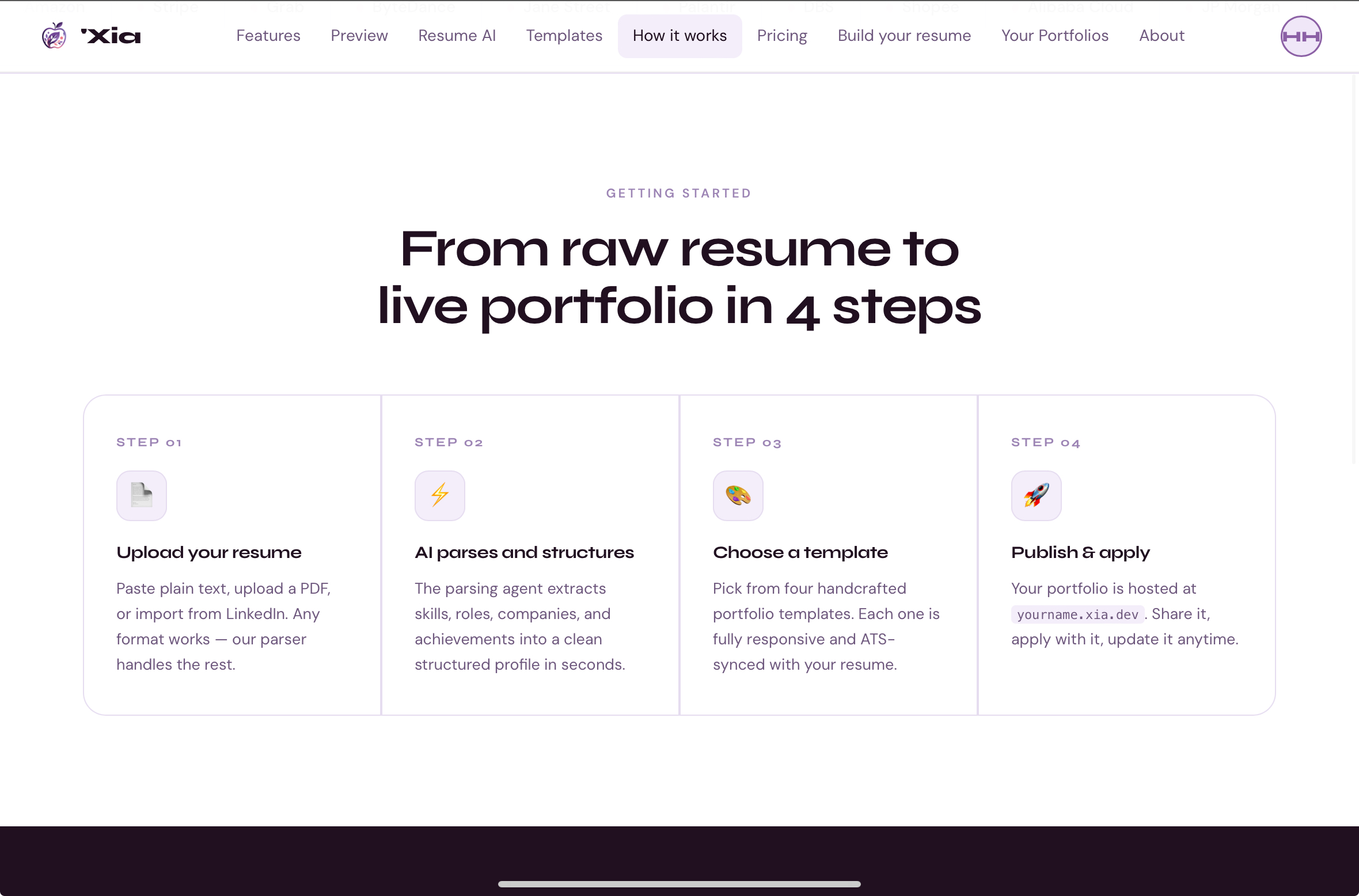
- Signup Lands on site, sees value prop, signs up — or starts the no-signup live demo already on the mock.
- Upload Uploads a resume — PDF, DOC, DOCX, plain text, or LinkedIn import.
- Autopilot Picks or pastes a target job posting; analysis, strategy, and content generation run automatically in one pass — the single biggest differentiator vs. all three competitors.
- Review Sees a strategy card and draft content, can edit directly or click regenerate. The human-in-theloop checkpoint.
- Export Exports an ATS-ready resume PDF and publishes a live portfolio at yourname.xia.dev
Prompt Briefs for the Five Agents (prompts.md)
A note on language: given the ASEAN positioning from the problem statement and competitor research above, I've written a default multilingual instruction into every agent rather than leaving language-handling as an afterthought. Confirm with Mei Tong's EN/ZH/FR toggle plan whether to expand this list — Bahasa Indonesia and Vietnamese are the highest-leverage additions given the market gap identified in Section 3. Agent 1 — /analyze (Profile Analyzer) • Tone: Neutral, extraction-focused. This agent should not editorialise or improve the content — it structures what's there. • Format: Strict JSON output — name, current role, top skills (max 8), experience (company, dates, title, 2–3 achievement bullets as written), education, languages detected in source document. No markdown, no commentary outside the JSON object. • Language: Detect the input language and preserve it in the structured output — do not autotranslate at this stage. Translation, if needed, happens downstream in /generate, not here. • Guardrail: If the resume is incomplete (missing education or experience entirely), return what's available with a flagged "incomplete" field rather than inventing placeholder content. Agent 2 — /analyze-job • Tone: Analytical and market-aware. This agent should think like an ASEAN-market recruiter, not a generic Western ATS — flag region-specific signals (work-pass/visa eligibility language, local degree equivalency mentions, bilingual requirements) as well as standard keywords. • Format: JSON with: required_keywords (ranked by importance), nice_to_have_keywords, seniority_level, region_specific_signals, language_requirements. • Language: Accept job postings in any of the supported languages; output keyword lists in the same language as the posting plus an English mirror, since ASEAN job postings frequently mix languages within one listing. • Guardrail: Never infer or assume a candidate's age, gender, ethnicity, or religion from a job posting's phrasing, even where local postings sometimes include such criteria — strip these from anything that flows into scoring. Agent 3 — /strategy • Tone: Direct and constructive, like a career coach giving specific, actionable feedback — not generic encouragement ("highlight your strengths") but specific moves ("reorder these three bullets, lead with the Kafka pipeline metric since it matches the posting's top keyword"). • Format: A short strategy card: 3–5 specific recommendations, each tied to a specific gap between the parsed profile (Agent 1 output) and the job analysis (Agent 2 output). This is what renders on Mei Tong's HITL review screen, so keep each recommendation to 1–2 sentences — it needs to be scannable, not a report. • Language: Match the language the student is building in, set via the frontend toggle. • Guardrail: Never recommend fabricating experience, metrics, or credentials to match a job posting — only recommend reframing, reordering, or emphasising what's actually in the parsed profile. This is the line item that directly supports the human-in-the-loop justification in the ethics section. Agent 4 — /generate • Tone: Professional and confident, calibrated to seniority level from Agent 2's output — a newgrad resume should not sound like a 10-year VP's, and the agent should adjust register accordingly rather than applying one fixed "professional" voice to everyone. • Format: Full resume content (summary, experience bullets, skills section) plus matching portfolio copy (homepage tagline, project descriptions) — both derived from the same approved strategy card so the resume and portfolio never drift out of sync, which is the exact duplication problem named in Pain Point 3. • Language: Generate directly in the student's selected output language rather than generating in English and machine-translating — quality drops noticeably with a translate-after step, especially for achievement bullets where idiom and emphasis matter. • Guardrail: Every generated bullet must be traceable to something present in the Agent 1 parsed profile — no invented numbers, employers, or credentials. This generation step is what the student reviews and edits at the HITL checkpoint, not a final, unreviewed output. Agent 5 — /export • Tone: N/A for this agent — it's primarily a formatting and rendering pass, not a generative one once Agent 4's content is approved. • Format: Clean, ATS-parseable PDF structure (standard fonts, no tables/columns that break ATS parsers, clear section headers) plus the final portfolio site assembly using the chosen template. • Language: Preserve whatever language the approved content (from Agent 4, post-HITL edits) is in — no further translation at export. • Guardrail: Re-run a lightweight ATS format check (the kind already mocked on the site — keyword presence, section headers, readability) before finalising export, so the exported resume's actual ATS score matches what was promised earlier in the flow.
AI Ethics & Legal Section
Data privacy • Resume content is among the most sensitive personal data a user uploads to any tool — it typically contains full name, contact details, employment history, and sometimes nationality or visa-status information. 'Xia's commitment, consistent with the "your data, your terms" principle already stated on the live site, is that resume and profile data is never sold or shared with third parties, including recruiters or ad networks. • Practically for this build: profile data parsed by the /analyze agent and OSS-hosted exports should be scoped to the individual user's account, with no cross-user data pooling used for model fine-tuning without explicit, separate consent — important to state clearly given Qwen calls route through Alibaba Cloud infrastructure, which judges may ask about directly. • Worth a one-line mention that 'Xia is currently a hackathon-stage MVP, not yet GDPR/PDPAaudited — overpromising compliance certifications it doesn't yet have would be a bigger credibility risk in Q&A than honestly scoping current data handling. Bias in resume screening and AI-assisted writing • The core bias risk in a tool like 'Xia isn't hidden discriminatory scoring — it's the more subtle risk of an AI agent learning to over-optimise for a Western-resume "voice" and quietly flattening the way ASEAN students naturally describe their achievements, which would ironically reproduce the same problem named in the original problem statement. • The /analyze-job agent's guardrail against inferring or scoring on age, gender, ethnicity, or religion (specified in the prompt brief, Section 5) is the concrete mitigation here — name it explicitly in the pitch, since "we built a guardrail against X" is a stronger answer to a judge's bias question than "we're aware bias could be a risk." • Worth naming the asymmetry directly: ATS systems and AI writing tools trained primarily on Western résumé corpora can systematically under-score non-Western formatting and phrasing conventions even with no intent to discriminate — this is precisely the gap 'Xia's region-aware analysis agent is designed to close, not just avoid
What it does
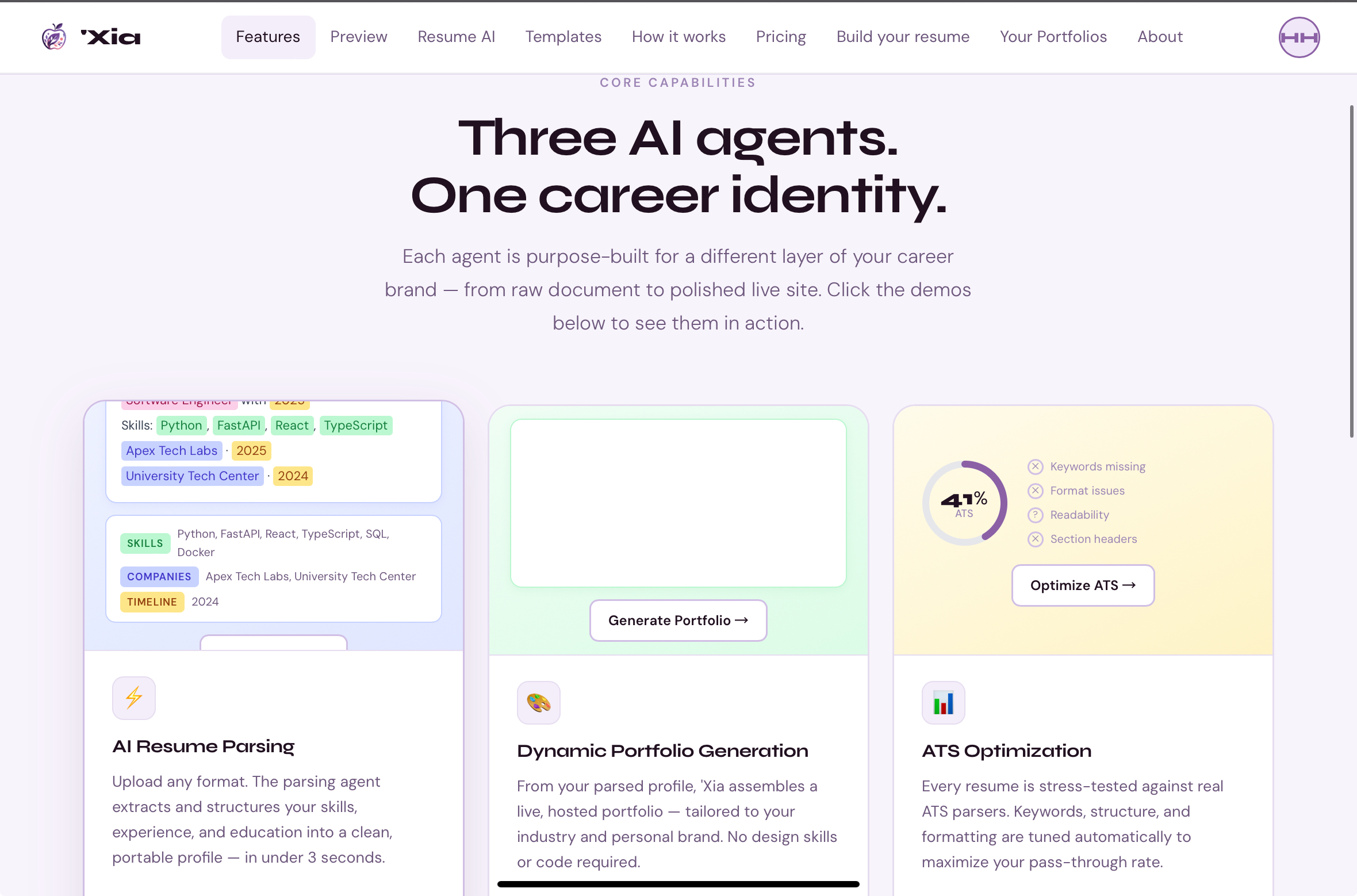
'Xia transforms static CVs into targeted career assets through an end-to-end suite of multi-agent modules running on top of Qwen 2.5:
Auto-Alignment Autopilot Orchestrator: Instantly aligns a candidate’s profile with any target job description by chaining four specialized AI agents sequentially:
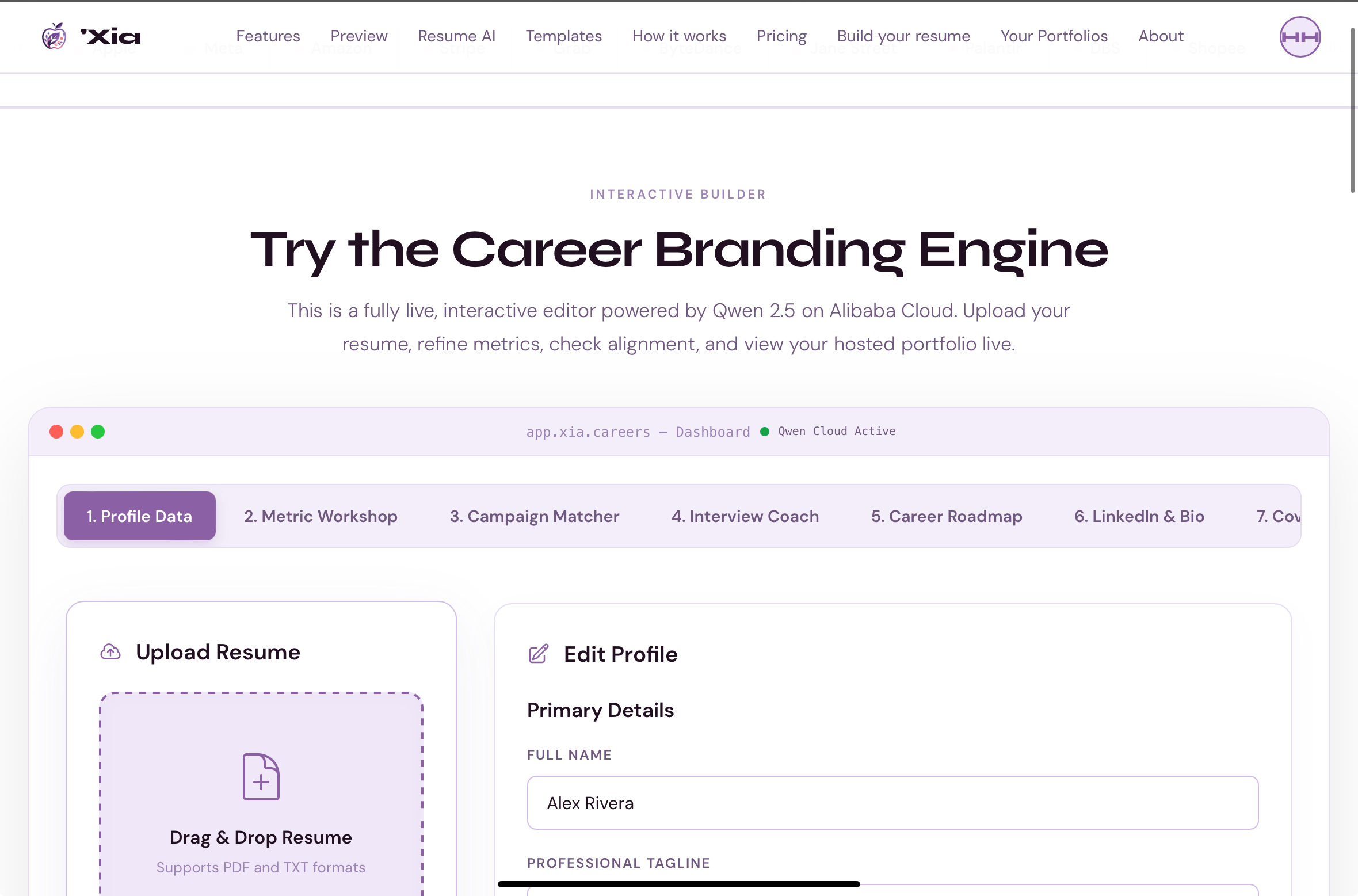
Profile Analyzer: Parses baseline achievements, strengths, and hidden skill sets from uploaded PDF/text resumes.
Job Analyzer: Deconstructs target job descriptions to extract core qualifications and identify key credential gaps.
Strategy Builder: Synthesizes a unique personal positioning statement and branding hook tailored to the employer.
Content Generator: Rewrites experience items into high-impact STAR-format (Situation, Task, Action, Result) accomplishments.
Interactive Mock Career Coach: Simulates real-time behavioral interview rounds by generating customized questions based on the applicant's resume and target job role, scoring candidate responses, and delivering concrete improvement points.
Resume Bullet Workshop & Campaign Analyzer: Offers real-time, fine-grained polishing of individual experience bullets based on user-chosen tones (e.g., executive, technical, balanced) and evaluates campaign-wide alignment metrics.
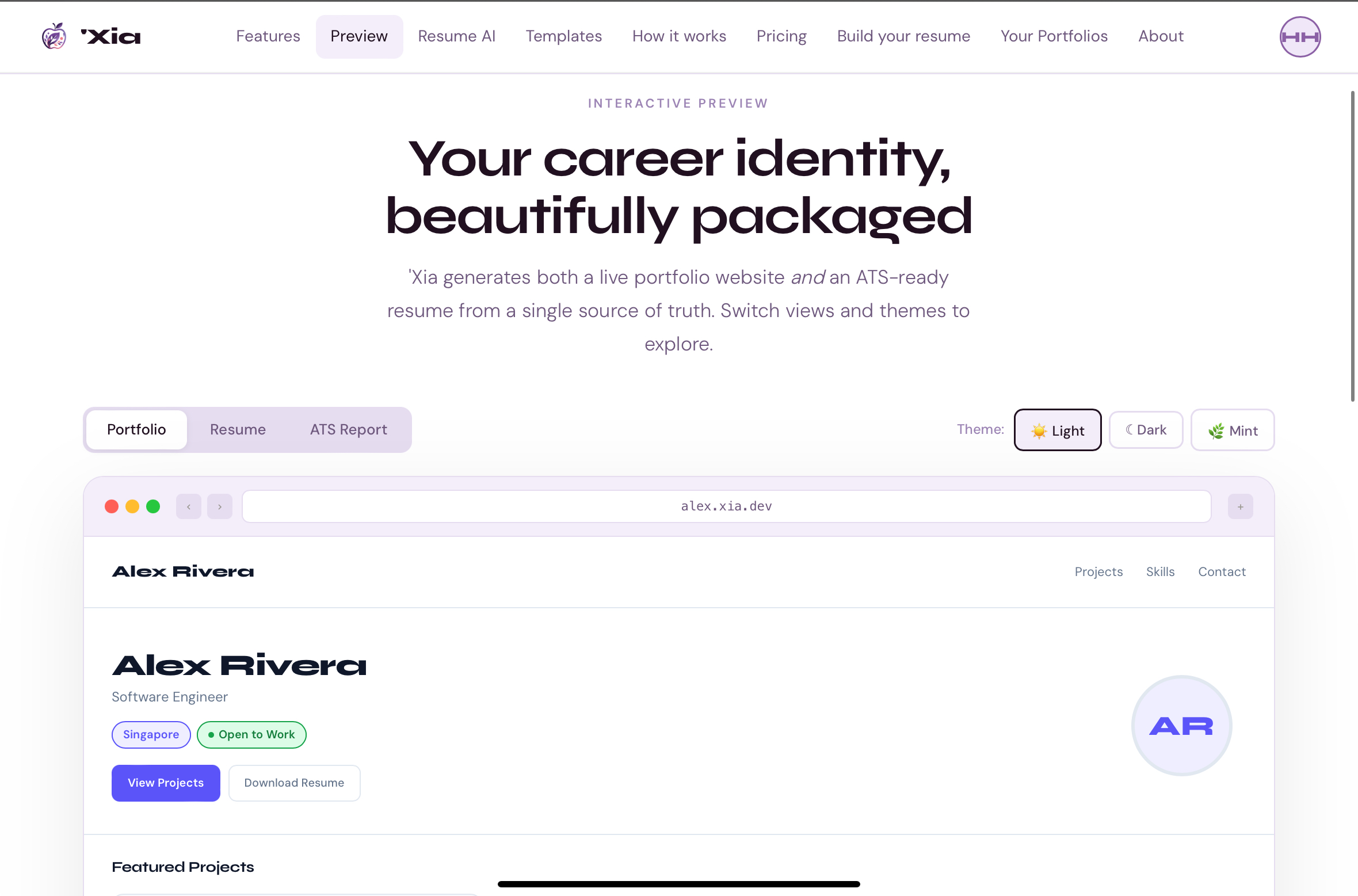
Multi-Asset Personal Branding Suite: Extends beyond basic resumes by auto-generating tailored cover letters, optimized LinkedIn profile summaries, multi-step career roadmaps, and instant web-ready portfolio HTML pages.
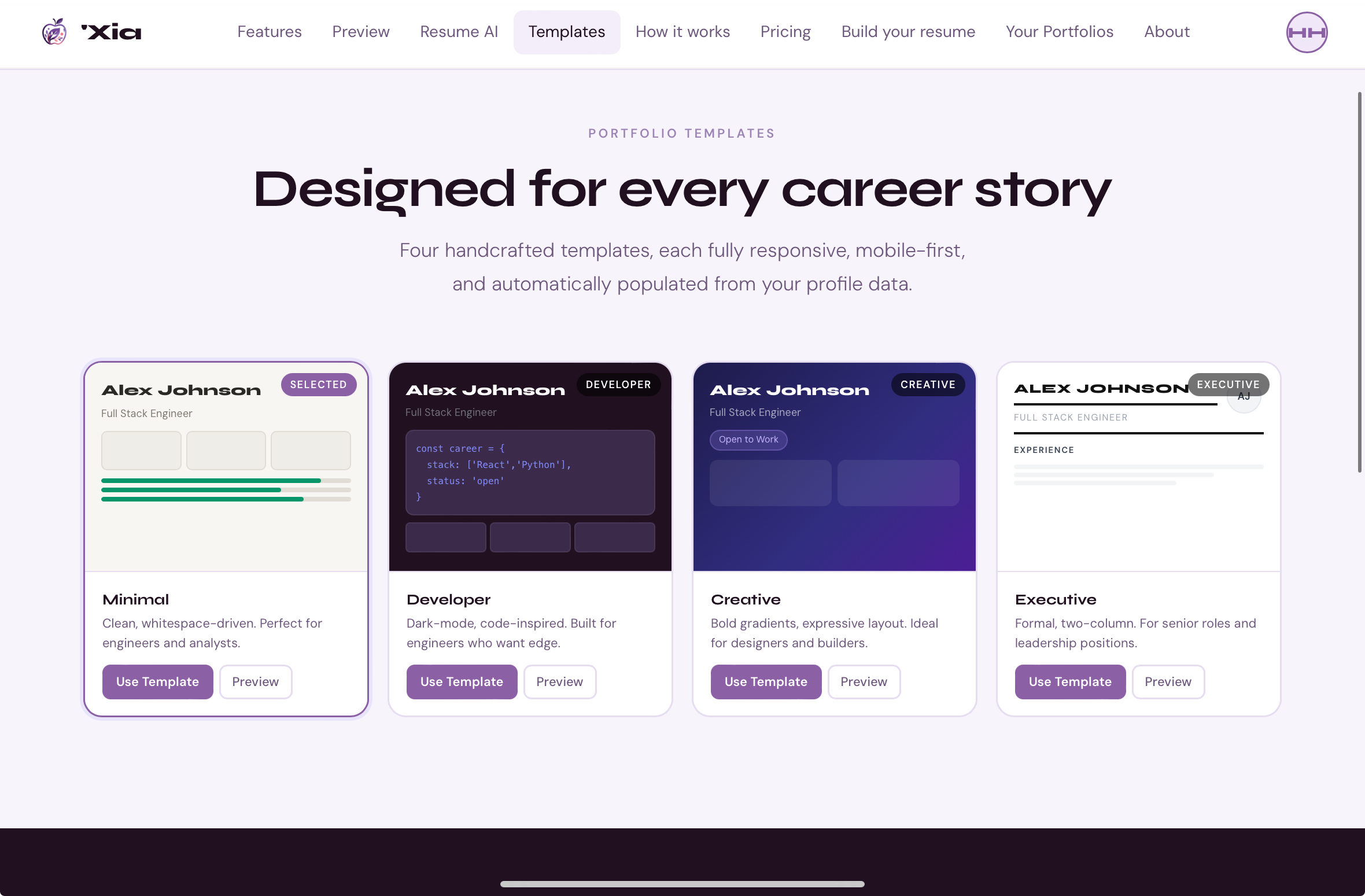
Print-ATS Optimized Template Builder & CRUD State: Features live template rendering (Minimal, Developer, Creative, Executive) with browser-side LocalStorage persistence and clean PDF export workflows supported by CSS media query print controls.
How we built it
- Frontend: A single-page application (SPA) with a responsive, glassmorphic layout hosted on Vercel.
- Serverless Backend: Deployed as a serverless microservice on Alibaba Cloud Function Compute (FC 3.0) in the Singapore (
ap-southeast-1) region. - Storage: Leverages Alibaba Cloud Object Storage Service (OSS) for storing and downloading generated portfolios.
- Intelligence: DashScope Model Studio powering Qwen 2.5 (32B/72B) to execute all agent orchestrations.
Challenges we faced
Connecting different serverless deployment requirements across platforms and maintaining low latency for multi-agent chains were initial obstacles. We resolved this by linking the serverless backend directly to the DashScope international API endpoint (dashscope-intl.aliyuncs.com), achieving sub-second latency for Qwen completions.
Accomplishments that we're proud of
We built a fully functioning, end-to-end multi-agent orchestration pipeline running completely serverless on Alibaba Cloud Function Compute, achieving a true scale-to-zero footprint.
What we learned
We learned the power of combining serverless compute architecture with advanced open-weight LLMs like Qwen to create highly responsive, cost-effective micro-agent workflows.
Cloud Architecture Integration: Learned how to chain DashScope AI models, Function Compute compute runtimes, and Object Storage Service (OSS) into a unified cloud product.
What's next for 'Xia
We plan to introduce automated LinkedIn profile optimization, real-time cover letter generation, and deeper integration with ATS feedback loops. Localized Multi-Language Alignment: Expand Qwen 2.5 prompt orchestration to support localized resume generation across ASEAN languages (e.g., Bahasa Indonesia, Vietnamese, Thai, Mandarin).
Built With
- alibaba
- cloud
- css3
- express.js
- function
- html5
- javascript
- node.js
- oss
- qwen
- serverless
- vercel


Log in or sign up for Devpost to join the conversation.