-
-

Main Profile Image
-
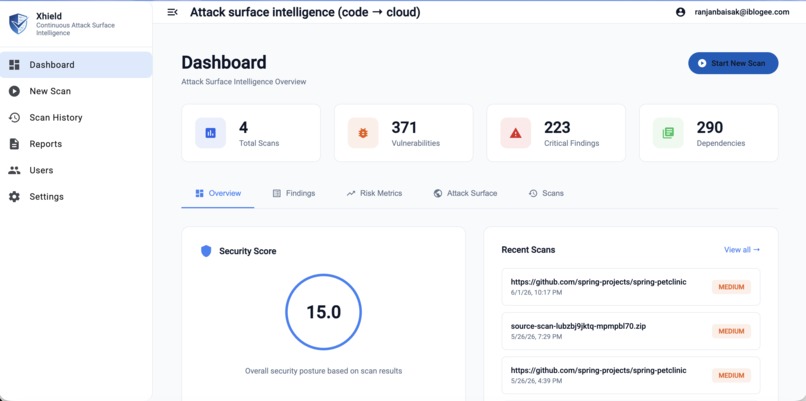
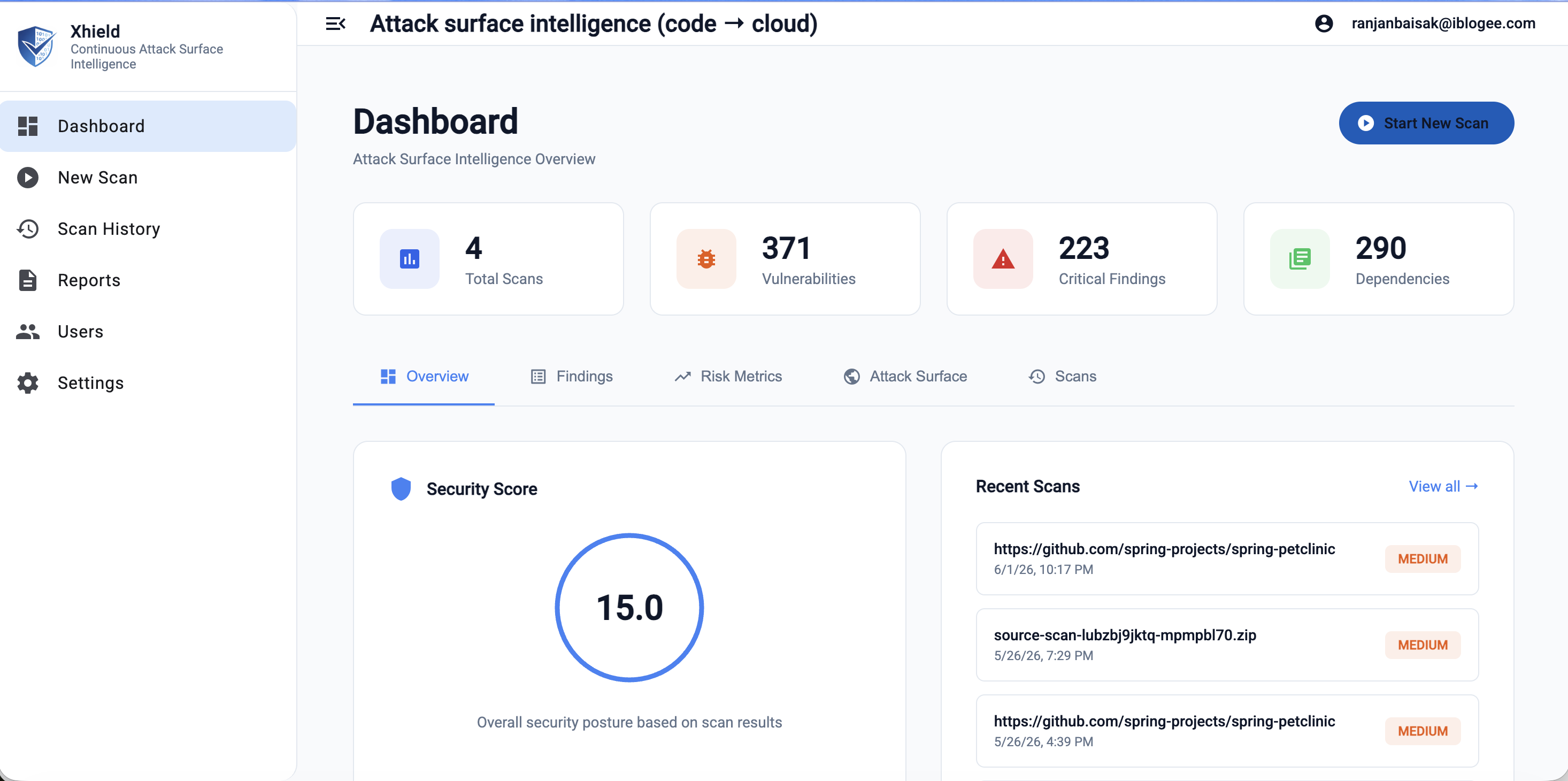
App Dashboard
-
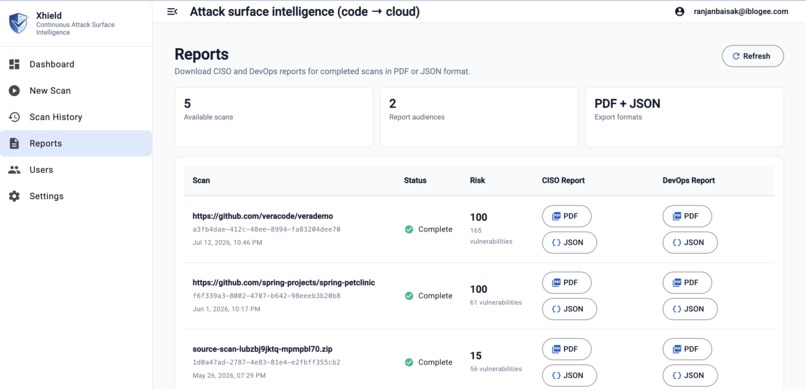
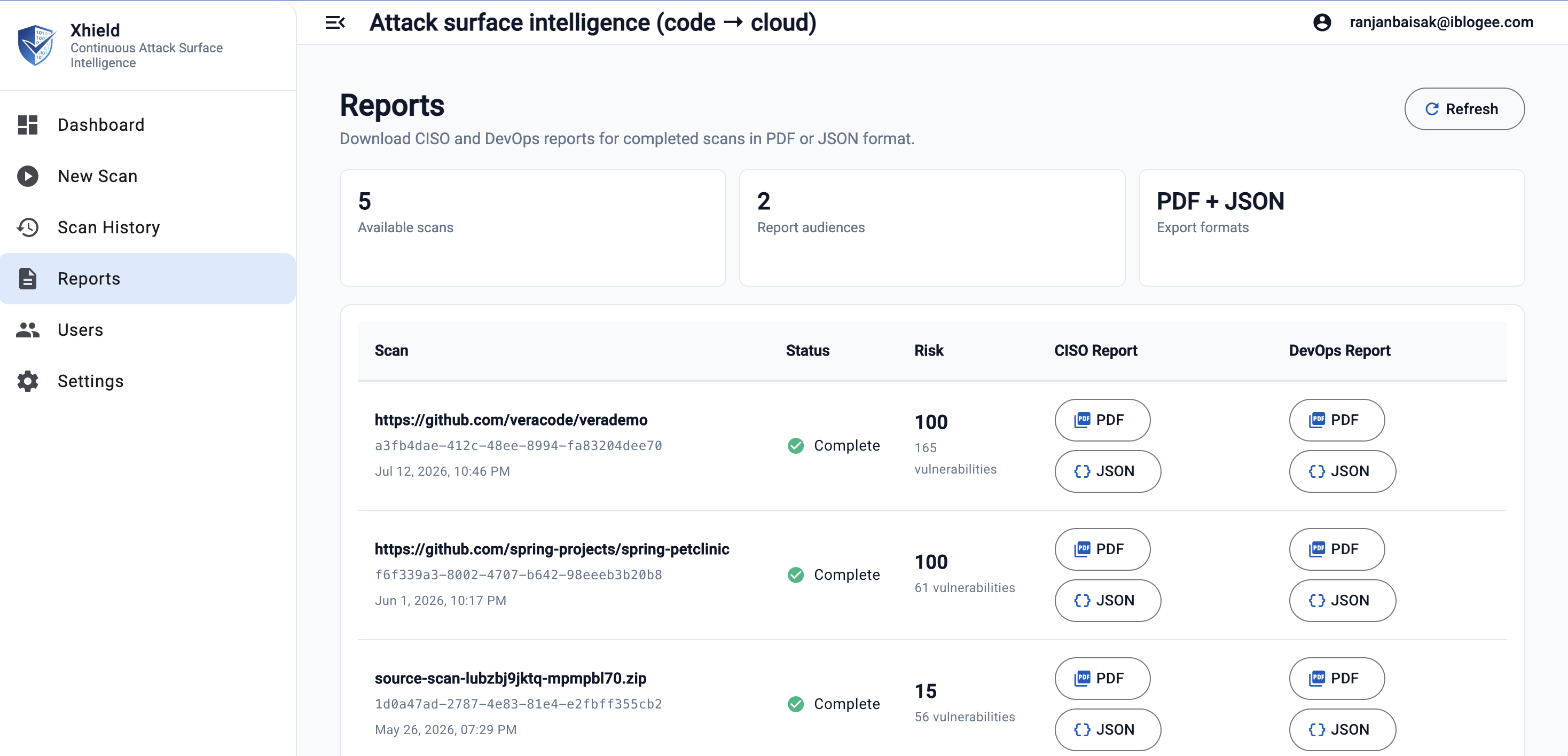
Reports of code scan
Inspiration
Cybersecurity has traditionally been approached as a periodic activity. Organizations conduct VAPT assessments, run vulnerability scanners, review compliance findings, and then work through large numbers of alerts.
Through my experience in enterprise cybersecurity, I saw a recurring problem: finding vulnerabilities is not the same as understanding which vulnerabilities can actually lead to an attack.
Modern applications are also increasingly complex. A single application may depend on hundreds of open-source libraries, cloud services, APIs, identities, and infrastructure components. A vulnerability in one component may appear low-risk in isolation but become critical when combined with other weaknesses.
This led to the idea behind Xhield: instead of simply asking “What vulnerabilities exist?”, we wanted to answer:
“Which risks can actually be exploited, how are they connected, and what should the organization fix first?”
What are building
SkureCloud is the company behind Xhield, a cybersecurity DeepTech platform focused on Continuous Attack Surface Intelligence. Xhield is designed to bring together security intelligence from:
- Application source code
- Open-source dependencies
- Software supply chains
- Cloud infrastructure
- External attack surfaces
- Vulnerability and threat intelligence
The platform uses Artificial Intelligence, Machine Learning, Graph Neural Networks (GNNs), and graph-based analytics to correlate security findings and identify meaningful attack paths.
Instead of presenting thousands of independent findings, Xhield aims to provide contextual risk intelligence—helping security teams understand exploitability, prioritize remediation, and move from periodic VAPT toward continuous cyber-risk management.
How I built it
We started with a practical problem rather than trying to build an AI model first.
The initial product focused on software dependency and vulnerability analysis, particularly for Java/Spring Boot applications. We built the backend using Java Spring Boot and the frontend using Angular, creating a foundation that could progressively incorporate additional security capabilities.
We integrated vulnerability intelligence from sources such as NVD, OSV, GitHub Security Advisories, CISA KEV and CWE-related datasets and developed mechanisms to analyze software dependencies and their associated vulnerabilities.
The next challenge was going beyond conventional rule-based scanning.
We began experimenting with Graph Neural Networks and security graphs, using datasets such as Juliet and OWASP to explore how relationships between code, vulnerabilities, weaknesses and attack patterns could be represented computationally.
Our ML models are developed using Python and deployed through ONNX, allowing us to integrate AI/ML capabilities with our Java-based platform.
The longer-term architecture is evolving toward a Unified Attack Surface Graph, where vulnerabilities, assets, dependencies, identities and relationships can be correlated to discover potential attack paths.
Challenges I ran into
- Fragmented Security Data
Different vulnerability and security databases use different identifiers, formats and levels of detail. Building reliable relationships between CVEs, packages, CWEs, software components and attack patterns has required significant engineering effort.
- False Positives
Traditional scanners can generate large volumes of findings. An AI system that simply generates more findings does not solve the customer’s problem.
Our focus therefore shifted toward contextual prioritization and exploitability, rather than detection volume.
- Building GNN-Based Security Intelligence
Applying GNNs to cybersecurity is considerably more complex than applying conventional classification models. Security relationships are heterogeneous and dynamic, and representing meaningful attack paths requires careful graph construction and feature engineering.
- Limited Resources
As an early-stage DeepTech startup, we have had to develop sophisticated technology with limited infrastructure and resources. GPU availability, large-scale model training, security datasets and cloud infrastructure all present practical constraints.
- Moving From POC to Product
Another major challenge has been balancing research innovation with product usability. A technically sophisticated model is not useful if a developer or CISO cannot understand its output.
This has pushed us to focus heavily on explainability, visualization, risk scoring and actionable remediation.
Accomplishments that I'm proud of
I am proud of taking the entrepreneurial journey from idea to building SkureCloud and Xhield, a cybersecurity DeepTech product focused on AI-driven Continuous Attack Surface Intelligence. Building the technology from an early concept into a working POC while exploring GNNs, vulnerability intelligence, attack-path analysis, and AI-driven security is one of my most meaningful accomplishments.
I am also proud of my earlier entrepreneurial experience as a co-founder of AppiVa Software, where we built eztask.io, an enterprise CRM product. Although the venture was eventually closed, it gave me first-hand experience in product development, customer needs, business execution, and the realities of building a startup.
Professionally, I am proud of building a career spanning 15+ years in enterprise technology and cybersecurity, including experience with organizations such as Juniper Networks and CyRAACS.
More recently, I am particularly proud that Xhield has gained recognition through startup and innovation ecosystems, including STPI Sayuj and participation in the Government of Karnataka Elevate NXT 2026 Grand Finale.
What I learned
One of our biggest lessons has been that AI accuracy alone does not create a useful cybersecurity product.
A security team does not simply need another prediction. It needs to know:
- Why is this vulnerability important?
- Can it actually be exploited?
- What assets are affected?
- What is the potential attack path?
- What should we fix first?
- How can we remediate it?
This led us to move from a simple vulnerability-detection mindset toward contextual risk intelligence.
We also learned that cybersecurity data is highly fragmented. CVEs, packages, CWEs, code, cloud resources, threat intelligence and business context all describe different parts of the same security problem. Connecting these relationships is itself a significant technology challenge.
What's next for Xhield.tech
Our vision is to evolve Xhield from vulnerability analysis into an intelligent cyber-risk reasoning platform. The evolution is: Code & Dependencies ↓ Vulnerability Intelligence ↓ Security Relationships ↓ Unified Attack Surface Graph ↓ Attack Path Discovery ↓ Exploitability Analysis ↓ Contextual Risk Prioritization ↓ AI-driven Remediation Xhield is still an early-stage product, and we recognize that there is a significant journey ahead—from POC validation to production deployments, customer adoption and global scale. Cybersecurity should not stop at finding vulnerabilities. It should understand risk, predict attack paths, and help organizations act before attackers do.
Built With
- ai
- cybersecurity
- deeptech
- gnn
- java
- ml
- owasp

Log in or sign up for Devpost to join the conversation.