
Inspiration
AI agents are becoming autonomous economic actors, but they lack the infrastructure to transact. When an AI agent needs to pay for an API, fetch data, or access compute resources, it hits a wall—traditional payment systems require human intervention for every transaction.
We asked ourselves: What if AI agents could pay for services as seamlessly as they make HTTP requests?
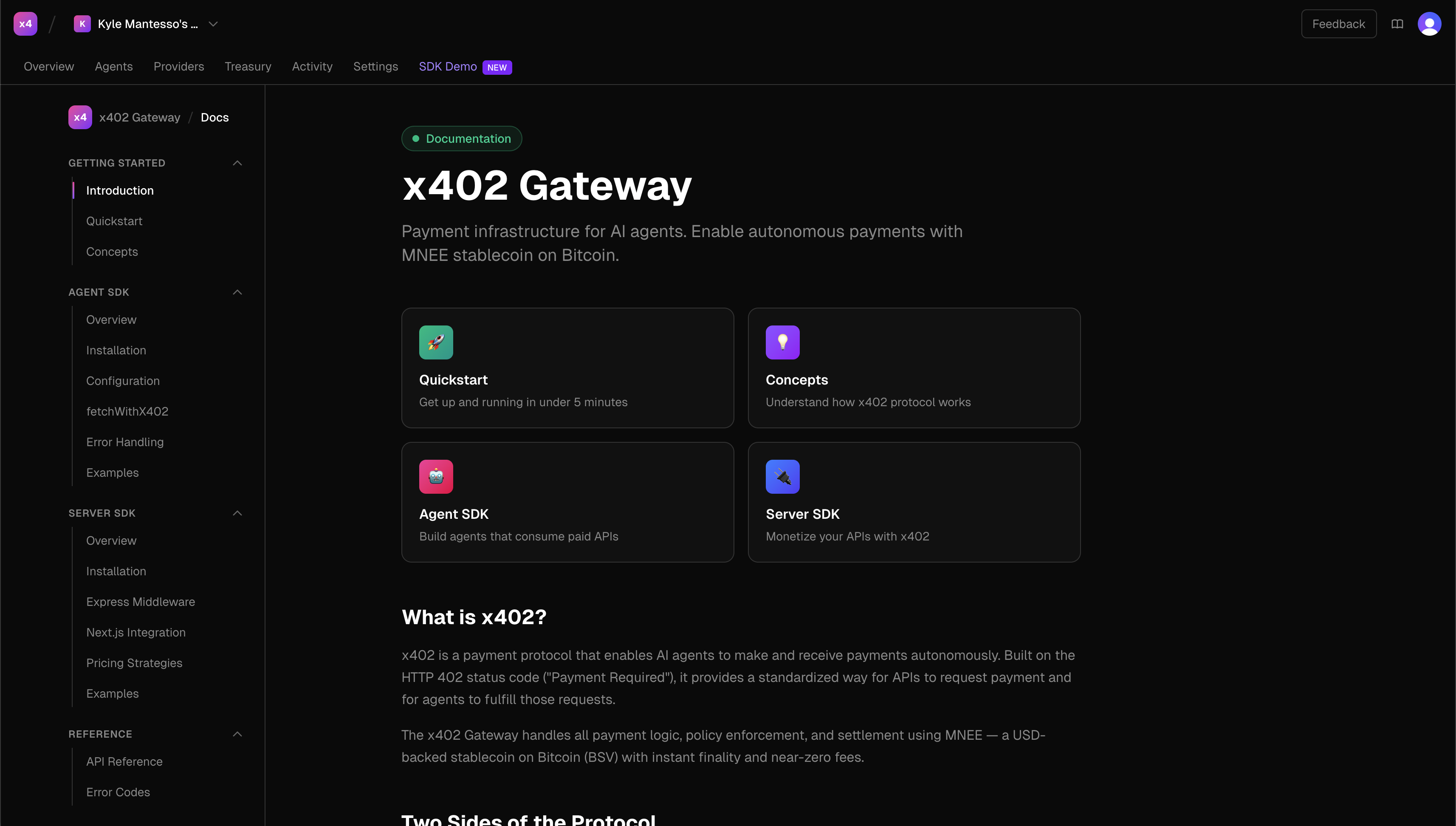
The x402 HTTP status code ("Payment Required") has existed since 1997 but was never widely implemented. We saw an opportunity to bring it to life for the agentic era—creating a standard protocol where agents can autonomously handle payments using MNEE stablecoin on Ethereum.
What it does
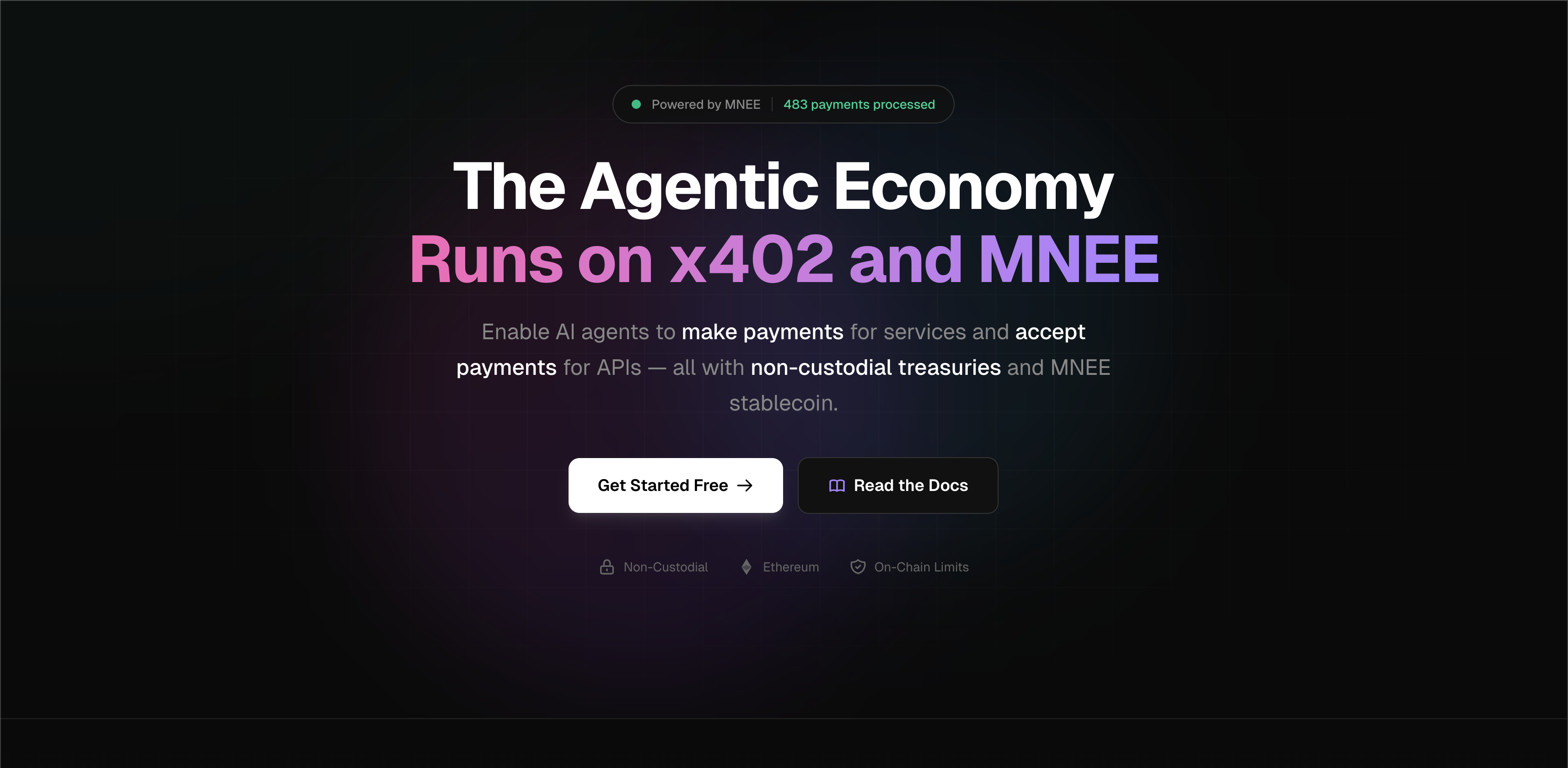
xFour is a programmable payment gateway that enables AI agents to transact autonomously using MNEE stablecoin (ERC20) on Ethereum. It implements the x402 protocol, turning the dormant HTTP 402 status code into a practical payment flow.
For AI Agents (consumers):
- Drop-in SDK (
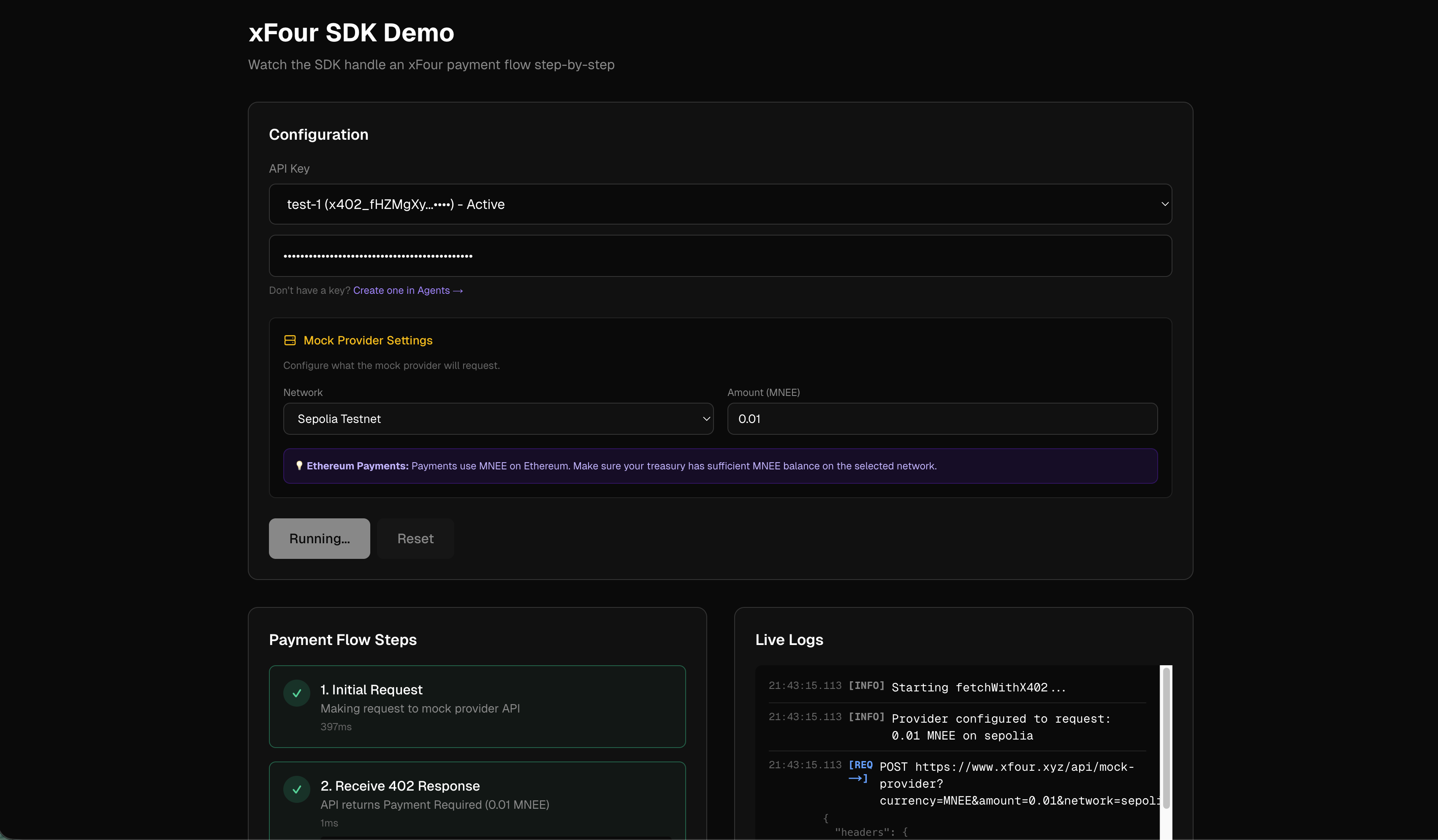
@x402/agent) that wrapsfetchand automatically handles payment flows - When an API returns 402, the SDK gets a quote, executes payment via MNEE, and retries with proof
- Budget controls, daily/monthly limits, and allowed provider lists
For API Providers (merchants):
- Server SDK (
@x402/server) with middleware for Express, Next.js, and other frameworks - Set prices per-endpoint or dynamically based on request complexity
- Receive payments directly to your Ethereum wallet
Dashboard features:
- Workspace isolation for teams/organizations
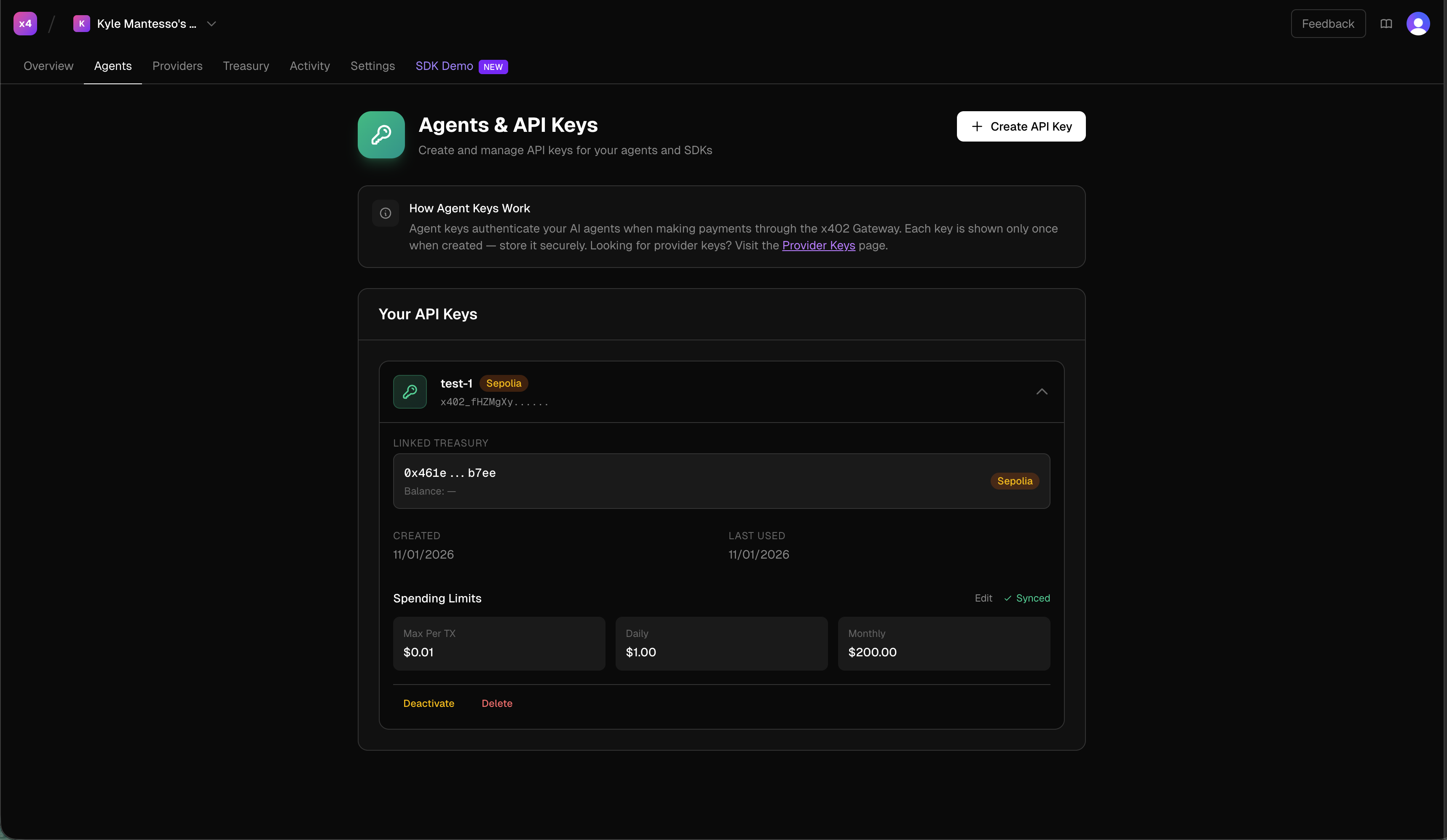
- API key management with secure hashed storage
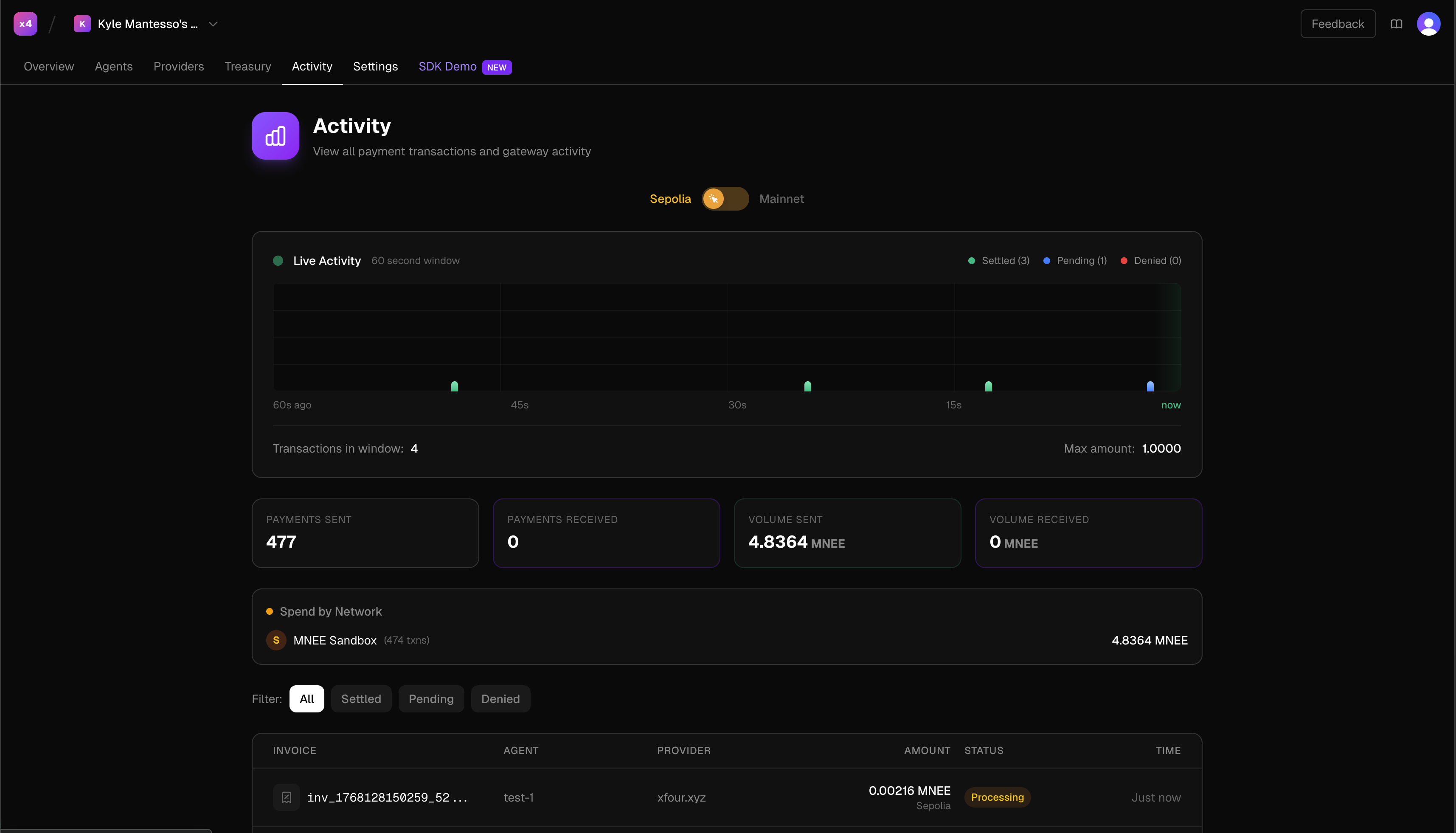
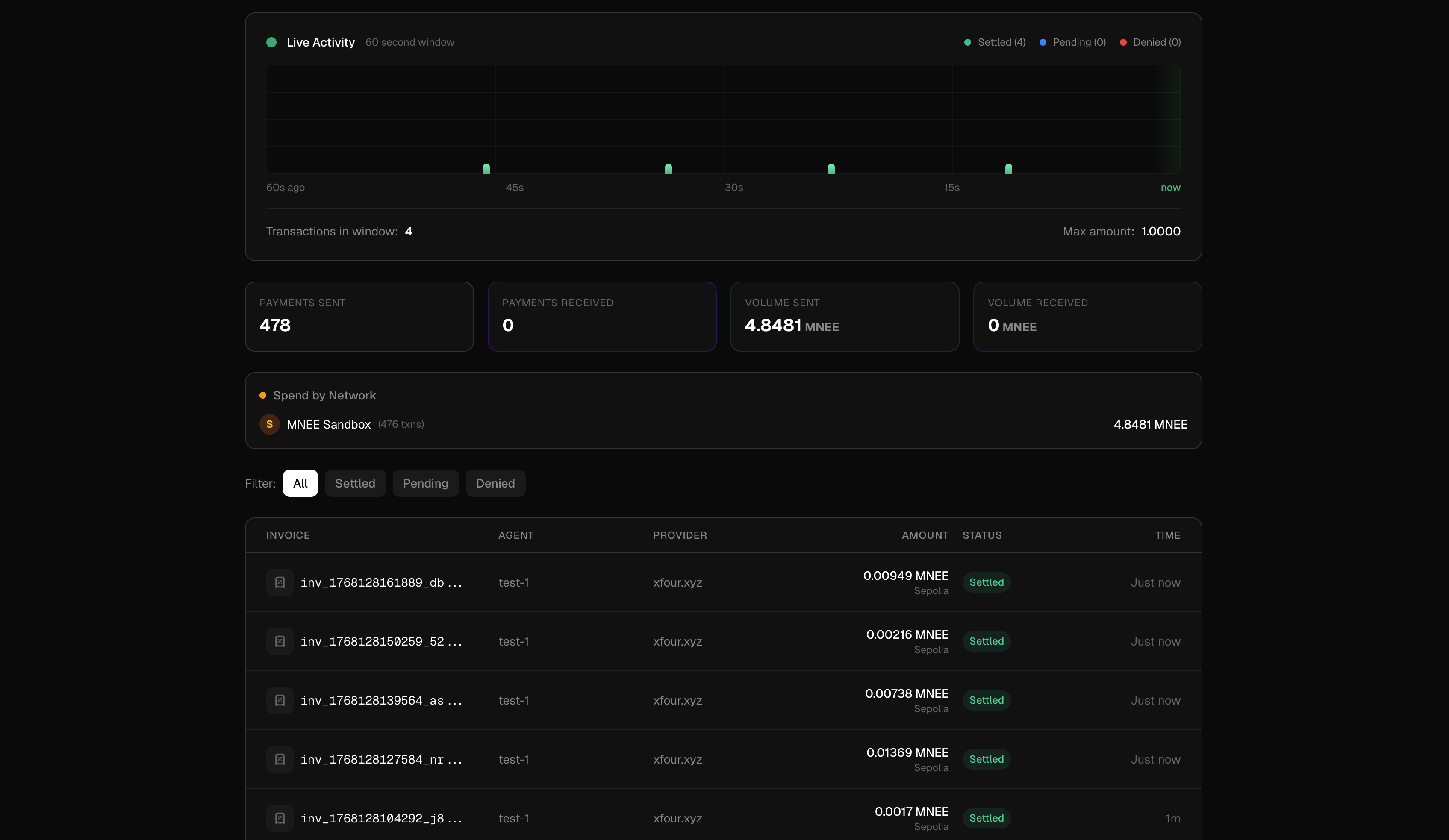
- Real-time payment activity and analytics
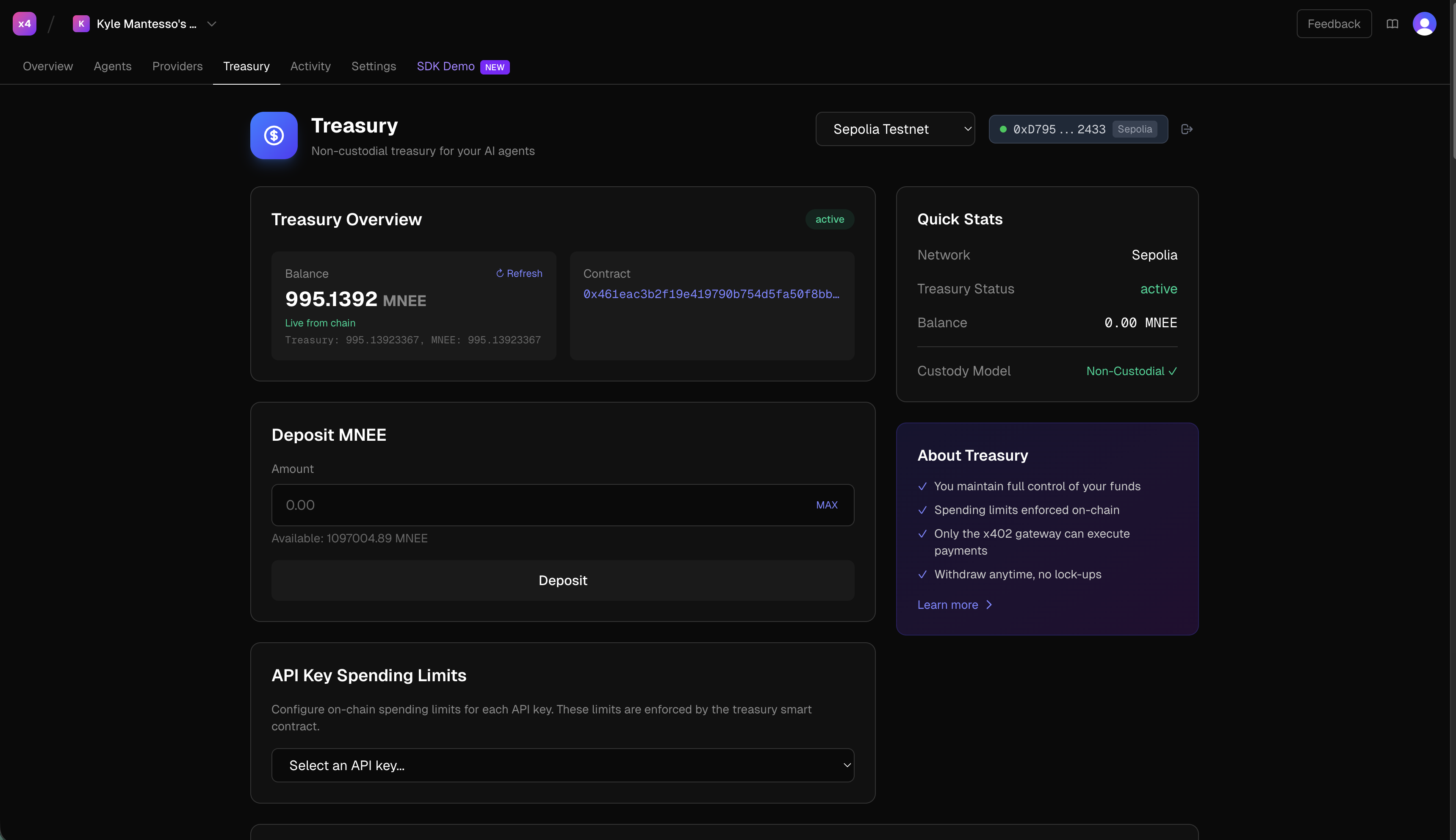
- Treasury smart contracts with on-chain spending limits
- Per-API-key spending policies enforced at the contract level
How we built it
Frontend: Next.js 15 with React and Tailwind CSS for a real-time dashboard experience.
Backend: Convex for real-time database operations, business logic, and instant subscription updates. The reactive nature of Convex means payment status updates appear instantly in the dashboard.
Smart Contracts (Solidity):
- Treasury.sol: Non-custodial treasury contract per workspace. Holds MNEE tokens and enforces spending limits (per-transaction, daily, monthly) for each API key on-chain.
- TreasuryFactory.sol: Factory contract that deploys new Treasury contracts for workspaces.
- X402Gateway.sol: Central gateway contract that executes payments across all treasuries. Uses nonces to prevent replay attacks.
- TestMNEE.sol: ERC20 test token deployed on Sepolia for development (mainnet MNEE at
0x8ccedbAe4916b79da7F3F612EfB2EB93A2bFD6cF).
Payment Flow:
- Agent makes request → API returns 402 with x402 headers
- SDK calls
/quoteto validate against spending policies (checks on-chain limits) - If approved, SDK calls
/payto execute MNEE transfer - Gateway calls
X402Gateway.executePayment()→ Treasury transfers ERC20 MNEE to recipient - Agent retries original request with proof header (transaction hash)
Security:
- Non-custodial treasuries—workspaces deploy their own smart contracts
- API key hashes stored on-chain (keccak256), spending limits enforced by contract
- Role-based access: ADMIN_ROLE for workspace owners, GATEWAY_ROLE for the x402 gateway
- ReentrancyGuard and Pausable patterns for contract safety
- Clerk for authentication with workspace-level isolation
MNEE Integration (Ethereum ERC20):
- Standard ERC20 interface with 18 decimals
- SafeERC20 for secure token transfers
- Testnet faucet built into TestMNEE contract (1000 tMNEE per hour)
- Synchronous transaction confirmation on Ethereum
Challenges we ran into
On-Chain Spending Limits: Designing a contract architecture that enforces spending limits per API key while remaining gas-efficient. We implemented daily/monthly period resets that happen lazily on each transaction to avoid expensive cron-like patterns.
Non-Custodial Design: We wanted workspaces to truly own their funds. This led to the Treasury-per-workspace pattern where each organization deploys their own contract and the gateway only has permission to execute authorized payments.
Convex + EVM Integration: Convex httpActions can't make external blockchain calls directly with wallets. We built the payment execution logic in Next.js API routes that call the contracts via ethers.js/viem.
x402 Header Standardization: There's no official standard for x402 headers. We defined our own schema (X-402-Invoice-Id, X-402-Amount, X-402-Pay-To, X-402-Network) and documented it clearly.
Gas Optimization: Batch payment execution was critical for reducing costs when processing multiple payments. The batchExecutePayments() function can process many payments in a single transaction.
Accomplishments that we're proud of
- Working SDK packages (
@x402/agentand@x402/server) that make integration trivial - Production-ready smart contracts with comprehensive security patterns (AccessControl, ReentrancyGuard, Pausable)
- On-chain spending limits that enforce policies without trusting the backend
- Real-time dashboard with live payment activity streaming via Convex subscriptions
- Complete payment flow from 402 response → quote → pay → retry, all automated
- Non-custodial architecture—workspaces control their own treasury contracts
- Clean developer experience—agents can start paying for APIs with 5 lines of code
What we learned
- Ethereum ERC20 provides a robust, well-audited foundation for programmable payments with strong tooling (ethers.js, viem, OpenZeppelin)
- On-chain policy enforcement is more powerful than off-chain—spending limits can't be bypassed even if the backend is compromised
- HTTP 402 is a sleeping giant that becomes powerful when combined with stablecoins and AI agents
- Real-time backends (Convex) transform the UX for payment dashboards—no polling, no stale data
- Factory pattern in Solidity enables scalable multi-tenant architectures where each workspace has isolated funds
- The agentic economy is real—AI systems increasingly need to autonomously acquire resources
What's next for xFour.xyz - x402 Payments using MNEE
- Provider Marketplace: A registry where API providers can list x402-enabled endpoints and agents can discover paid services
- Advanced Policies: Time-based limits, approval workflows, multi-sig treasury controls
- Analytics & Insights: Cost optimization suggestions, usage patterns, spend forecasting
- MCP Integration: Native support for Model Context Protocol so LLMs can discover and use paid tools
- Streaming Payments: For long-running agent tasks, enable per-second or per-token billing using payment channels
- L2 Deployment: Deploy on Base, Arbitrum, or other L2s for lower gas costs on high-frequency micropayments
- Cross-Chain Support: Extend the architecture to support MNEE on multiple chains with bridge integration
Technological Implementation
- Production-ready smart contracts with OpenZeppelin security patterns (AccessControl, ReentrancyGuard, Pausable)
- On-chain spending limits enforced at the contract level—can't be bypassed even if the backend is compromised
- Non-custodial treasury architecture where each workspace deploys their own contract
- Working SDK packages (@x402/agent and @x402/server) for seamless integration
- Gas-optimised batch payment execution for high-frequency micropayments
Design & User Experience
- Real-time dashboard with live payment activity streaming—no polling, no stale data
- Agents can start paying for APIs with just a few lines of code
- Clean workspace isolation for teams and organisations
- Intuitive API key management with configurable spending policies
Impact Potential
- Unlocks the $50B+ agentic transaction market by enabling true micropayments
- Drop-in SDKs for LangChain, CrewAI, and popular agent frameworks
- Scalable multi-tenant architecture ready for enterprise adoption
- Path to multi-chain support (Base, Arbitrum) for lower gas costs
Originality & Quality of Idea
- Brings the dormant HTTP 402 status code to life for the agentic era
- First non-custodial x402 implementation with on-chain policy enforcement
- Positions MNEE as the default currency for machine-to-machine payments
Solves Real Coordination Problems
- Treasury transparency—all spending verifiable on-chain
- Automated agent-to-agent commerce without human intervention
- On-chain spending limits enable shared budgeting across teams
- Gateway architecture ensures funds can only move within defined policies
Built With
- convex
- mnee
- nextjs
- node.js
- react
- typescript
- vercel


Log in or sign up for Devpost to join the conversation.