-
-
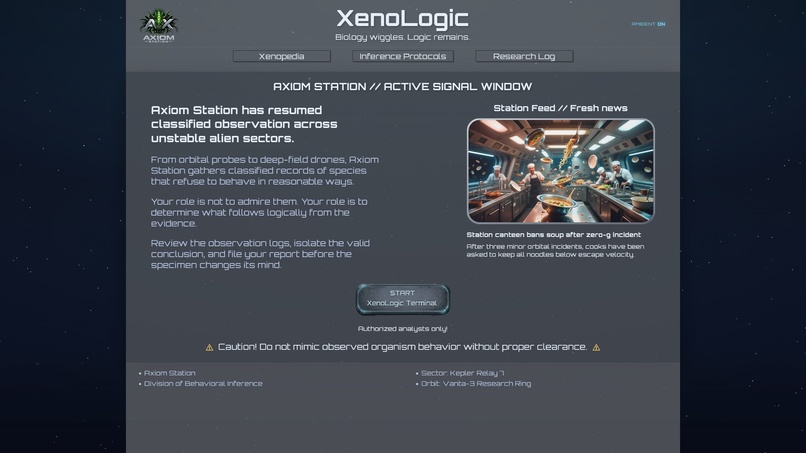
Launcher
-
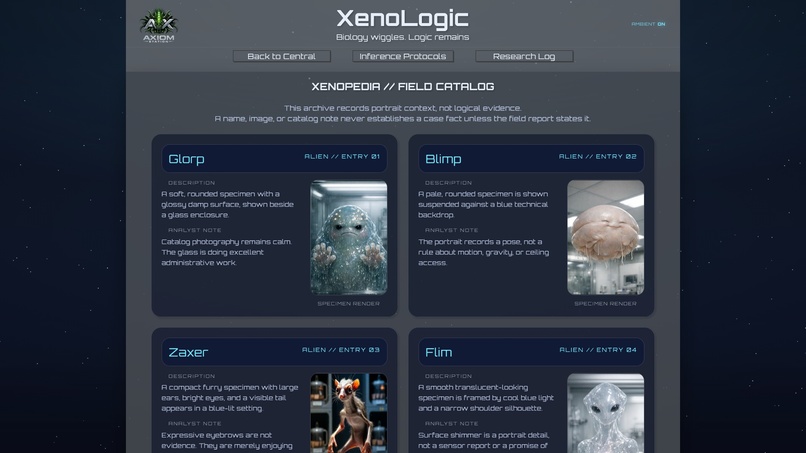
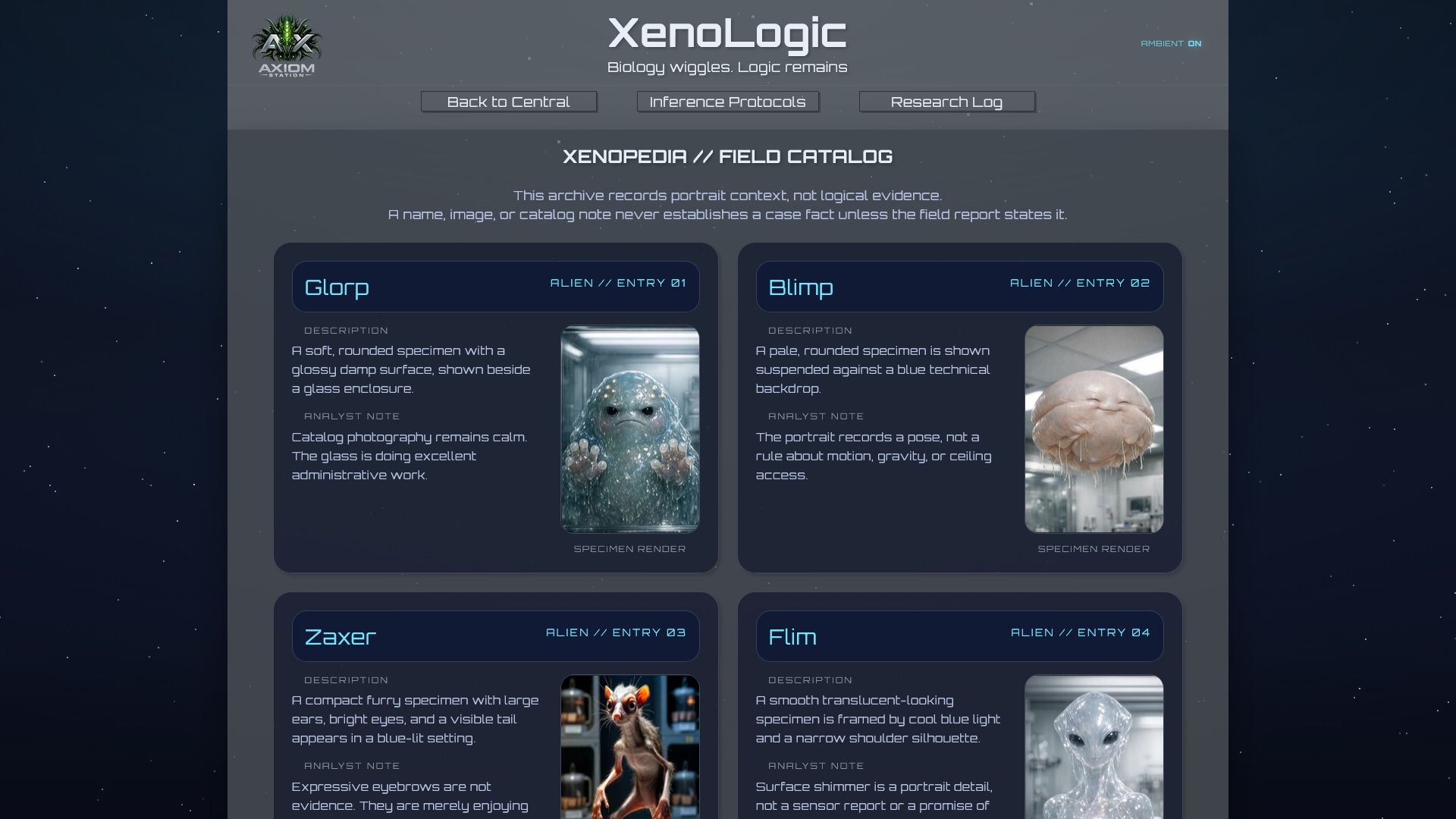
Xenopedia
-
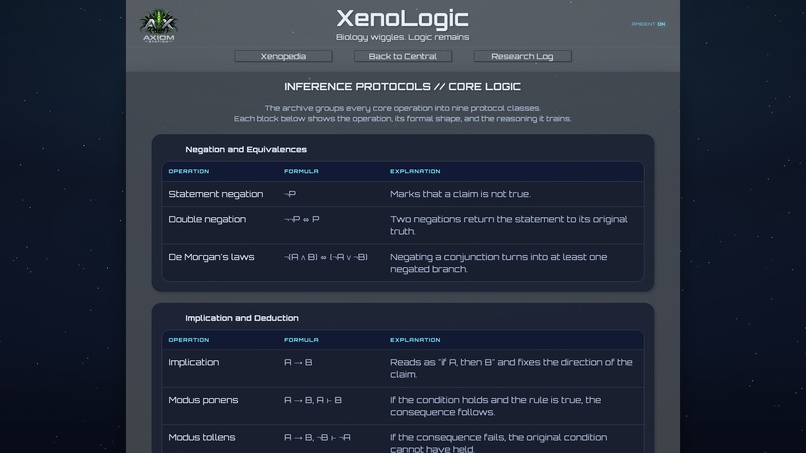
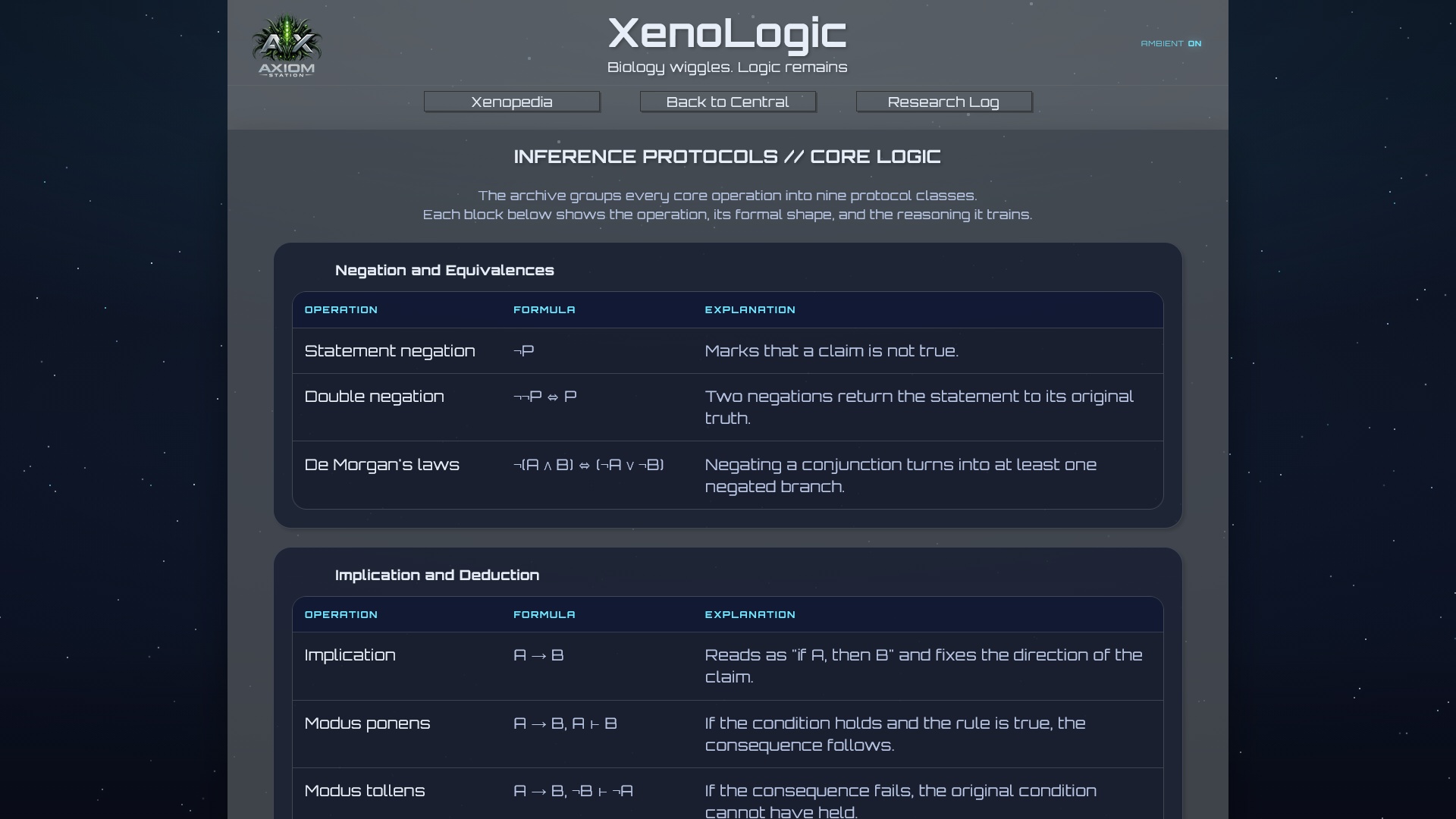
Logical operations
-
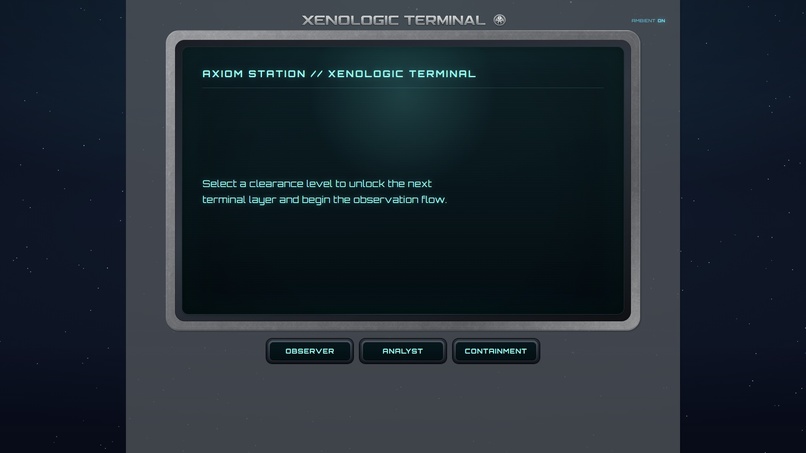
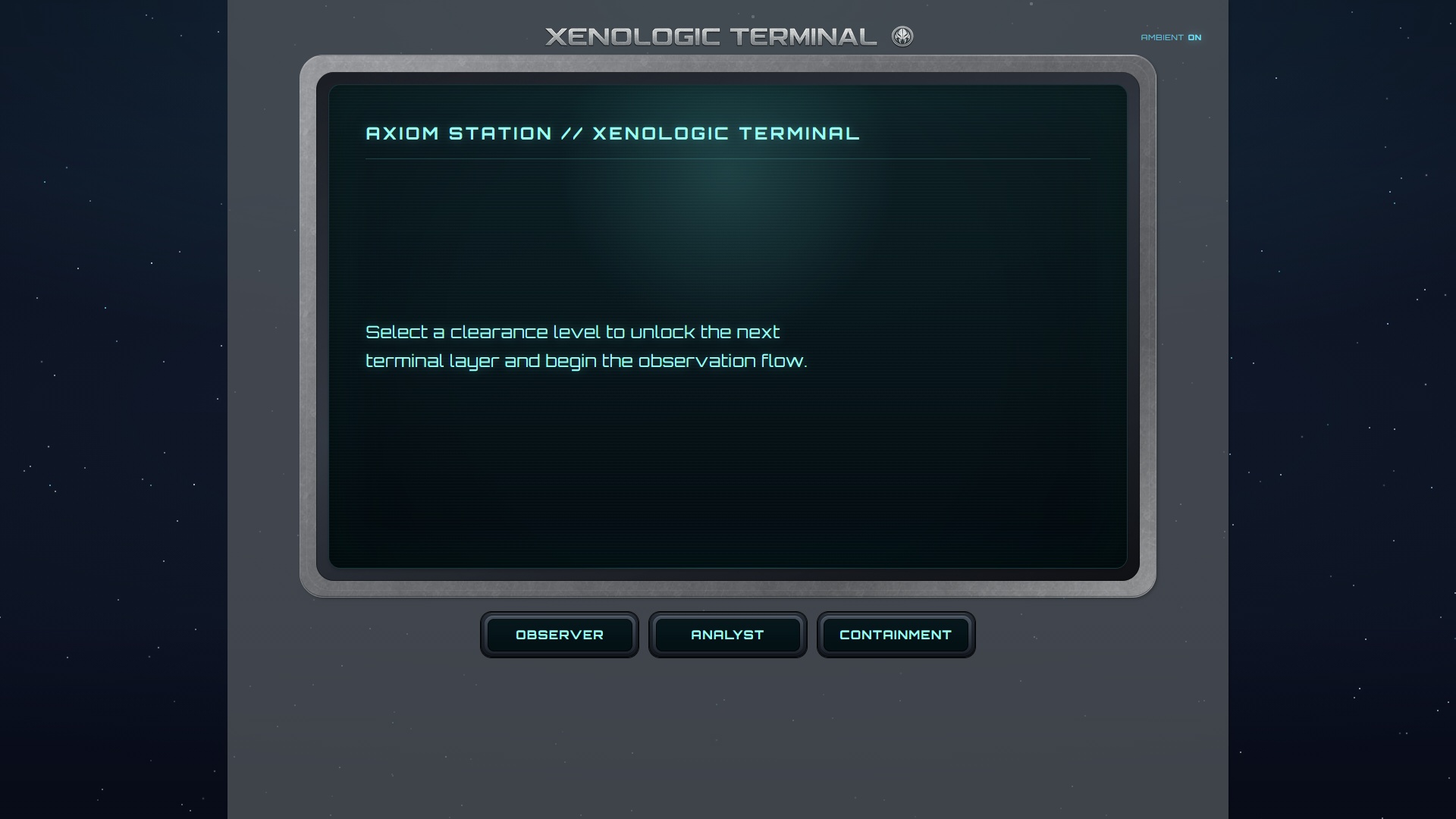
Difficulty choice
-
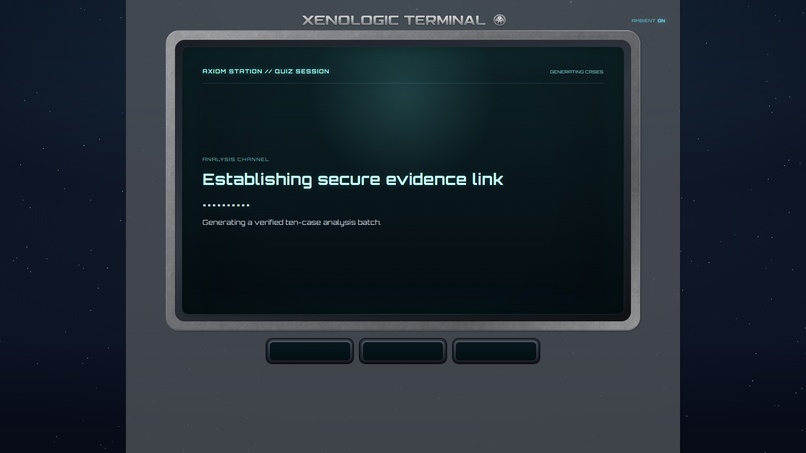
Generating session
-
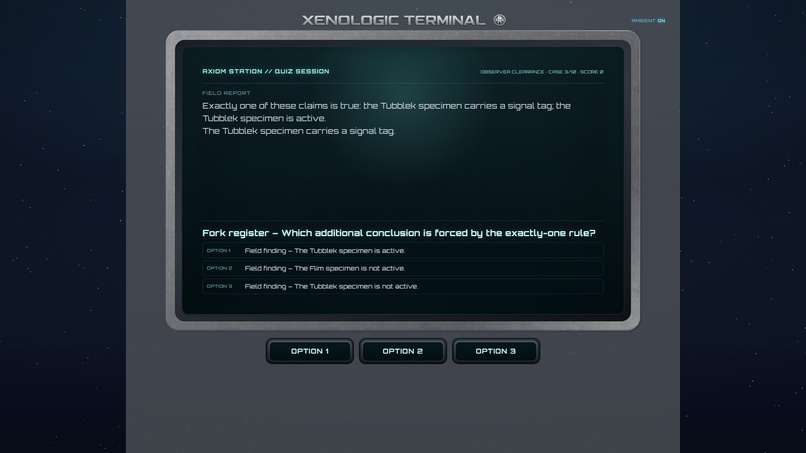
Task
-
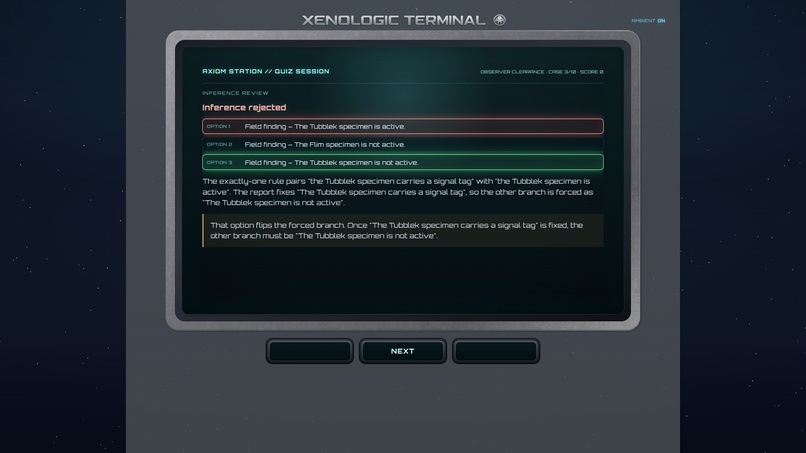
Wrong result
-
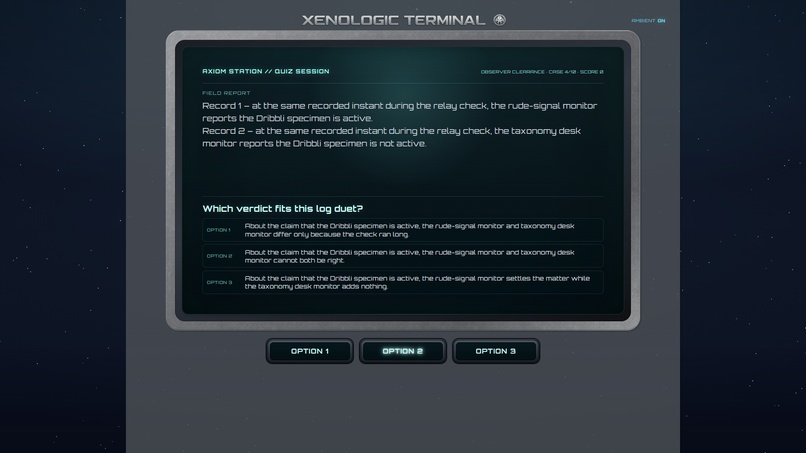
Task
-
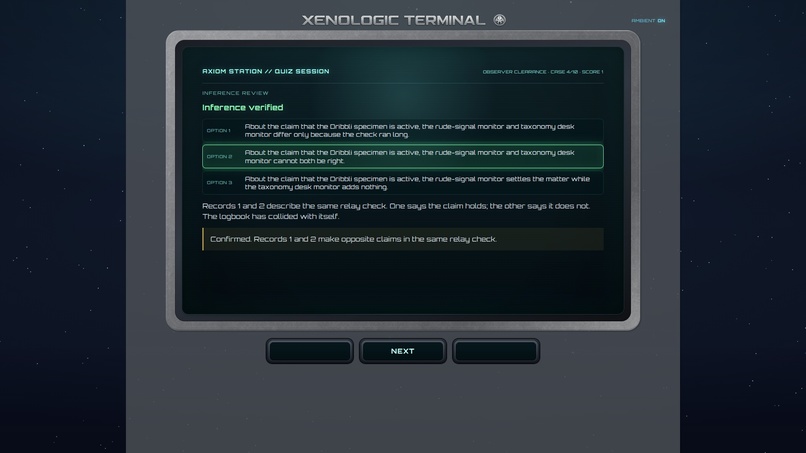
Correct result
-
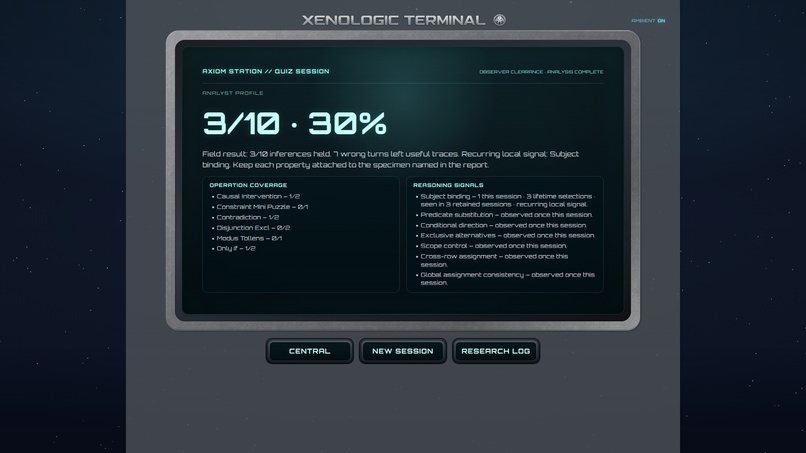
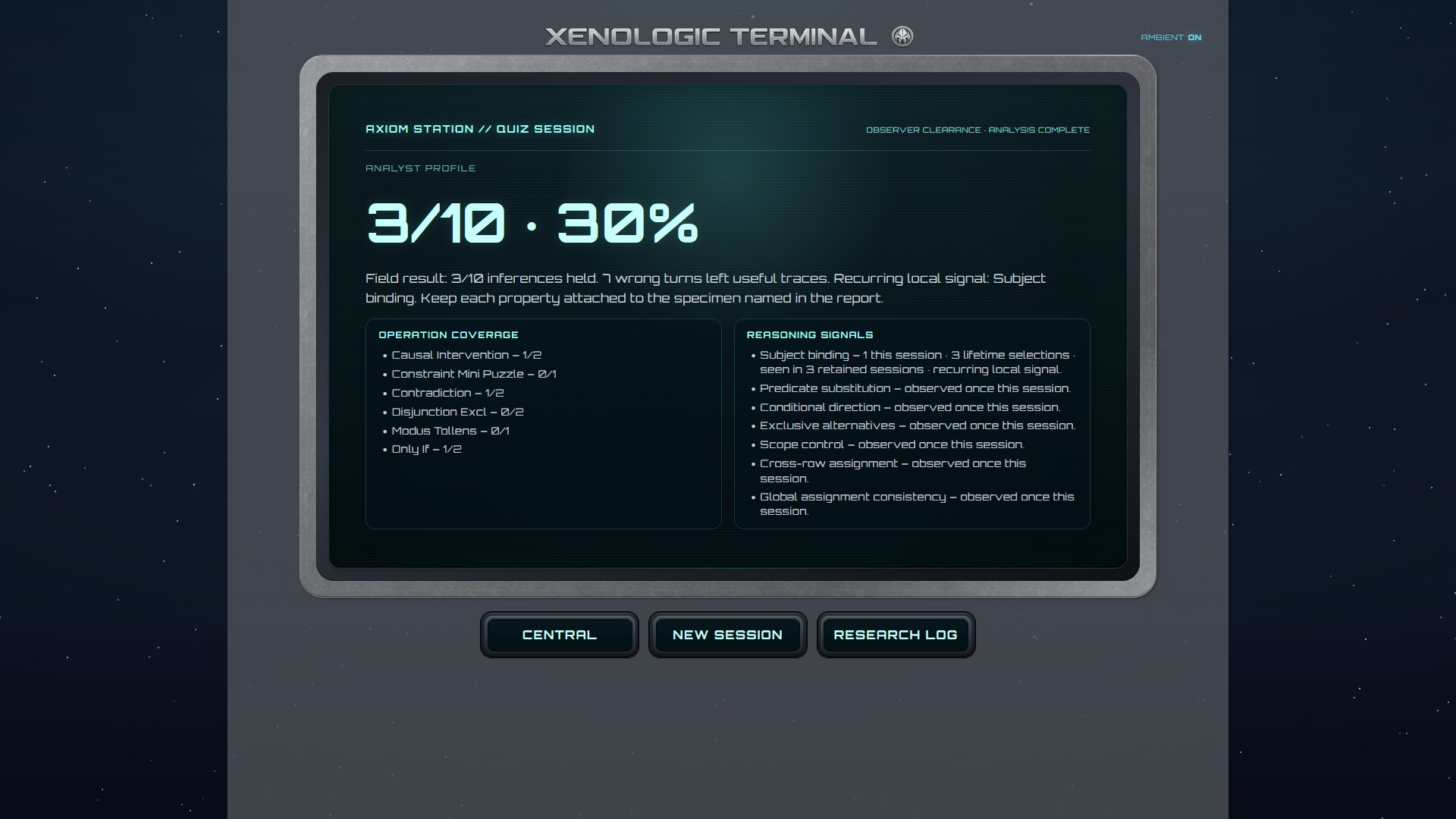
Final results
-
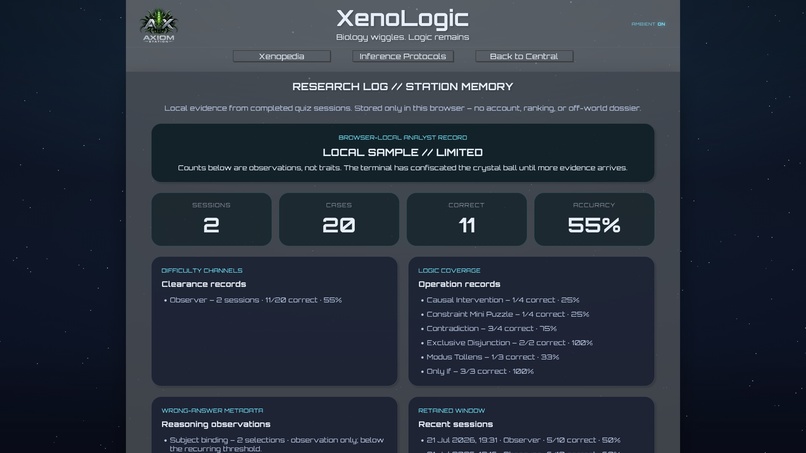
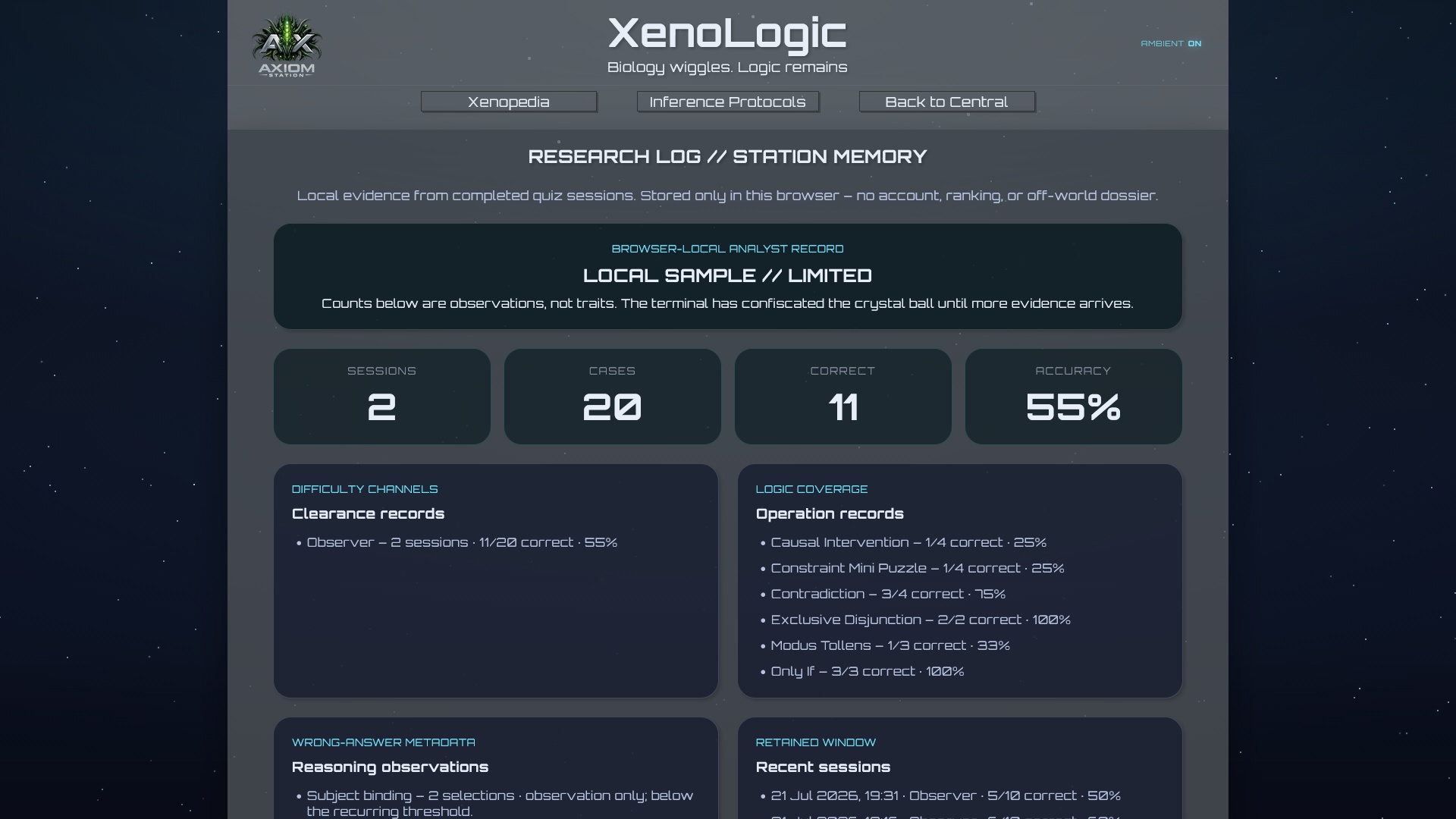
User stats
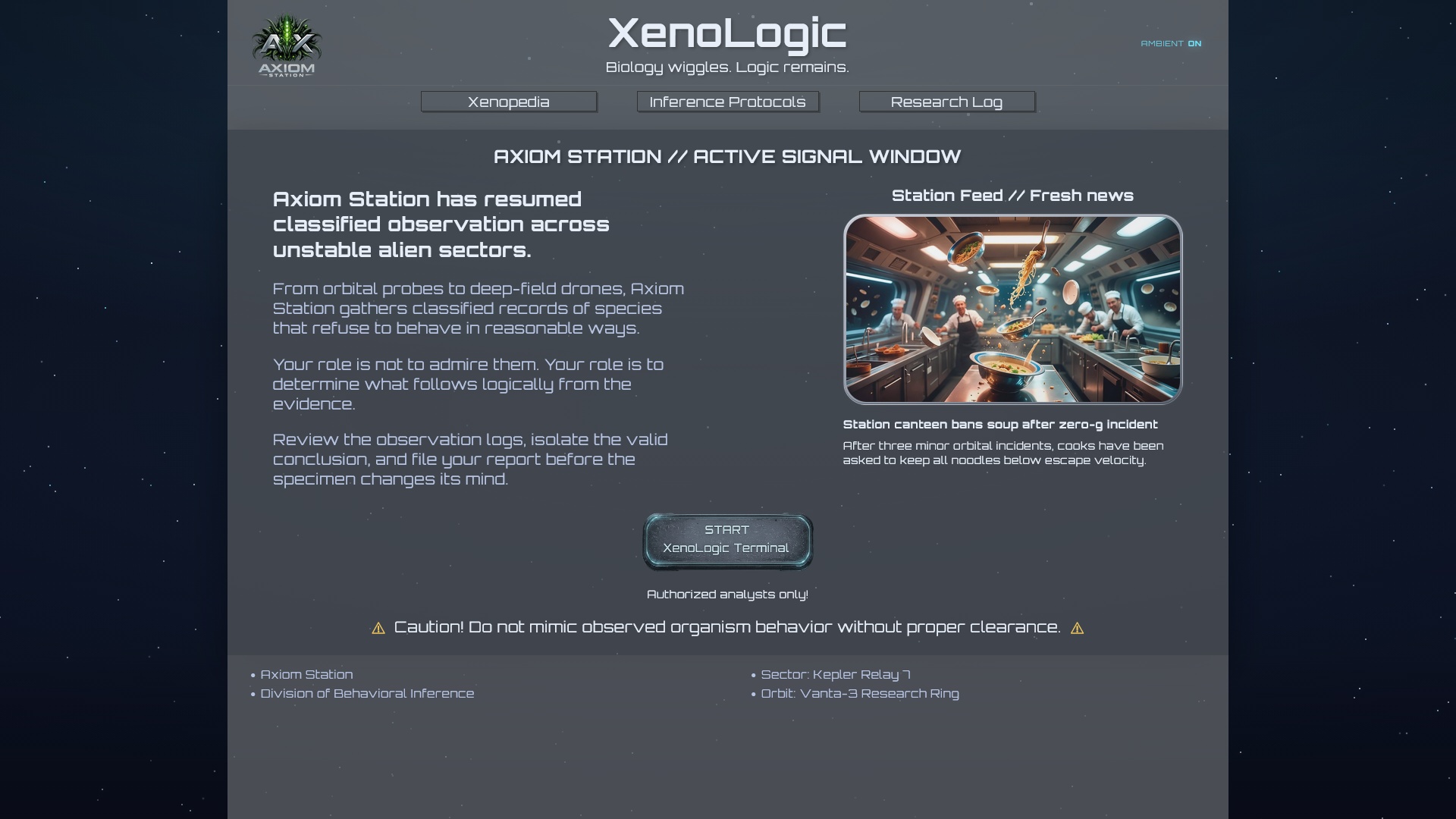
Inspiration
Most logic quizzes ask players to recognize a familiar classroom pattern. XenoLogic asks a more useful question: what actually follows from the evidence when the setting is unfamiliar, funny, and full of confident alien nonsense?
I wanted rational thinking to feel like an investigation rather than homework. The player becomes a xeno-analyst aboard Axiom Station and examines field reports involving sixteen strange species, unreliable-looking machinery, suspicious soup, and conclusions that still have to obey logic.
My AI copilot, Inferika, and I share a motto: Infero ergo sum – I infer, therefore I am. XenoLogic turns that idea into a game.
What it does
XenoLogic is a browser-based logic-training game with three clearance levels: Observer, Analyst, and Containment.
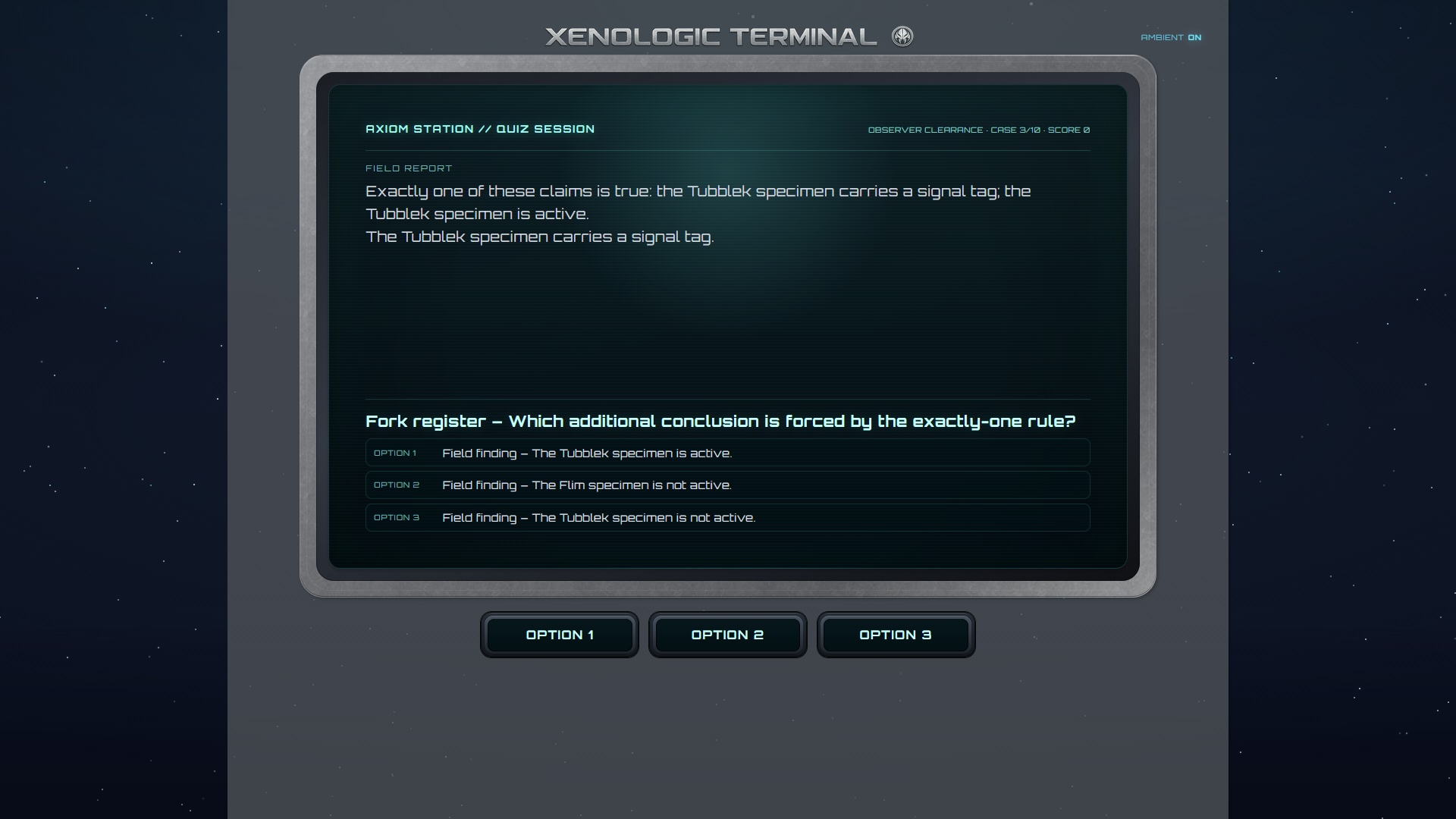
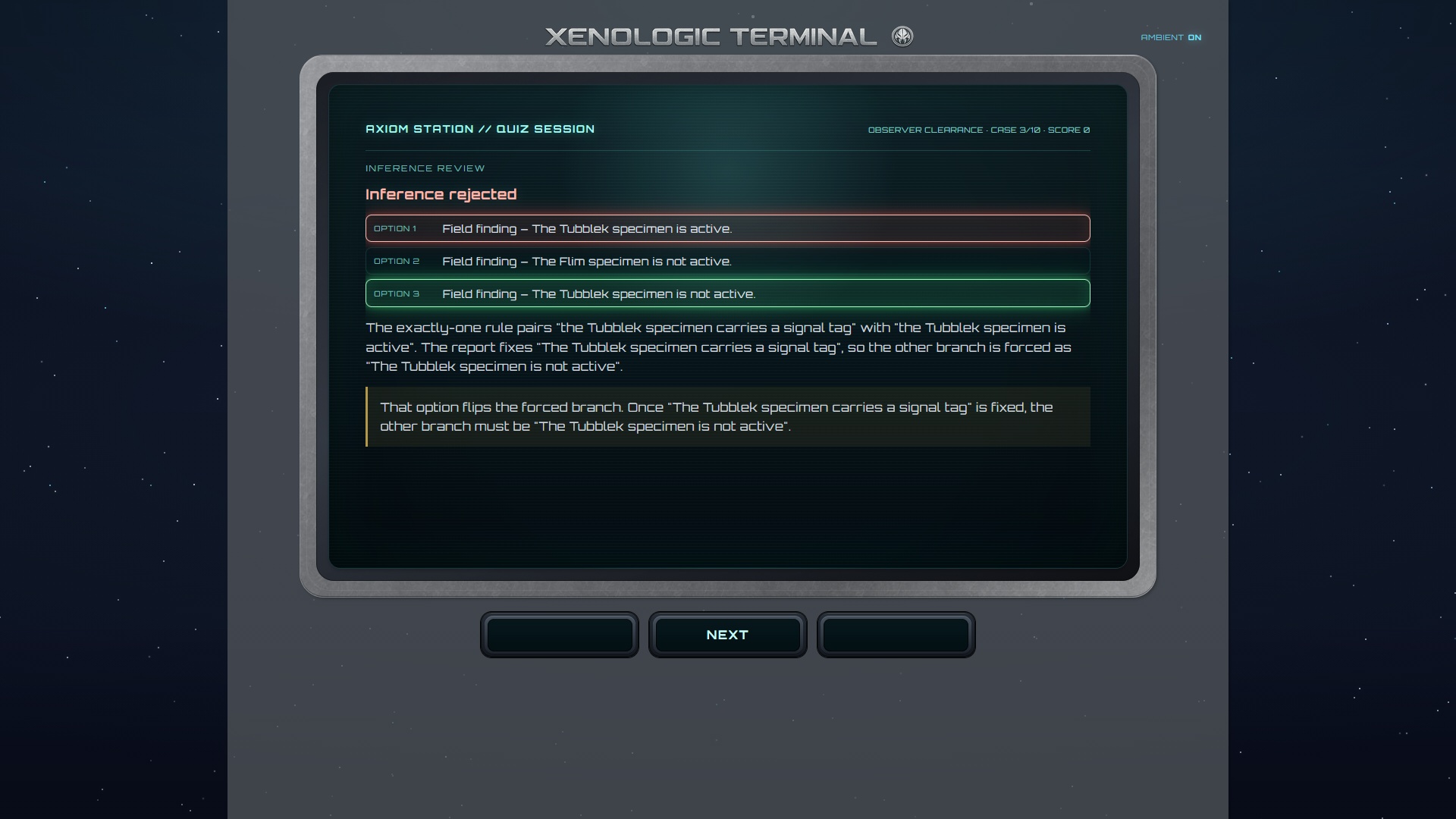
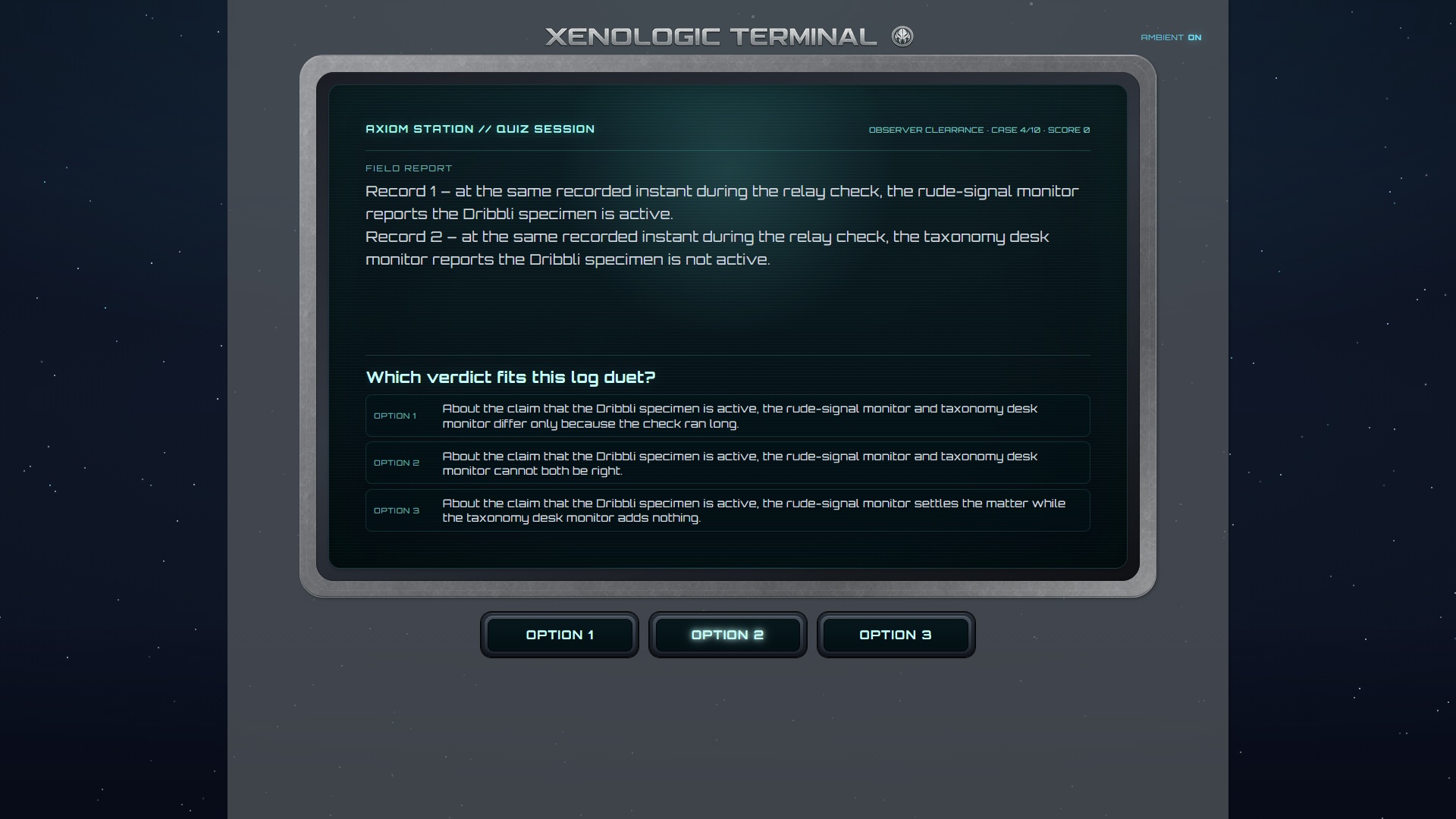
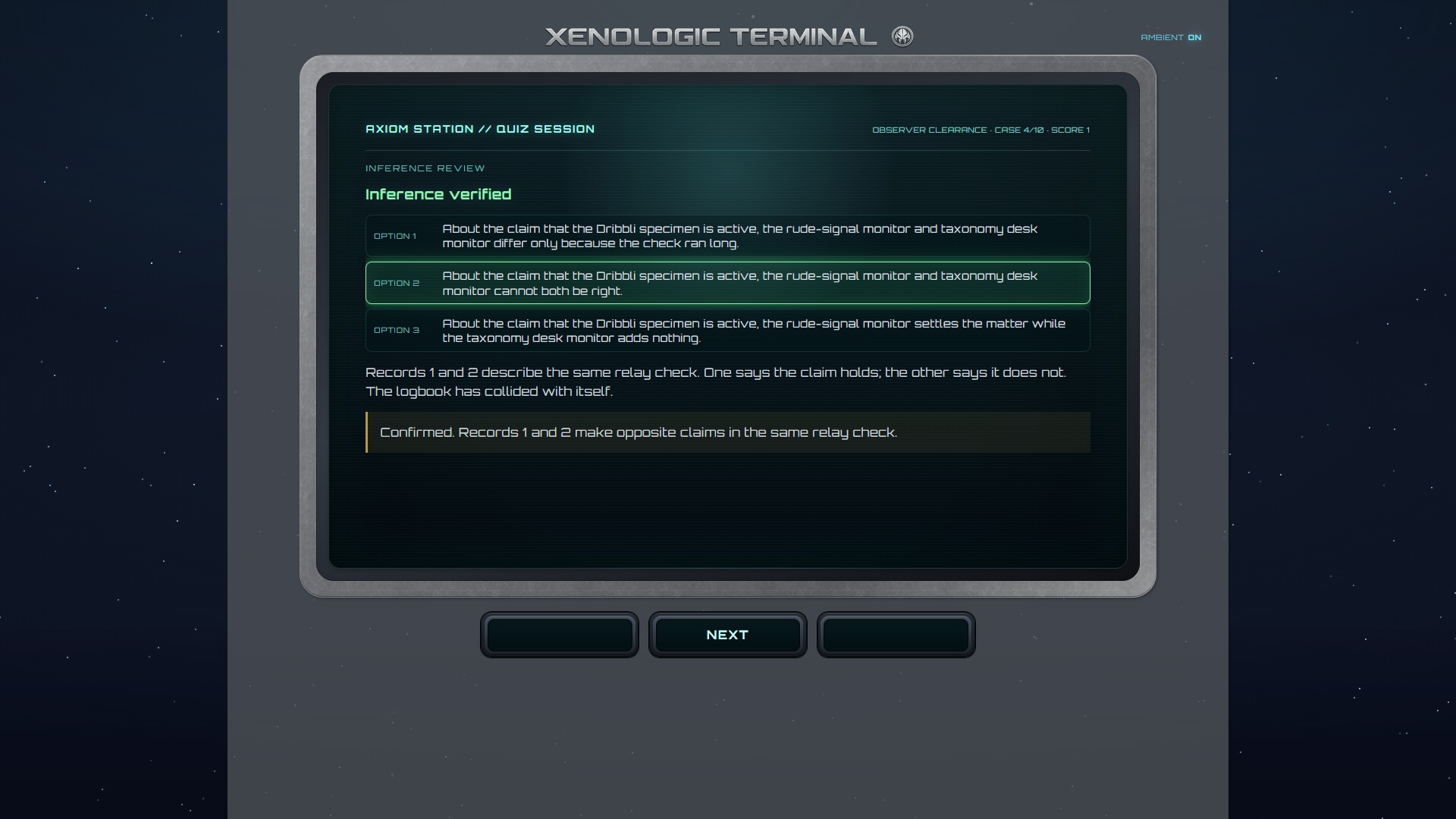
Each session contains ten alien field cases. Every case presents visible evidence, one focused question, and exactly three direct conclusions or possible world states. One answer follows from the evidence; the other two fail for distinct logical reasons.
After every choice, XenoLogic shows the supported conclusion and explains the reasoning error behind a wrong answer – for example, reversing a condition, swapping a subject, confusing possibility with necessity, or claiming more than the evidence allows.
At the end of a session, the player receives a score and an operation breakdown. The browser-local Research Log stores aggregate performance and recurring reasoning observations without registration, accounts, or server-side personal profiles. These are calibrated observations, not psychological diagnoses.
The game also includes the Xenopedia, a responsive research-terminal interface, a procedural persistent starfield, and an original AI-generated ambient soundtrack.
How we built it
I entered Build Week with a visual frontend, the basic Axiom Station lore, sixteen illustrated alien species, and a static session placeholder. I also had a mature logic-quiz donor in another project.
During Build Week, I used Codex with GPT-5.6 to transform those inputs into an independently owned working product. We reused verified logical methods and invariants, but not the donor runtime, branding, state, or deployment.
The new Build Week implementation includes:
- a deterministic Python logic engine;
- typed XenoLogic-owned world and locale data;
- proof-checked answer generation;
- diagnostic distractor roles;
- FastAPI session and result APIs;
- ten-question sessions with three difficulty levels;
- immediate explanatory feedback;
- scoring, restart, and browser-local progress;
- a responsive vanilla JavaScript terminal;
- automated review packs, counterfactual mutation checks, cue audits, and blind-solving tools;
- GitHub-to-Railway deployment and production verification.
I made the educational, product, lore, scope, and design decisions. Codex and GPT-5.6 helped inspect the donor, formalize operation contracts, implement the engine and interface, generate tests, investigate semantic failures, review bounded implementation slices, and verify production behavior.
GPT-5.6 Sol acted as the technical lead, while bounded Terra agents handled selected implementation or independent-review tasks. Their output was never self-approving: the lead inspected the actual changes, reran decisive checks, rejected weak results, and admitted only evidence-backed work.
At runtime, AI does not decide which answer is correct. Deterministic and testable logic does.
Challenges we ran into
The hardest problem was not generating more questions. It was guaranteeing that every rendered case had exactly one defensible answer, two meaningfully different wrong answers, no hidden lore premise, and no stylistic shortcut that revealed the key.
Several apparently successful evidence packs failed deeper review. We preserved those failures, repaired the contracts or auditors, regenerated the packs, and reran blind and semantic checks instead of lowering the thresholds.
Another challenge was adapting a broad donor system into one coherent world of sixteen species without producing a reskin or importing a second alien zoo. Every answer-relevant fact had to appear directly in the field report rather than being inferred from an image or external lore.
We also encountered two serious cases of AI-assisted overengineering. One implementation expanded the player contract from three answers to four. Another inserted a Card A/B/C indirection between the evidence and the conclusions to improve an internal metric. I rejected both. We removed the extra machinery and restored the direct player flow: premises, question, three semantic answers.
That became one of the most valuable lessons of the build – a sophisticated metric can still optimize the wrong thing.
Accomplishments that we're proud of
The largest accomplishment is the Build Week delta itself: XenoLogic changed from an attractive static shell into a deployed, playable educational product with an independently owned runtime.
I am particularly proud that:
- players can complete and restart full ten-question sessions at all three clearance levels;
- every public question retains the direct three-answer contract;
- answer correctness is recomputed by deterministic mechanics rather than trusted metadata;
- feedback explains both the valid inference and the specific reasoning error;
- the sixteen-species world remains coherent without becoming a hidden source of answers;
- the Research Log remains useful while collecting no account or server-side personal profile;
- failed review packs and rejected designs remain visible evidence rather than being rewritten into a perfect development story;
- hundreds of automated checks protect logic, session state, privacy boundaries, world references, rendering, and deployment;
- the production game runs freely on Railway without requiring an account.
What we learned
I learned that AI collaboration becomes much stronger when product authority and verification remain explicit.
GPT-5.6 accelerated architecture, implementation, testing, semantic pressure checks, debugging, and production delivery. But acceleration was not the same as automatic correctness. Some of the most important contributions were failed proposals, adversarial reviews, and the moments when I said no.
The project also demonstrated that educational AI does not require placing an unpredictable model inside the learner-facing runtime. AI can help construct and verify a deterministic learning system while exact logic remains authoritative for the player.
Most importantly, I learned to separate evidence from confidence. A conclusion does not become true because a human, an AI, or an alien says it with impressive posture.
What's next for XenoLogic
The next step is to continue expanding the evidence-backed operation library toward complete donor coverage while preserving the same one-answer, direct-UX, lore, and validation standards.
The existing locale architecture is also ready for separately validated Ukrainian and Norwegian packs. Future work can deepen the Xenopedia, add more field-report variety, improve accessibility and mobile polish, and turn the Research Log into a richer private learning companion without introducing accounts or diagnostic overclaims.
The rule remains simple: add depth only when it improves the player’s reasoning experience. The galaxy already contains enough unnecessary machinery.
Built With
- codex
- css3
- fastapi
- github
- gpt-5.6
- html5
- javascript
- pydantic
- python
- railway
- uvicorn

Log in or sign up for Devpost to join the conversation.