-
-
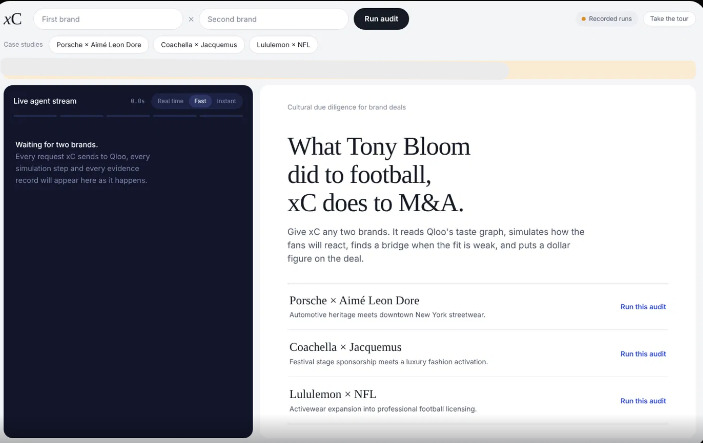
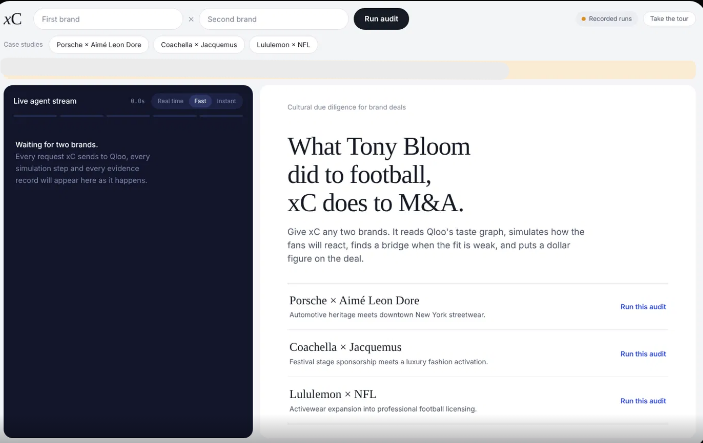
xC Interface — Editorial brand audit setup with pre-loaded case studies & live SSE stream panel.
-
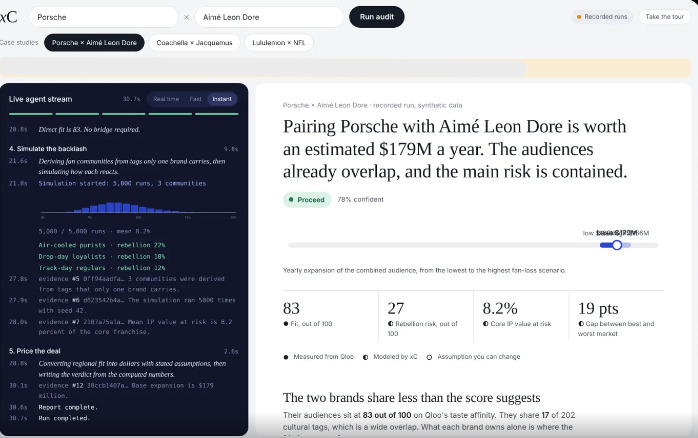
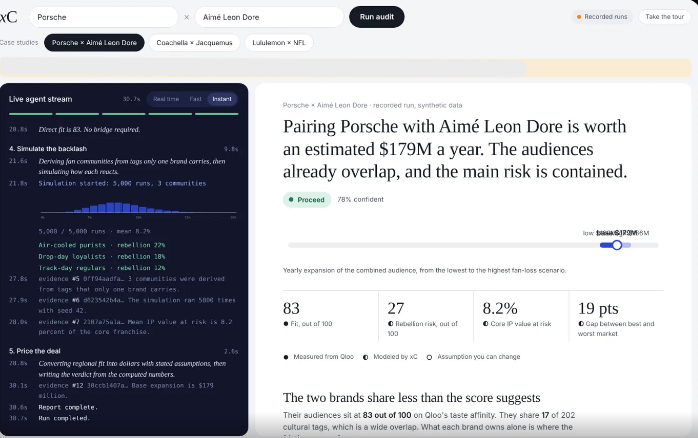
Live Audit Results — $179M valuation & backlash simulation for Porsche × Aimé Leon Dore.
-
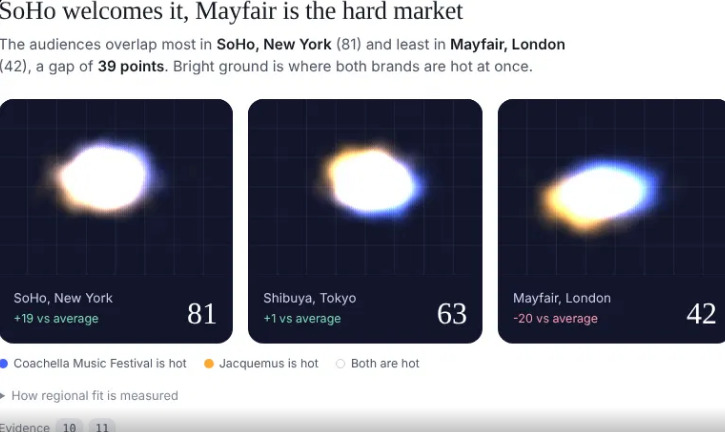
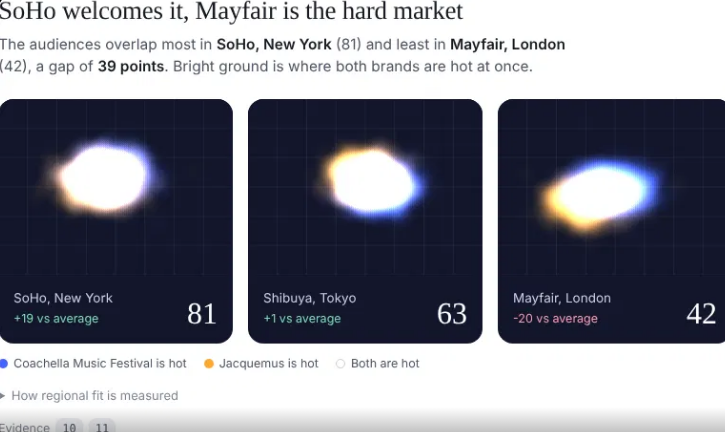
**Subculture Heatmaps** — Visualizing regional overlap for Coachella × Jacquemus across SoHo (81), Shibuya (63), and Mayfair (42).
-
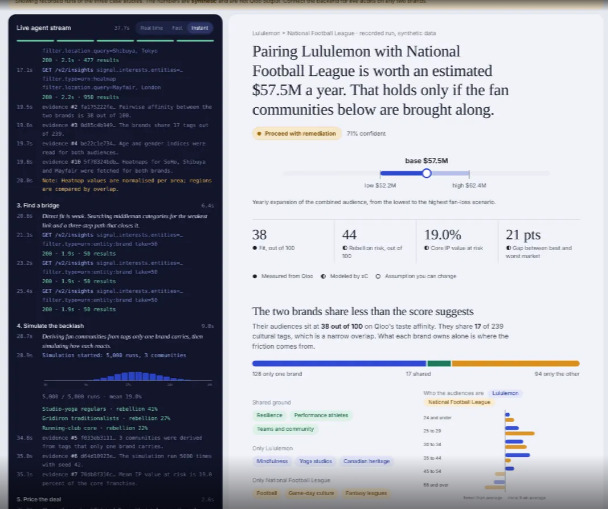
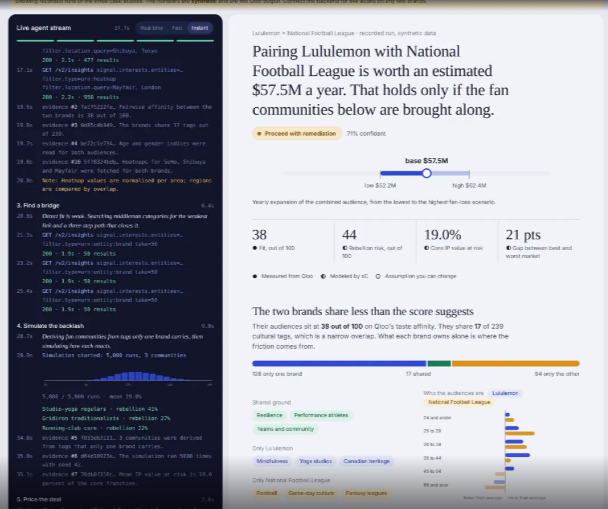
Deal Remediation Audit — Lululemon × NFL audit showing $57.5M value conditional on remediation, with a low 38 fit score & 19% IP risk.
Inspiration
Brighton & Hove Albion proved algorithms beat intuition by using data to spot hidden, undervalued footballers before the market caught on.
Yet multi-billion dollar M&A deals still rely on gut feel and agency retainers to evaluate "cultural fit"—leading to failed synergies and brand dilution.
Named after expected goals (xG), X-Culture Co-Pilot (xC) applies Brighton's quantitative playbook to enterprise deal-making.
Powered by Qloo’s taste graph, xC turns cultural affinity into a predictive metric—mapping latent brand bridges, calculating true TAM expansion, and auditing backlash risk before capital is committed.
How we built it
X-Culture Co-Pilot (xC) was built as an enterprise-grade M&A analysis stack, replacing qualitative guesswork with deterministic taste analytics.
- Taste Engine Core: Integrated Qloo’s API to process multi-domain taste graphs, querying overlapping cross-category behavioral vectors (fashion, media, automotive, dining, lifestyle) to compute raw affinity scores between target entities.
- Algorithmic Analytics Layer: Built custom data normalization pipelines to calculate:
- Latent Bridge Vector: Isolates non-obvious shared audience nodes between brands.
- xC Metric (Cultural Affinity): Converts multidimensional similarity into an actionable $0.00-1.00$ baseline score.
Pandering & Dilution Index: Scans adversarial overlap to quantify brand safety risk and audience fatigue prior to capital commitment.
Frontend Architecture: Structured with Next.js (App Router) and Tailwind CSS, utilizing streaming fetch readers for real-time Server-Sent Events (SSE) to render live metric streaming, graph visualizations, and financial sensitivity updates without interface lag.
Design & System Aesthetics: Rejected generic web components for an executive, Bloomberg/FT-inspired editorial UI—utilizing high-contrast obsidian themes (
#090D16), precise crosshair grids, crisp typography, and SVG metric readouts.
Challenges we ran into
Sparse High-Dimensional Graphs & Heatmap Normalization: Rendering real-time, cross-domain cultural affinity heatmaps (e.g., mapping niche luxury outerwear against regional craft distilleries) meant dealing with sparse Qloo taste graph intersections. We had to build custom data normalization layers so low-sample noise wouldn't warp the matrix color scales or skew baseline affinity scores.
Quantifying "Dilution" & Backlash: Turning qualitative consumer fatigue into a deterministic risk metric was hard. We had to algorithmically balance positive affinity overlaps against adversarial taste clusters to output a reliable Pandering & Dilution Index.
Zero-Slop UI Realism: Translating dense, multi-vector graph data into an executive-grade, Bloomberg/FT-inspired editorial interface required strict constraints. We had to build custom Tailwind design systems and native SVG charts to eliminate generic component bloat and keep typography razor-sharp.
Streaming Multi-Vector Calculations: Handling multi-entity cross-comparisons in real time created streaming latency bottlenecks. We solved this by using fetch body readers over Server-Sent Events (SSE) to deliver live metric updates to the frontend incrementally without UI lag.
Accomplishments that we're proud of
Deterministic Cultural Metric (xC Score): Quantified "cultural fit" from a vague marketing buzzword into a concrete, predictive index—mapping non-obvious cross-domain affinities and pricing cultural alignment like expected goals (xG).
Adversarial Dilution Engine: Successfully operationalized a real-time Pandering & Dilution Index that audits audience fatigue, cultural divergence, and brand backlash risks before M&A capital is committed.
Real-Time Data Streaming Architecture: Built a high-throughput frontend engine using Next.js App Router and fetch streaming body readers over Server-Sent Events (SSE) to render live metric updates, heatmap matrix scaling, and dynamic financial sensitivity readouts with zero interface lag.
What we learned
Cultural Affinity Has High-Dimensional Structure: We learned that consumer taste isn't linear—it operates as a complex, multi-layered graph. Mapping cross-domain affinities (like how niche architecture preferences correlate with beverage loyalty) required thinking in latent vector spaces rather than simple keyword matches.
Adversarial Signals Are Harder to Isolate Than Positive Ones: Predicting brand safety and consumer backlash (the Pandering & Dilution Index) is significantly more complex than calculating brand synergy. True cultural risk often sits in subtle subcultural friction points rather than obvious negative sentiment.
Streaming Raw Data Demands Strict Contract Design: Streaming complex cross-domain metrics over Server-Sent Events (SSE) taught us that frontend state management must be strictly decoupled from backend processing loops to maintain pixel-perfect, sub-second matrix renders.
What's next for xC
Predictive Post-Merger Trajectory Models: Train dynamic time-series forecasting models to project 12-to-36-month brand value evolution and customer retention post-acquisition.
Automated M&A Target Discovery: Build an autonomous scanning agent that constantly audits emerging cultural shifts, flagging under-the-radar subcultural entities for acquisition before they hit mainstream enterprise radar.
Live Social & Cultural Sentiment Feeds: Integrate real-time social, news, and search trends alongside Qloo’s taste graph to track instantaneous shifts in brand equity and viral backlash risks.
Enterprise API & Deal Room Integration: Expose xC’s scoring engines via secure REST/GraphQL APIs for direct integration into private equity workflows, Virtual Data Rooms (VDRs), and corporate development toolchains.
Built With
- qloo

Log in or sign up for Devpost to join the conversation.