-
-
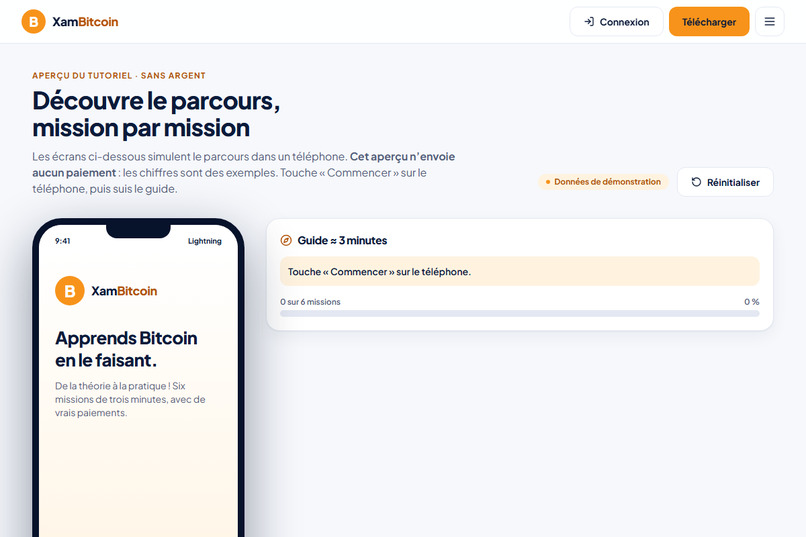
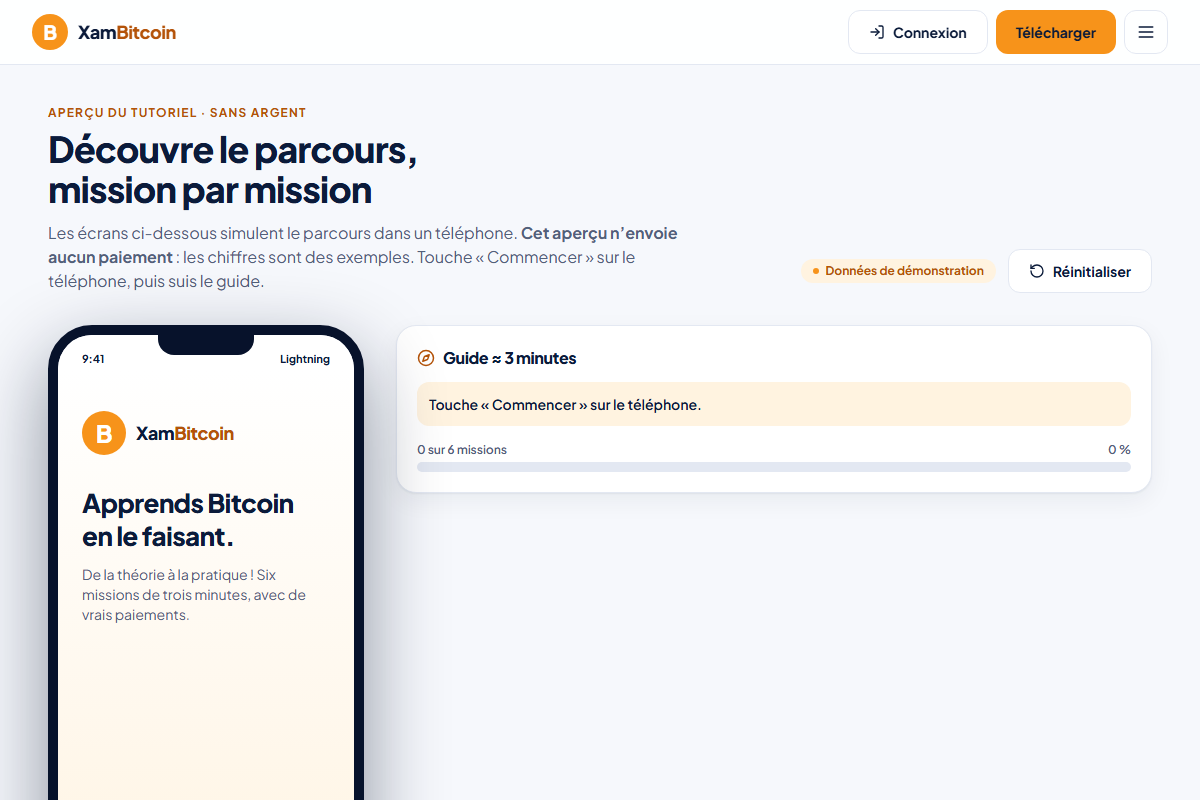
Page Apercu Tutoriel
-
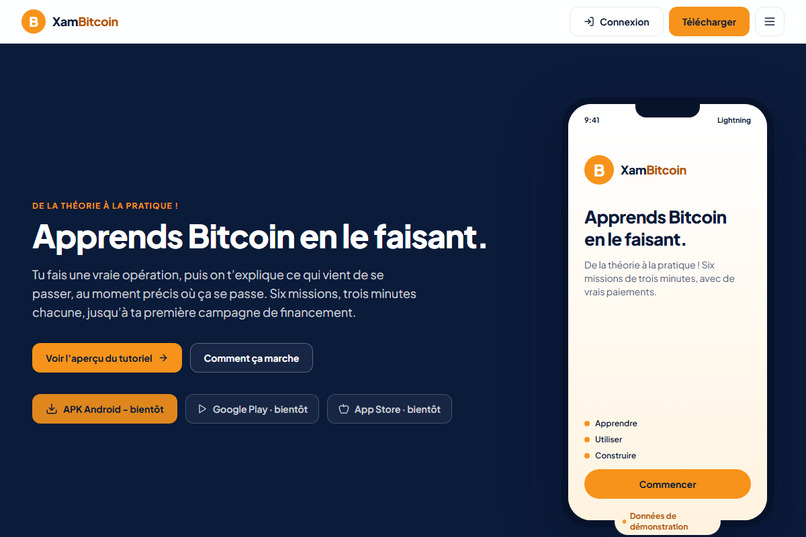
Page Accueil
-
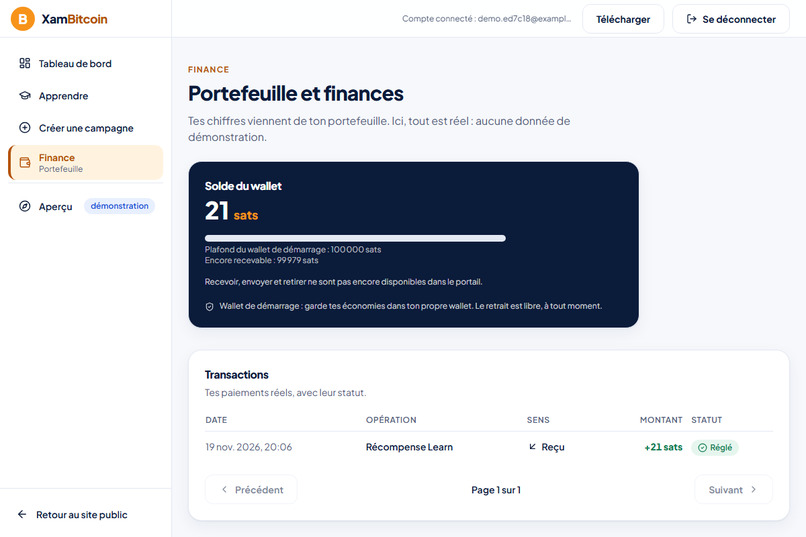
Page Portefeuille et Wallet
-
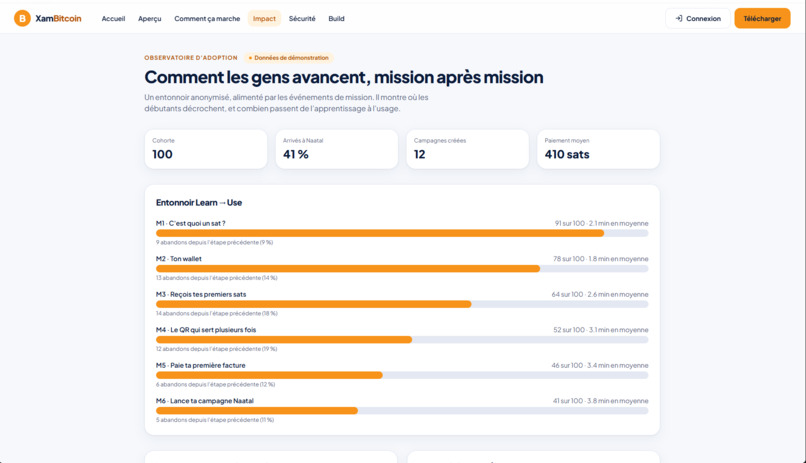
Page Impact
-
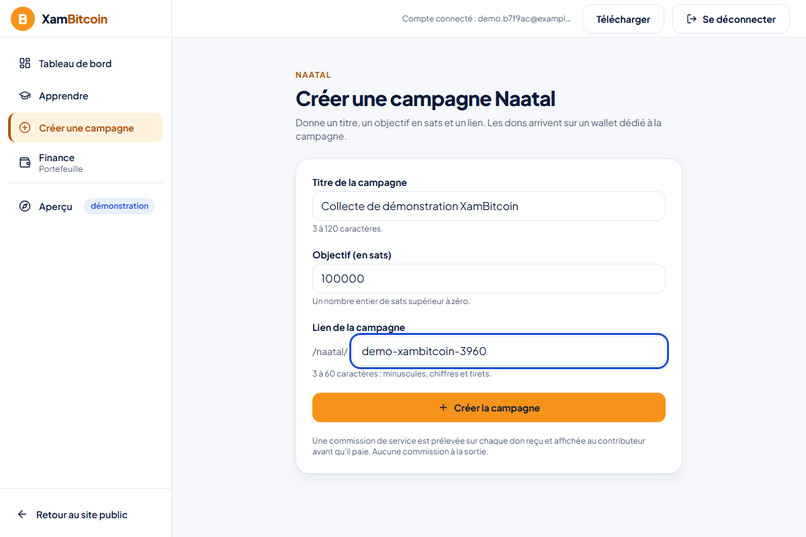
Page Création d'une campagne Naatal
-
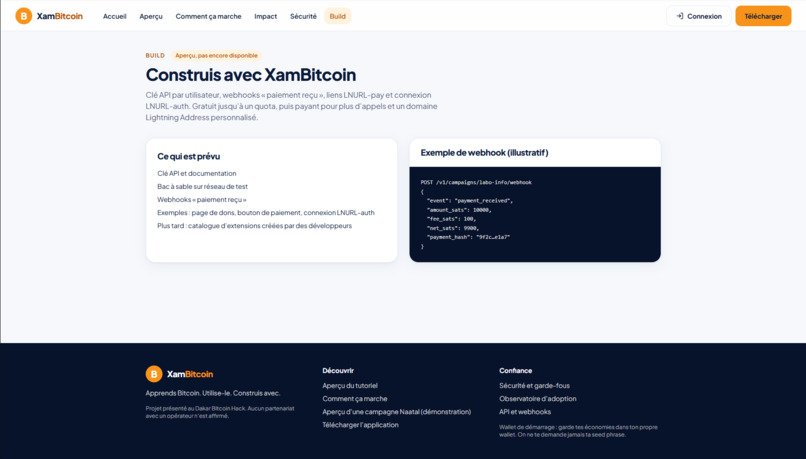
Page Build
-
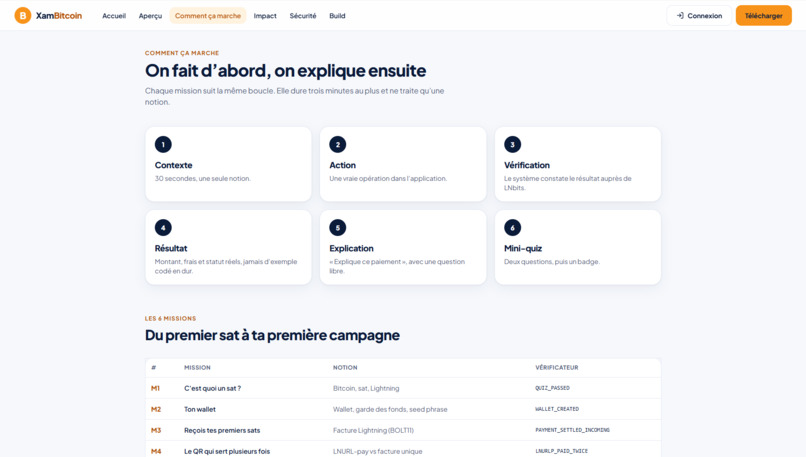
Page Comment Ça Marche
-
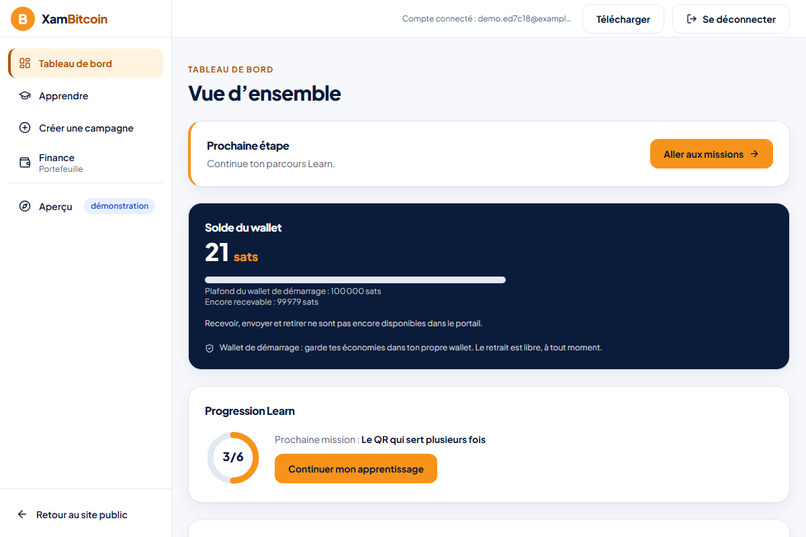
Dashboard Page
-
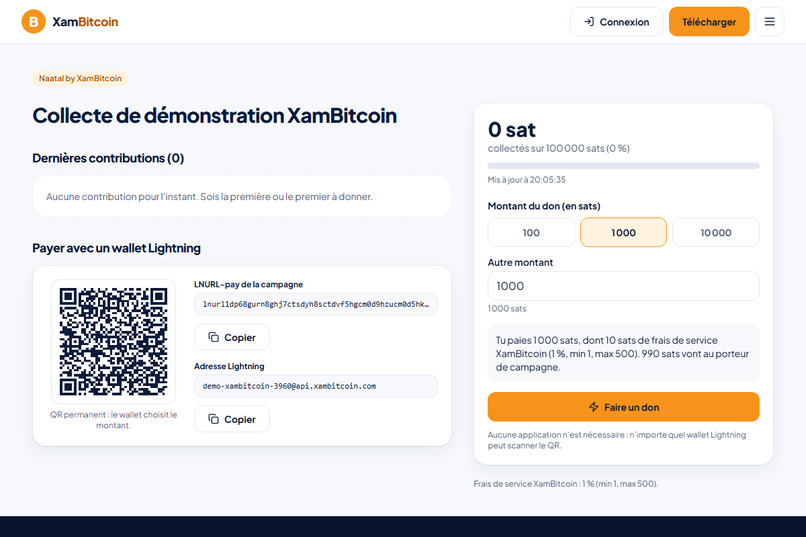
Page Paiement avec Génération LNURL PAY
-
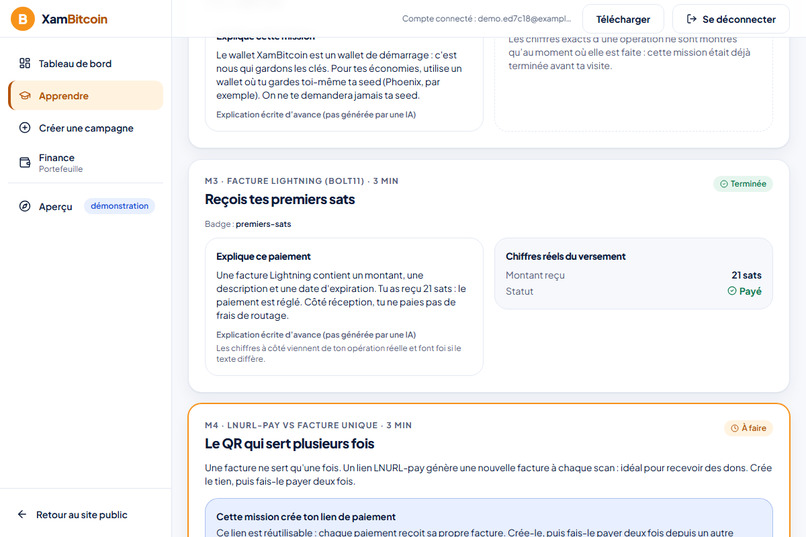
Page Apprentissage Learn
-
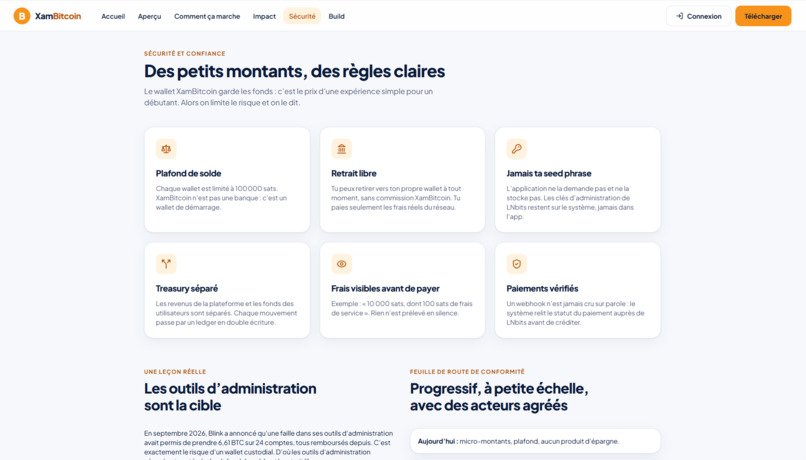
Page Security
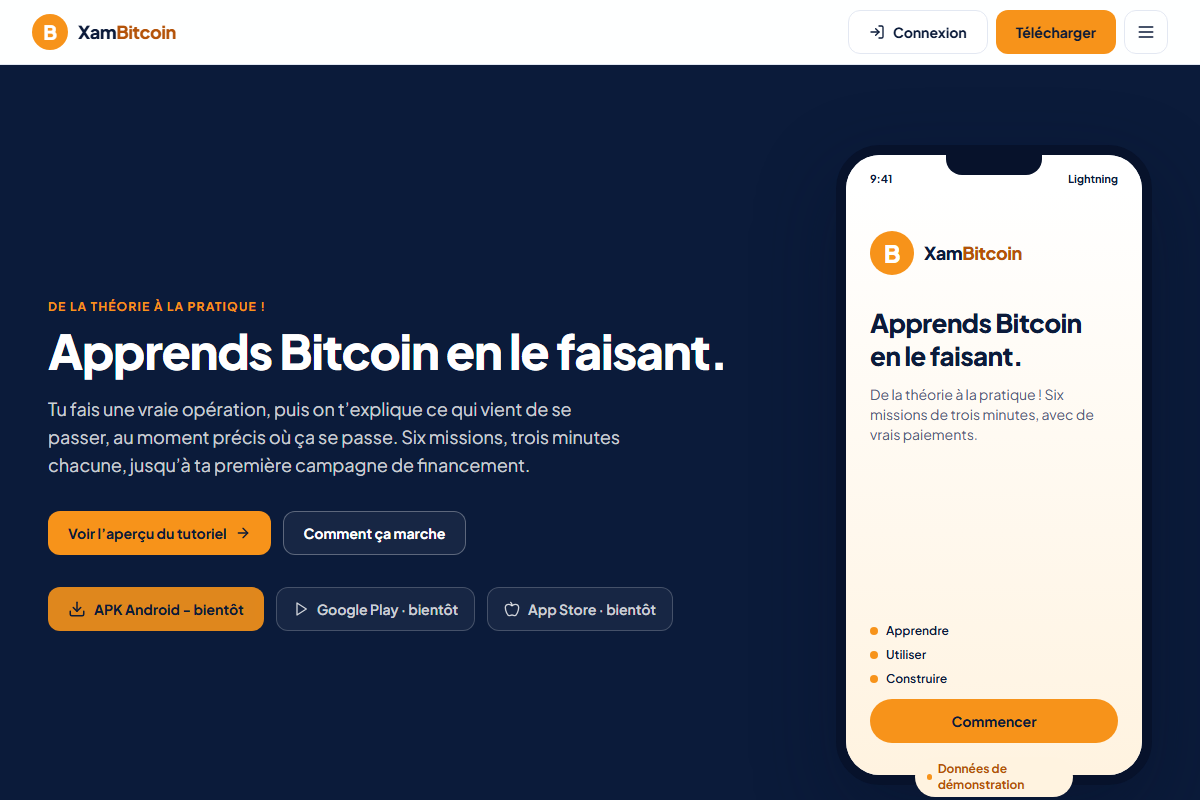
XamBitcoin - Learn Bitcoin by using it
Learn Bitcoin. Use it. Build with it. Live at xambitcoin.com, running on Bitcoin mainnet.
Inspiration
Bitcoin and Lightning are easy to describe and hard to feel. What is a sat? What does an invoice really contain? Why does a payment sometimes cost a few extra sats? Who actually holds the keys of the wallet in my phone? Even people who follow Bitcoin closely stay unsure about some of these mechanisms, and most tutorials make it worse in two ways:
- They explain first and let you try later, so the explanation lands on nothing.
- They send you to a test network, where nothing is at stake and nothing is real, so you never learn what a real fee or a real expiry feels like.
We lived this ourselves: some mechanisms stayed blurry until we saw a real payment go through with real figures. That is the idea behind XamBitcoin:
You do a real operation first. Then the app explains what just happened, using the real figures of your own payment.
The second inspiration is what comes after learning. In Dakar and across Africa, communities already pool money: a student association equipping a computer lab, a neighbourhood fund, a small shop selling on credit, a savings circle. Lightning is the natural rail for these small, frequent, borderline-free payments. So the last learning mission is the first real action of the product: launching a fundraising campaign, and the same base can later carry more modules.
We built it for the Dakar Bitcoin Hack.
What it does
XamBitcoin is one common Bitcoin and Lightning base (wallet, payment engine, double-entry ledger, receipts, treasury) with three layers on top:
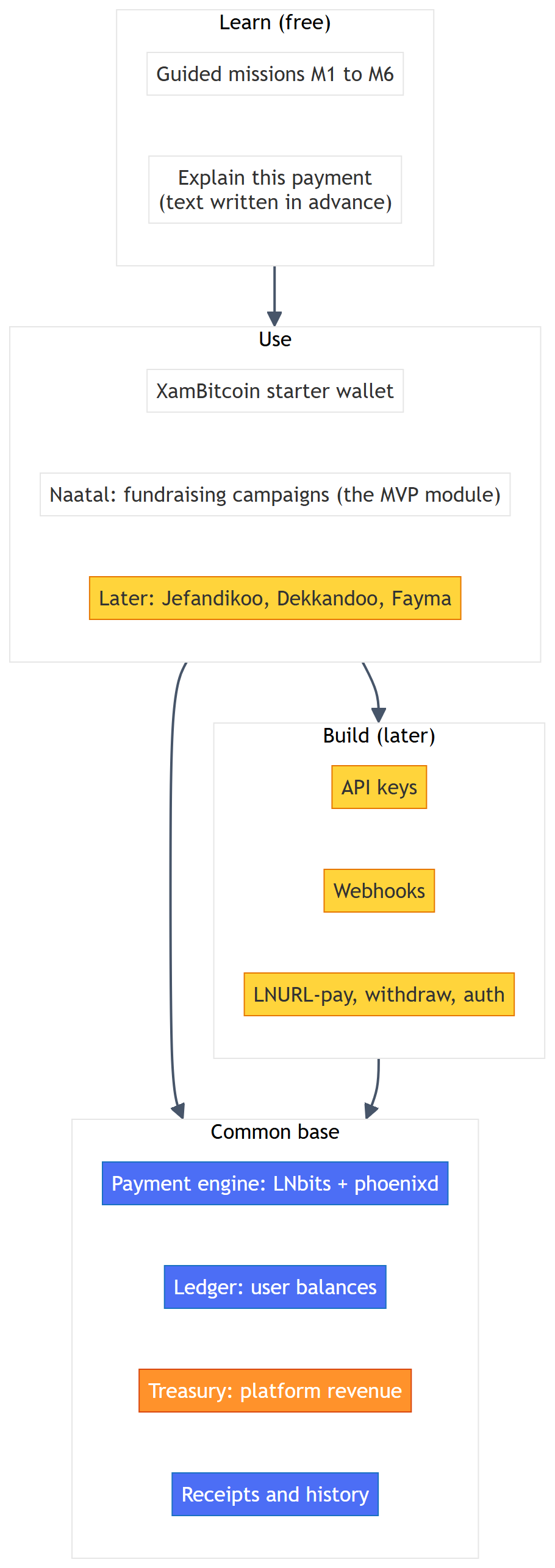
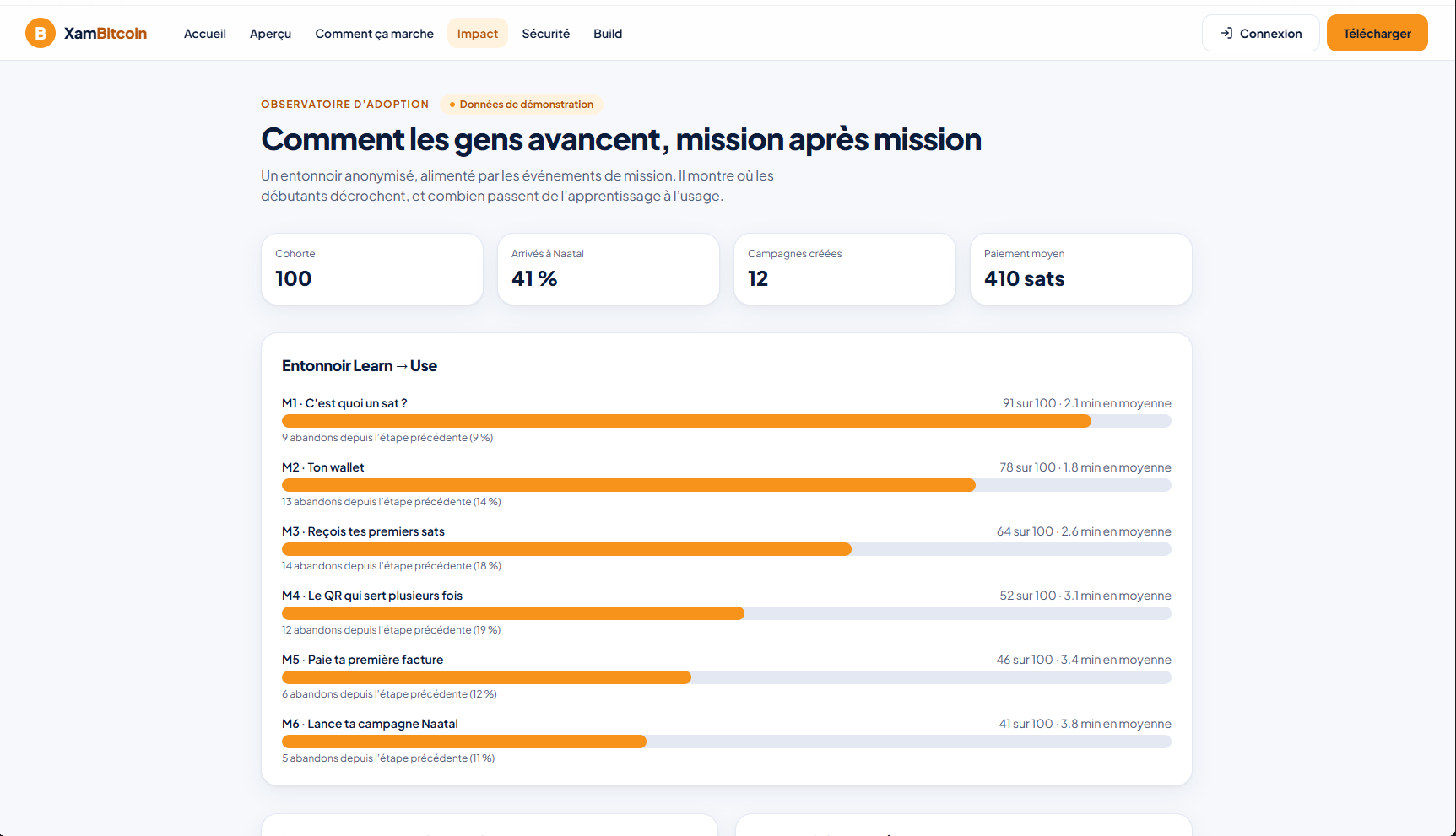
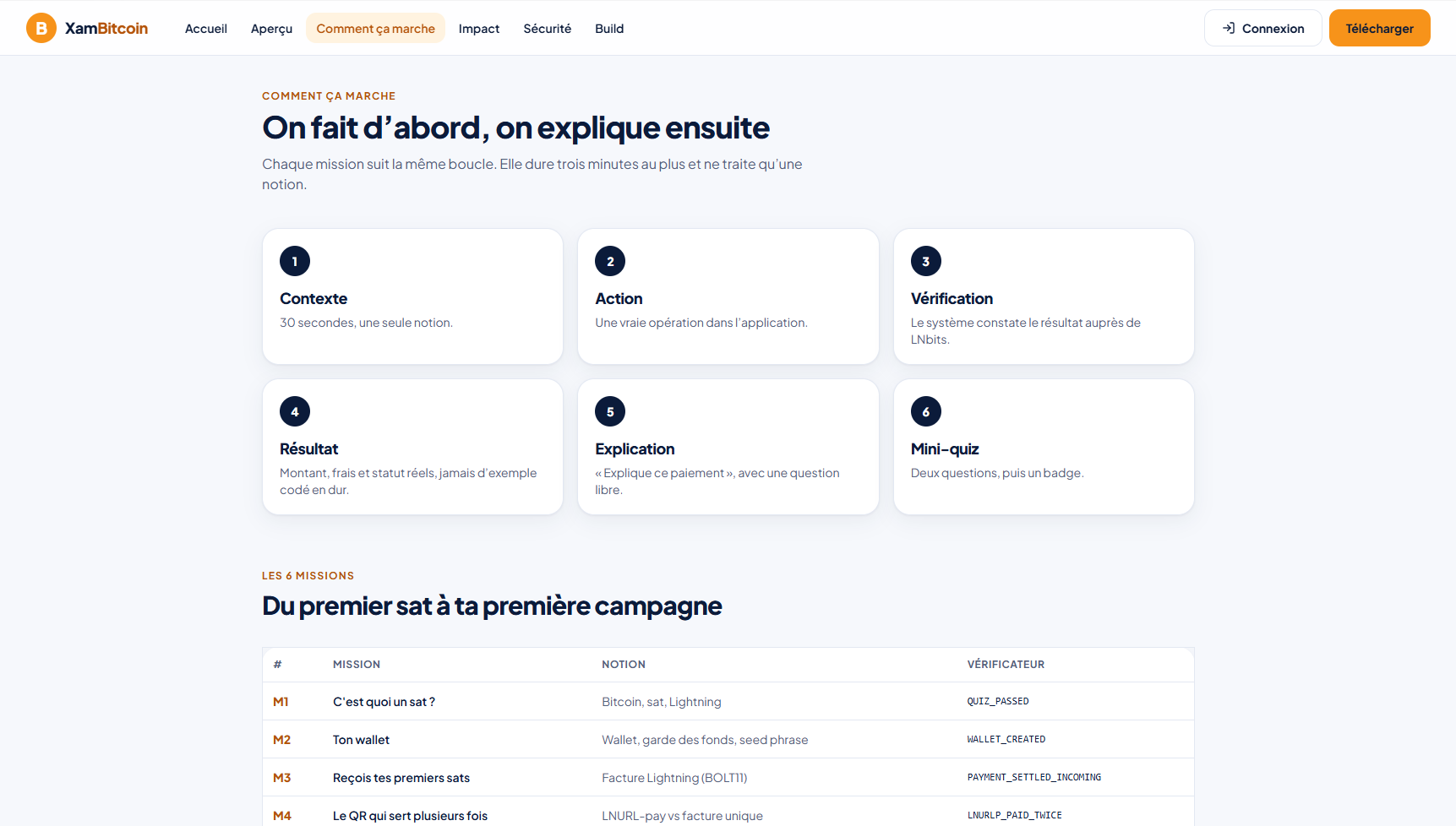
Learn: six missions of three minutes
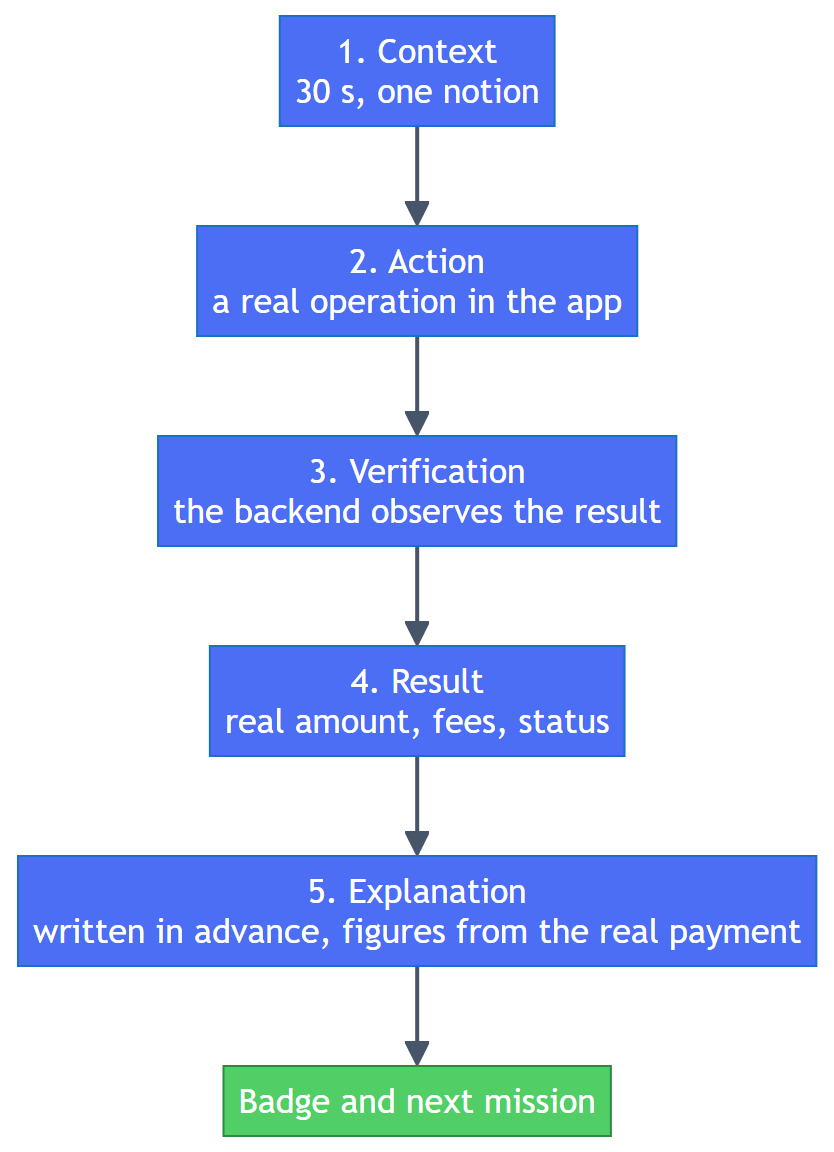
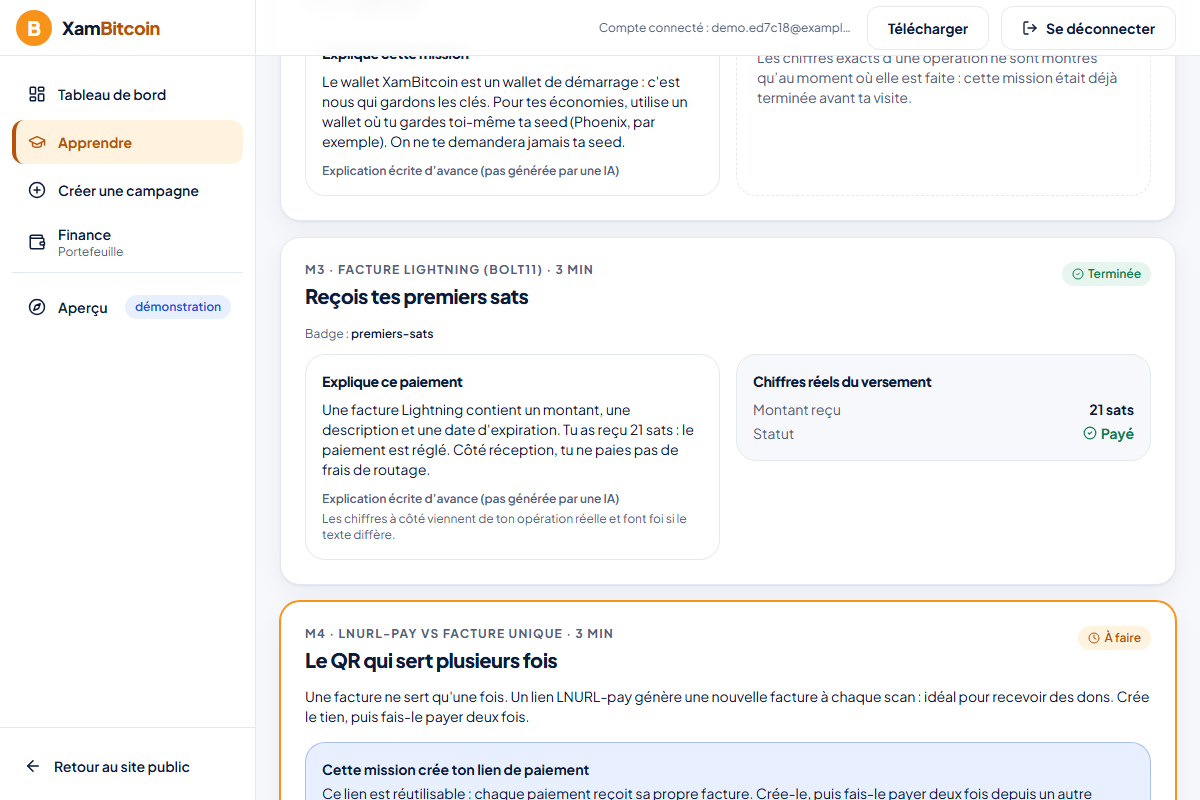
Every mission follows the same loop: context, real action, verification by the backend, real result, written explanation.
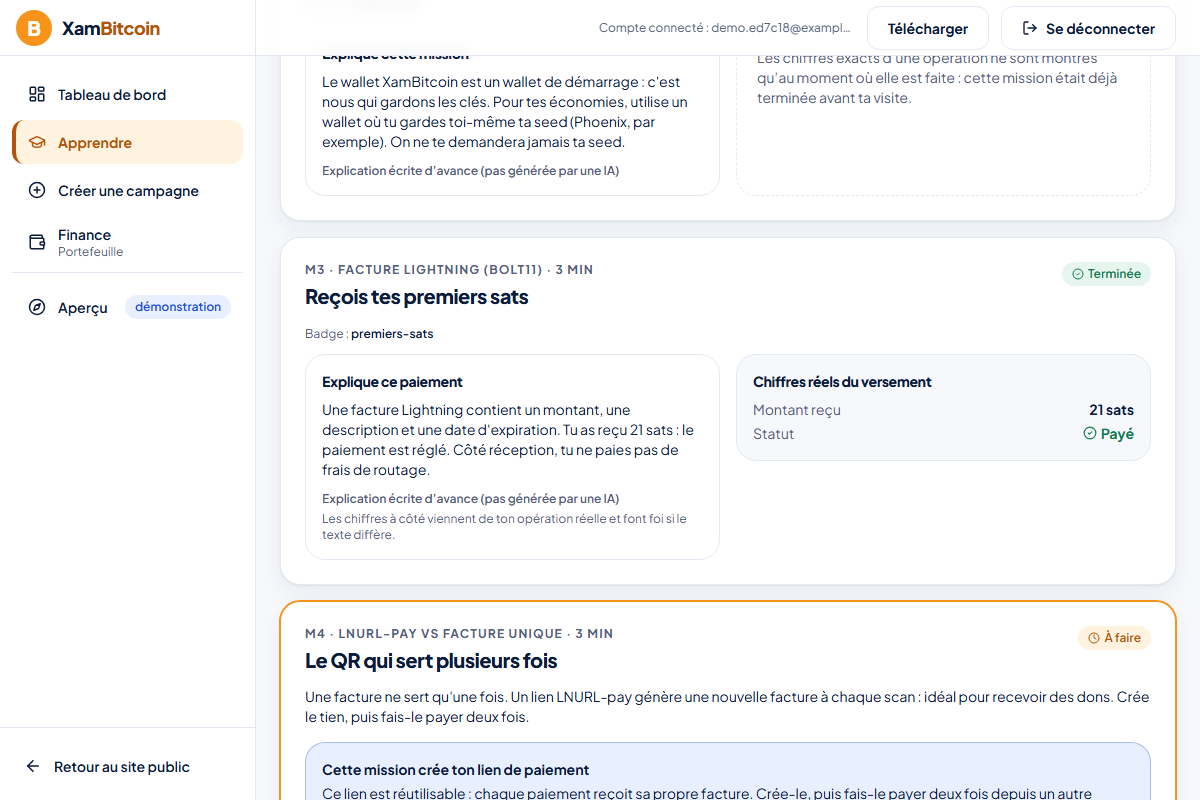
| # | Mission | What the learner does | What is explained afterwards | Status on the live site |
|---|---|---|---|---|
| 1 | What is a sat? | A 3-question quiz, graded by the server | 1 BTC = 100,000,000 sats; Lightning = fast, cheap payments on top of Bitcoin | Real |
| 2 | Your wallet | Activates the starter wallet, sees a 0 balance | It is a starter wallet: we hold the keys; keep savings in a wallet where you hold your seed; we never ask for a seed | Real |
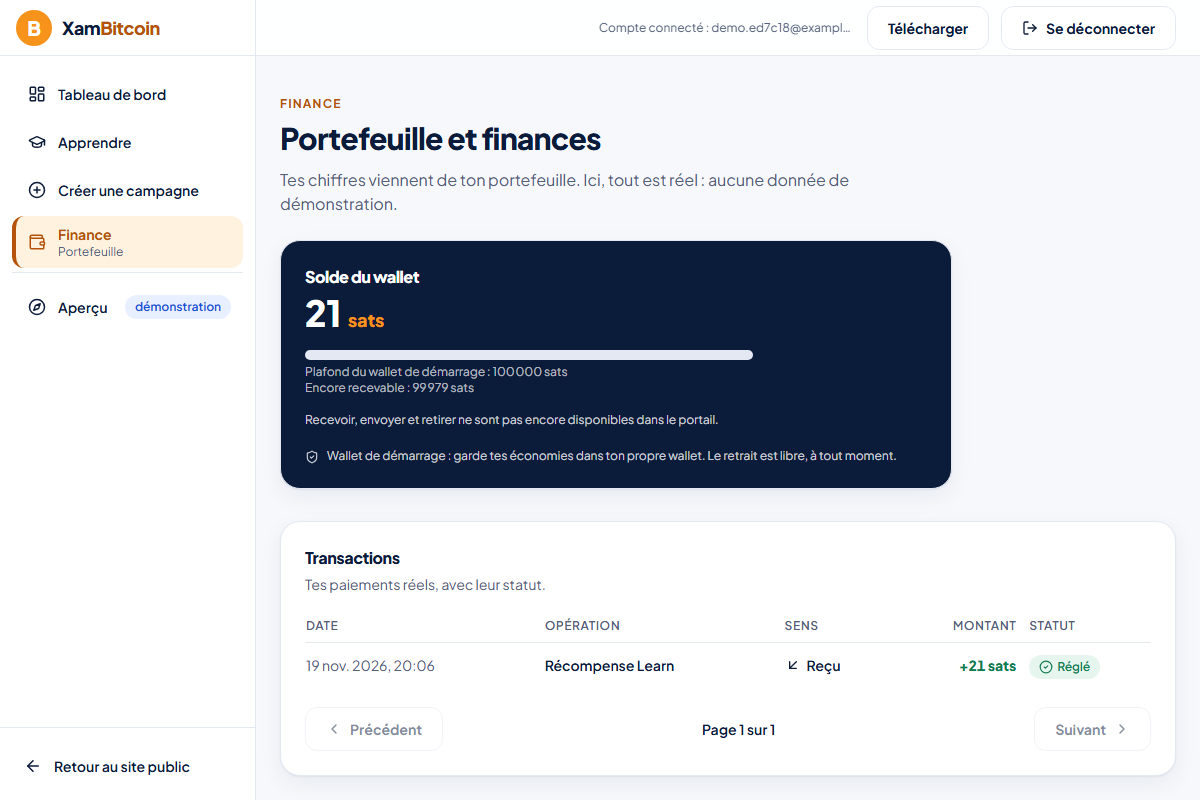
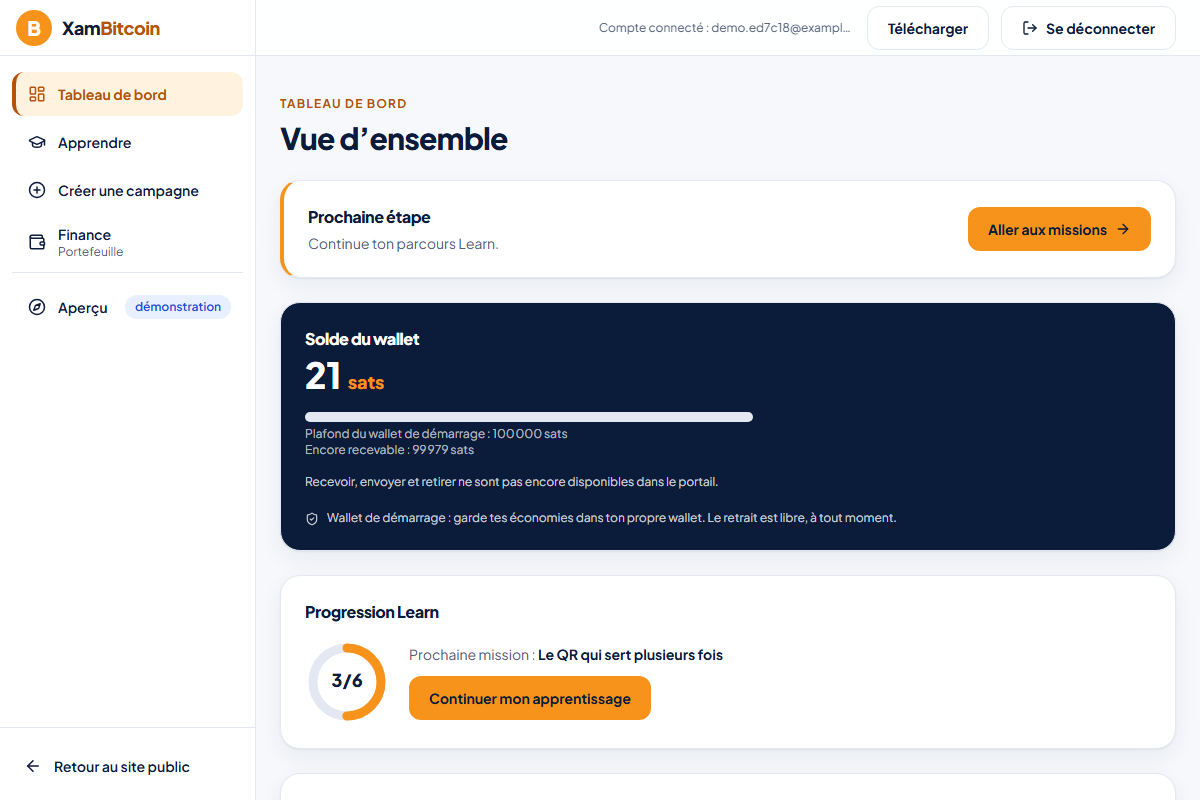
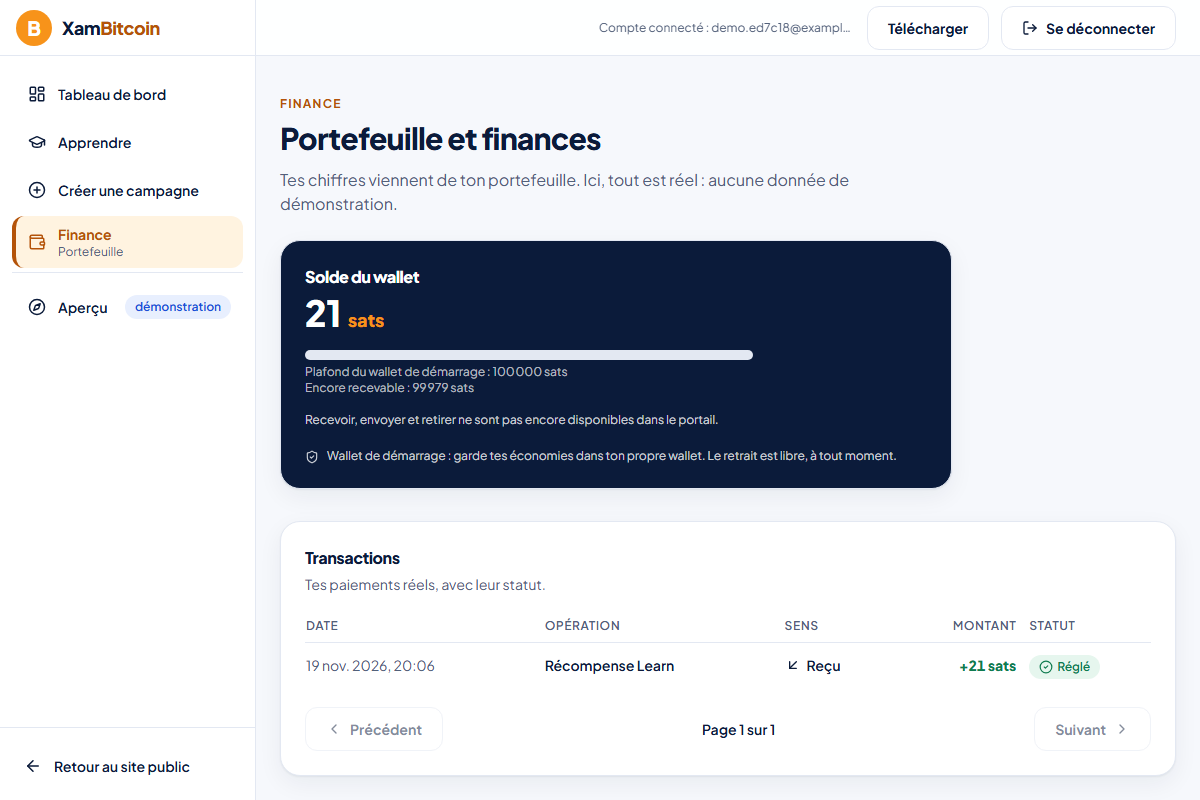
| 3 | Receive your first sats | Asks for the reward: an invoice of 21 sats is created in the learner's wallet and paid | What an invoice contains: amount, description, expiry | Real, 21 sats on mainnet |
| 4 | The QR that works many times | Creates a LNURL-pay link and has it paid twice | One invoice = one payment; LNURL-pay creates a new invoice at every scan, ideal for donations | Built and tested, not tried on the live site yet |
| 5 | Pay your first invoice | Pays a 10-sat invoice from an external wallet | Amount sent vs total debited; routing fees are paid by the sender | Built and tested, not tried on the live site yet |
| 6 | Launch your Naatal campaign | Creates a campaign: public page, permanent QR | How the app learns a donation arrived; the fee line is shown before the donation | The campaign page is real; the mission itself is not offered on the live site yet |
Missions 4 and 5 can be skipped; skipping the reception mission forces the outgoing one to be skipped too. Explanations are texts written in advance (no AI runs on the server); only the figures come from the real payment, and the screen says so ("Written in advance, not generated by an AI").
Use: a starter wallet and Naatal
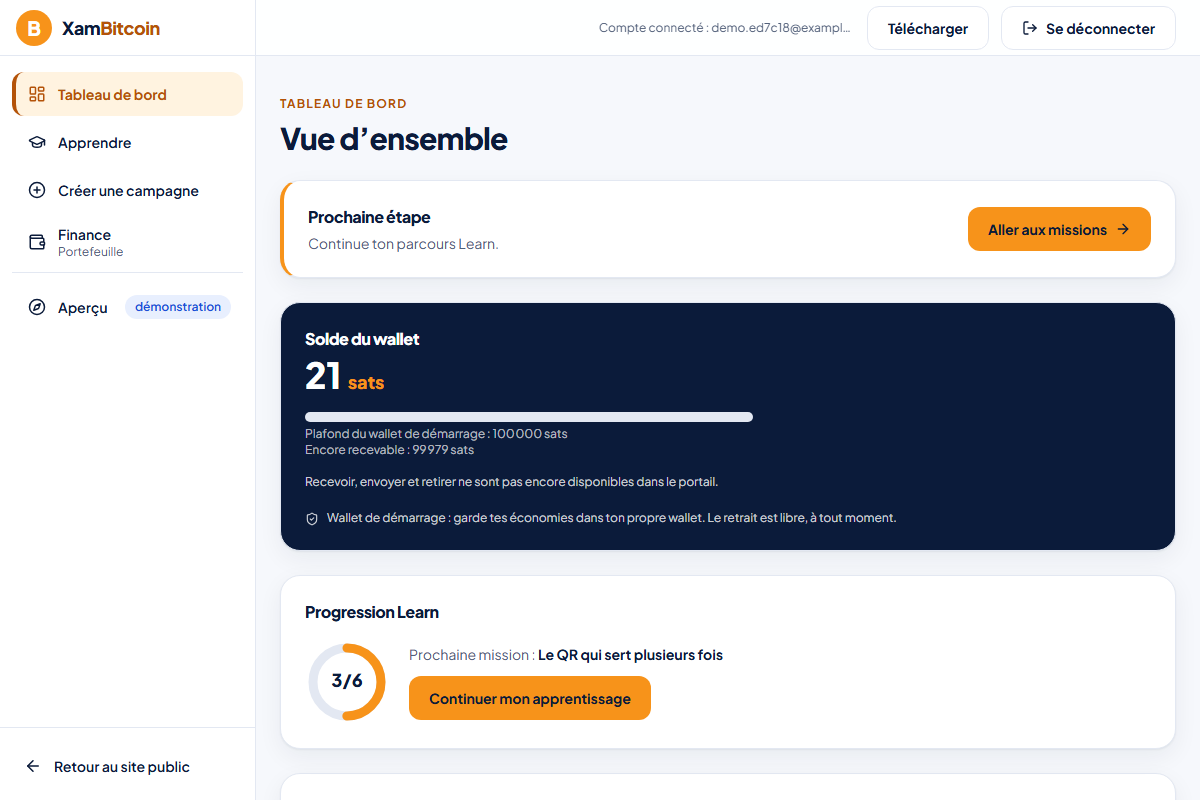
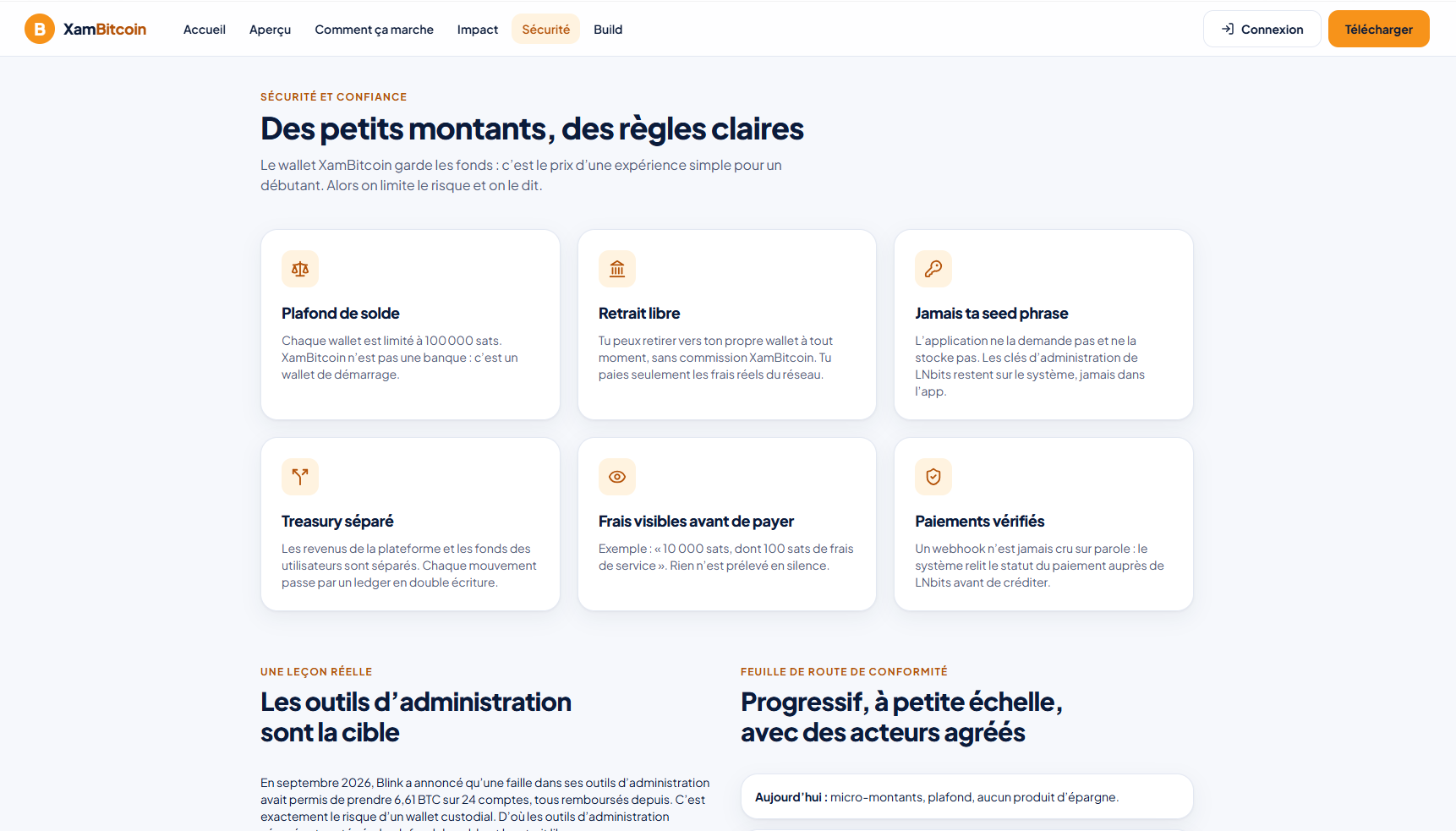
The starter wallet is custodial and capped (100,000 sats): XamBitcoin is not a bank, the app never asks for a seed phrase or a private key, and withdrawal to a wallet you control is free of commission (only real network fees).
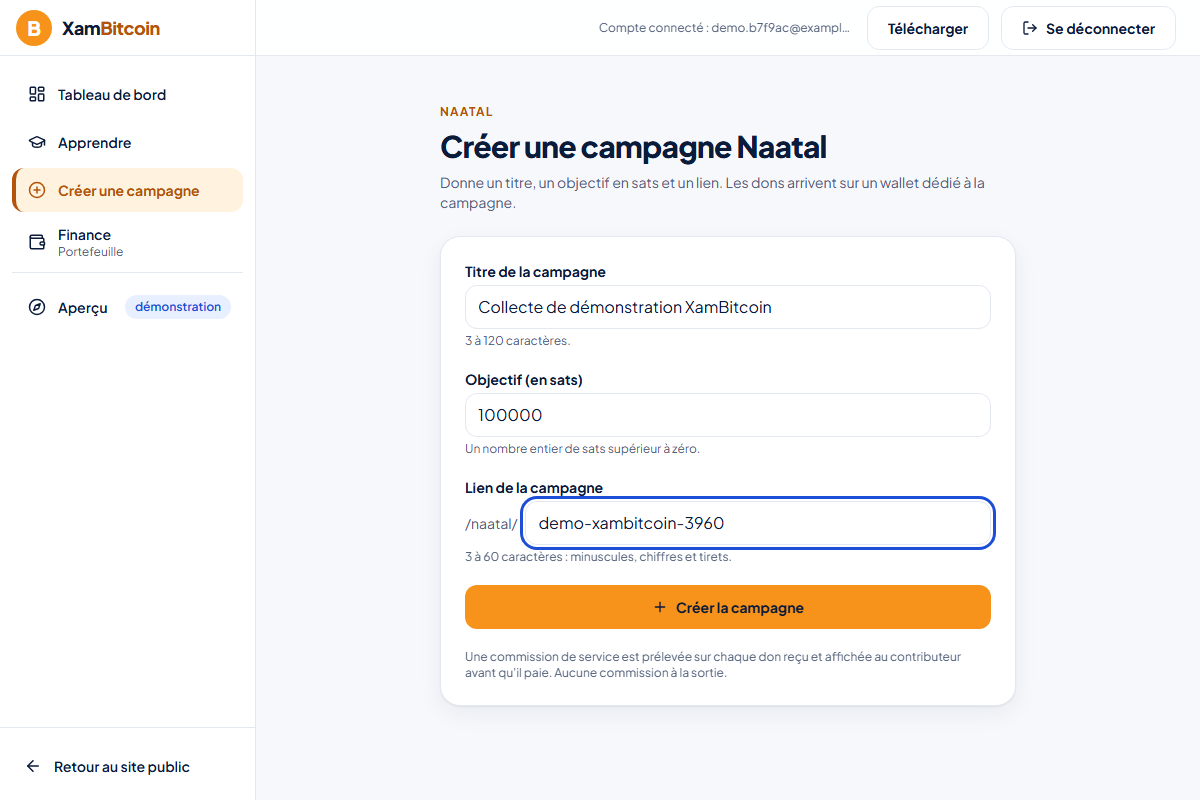
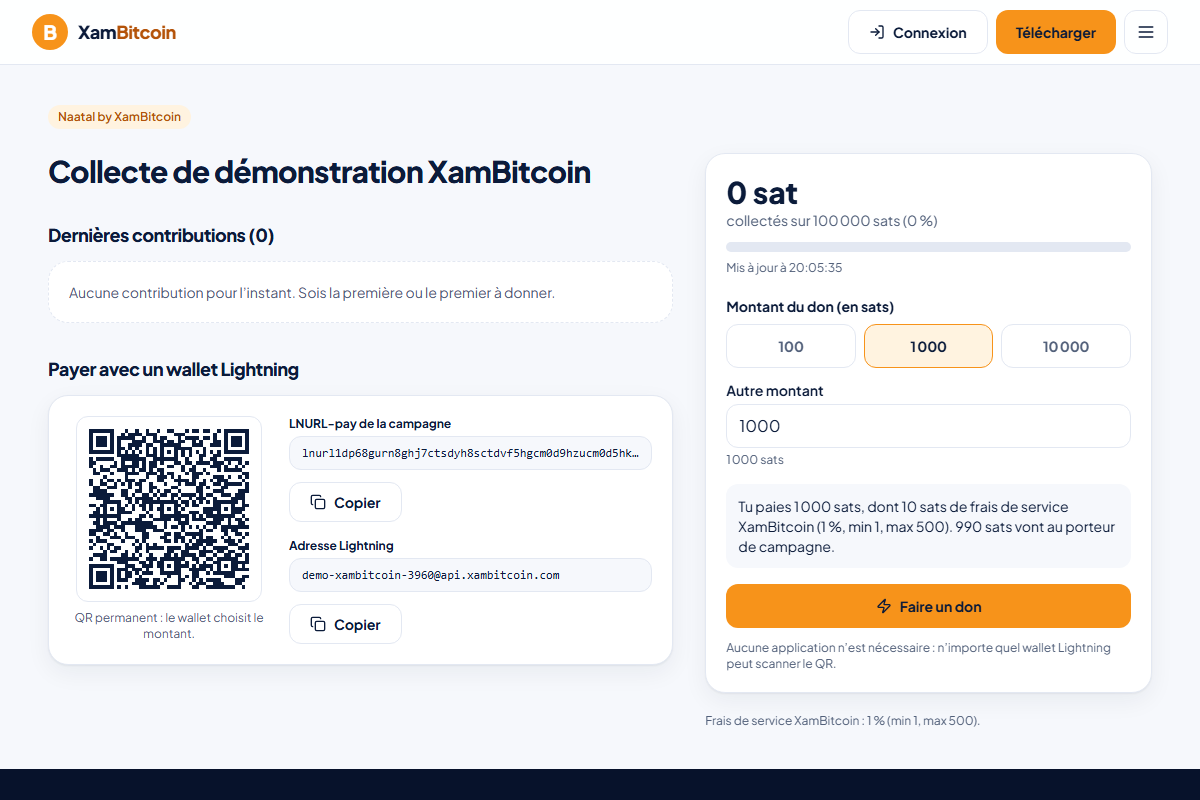
Naatal (the only module of the MVP) turns what was learned into something useful: a fundraising campaign with a title, a goal in sats, a public link, a permanent LNURL-pay QR, a Lightning address and a progress bar. Any Lightning wallet can pay: no app to install for the donor.
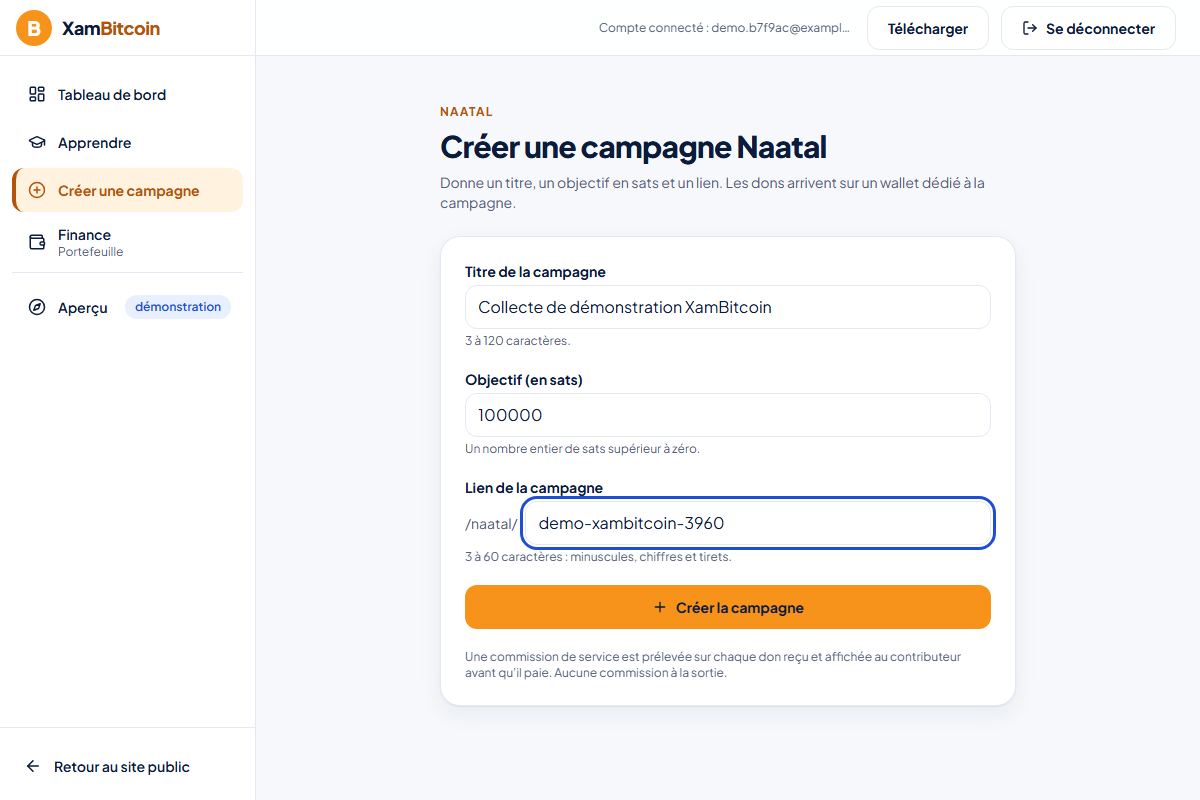
The service fee is shown before the donation, never after:
"You pay 1,000 sats, of which 10 sats of XamBitcoin service fee (1 %, min 1, max 500). 990 sats go to the campaign owner."
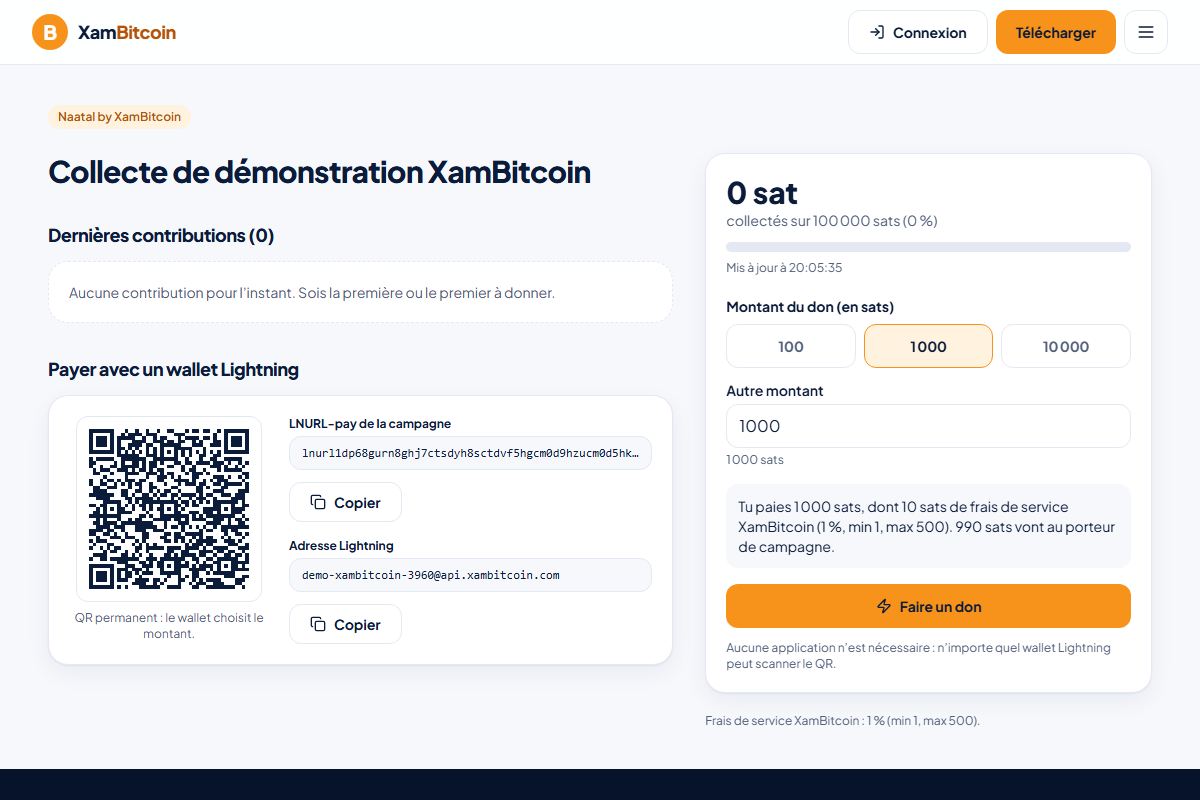
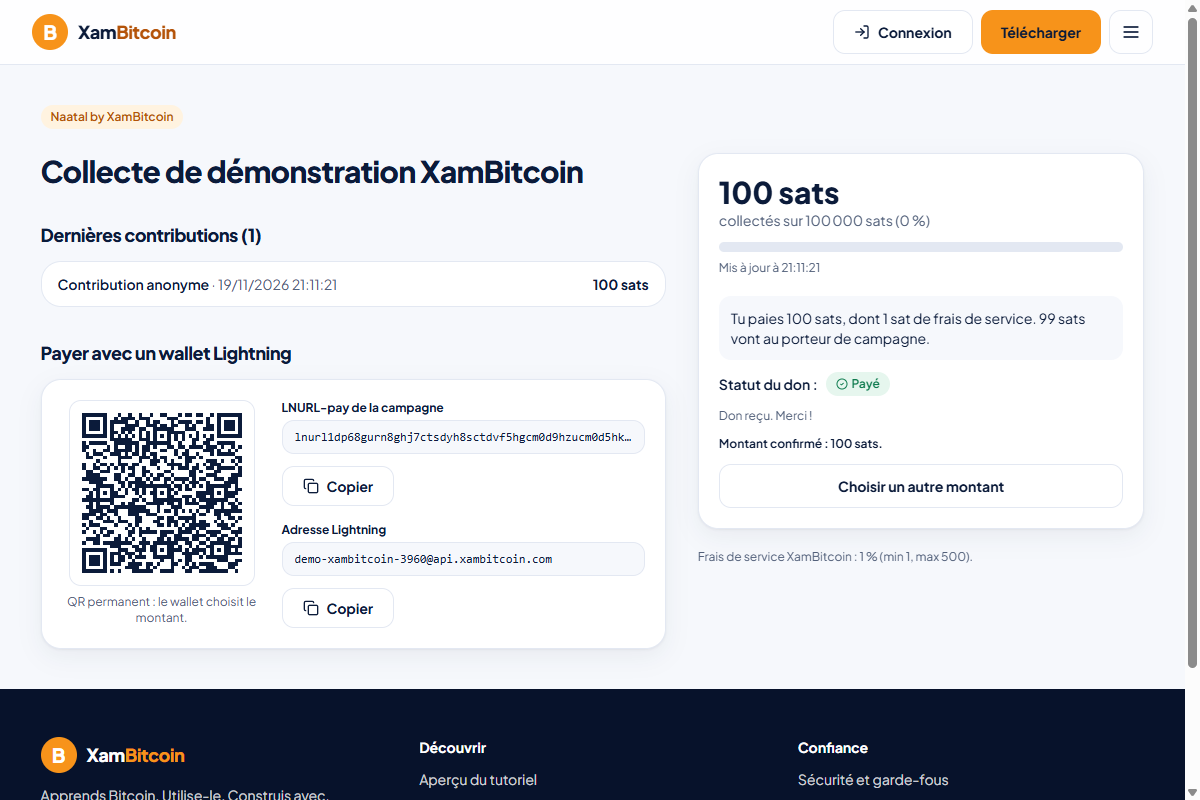
A real donation, paid from a Lightning wallet. On the live site we paid 100 sats to a test campaign. Before paying, the page said "You pay 100 sats, of which 1 sat of XamBitcoin service fee. 99 sats go to the campaign owner." Then the status moved to Paid ("Donation received. Thank you!") and the contribution appeared in the list.
How the platform earns (and what it never charges)
| Flow | Commission |
|---|---|
| Personal reception into a wallet | None |
| Withdrawal or sending | None, only real network fees |
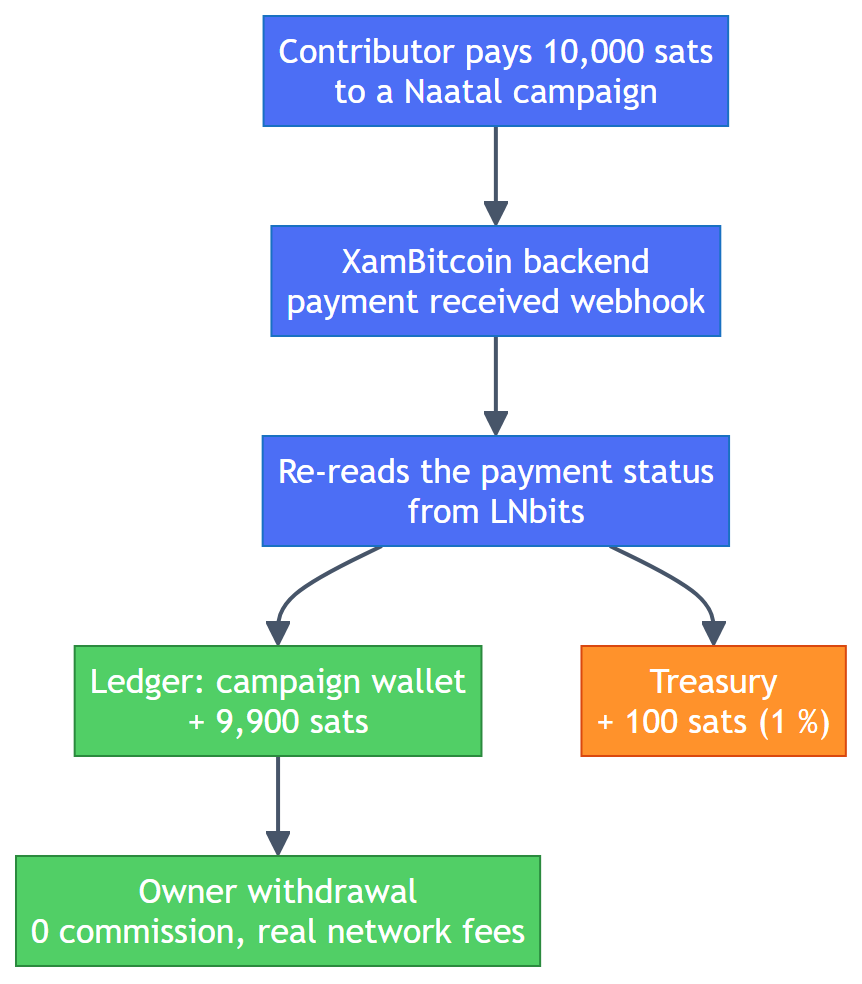
| Donation to a Naatal campaign | Configurable rule: percentage + minimum + maximum (starting value 1 %, min 1 sat, max 500 sats: a teaching value, still to be tuned with real testers) |
The commission goes to the Treasury, which holds only earned revenue, never user funds.
Build (later)
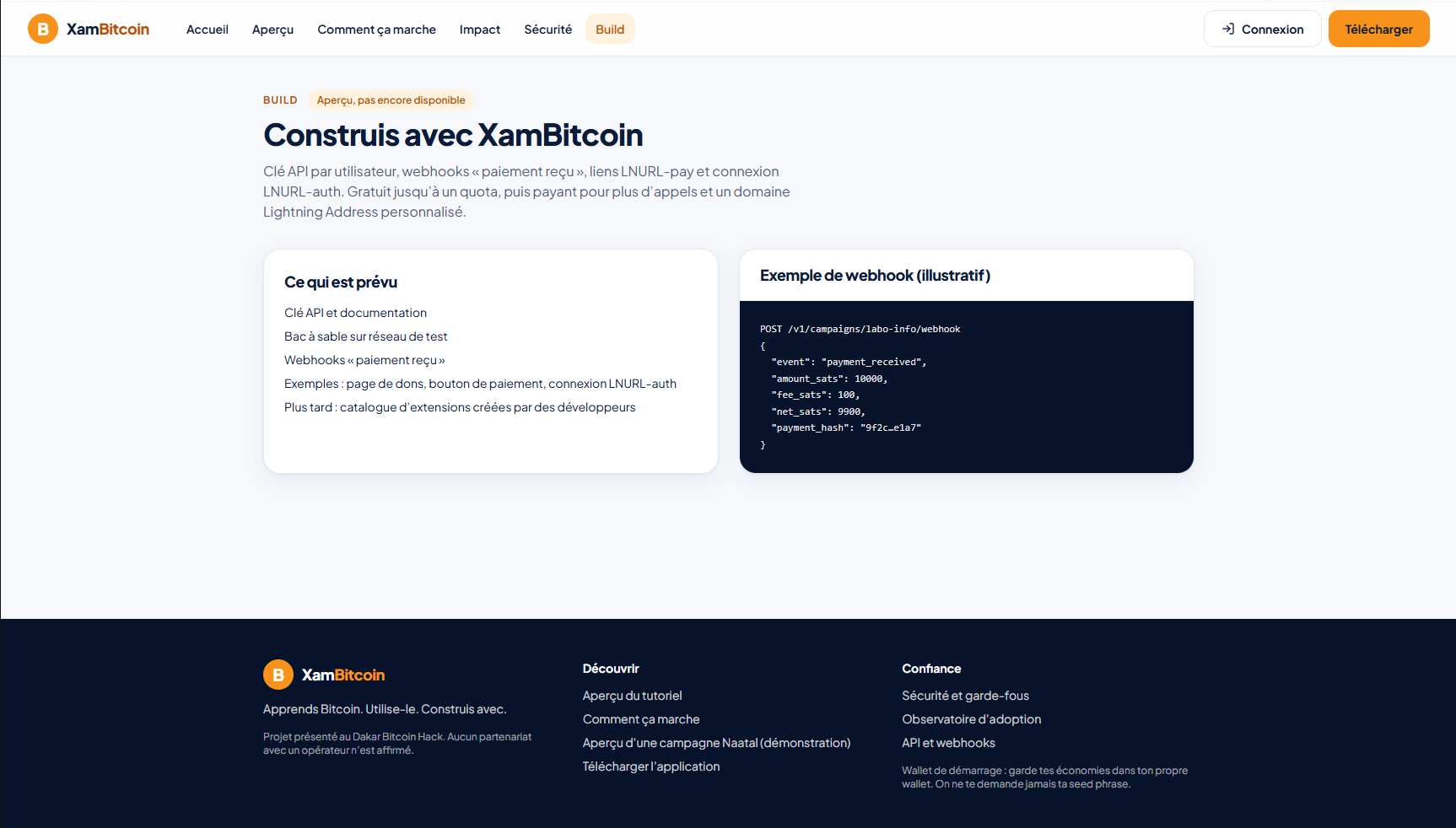
API keys, "payment received" webhooks, and LNURL-pay, withdraw and auth tools for developers. Today only a preview page exists: nothing of Build is built yet.
Honest by design
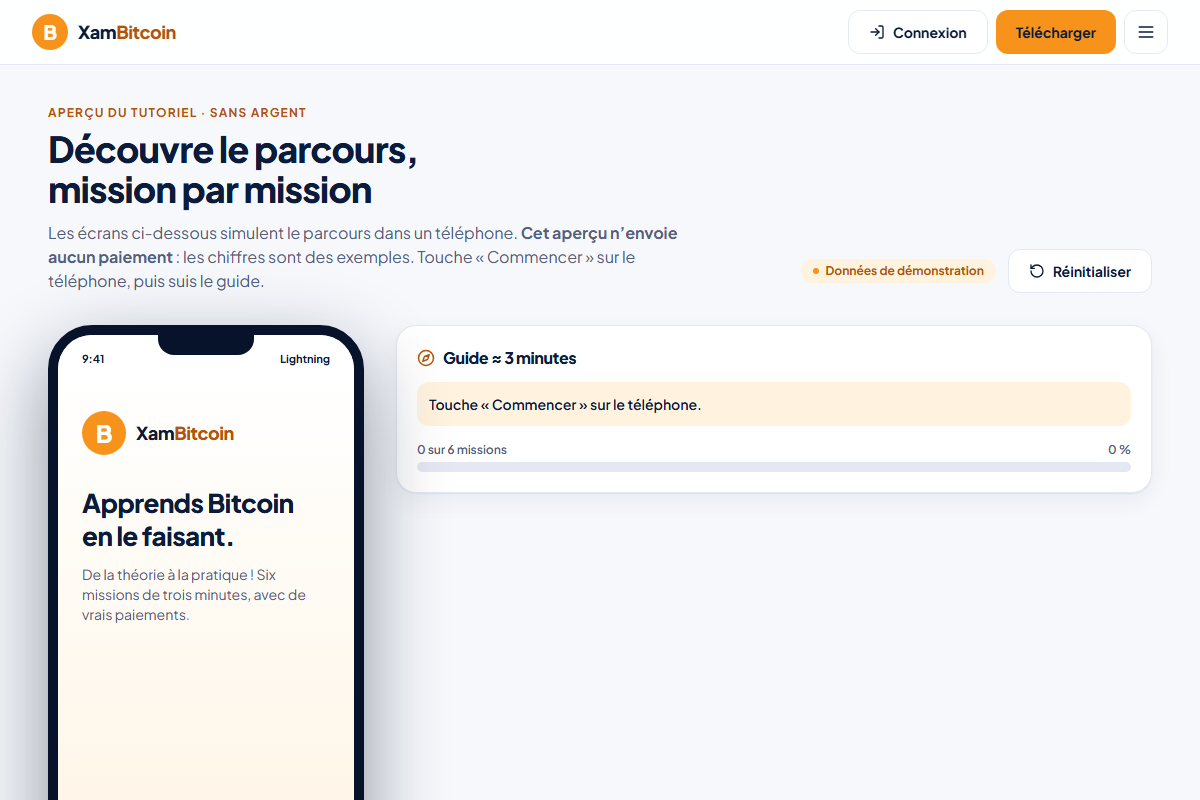
Demo pages are labelled "Demonstration data" and never mix with real payments. The "demonstration" preview of the tutorial sends no payment at all.
How we built it
Stack at a glance
| Layer | Choice | Why |
|---|---|---|
| Payment engine | LNbits 1.6.2 on top of a phoenixd 0.9.3 node, mainnet | One wallet per user, LNURL-pay, webhooks; phoenixd is a light node we can operate alone |
| Backend | NestJS, TypeORM, PostgreSQL | Modules by domain, migrations written as TypeScript classes, validation on every input |
| Portal | Vite, React, Tailwind | Static build, fed by one shared package |
| Shared contract | packages/shared |
Mission sheets, texts and design tokens in one place: the portal never re-defines a rule |
| Production | Docker Compose, Caddy, a small server, Cloudflare Pages | One public door, automatic HTTPS |
| Quality | Jest, Vitest, GitHub Actions | Tests on every pull request |
1. The payment engine: LNbits and phoenixd
- One LNbits wallet per user, one for each campaign, one for the Treasury and one for the learning budget that pays the 21-sat rewards.
- LNURL-pay: a static QR code that creates a new invoice at every scan. The campaign link is built on the public domain, and the Lightning address (
<campaign-link>@api.xambitcoin.com) is served by the API. - phoenixd is a Lightning node for mainnet, run as an official container with no public port: only LNbits can talk to it.
2. The backend: the only component that touches the money
The NestJS API is the only component that talks to LNbits and holds the admin keys. Main routes (all validated, JWT-protected unless public):
POST /api/auth/register            create an account (e-mail + password, sessions with refresh tokens)
POST /api/missions/m1/quiz         the quiz is graded on the server
POST /api/missions/m2/wallet       activate the starter wallet
POST /api/missions/m3/reward       pay the 21-sat reward from the learning budget
POST /api/campaigns                create a Naatal campaign (title, goal, link)
GET  /api/fees/preview             compute the service fee BEFORE the donation
POST /api/campaigns/:slug/donations  create the donation invoice
POST /api/webhooks/lnbits          "payment received" (authenticated, then re-read from LNbits)
GET  /lnurlp/:slug/callback        LNURL-pay: a new invoice at every scan
GET  /api/wallets/me/transactions  the personal history (paged)
GET  /api/healthz                  health check (database included)
3. Money rules that are enforced, not just documented
- Whole sats only. No float, no fractional BTC. The commission (percent, minimum, maximum) is computed on integers with an explicit rounding rule.
- Double-entry ledger. Every movement is a debit and a credit of the same amount, in one database transaction. A ledger that does not balance is a blocking bug.
- Treasury is not user money. It holds earned revenue only; every movement goes through the ledger.
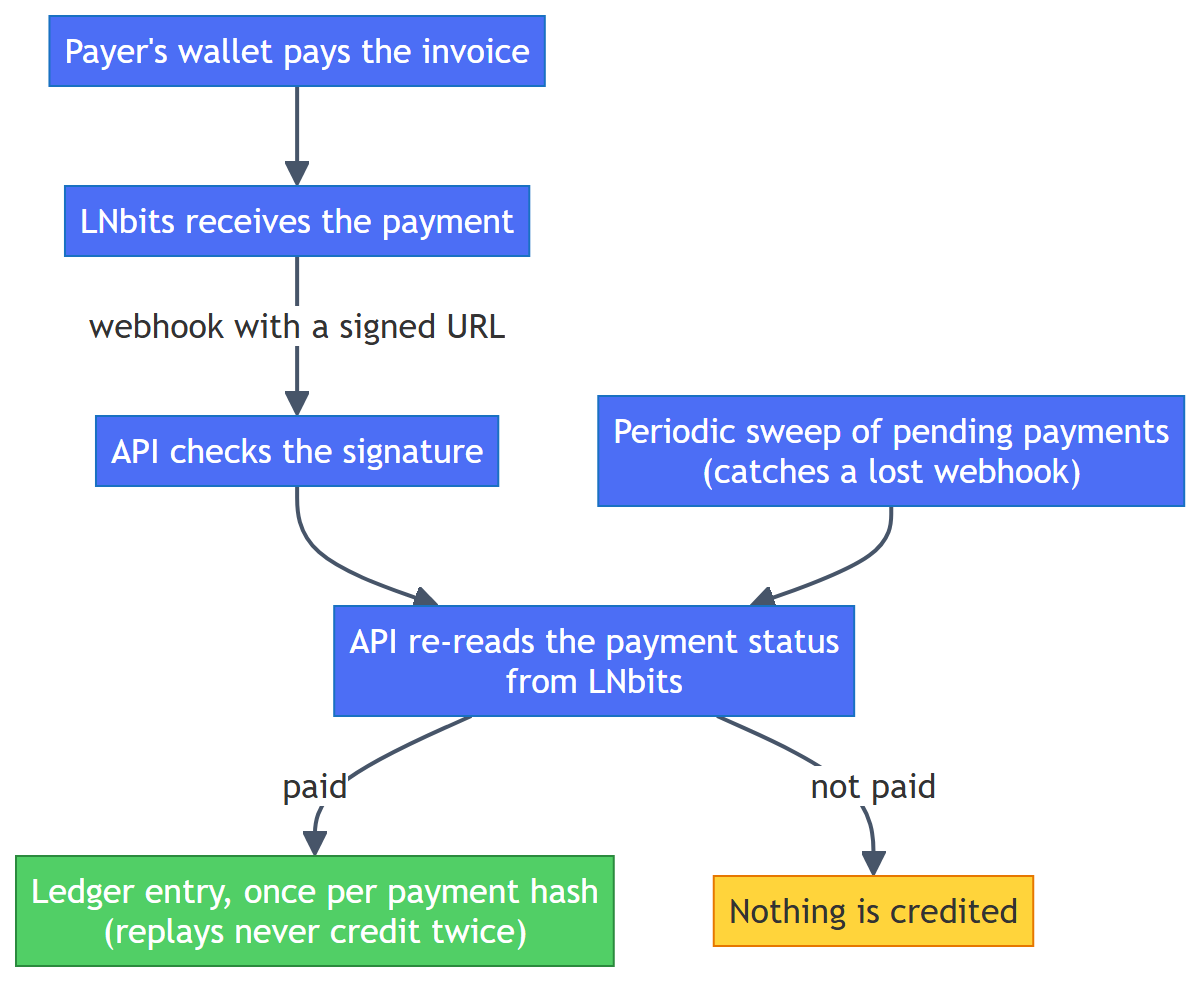
- Idempotent webhooks, re-read from the source. The webhook URL is signed; the backend then re-reads the payment status from LNbits before crediting. Replaying the same webhook never credits twice (the key is the payment hash). A periodic sweep re-reads pending payments to catch a lost webhook.
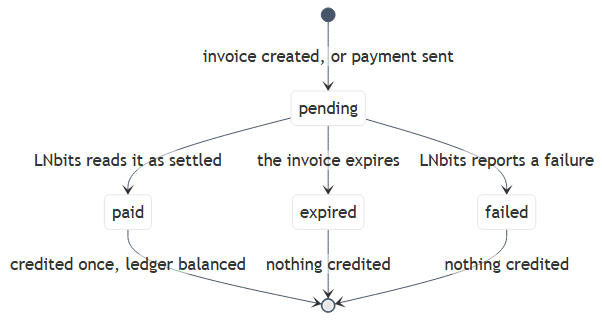
- Status is never invented. An incoming or outgoing payment stays pending until LNbits says paid; a failed or expired payment is recorded as such.
4. Security by design
- No seed phrase, no private key is ever asked or stored from a user.
- Admin keys only on the server. They never reach the portal, the logs or an API response.
- Two database roles. A migration role owns the tables; the API runs with an execution role that cannot change the schema and can only insert and read the administrators' audit trail.
- One public door. Caddy is the only service that publishes ports; LNbits and phoenixd are never exposed; the LNbits admin UI is reachable only through an SSH tunnel.
- Rate limits and trusted proxy. Connection and sign-up are rate-limited by client address, with the number of trusted proxies set exactly.
- An administrators' audit trail records sensitive actions.
- A capped starter wallet and a free withdrawal keep the custodial risk small and the exit open.
5. Production and delivery
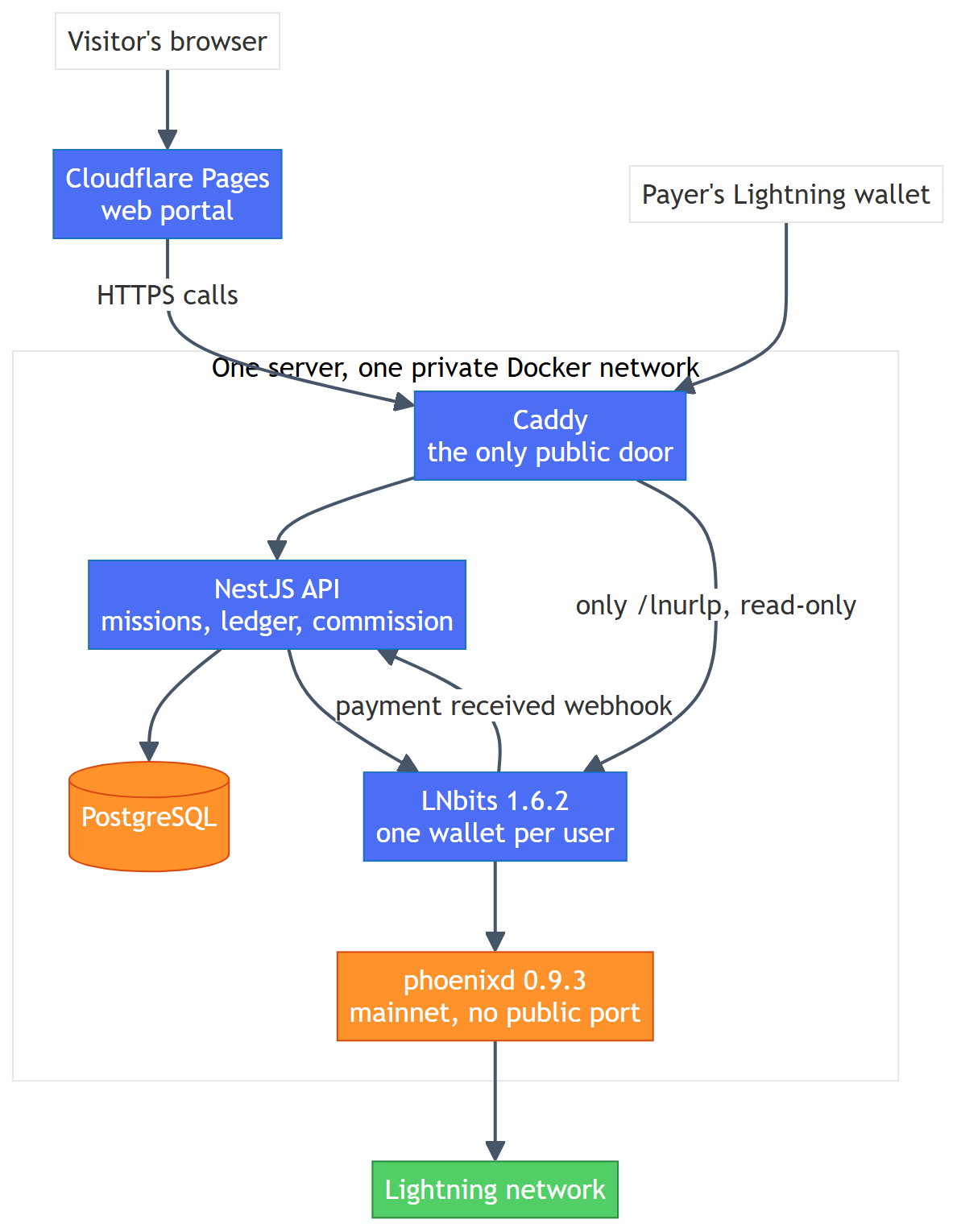
- Docker Compose on a small server; Caddy gives automatic HTTPS; the portal is on Cloudflare Pages.
- A deploy script takes a backup before every migration, refuses to deploy a commit that is not on the main branch, refuses a roll-back from the CI key, and fails loudly if the proxy loses its address or the internal DNS.
- A GitHub Actions workflow runs the whole test suite on every pull request; the deploy workflow is manual by default.
- Reference data (the fee rule and the mission sheets) is seeded by a command that is safe in production.
6. Tests
1,378 unit and contract tests (42 suites), 260 end-to-end tests on a real PostgreSQL, 139 portal tests. They include replayed webhooks, balanced-ledger checks, and repository contracts that run against both an in-memory double and PostgreSQL.
The end-to-end path, step by step
1. Sign up          -> POST /api/auth/register              (account + session)
2. Mission 1        -> POST /api/missions/m1/quiz           (graded on the server)
3. Mission 2        -> POST /api/missions/m2/wallet         (LNbits wallet created)
4. Mission 3        -> POST /api/missions/m3/reward         (invoice of 21 sats created in the learner's wallet,
                                                             paid from the learning budget, ledger entry posted once)
5. Campaign         -> POST /api/campaigns                  (campaign wallet + permanent LNURL-pay link)
6. Donation         -> GET  /api/fees/preview               (fee shown BEFORE paying)
                       POST /api/campaigns/:slug/donations  (invoice) -> payer's wallet pays
7. Credit           -> webhook (signed) -> re-read from LNbits -> ledger: campaign + Treasury
Challenges we ran into
1. The first Lightning channel is expensive
Challenge: a Lightning node needs inbound liquidity before anyone can pay it. For 2,000,000 sats of capacity, phoenixd quoted 21,000 sats of service fee plus about 400 sats of mining fee. A first deposit of 30,000 sats left only about 7,600 sats once the channel was open. Solution: we always ask for the quote before funding, we turned off automatic channel opening, and we now recommend a first deposit of 50,000 to 100,000 sats. Learning: on Lightning, liquidity has a price, and a "small test deposit" can be eaten by fees.
2. LNbits refuses to call back a private address
Challenge: LNbits will not send a webhook to a name that resolves to a private address. An internal network shortcut we had added to be helpful made the webhooks fail. Solution: the webhooks go through the public address; we removed the shortcut, documented why, and kept the periodic sweep as a safety net. Learning: a security default you do not understand can break a "helpful" shortcut.
3. A slow Lightning backend
Challenge: creating an invoice sometimes took more than 10 seconds, so the reward request failed with "slow connection". Solution: the logs showed the failures happened before any payment: the reward quota was released and nothing was paid twice. We made the timeout configurable, and the screen now explains what happened instead of a generic error. A rarer case (a payment sent but the answer lost) is documented as a known risk. Learning: read the logs before believing the first theory. We had suspected a triple payment; the logs disproved it.
4. A payment that is paid but still "pending"
Challenge: an outgoing payment can be reported pending by LNbits for a while even though it goes through. The mission stayed blocked. Solution: a "Verify my payment" step re-reads the status from LNbits and completes the mission only when LNbits reads it as settled, never on failed or pending. Learning: do not guess the outcome of a payment; re-read it from the source.
5. A test that failed by pure chance
Challenge: a continuous-integration run failed on a test that had passed many times. Solution: the test searched the answer for the text "777", the amount of another user, but the short payment identifier is a random hash prefix and happened to contain "777". We compare the amount field instead. Learning: a test must assert what the code guarantees for every case, never a lucky one.
6. Production surprises on day one
Three incidents on the first deployment, each documented in the repository:
- A truncated secret. A wallet password copied with the mouse lost most of its characters and was stored in LNbits' own database; fixing the environment did nothing.
- A fixed Docker address taken by another container, so the proxy could not start.
- Docker's internal DNS failing after partial restarts, so the whole site answered 502 while the deploy script said "done". Solution: write down the cause of each, never copy secrets by hand, never partially restart, and make the deploy script fail loudly in the last case. Learning: the incident that costs you a day is usually in the plumbing, not in the code.
7. Custody and trust
Challenge: a custodial wallet makes people nervous, and rightly so. Solution: a capped balance, a free withdrawal, no seed ever asked, a Treasury kept apart from user balances, admin keys only on the server, and a ledger where every sat is traceable. Learning: security and honesty are part of the product, not a page at the end.
8. Time
Challenge: from late October to the submission on 20 November, with studies and work in parallel, a product that touches real money. Solution: strict priorities: foundation, then Learn, then one module (Naatal); everything else on a roadmap; a feature that we could not prove stayed out of the claims. Learning: it is better to ship a smaller product that is true than a larger one that is not.
Accomplishments that we're proud of
- A live product with real sats on mainnet, not a mock-up: account, wallet, a 21-sat reward, a Naatal campaign page and a real 100-sat donation paid from a Lightning wallet (fee shown before, status Paid), all on the live site.
- The fee is visible before you pay, and the commission rule (percent, minimum, maximum) is configurable.
- A money core we can defend: double-entry ledger, idempotent webhooks re-read from LNbits, a sweep for lost webhooks, a Treasury kept apart from user balances.
- Security by default: no seed ever asked, capped wallet, admin keys only on the server, one public door, two database roles, an audit trail.
- 1,378 + 260 + 139 automated tests, including replayed webhooks and balanced-ledger checks.
- A real deployment, not a tunnel: HTTPS, backup before every migration, a guarded deploy script, a CI that runs on every pull request.
- A product that tells the truth: the demo is labelled, the explanations are said to be written in advance, and the repository lists what is not done.
- Documentation that records what went wrong, with cause, fix and the rule to remember.
What we learned
About Lightning and LNbits
- Inbound liquidity is a cost, and the quote must come before the deposit.
- An invoice contains an amount, a description and an expiry; the sender pays the routing fees, not the receiver.
- LNURL-pay gives one QR code that creates a new invoice at every scan: ideal for donations.
- Webhooks are not signed by default: we sign the URL, then re-read the payment before crediting.
- A timeout on our side does not stop LNbits: an invoice may exist even though our call failed. It leaves harmless unpaid invoices, but it must never release money.
About money software
- Whole sats and a balanced double-entry ledger make bugs visible.
- Idempotency (one entry per payment hash) is what makes retries and replays safe.
- The Treasury must never include user funds; separation is a rule, not a hope.
- A status is a fact read from the source, never a guess.
About operating a real node
- A restart does not reload environment variables; a recreated container does.
- A setting saved in an admin interface can live in the application's own database, not in the environment you just fixed.
- A fixed network address must sit outside the automatic address range.
- Never copy a secret by hand; use the clipboard or a hidden prompt.
- A deploy script should fail loudly rather than report "done" in front of a broken site.
About testing
- A test asserts what the code guarantees for every order of events, not one lucky order.
- A test double and the real database must pass the same contract.
- Counts without dates are lies: we measure and date every number.
About product and honesty
- People trust a product that says what is a demonstration and what is real.
- Written-in-advance explanations with real figures beat a generated explanation that may be wrong.
- Plain, human error messages ("the payment service is slow, nothing was debited, try again") beat technical ones.
What's next for XamBitcoin
XamBitcoin is one base on which several modules can sit: each new module only adds its specific part, because the wallet, payments, ledger, Treasury, receipts and notifications already exist.
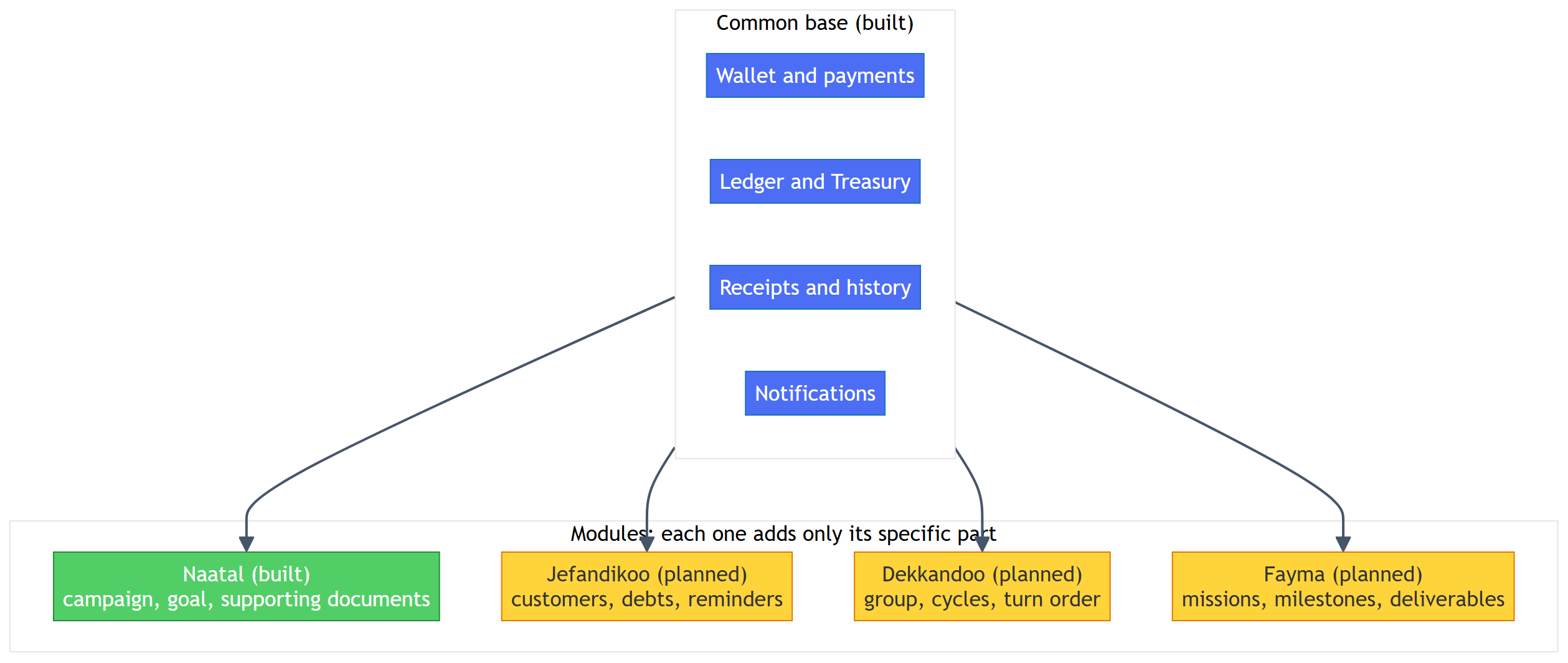
This is a proposed roadmap, not a promise: durations are estimates, and the rates mentioned are illustrative values still to be set.
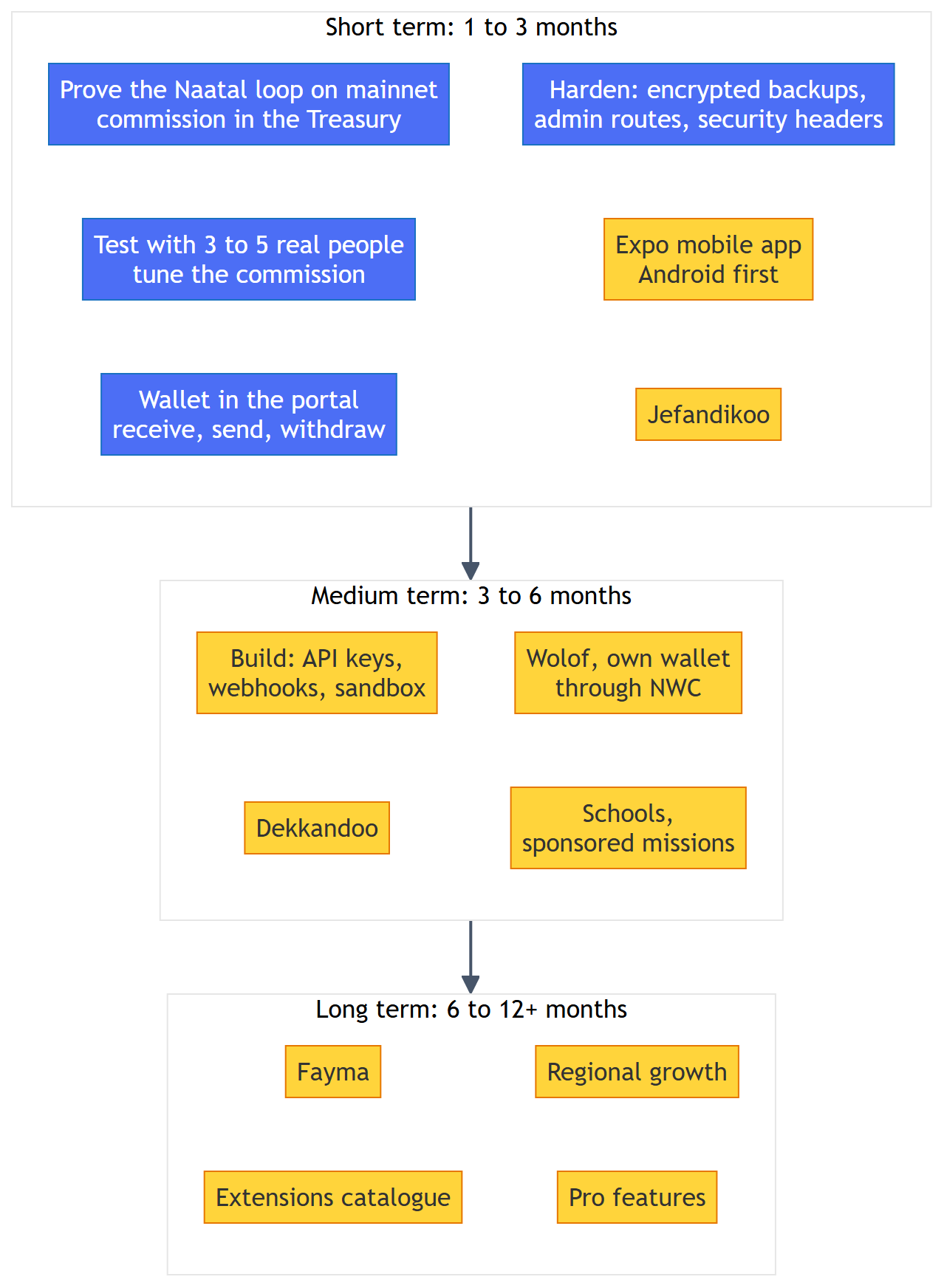
Short term (1 to 3 months): prove it, then make it usable
1. Close the proof of the Naatal loop on mainnet
- The 100-sat donation is already proven on the live site (fee shown before, status Paid). What is left is to show the commission landing in the Treasury, which needs an administrator screen that is not created yet.
- The same for the outgoing payment of mission 5 and the reusable link of mission 4, on the live site.
2. Test with 3 to 5 real people
- Time each mission (above 3 minutes, we simplify), watch where they stop, fix the texts.
- Tune the starting commission rate (1 %, min 1, max 500) with their feedback.
3. Finish the wallet in the portal
- Receive, send and withdraw from the portal (the API routes exist; the portal says "not available yet").
- Balance cap and free withdrawal explained at each step.
4. Harden what is already running
- Encrypted backups sent off the server and a tested restore.
- Close the administrator routes to the Internet once the demo is done, and keep the audit trail.
- Fix the server's outgoing DNS and IPv6, and add the portal's security headers.
- Move the runtime to a supported Node version.
5. The mobile app
- An Expo app on the same shared package and the same API, Android first (an APK), iOS and the stores later. It does not exist yet.
6. First extra module: Jefandikoo
- See below. It is the closest to what Naatal already does.
Medium term (3 to 6 months): open the platform
7. Build: a public API for developers
- An API key per user, documentation, a sandbox on a test network, "payment received" webhooks.
- Examples: a donation page, a payment button, LNURL-auth login.
- Free up to a quota, paid beyond it (more calls, a custom Lightning-address domain).
8. Dekkandoo
- See below. It holds the group's money between two cycles: it needs the security work above first.
9. Wolof and local reach
- Plain French first, Wolof next for the mission texts.
- A way to connect your own wallet (NWC) without commission on reception.
- Investigate local payment channels (mobile money, local exchanges): to be verified, nothing is promised.
10. Schools and bootcamps
- A class space to follow students' progress on Learn.
- Sponsored missions: a Bitcoin project pays for a mission on its own tool and funds the rewards.
Long term (6 to 12+ months): a super-app and an ecosystem
11. Fayma
- See below. It holds money until a deliverable is validated: the most sensitive module.
12. An extensions catalogue
- Modules written by outside developers, with a possible revenue share.
13. Regional growth
- Adapt to other French-speaking markets in West Africa, with local partners, once the first pilots have proven the model.
14. Pro features
- Multi-shop accounting exports and SMS reminders for merchants, and a paid tier for heavy API users.
The three planned modules
Each module reuses the same bricks (wallet and payments, ledger and Treasury, receipts and history, notifications) and adds only its specific part.
| Module | What it is | Specific part | Commission (illustrative, to be set) |
|---|---|---|---|
| Naatal | Fundraising campaigns (built) | Campaign, goal, supporting documents | 1 % with a minimum and a maximum |
| Jefandikoo | Sales on credit for small merchants | Customers, debts, reminders | about 0.5 % or a small fixed amount on a customer's Lightning payment |
| Dekkandoo | Savings circles and shared funds | Group, cycles, turn order | a small fixed amount per cycle, on the payout to the beneficiary |
| Fayma | Freelance missions with milestones | Missions, milestones, deliverables | about 1 % on a milestone payment |
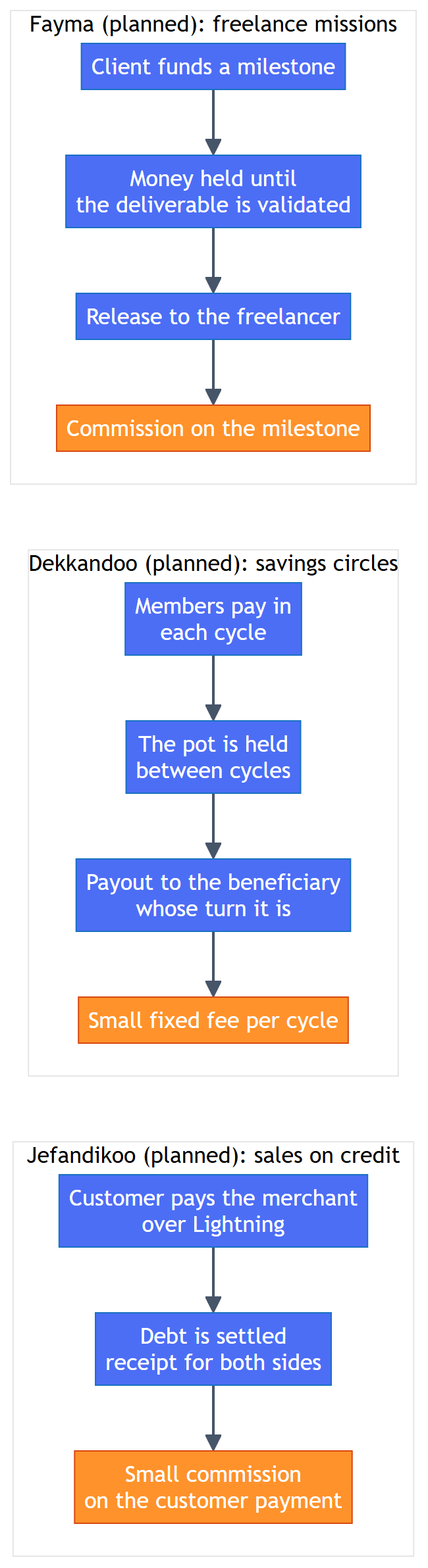
A rule for all modules: the platform earns when a module renders a service, never when you simply receive money and never when you withdraw. Withdrawal stays free of commission, with only the real network fees.
A point of vigilance: a savings circle keeps the group's money between two cycles, and a freelance escrow keeps money until validation. These two are the most sensitive in security and responsibility, so they come after the hardening work above.
Impact we aim for
Quantitative goals (proposed, to be measured):
- Learners who finish the six missions and make a first real payment.
- Real campaigns created and funded in sats.
- Time per mission under 3 minutes.
Qualitative goals:
- Make Lightning something people have done, not just heard of.
- Give communities a simple, transparent way to pool money, with the fee visible before the payment.
- Offer developers a base they can build on.
Ultimate vision
A place where learning Bitcoin is the first step of using it, where a student association can fund its lab in a few taps, where every fee is visible before it is paid, and where the same simple base carries the tools that communities need.
Team
Salif Diallo: Project Author and Developer.
- GitHub: @MrSalifDiallo
- LinkedIn: Salif Diallo
- Email: [email protected]
Aicha Ndiaye Big Data & AI Engineer
- GitHub: @smiley100
- LinkedIn: Aicha Ndiaye
- Email: [email protected]
Fatou Tambedou Big Data & AI Engineer
- GitHub: @fatoutambedou-ctl
- Email: [email protected]
Links
- Live site: xambitcoin.com
- Code: github.com/HackathonBTCDays/XamBitcoinAssets
- Built for: Dakar Bitcoin Hack
Built With
- bitcoin
- docker
- electrum-server
- expo.io
- github-jobs
- lightning-network
- nestjs
- node.js
- oauth
- phoenixd-asinc
- postgresql
- react
- taildwind-css
- typeorm
- typescript
- vite
