-
-

Presenting x500!
-
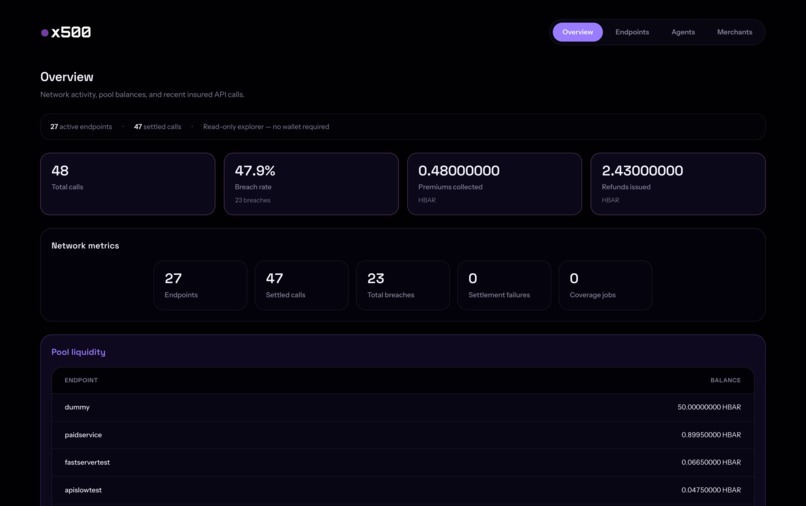
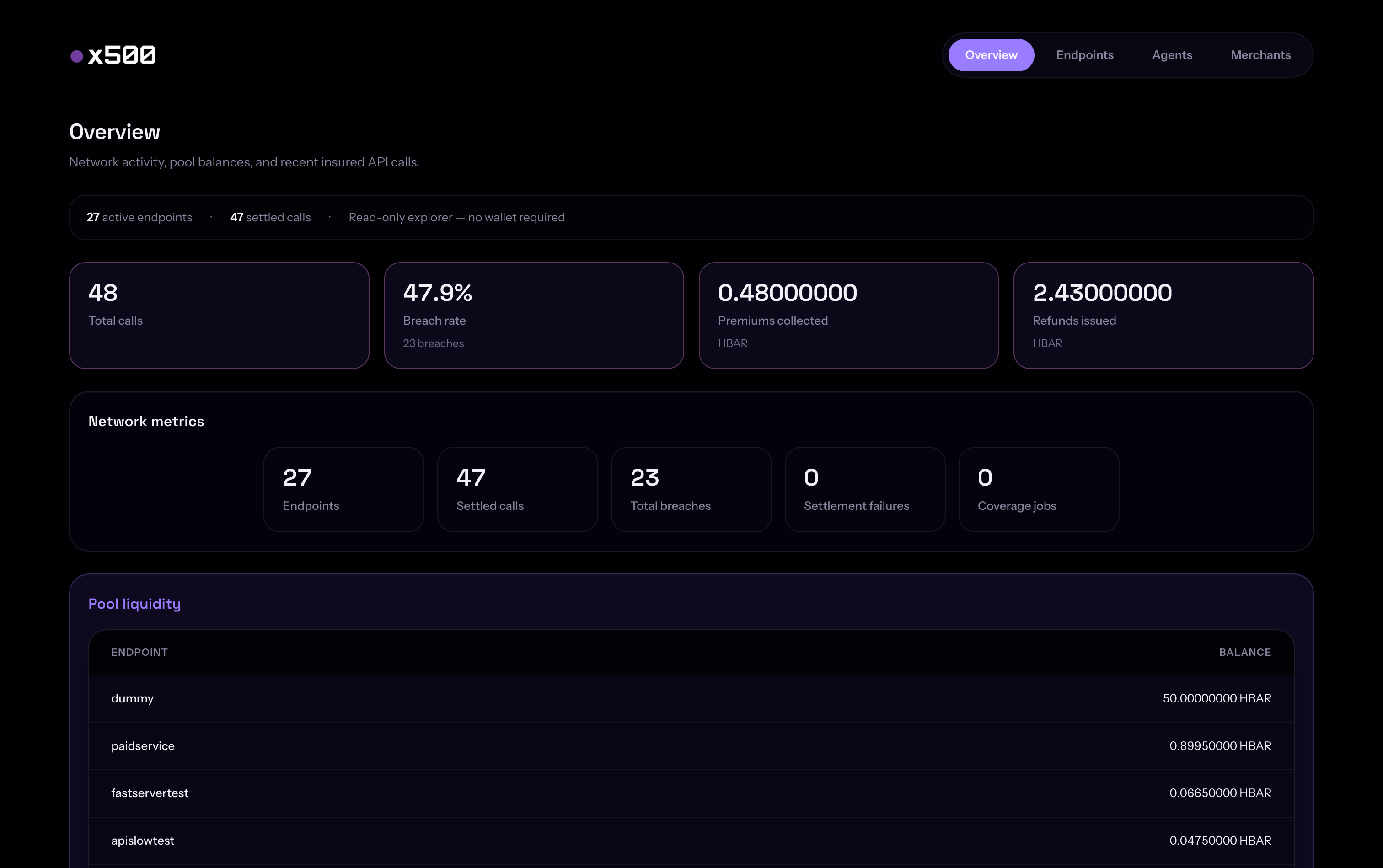
Dashboard
-
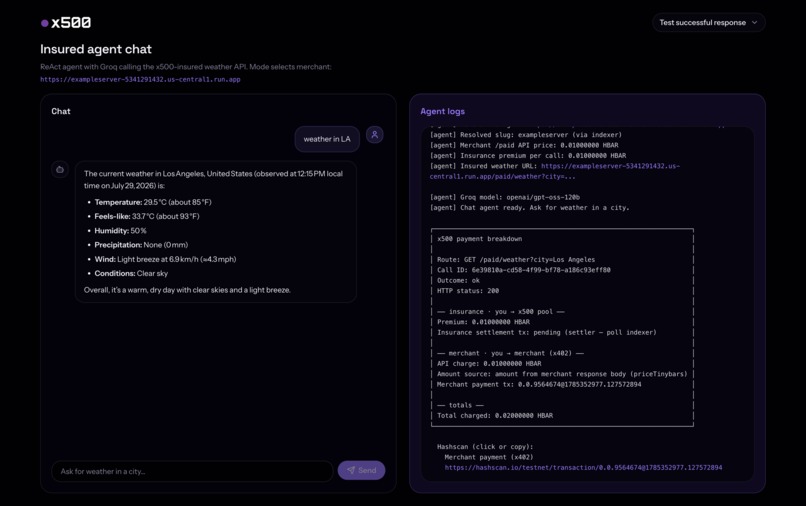
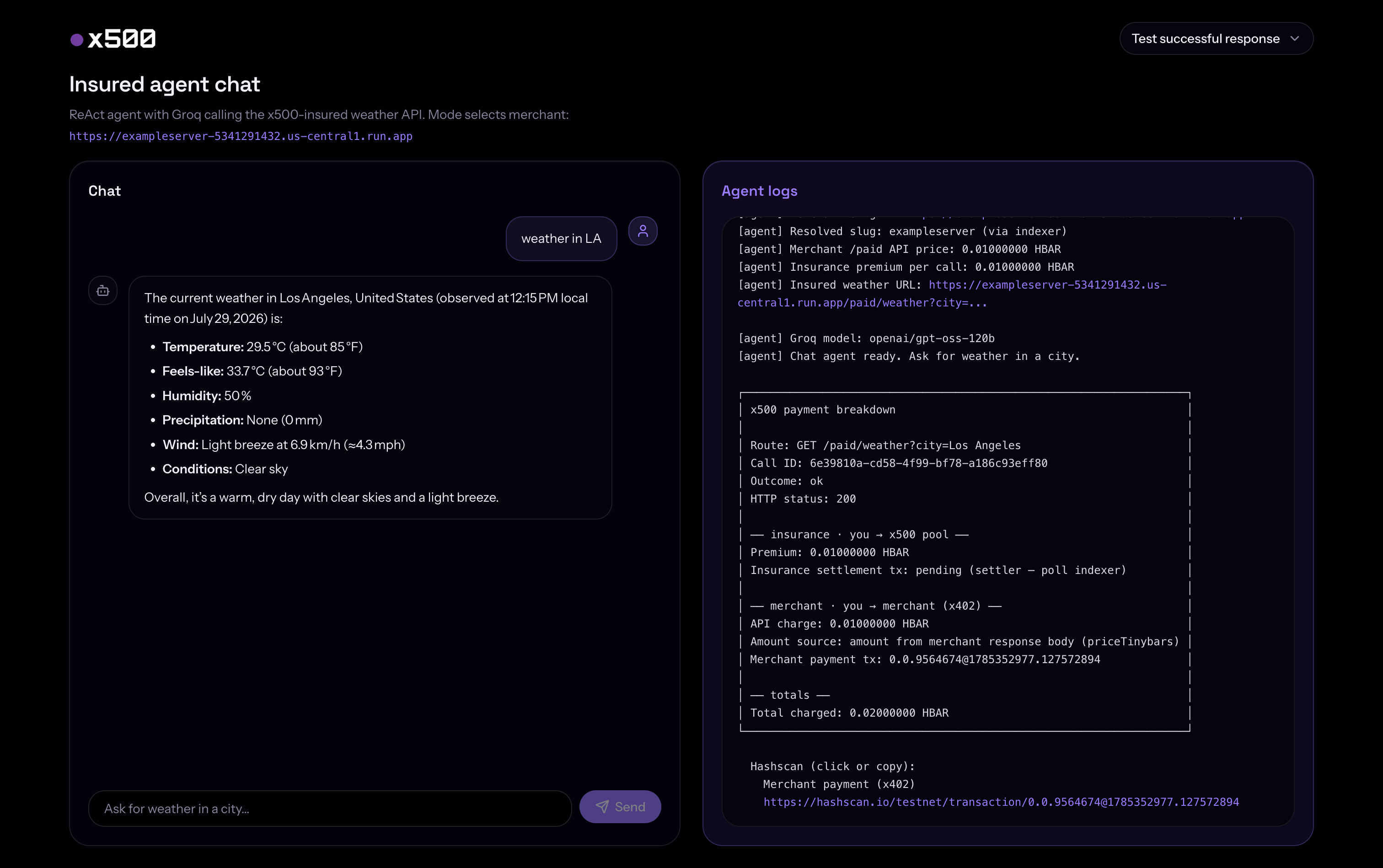
Example Agent Chat
-
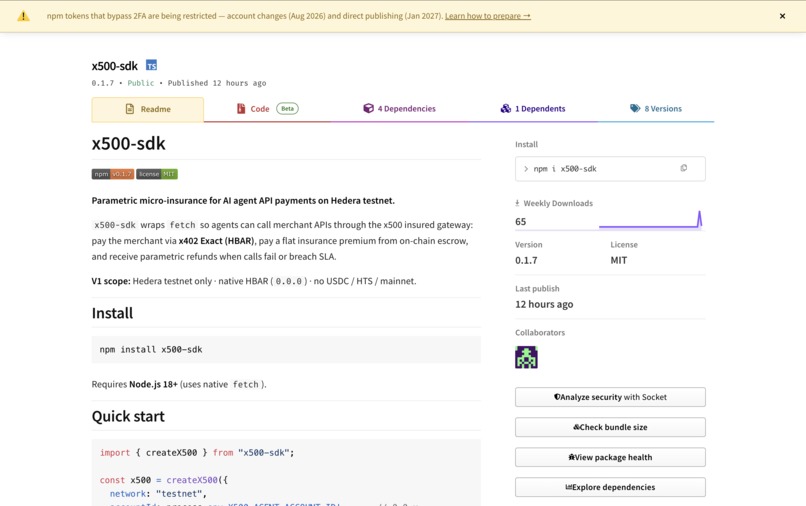
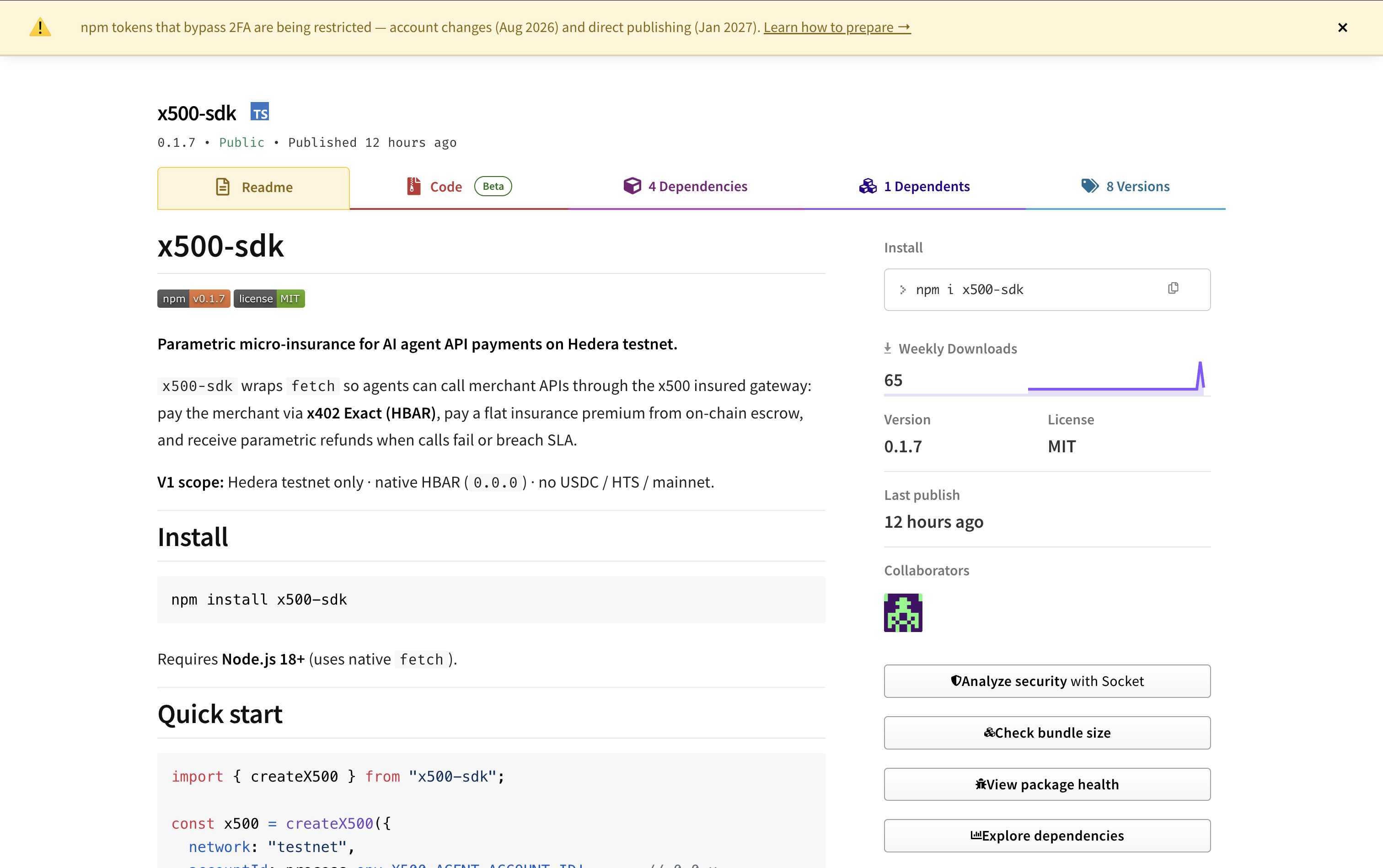
x500-sdk npm package

Inspiration
When a paid service fails, a human can call customer support. Agents cannot.
As AI agents pay for more APIs on their own - weather, search, tools, data etc.. a failed or slow response after payment leaves them with no recourse. x402 makes agent-to-API payments real; x500 asks the next question: who refunds a 500 after the agent already paid?
What it does
x500 is a micro-insurance for AI agent's x402 based API payments.
- Agents call merchant APIs through an insured gateway
- Merchants get paid via x402 Exact
- Agents pay a flat insurance premium from on-chain escrow
- If the call fails or misses SLA, the protocol refunds them automatically - no tickets, no claims desk
Try it live: dashboard · chat demo (normal + SLA-breach refund) · pitch · demo video
Who benefits
Merchants
- List a paid API once and receive HBAR per call via x402
- Set slug, origin URL, API price, and SLA in the dashboard
- Stay focused on serving the API — premiums and refunds settle in the protocol
- Become discoverable to agents that resolve your origin through x500
Agent builders
- One insured
fetchpath: pay the merchant + pay the premium - Automatic parametric refunds on failure / SLA breach
- No need to know the merchant slug — pass the public origin URL
- Drop-in SDK for any agent runtime (CLI, LangChain, custom bots)
How merchants use x500
- Host an HTTP API with a public HTTPS origin (e.g. ngrok for demos)
- Open the dashboard → Merchants
- Connect HashPack and register slug, origin, API price, and SLA
- Serve the route with x402 Exact HBAR — agents reach you through the insured proxy
How agents use x500
Install the SDK, fund escrow once, then call any registered merchant by origin URL:
npm install x500-sdk
import { createX500 } from "x500-sdk";
const x500 = createX500({
  network: "testnet",
  accountId: process.env.X500_AGENT_ACCOUNT_ID!,      // 0.0.x
  privateKey: process.env.HEDERA_AGENT_PRIVATE_KEY!, // ECDSA hex 0x...
});
// 1. Fund insurance escrow once
await x500.setup({ escrowTinybars: 50_000_000n }); // 0.5 HBAR
// 2. Call a registered merchant by origin URL — slug resolved automatically
const res = await x500.fetchMerchant(
  "https://your-merchant.example/paid/weather?city=Paris",
);
console.log(res.status, await res.text());
await x500.close();
How we built it
End-to-end stack:
- Contracts —
X500Registry,X500Pool,X500Settler - Agent SDK / CLI —
x500-sdk,x500(npm) - Market proxy + wrap/classifier — route, classify outcomes, price premium/refund
- Facilitator — x402 Exact HBAR verify & settle
- Settler + indexer — on-chain
settleBatch+ mirror sync API - Dashboard — HashPack merchant registration & explorer
- Examples — merchant server + LangChain agent
Challenges we ran into
- Keeping x402 merchant payment and insurance escrow as separate rails without confusing agents or merchants
- Making outcomes parametric (HTTP status / latency → refund) instead of subjective claims
- Reliable settlement: idempotent
callIds, settler batching, and readable Hashscan links in demos - Machine-specific client quirks (e.g. Node 22 +
node-fetchvs nativefetchfor Groq in the example agent)
Accomplishments that we're proud of
- A full path from register → pay → insure → refund on Hedera testnet
- Published x500-sdk and a HashPack-powered dashboard
- Live chat demo for success and SLA-breach refund scenarios
- Clear separation: merchants keep their x402 servers; x500 only settles risk
What we learned
- Agent commerce needs refunds as much as payments
- Parametric triggers beat manual claims for autonomous callers
- Hedera primitives (x402 Exact, HSCS contracts, mirror reads) are a strong fit for prepaid escrow + settlement
- Good demos need honest payment breakdowns and explorer links, not just “it worked”
What's next for x500
- Mainnet migration
- Broader merchant onboarding and richer SLA policies
- Hardening settlement UX and observability for production agents
- Exploring additional networks / assets beyond V1 (like USDC, USDT etc)
For a deeper walkthrough — architecture, headers, contracts, and integration guides — see the full GitHub README.


Log in or sign up for Devpost to join the conversation.