The Problem:
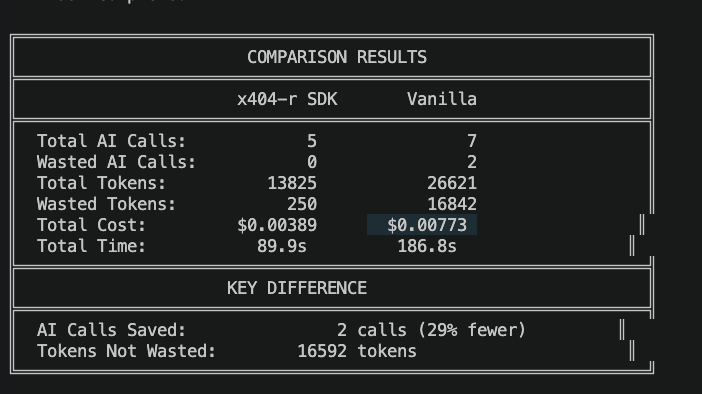
Long-running AI agents lose all progress when workers crash. Lambda timeouts, memory limits, network failures, deployments - any of these events result in hours of work lost. Context? 404 Not Found.
Our Solution:
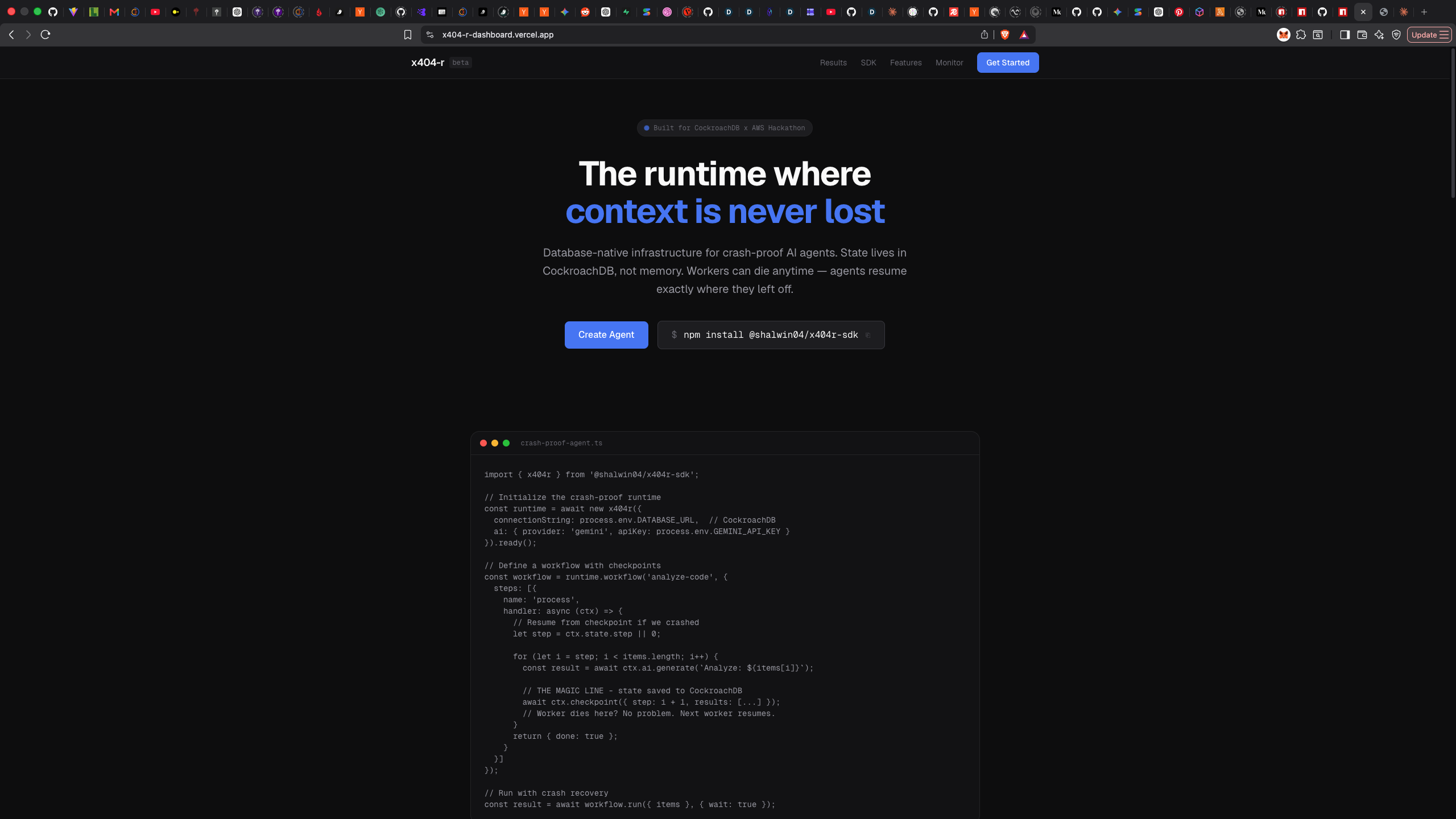
x404-r is a crash-proof runtime for AI agents built on CockroachDB. The key insight: state belongs in the database, not in memory.
Workers are completely stateless. They checkpoint their progress to CockroachDB. If a worker dies, another one picks up exactly where it left off - no progress lost, ever.
What We Built:
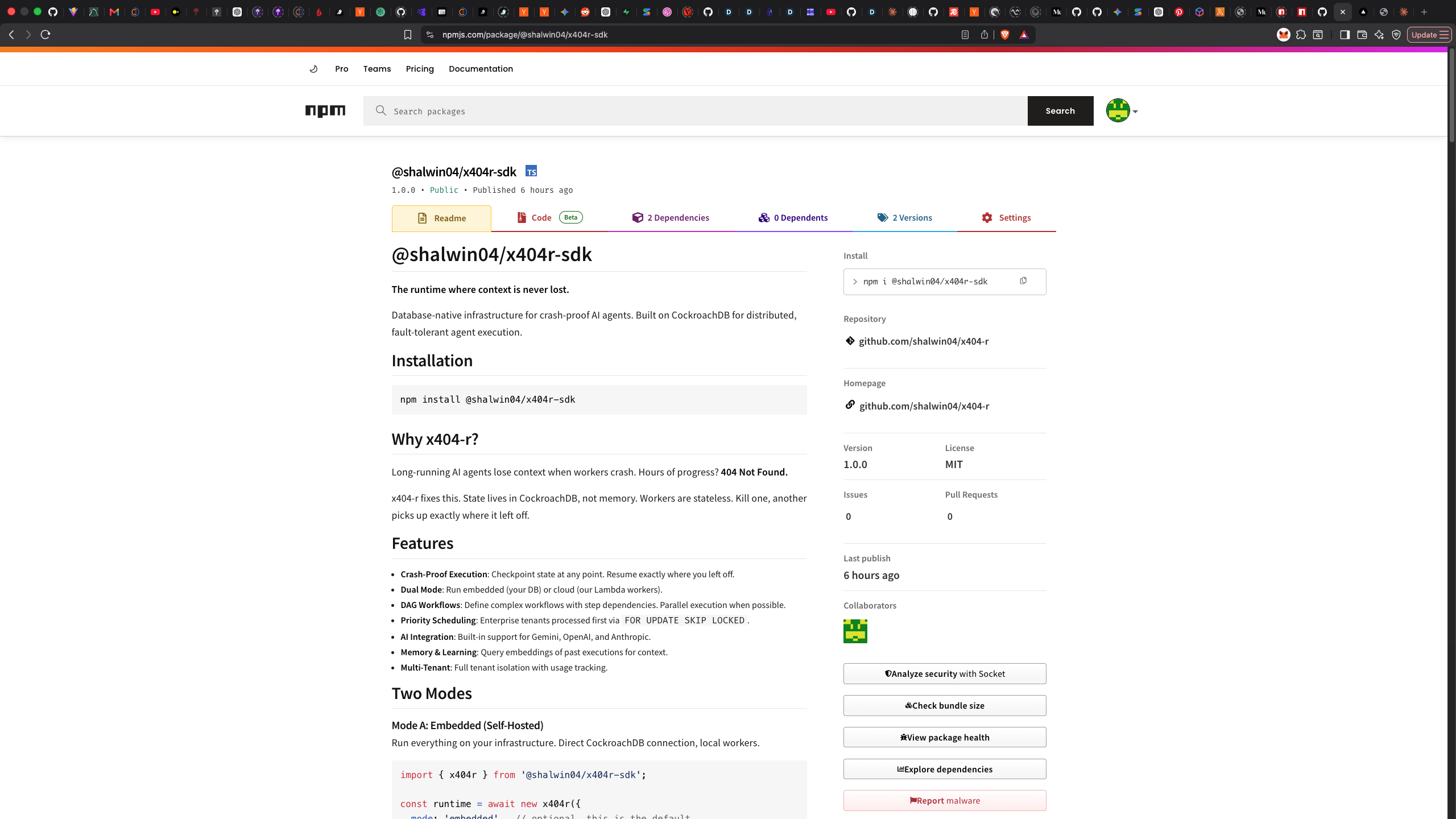
TypeScript SDK (
@shalwin04/x404r-sdk)ctx.checkpoint()- Save state atomically to CockroachDBctx.state- Resume from last checkpoint automatically- DAG workflows with parallel execution
- AI provider abstraction (Gemini, OpenAI, Anthropic)
AWS Lambda Workers
- Stateless execution triggered by EventBridge
- Atomic task claiming with
FOR UPDATE SKIP LOCKED - Automatic crash recovery
Next.js Dashboard
- Real-time DAG visualization with React Flow
- Time travel debugging (replay from any checkpoint)
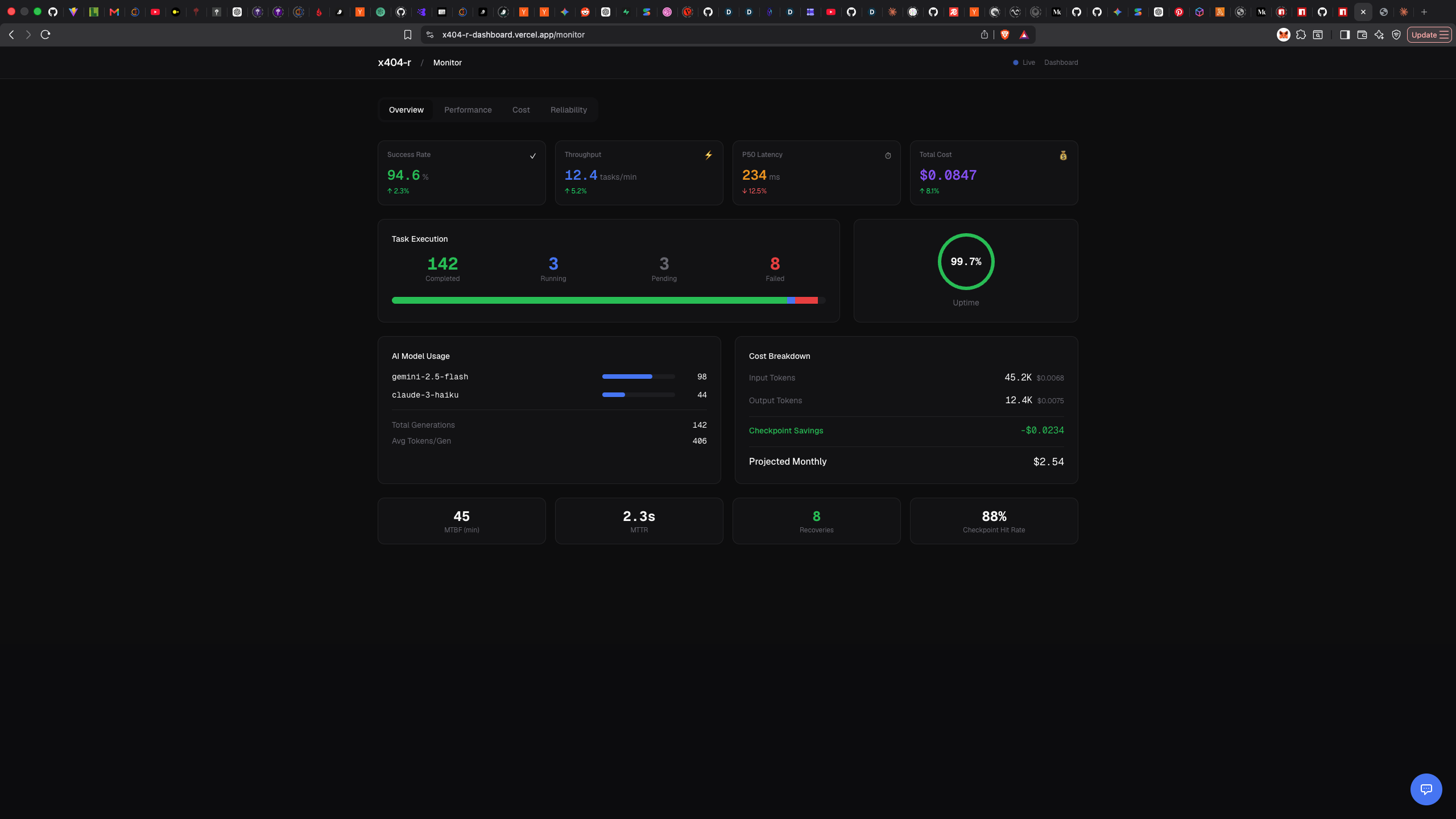
- Cost tracking and metrics
Production Deployment
- CockroachDB Serverless for state storage
- AWS Lambda + API Gateway + EventBridge
- Vercel for dashboard hosting
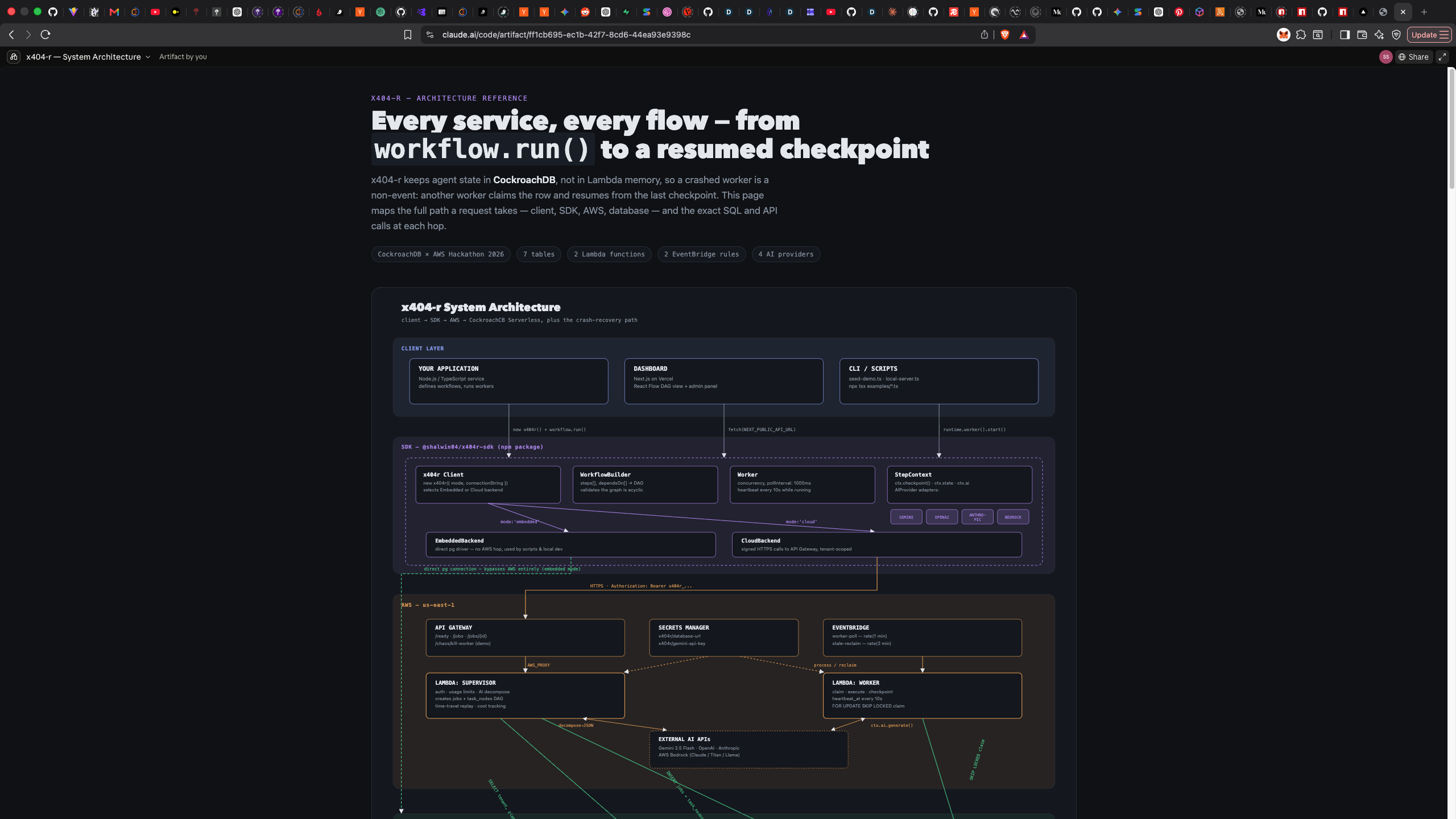
Architecture

Key Technical Achievement:
Using CockroachDB's FOR UPDATE SKIP LOCKED, multiple workers can race to claim tasks without conflicts. Combined with distributed transactions for checkpoints, we achieve true crash-proof execution.
How does your project use CockroachDB? (required)
x404-r uses CockroachDB as the core runtime layer - not just for storage, but as the coordination mechanism for distributed agent execution.
CockroachDB Features Used:
1. FOR UPDATE SKIP LOCKED (Atomic Task Claiming)
SELECT * FROM task_nodes
WHERE status = 'pending'
  AND (dependencies_met = true)
ORDER BY priority DESC
FOR UPDATE SKIP LOCKED
LIMIT 1;
- Multiple Lambda workers compete for tasks simultaneously
- No race conditions or duplicate processing
- Higher priority tasks claimed first
- Essential for our stateless worker architecture
2. Distributed Transactions (Consistent Checkpoints)
BEGIN;
  UPDATE task_nodes
    SET state = $1, heartbeat_at = NOW()
    WHERE id = $2;
  INSERT INTO checkpoints (task_id, step_index, state)
    VALUES ($2, $3, $1);
COMMIT;
- Checkpoints are ACID - never partial
- Task state and checkpoint saved atomically
- If transaction fails, nothing is saved (crash-safe)
3. JSON Columns (Flexible State Storage)
CREATE TABLE task_nodes (
  input_payload JSONB,
  state JSONB,           -- Checkpoint state
  output_payload JSONB
);
- Agent state is arbitrary JSON
- No schema migrations needed
- Query checkpoint data with SQL
4. Vector Storage / Embeddings (Agent Memory)
CREATE TABLE memory_vectors (
  embedding VECTOR(768),
  context_summary TEXT,
  task_type STRING
);

-- Query similar past experiences
SELECT * FROM memory_vectors
ORDER BY embedding <-> $1
LIMIT 5;
- Agents learn from past executions
- Similar failures/successes retrieved as context
- Improves agent performance over time
5. Multi-Region Capability
- Workers can run in any region
- CockroachDB handles replication
- Low latency reads from nearest replica
Why CockroachDB over Postgres?
SKIP LOCKEDworks across distributed nodes- Transactions are globally consistent
- Serverless tier perfect for hackathon/startup scale
- Vector support built-in
How does your project use AWS? (required)
x404-r uses AWS as the serverless compute layer for executing crash-proof agent tasks.
AWS Services Used:
1. AWS Lambda (Primary Compute)
Worker Lambda:
- Executes agent tasks with checkpointing
- Triggered every 1 minute by EventBridge
- Claims tasks atomically from CockroachDB
- Sends heartbeats during execution
- Timeout: 5 minutes, Memory: 1024MB
Supervisor Lambda:
- Handles API requests (job creation, status)
- Task decomposition using Gemini AI
- Authentication and authorization
- Timeout: 2 minutes, Memory: 1024MB
2. Amazon API Gateway
- REST API for dashboard and SDK clients
- Endpoints:
GET /ready- Health checkPOST /jobs- Create new jobGET /jobs- List jobsGET /jobs/{id}- Get job detailsPOST /chaos/kill-worker- Demo crash simulation
- CORS enabled for dashboard access
3. Amazon EventBridge
- Scheduled rules for worker polling:
rate(1 minute)- Poll for new tasksrate(2 minutes)- Reclaim stale tasks (dead workers)
- Enables serverless, event-driven architecture
- No long-running processes needed
4. AWS Secrets Manager
- Secure storage for:
- CockroachDB connection string
- Gemini API key
- Lambda retrieves secrets at runtime
- No credentials in code or environment
5. Amazon CloudWatch
- Lambda execution logs
- Metrics for invocations, errors, duration
- Debugging and monitoring
6. AWS CDK (Infrastructure)
- Infrastructure as code
- Single
npx cdk deployfor full stack - Reproducible deployments
Why Serverless?
- Workers are stateless by design - perfect for Lambda
- Pay only for execution time
- Auto-scaling handled by AWS
- No server management
What did you learn while building this project?
Technical Learnings:
CockroachDB as a Coordination Layer
FOR UPDATE SKIP LOCKEDis incredibly powerful for distributed task queues- Distributed transactions enable true crash-proof checkpointing
- JSON columns provide schema flexibility without sacrificing query power
Stateless Architecture Benefits
- Moving state to the database simplifies everything
- Workers become interchangeable and disposable
- Scaling is trivial - just add more Lambdas
Lambda Packaging Challenges
- Initially deployed with unbundled code - missing dependencies
- Solution: esbuild to create single-file bundles with all deps
- Reduced cold start times significantly
EventBridge Limitations
- Minimum 1-minute schedule (not seconds)
- Acceptable tradeoff for simplicity
- Alternative: SQS with Lambda triggers (more complex)
Architecture Insights:
Checkpoint vs Event Sourcing
- Checkpoints are simpler for crash recovery
- Don't need full event history, just last known good state
- Easier to reason about and debug
Dual-Mode SDK Design
- Abstract backend behind interface
- Same SDK API for embedded (direct DB) and cloud (HTTP)
- Users choose based on their infrastructure needs
Process Learnings:
Test Early, Test Often
- 78 tests for SDK caught many edge cases
- Mock AI providers for fast test execution
- Integration tests with real CockroachDB for confidence
Documentation is a Feature
- Clear README with examples
- Working code samples in
examples/ - Users can copy-paste and run immediately
What is the potential business value of this project?
The Problem is Real and Expensive:
- AI agent tasks can run for hours
- Crashes cost: compute time + API calls + human time
- Enterprises can lose $100s-$1000s per crash
- Current solutions: restart from scratch, hope for the best
x404-r Value Proposition:
Cost Savings
- Don't re-run crashed work
- Resume from checkpoint = pay only for remaining work
- Track exact savings in dashboard
Reliability SLA
- "Your agent WILL complete"
- No more manual restarts
- Predictable execution times
Developer Productivity
- Simple SDK - one line to checkpoint
- Don't build crash recovery yourself
- Focus on agent logic, not infrastructure
Market Opportunity:
- AI agent market growing rapidly (AutoGPT, CrewAI, LangGraph)
- Long-running tasks becoming more common
- Enterprises need reliability guarantees
Monetization:
Self-Hosted (Open Source)
- Free SDK, bring your own CockroachDB
- Builds community and adoption
Cloud (SaaS)
- Managed Lambda workers
- Usage-based pricing (tasks/month)
- Tiers: Free (100 tasks) → Pro → Enterprise
Enterprise
- Private deployment
- SLA guarantees
- Priority support
Competitive Advantage:
- Built specifically for crash-proof execution
- CockroachDB integration is deep, not bolted on
- Dual-mode (embedded/cloud) serves all segments
Built With
- amazon-web-services
- cli
- cockroachdb
- express.js
- lambda
- langchain
- langgraph
- node.js
- react


Log in or sign up for Devpost to join the conversation.