Inspiration
Everyone can imagine an object - a replacement knob, a custom figurine, a prototype bracket, but between the idea and the physical thing sits a wall: buy a $1,500 printer, learn slicing, babysit failed prints, sand, pack, ship. We kept watching people bounce off that wall. Meanwhile our Bambu Lab printers sat idle between our own jobs. The question that started X3D Studios: what if getting a physical product was as easy as writing a prompt? Type a sentence, hold the object a few days later, and if you're a maker who already knows what you're doing, rent a real printer by the hour from your couch instead of buying one.
What it does
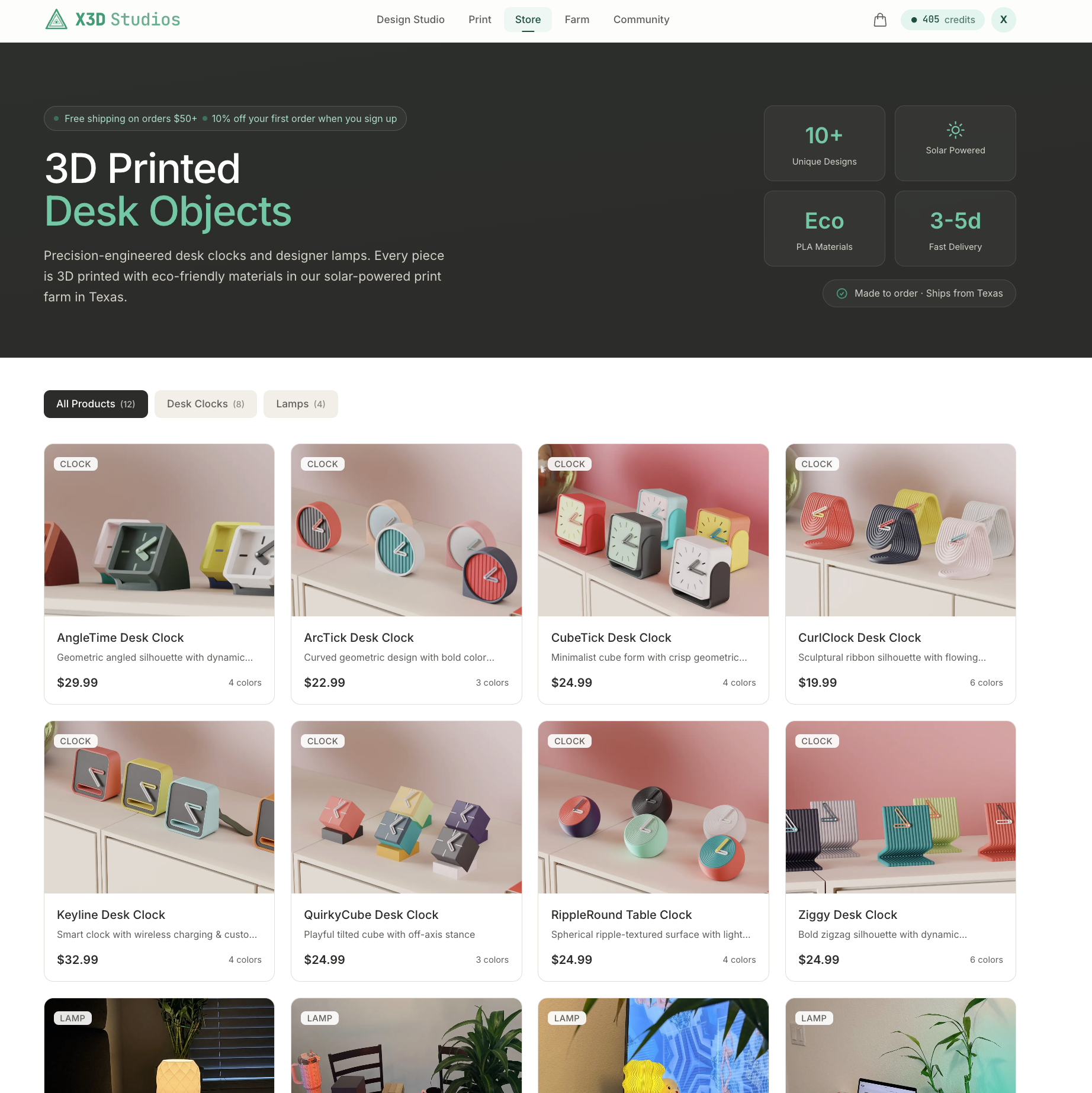
X3D Studios is Prompt to Printed Product as a Service - a real print farm in Austin, TX wrapped in software:
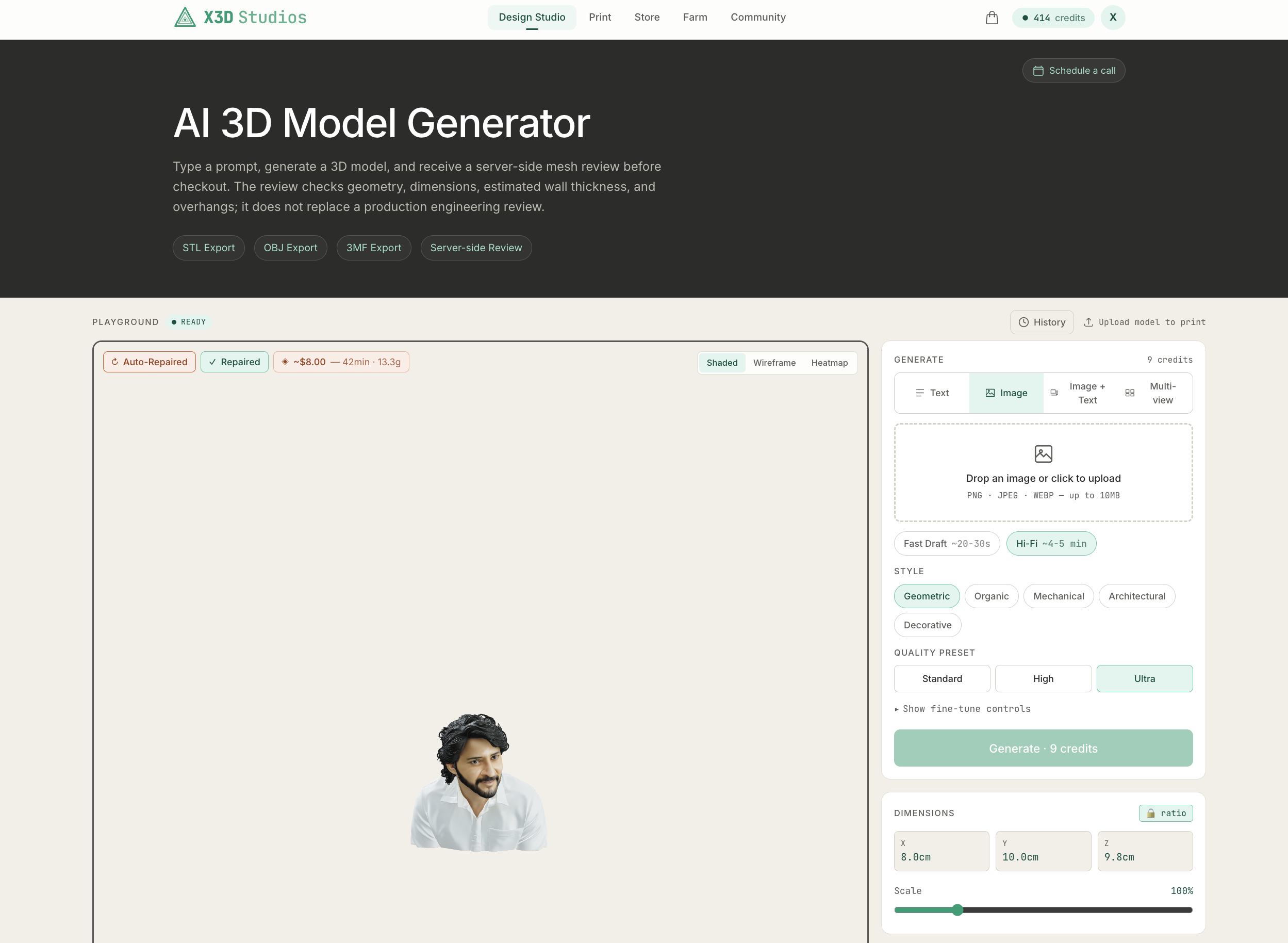
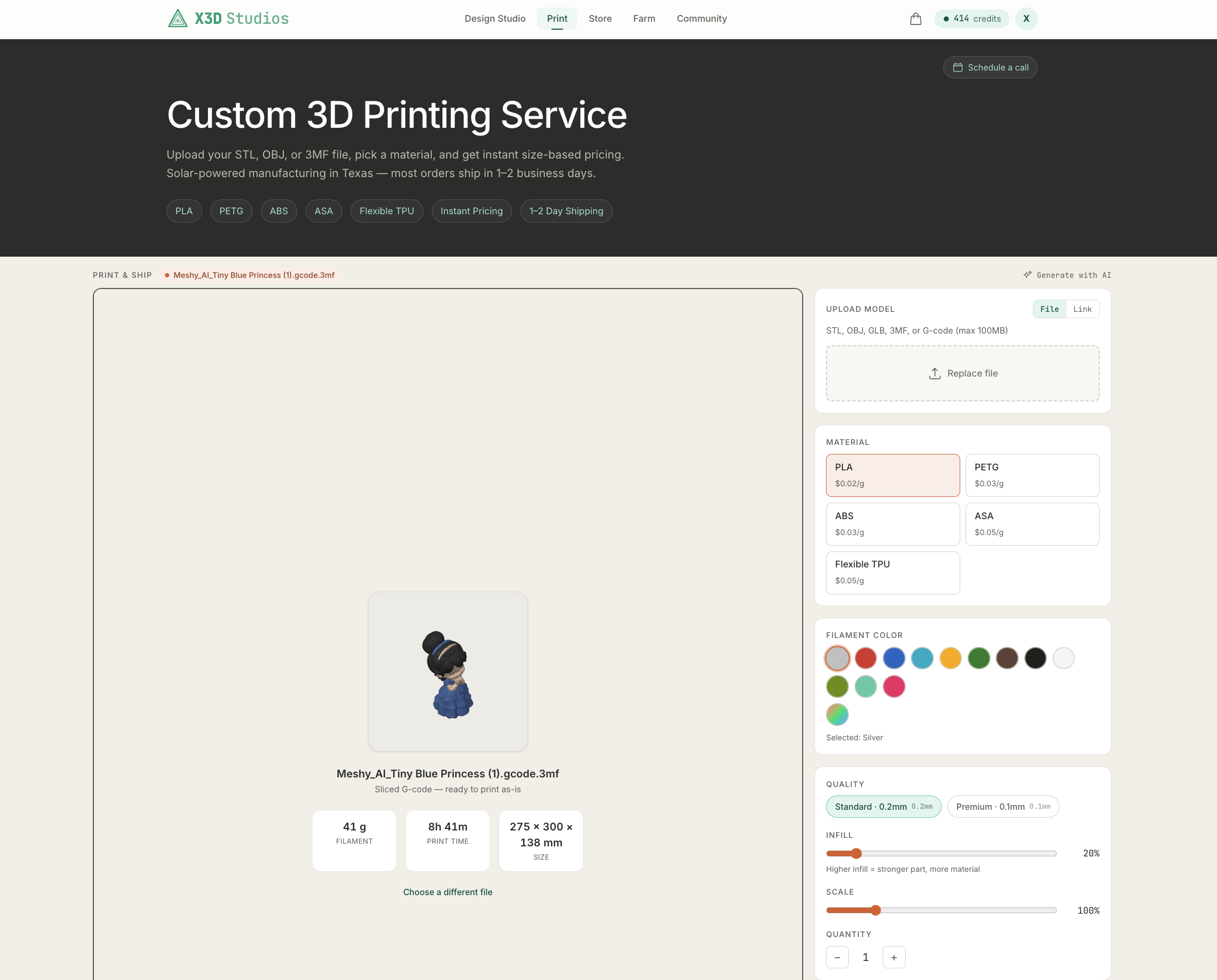
- Prompt → Product: Type a description or upload a photo. AI generates a 3D model, we auto-repair the mesh (manifold fixes, hollowing, print-orientation), quote a real price from grams and machine-hours, print it on Bambu Lab H2S hardware, and ship it (or hand it over for local pickup).
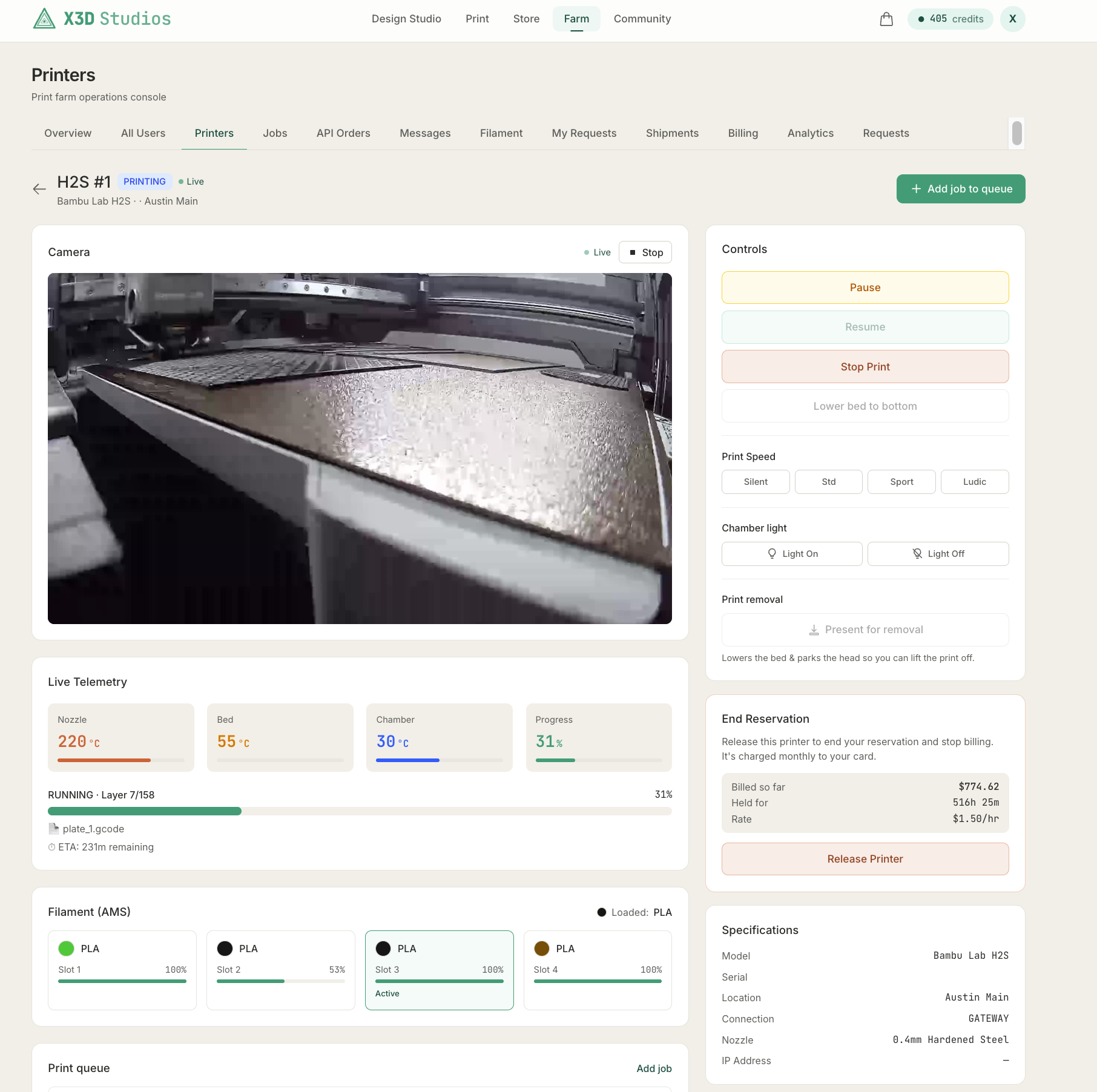
- Remote print farm: Members reserve physical printers by the hour, upload sliced files from Bambu Studio, watch live camera streams, and pause/resume real machines from the dashboard, with per-user privacy (a printer in use by another member shows only "In use").
- Multi-color prints, visually: Upload a multi-color file and the print dialog draws your actual build plate with every object on it. Tap an object, pick an AMS slot, and the part recolors live to the exact filament loaded in the machine.
- Manufacturing as code: A REST API where one POST uploads a file with shipping details, charges the card, and returns tracking, 3D printing as a serverless function.
- Self-running operations: G-code safety validation, automatic job completion, auto bed-lowering, printer fault detection with Bambu's own error text, operator email alerts, monthly usage billing, and Shippo-powered shipping.
How we built it
- Web: Next.js + Prisma/PostgreSQL on Google Cloud Run, Stripe billing, Resend email, Shippo shipping, Gemini-powered assistant, and Tripo/Meshy for AI 3D generation with our own mesh-repair pipeline on top.
- The hardware bridge (the fun part): real Bambu printers speak MQTT/FTPS on a LAN, so we built a gateway: a Linux box running a Bambu printer manager, a Python print agent (Flask + bambulabs_api), and go2rtc camera streaming, exposed to the cloud through named Cloudflare tunnels. The cloud app validates and stores files; the agent FTPS-uploads them to the printer and drives the full print lifecycle over MQTT.
- File intelligence: We parse 3MF/G-code headers for time/filament/temperature estimates, run safety validation before anything touches a machine, and mine the sliced file's own metadata including Bambu's per-object pick-mask images and per-object G-code labels to reconstruct an interactive, recolorable plate view with zero 3D geometry.
- Reliability: Cloud Scheduler sweeps poll every printer server-side, so jobs complete, beds lower, and faults page the operator even with no browser open. A hardware watchdog auto-reboots the gateway box on lockups.
Challenges we ran into
- Bambu printers fight you at every layer. FTPS uploads failed with cryptic 426 errors until we discovered the TLS data channel needed an explicit clean unwrap. Print commands "succeeded" while the printer silently ignored them, newer firmware drops minimal payloads and cloud-bound printers ignore LAN writes entirely until LAN-Only + Developer Mode are on.
- The AMS mapping bug from hell: prints started from our dashboard halted with "Failed to get AMS mapping table" while the same file printed fine from the touchscreen. Root cause: Bambu's
ams_mappingis indexed by project filament id, not "first used filament", a file sliced in a 5-filament project using only filament #2 needs[-1, 0, -1, -1, -1], not[0]. We diagnosed it by reading the printer's own captured command through the gateway. - Trustworthy telemetry is hard: the printer manager would freeze and serve stale "RUNNING 33%" snapshots for hours. We learned that presence of data proves nothing, only movement does and built freshness detection so the dashboard never dresses stale readings up as live.
- Sliced exports strip 3D meshes, killing our geometry-based plate preview until we found Bambu's pick-mask PNGs encode object identity per pixel, which turned out to be better than geometry.
Accomplishments that we're proud of
- The full loop is live on real hardware: prompt → AI model → repair → quote → physical print → doorstep, with no human in the happy path.
- A print dialog that shows your real plate and recolors each object live to the filament actually loaded in the AMS, something even Bambu's own ecosystem doesn't do at print time.
- A farm that runs itself overnight: completes jobs, lowers beds, emails the operator when a print is ready for collection, and detects a frozen gateway or a dead tunnel without a single browser tab open.
- Shipping physical goods with software margins: reservation billing, metered usage, and monthly auto-invoicing on Stripe.
What we learned
- Hardware doesn't lie, but its APIs do. Verify against the machine, not the docs, half our fixes came from reading what the printer actually said over MQTT.
- Silence is not health. Every "it's fine" signal needs an "and it's current" proof, or your dashboard becomes fiction.
- The best data source is often the one the vendor built for themselves, printer touchscreen assets (pick masks, per-object labels) gave us features geometry couldn't.
- Ship every feature to production the day it's built. Small, deployed, tested-on-real-hardware increments beat big branches every time.
What's next for X3D Studios - Prompt to Printed Product as Service
- MCP server for the print API: So, AI agents (Claude, ChatGPT) can order physical objects as a tool call: the agent designs it, we materialize it.
- Scale the farm: more printers, more materials (carbon-fiber, TPU), and a "farm appliance" so other print shops can plug their hardware into our software and become sellers on the network.
- Instant multi-color everywhere: finish carrier integrations (UPS/FedEx), same-week local pickup in Austin, and a storefront where every product is printed on demand with zero inventory.
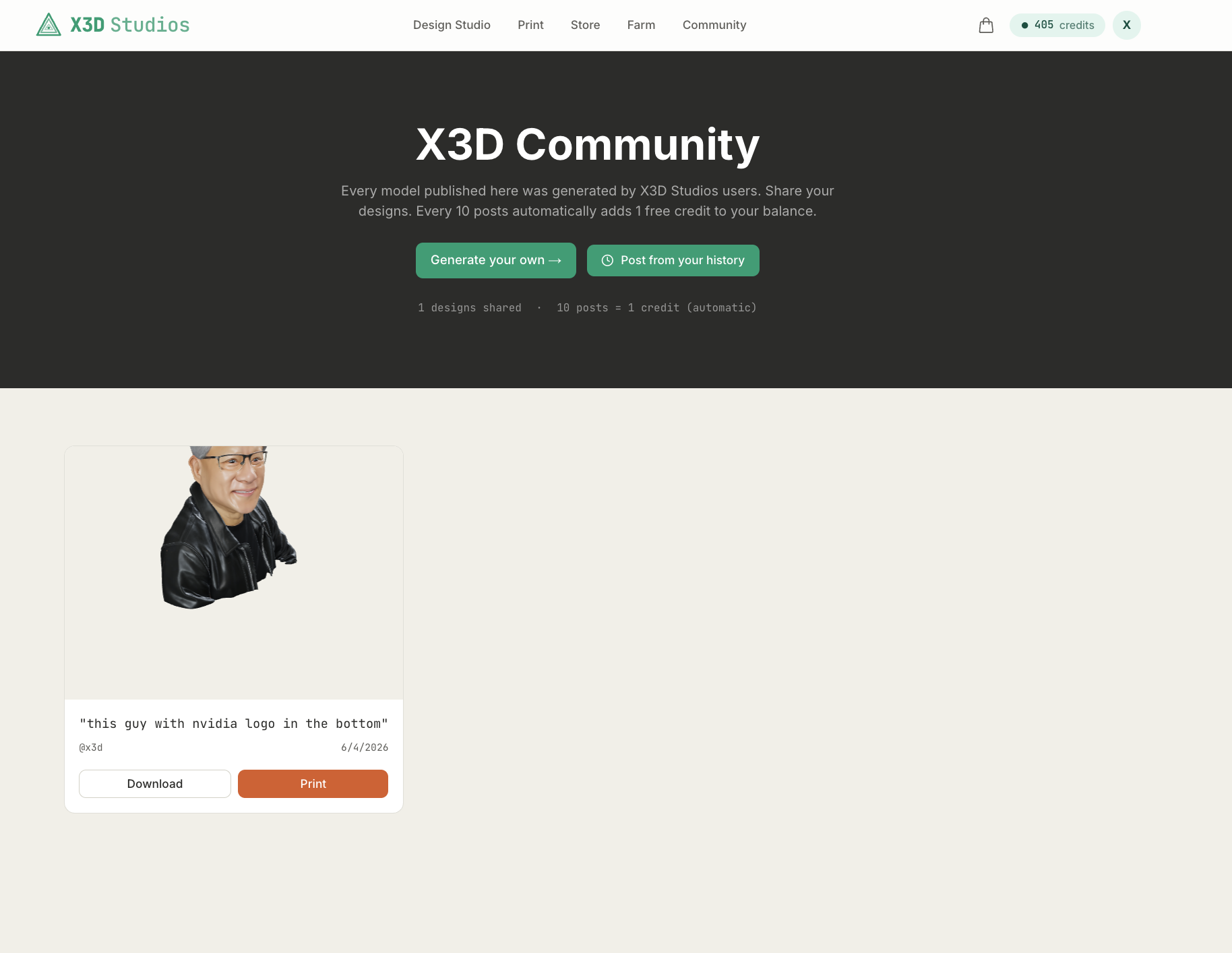
- From prompt to product line: let creators publish AI-generated designs and earn per print, turning X3D into a marketplace where imagination is the only inventory.
Built With
- bambu-lab
- cloudflare-tunnels
- docker
- flask
- gcode
- gemini
- go2rtc
- google-cloud
- google-cloud-run
- meshy
- mqtt
- next.js
- node.js
- postgresql
- prisma
- python
- react
- resend
- shippo
- stripe
- tailwindcss
- tripo
- typescript
- webrtc


Log in or sign up for Devpost to join the conversation.