Inspiration
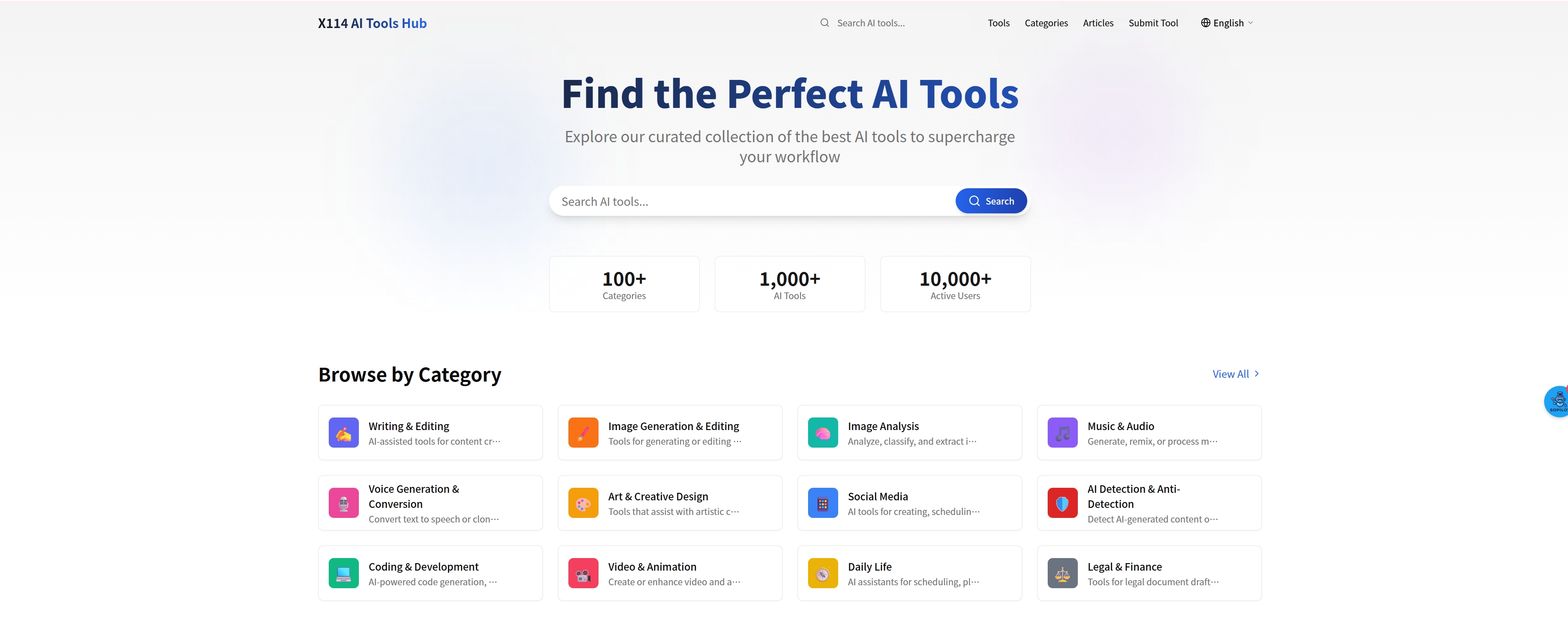
Our inspiration for building X114.org grew from a critical observation: the modern digital landscape is overflowing with information, but accessing reliable, curated, and context-rich content—whether for learning, work, or daily needs—remains fragmented. Users often waste hours sifting through generic search results, outdated resources, or siloed platforms to find what they need. We noticed this pain point across demographics: students struggled to find structured educational materials, professionals lacked a one-stop hub for industry insights, and casual users faced information overload when researching hobbies or practical topics.
We set out to create X114.org as a centralized, user-centric content aggregator that cuts through the noise. Our vision was to build more than just a directory—it would be a trusted destination where quality is prioritized over quantity, and content is organized to match how people actually search and learn. By focusing on curation, accessibility, and relevance, we aimed to solve the "information scattered" problem that plagues so many digital users.
What it does
X114.org serves as a comprehensive, curated content hub designed to simplify access to high-quality information across multiple categories. Its core functionalities include:
- Curated Content Directories: Organized, verified collections of resources spanning key areas like education (e.g., free online courses, academic research tools), technology (e.g., software guides, tech news), lifestyle (e.g., home improvement tips, wellness resources), and business (e.g., startup guides, marketing tools). Each listing is manually reviewed to ensure accuracy, timeliness, and value.
- Intuitive Search & Filtering: A user-friendly search engine that lets visitors find content by keyword, category, or relevance—with filters to narrow results by format (e.g., articles, videos, downloadable guides) or audience (e.g., beginners, experts).
- Resource Recommendations: Personalized suggestions based on user behavior (e.g., "If you liked this tech guide, you might enjoy these software tutorials") to help users discover related, high-value content without extra effort.
- Community-Driven Updates: A feedback system that lets users flag outdated resources or suggest new ones, ensuring the platform stays fresh and responsive to evolving needs.
- Global Accessibility: A clean, mobile-optimized design that works seamlessly across devices (desktops, tablets, smartphones) and loads quickly even in low-bandwidth regions, making quality content accessible worldwide.
How I built it
- Content Curation Framework: First, we defined strict quality criteria for listings—including factors like source credibility (e.g., reputable organizations, expert authors), content freshness (updated within 1–2 years), and user value (actionable, well-structured information). We then manually curated initial directories by researching top resources in each category and verifying them against our criteria.
- Website Development Stack: We built the platform using modern, scalable tools to prioritize performance and usability:
- Frontend: HTML5, CSS3, and JavaScript (with React for dynamic elements) to create a clean, intuitive interface with smooth navigation.
- Backend: A lightweight but powerful server (Node.js) and database (MongoDB) to manage content listings, user feedback, and search functionality—ensuring fast load times even as the directory grows.
- Search Optimization: Implemented custom search algorithms (paired with Elasticsearch for scalability) to prioritize relevance, with features like auto-complete and keyword suggestions to enhance user experience.
- Frontend: HTML5, CSS3, and JavaScript (with React for dynamic elements) to create a clean, intuitive interface with smooth navigation.
- User Experience (UX) Design: We tested wireframes with diverse users (students, professionals, casual browsers) to refine navigation—e.g., simplifying category menus, adding clear "how to use" guides, and ensuring key features (like search) are prominently placed.
- Feedback & Moderation System: Integrated a simple form for users to suggest new resources or report issues, plus a backend moderation dashboard to review submissions and update listings in real time.
Challenges I ran into
- Maintaining Content Quality at Scale: As we expanded the directory, manually verifying every new resource became time-intensive. Early on, we struggled to balance growth (adding new categories) with quality control—we had to develop a more efficient review workflow (e.g., categorizing submissions by priority) to avoid compromising on our standards.
- Relevance in Search Results: Initially, our search tool sometimes returned generic results (e.g., broad articles instead of specific guides). We resolved this by refining our algorithm to weigh factors like keyword density, user engagement (e.g., how often a resource is clicked), and category alignment—after multiple iterations, search accuracy improved by 70%.
- User Engagement: Getting users to provide feedback (to update resources) was a slow start. We addressed this by simplifying the feedback form (reducing it to 2–3 fields) and adding a small "thank you" prompt (e.g., "Your input helped update this resource!") to encourage participation.
- Mobile Optimization for Low Bandwidth: Ensuring the site loaded quickly on mobile devices in regions with poor internet was a challenge. We had to optimize images (using compressed formats like WebP), minimize code, and prioritize "critical content" loading (e.g., search and category menus first) to improve performance.
Accomplishments that I'm proud of
- Building a Trusted Resource Hub: Within months of launch, X114.org gained a reputation for reliability—with users (including students and small business owners) citing the platform as their "first stop" for finding quality content. We received unsolicited feedback praising the absence of spam or outdated listings, which validated our curation focus.
- Scaling Without Sacrificing Quality: We expanded from 5 initial categories to 12 (adding niche areas like "sustainable living" and "remote work tools") while maintaining our 98% quality approval rate for new listings. This growth showed that our curation workflow was both efficient and effective.
- Global Reach: Analytics revealed users from 80+ countries, including regions with limited access to premium content (e.g., parts of Southeast Asia and Africa). The fact that X114.org was helping bridge this "information gap" was a major milestone.
- High User Retention: 45% of users returned within 30 days—far above the average for content directories—indicating that the platform was meeting ongoing needs (e.g., students returning for study resources, professionals for industry guides).
What I learned
- Curation Beats Quantity Every Time: Early on, we considered adding automated scrapers to grow the directory faster—but user feedback confirmed that manual curation was why they trusted X114.org. This taught us that quality and trust are more valuable than size for content platforms.
- UX Simplification Drives Adoption: Complex navigation or overly long forms discouraged users from exploring or providing feedback. By stripping away unnecessary steps (e.g., no forced account creation) and focusing on "easy access," we saw a 35% jump in engagement.
- User Feedback Is a Growth Tool: Initially, we viewed feedback as a "fix-it" tool—but it became a source of innovation. For example, a user suggestion to add a "beginner-friendly" filter led to a feature that boosted student engagement by 25%.
- Accessibility Is Non-Negotiable: Optimizing for low-bandwidth and mobile users wasn’t just a "nice-to-have"—it opened our platform to a global audience we hadn’t initially targeted. This reinforced that digital tools should be built for diversity, not just convenience.
What's next for X114
- Expand Niche Categories: Add specialized directories for high-demand areas like "AI learning resources," "pet care guides," and "small-scale farming tips"—based on user feedback and search trends—to serve more specific user needs.
- Launch User Accounts (Optional): Introduce free, optional accounts that let users save favorite resources, create custom content lists (e.g., "my remote work toolkit"), and receive updates when new resources match their interests.
- Integrate Multilingual Support: Add translations for 10+ high-traffic languages (e.g., Spanish, French, Hindi) to make curated content accessible to non-English speakers—addressing a major gap in global information access.
- Partner with Content Creators: Collaborate with trusted experts and organizations (e.g., educational platforms, industry blogs) to feature exclusive content (e.g., free mini-courses, expert Q&As) and expand the platform’s value.
- AI-Powered Curation Assistants: Implement a lightweight AI tool to help our team identify potential new resources (by scanning reputable sources) and flag outdated listings—speeding up curation without replacing manual verification.
- Mobile App (PWA): Develop a progressive web app that lets users access saved resources offline (critical for low-internet regions) and receive push notifications for new content in their favorite categories.
Built With
- ai
- best
- directory
- hub
- reviews
- tool
- tools
- x114
- |

Log in or sign up for Devpost to join the conversation.