-
-
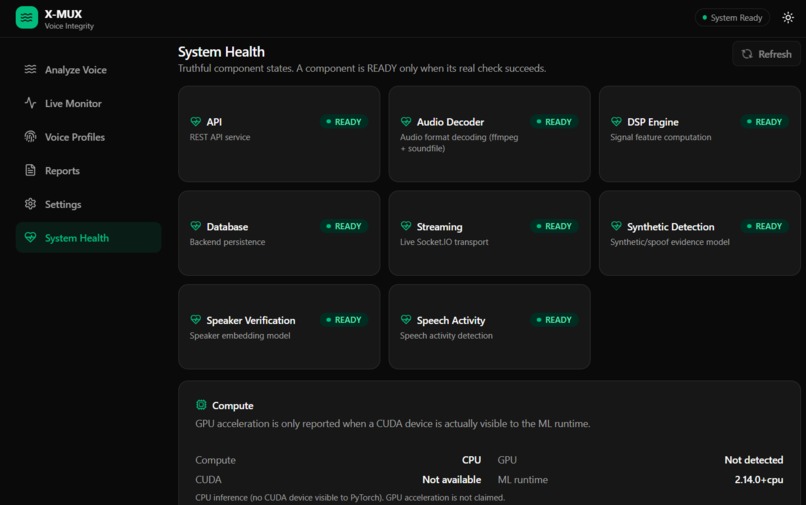
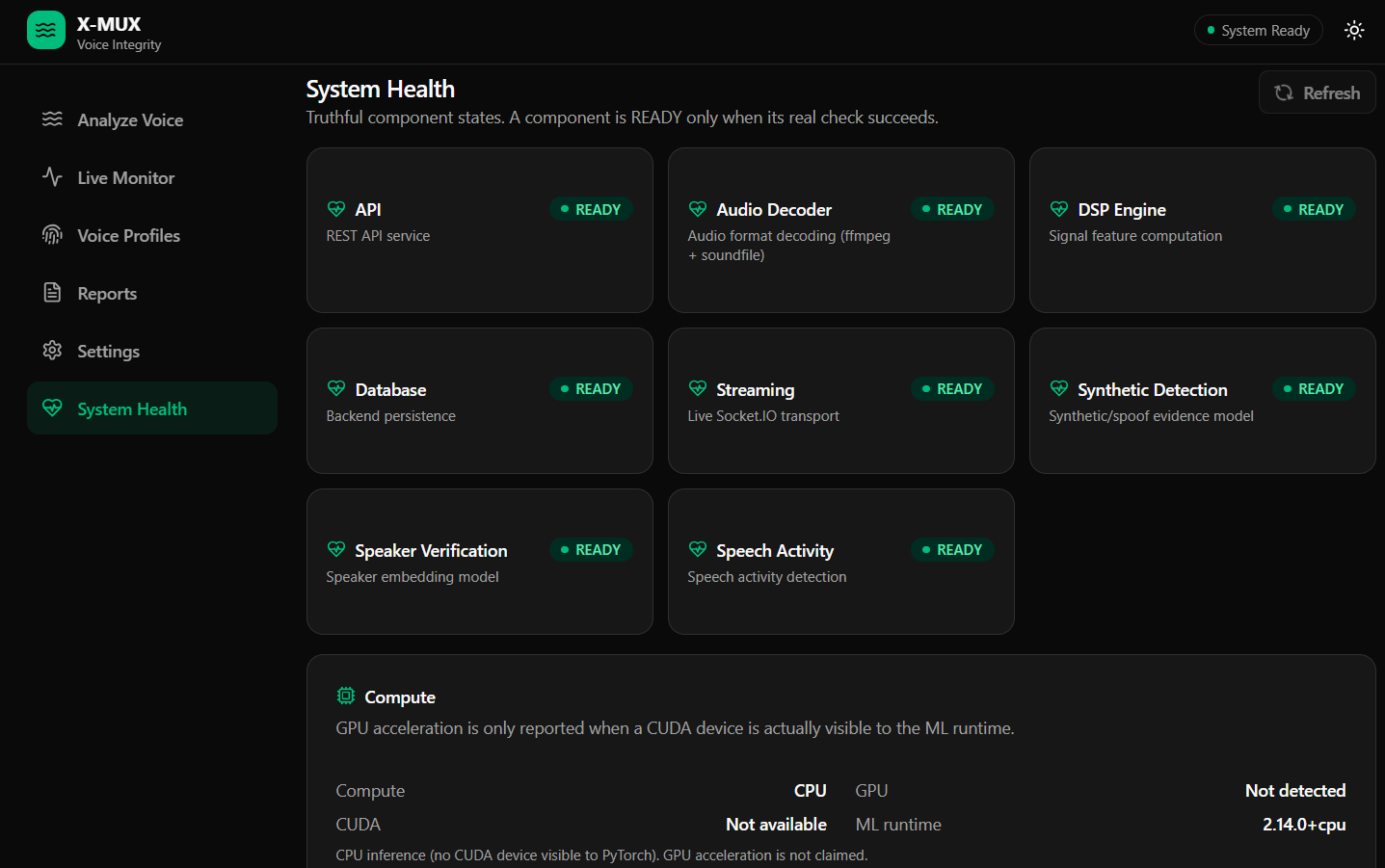
SYSTEM HEALTH
-
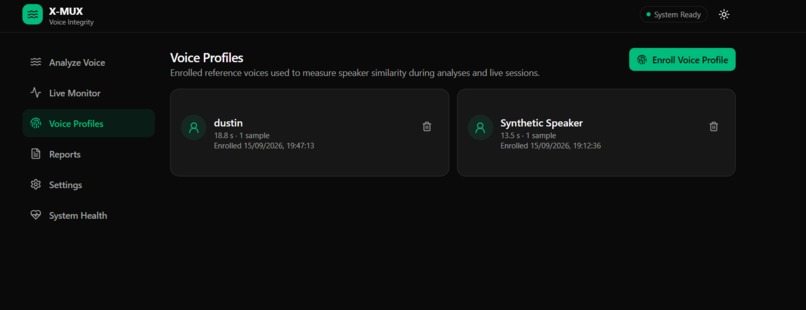
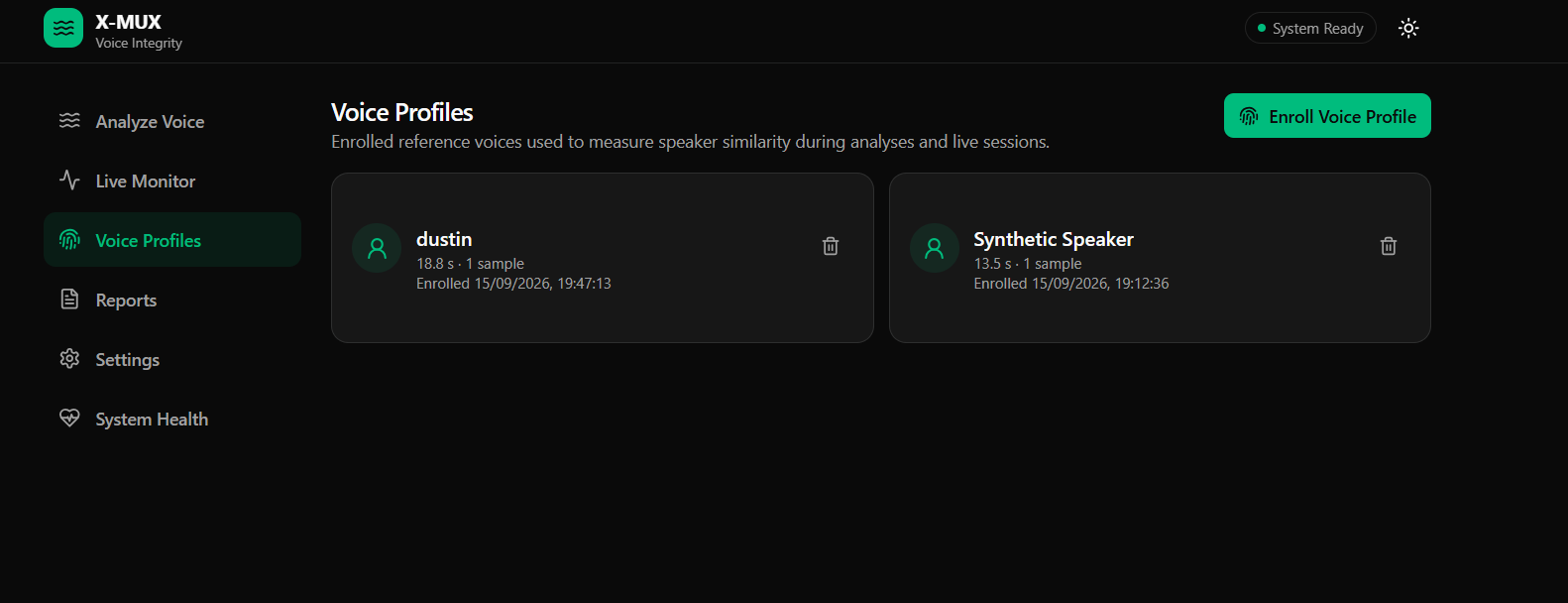
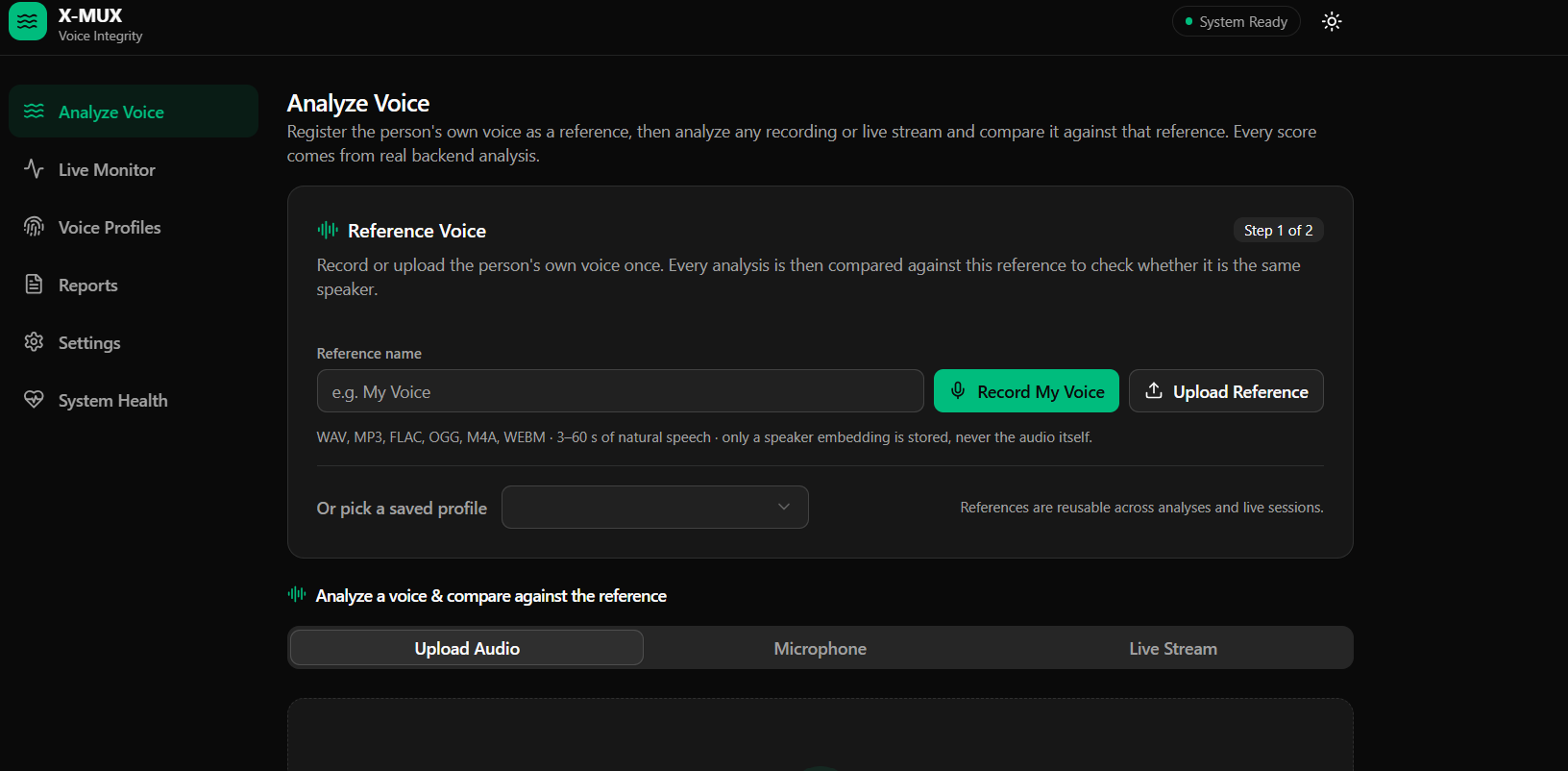
VOICE PROFILE
-
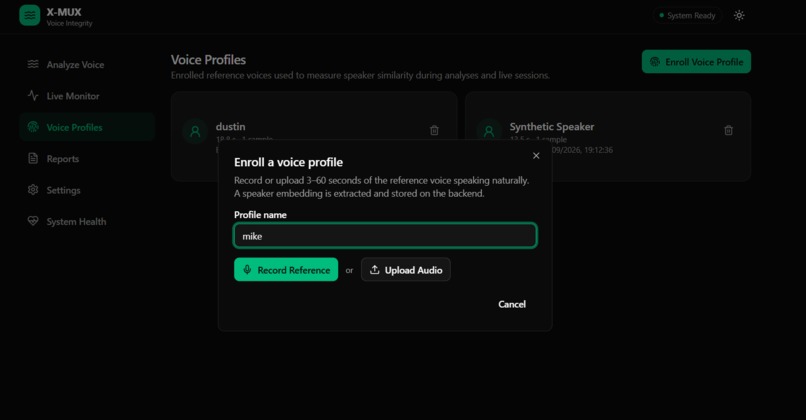
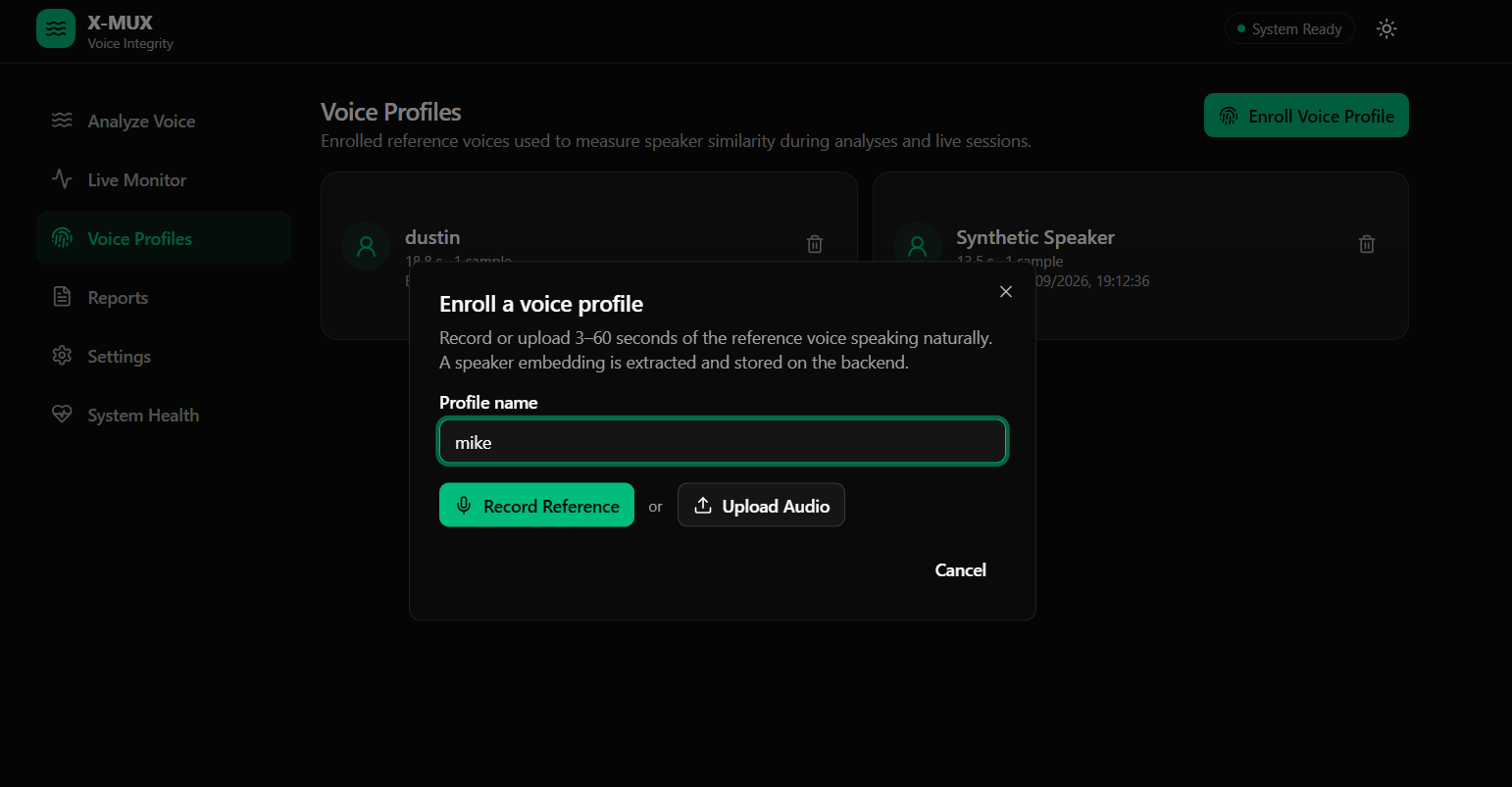
ENROLL TO VOICE PROFILE
-
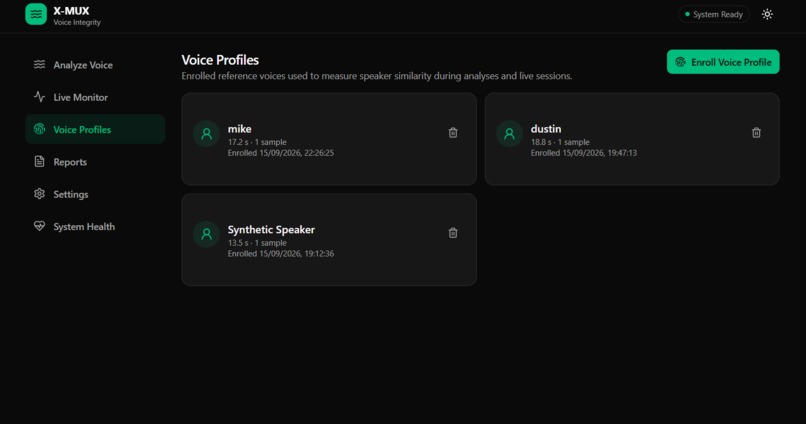
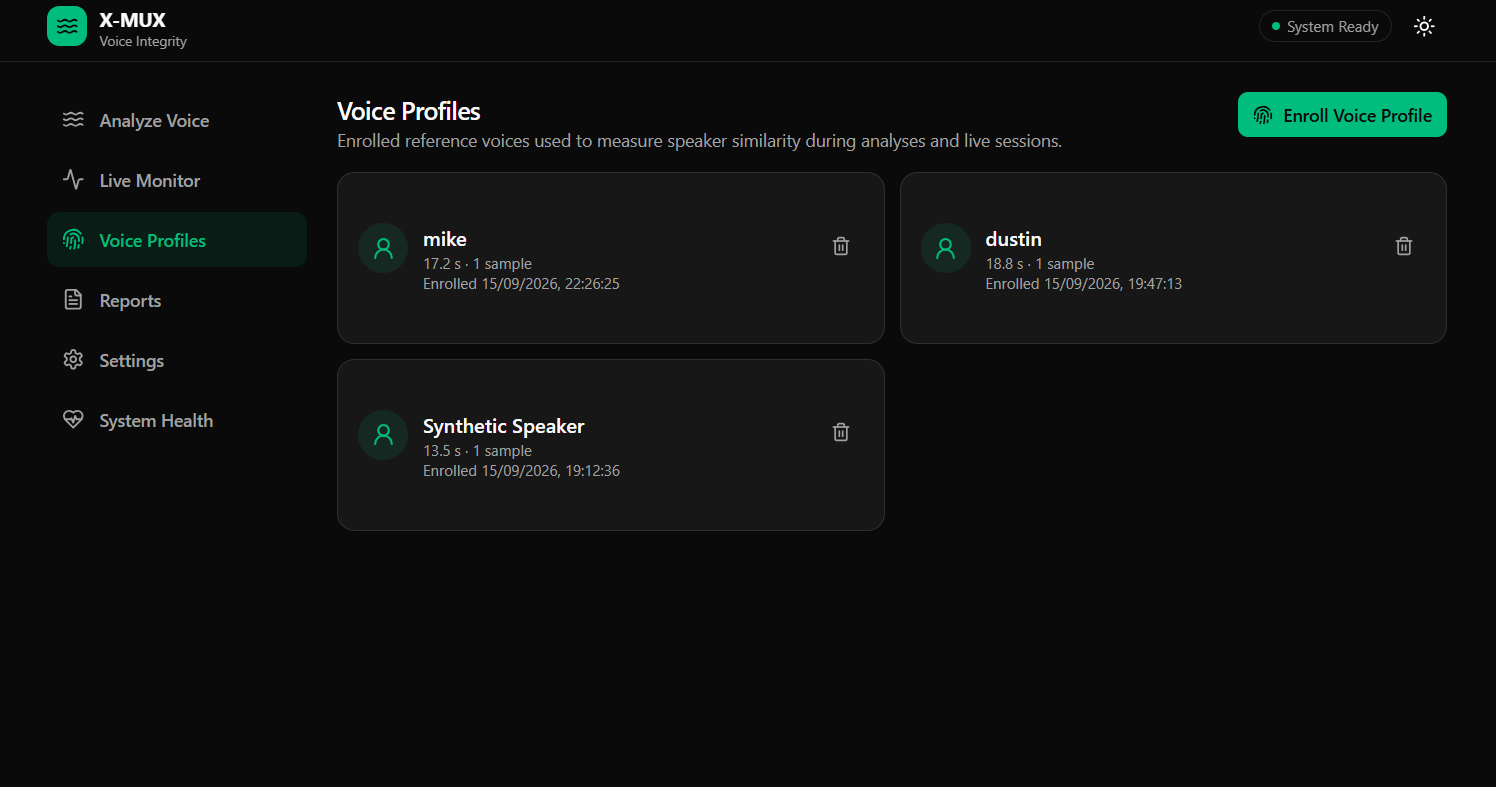
VOICE PROFILE CREATED - MIKE
-
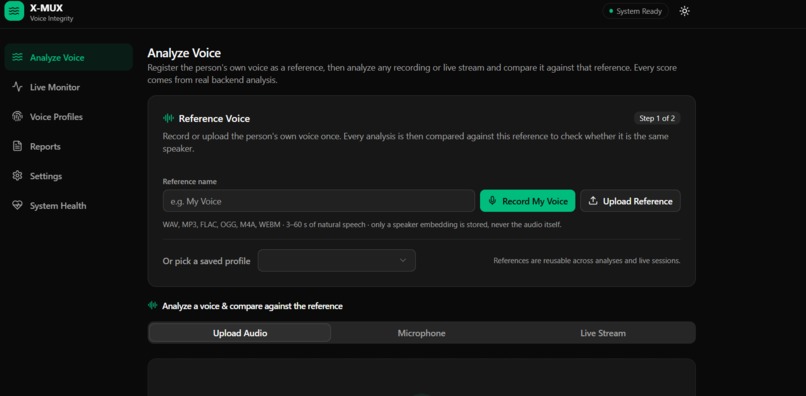
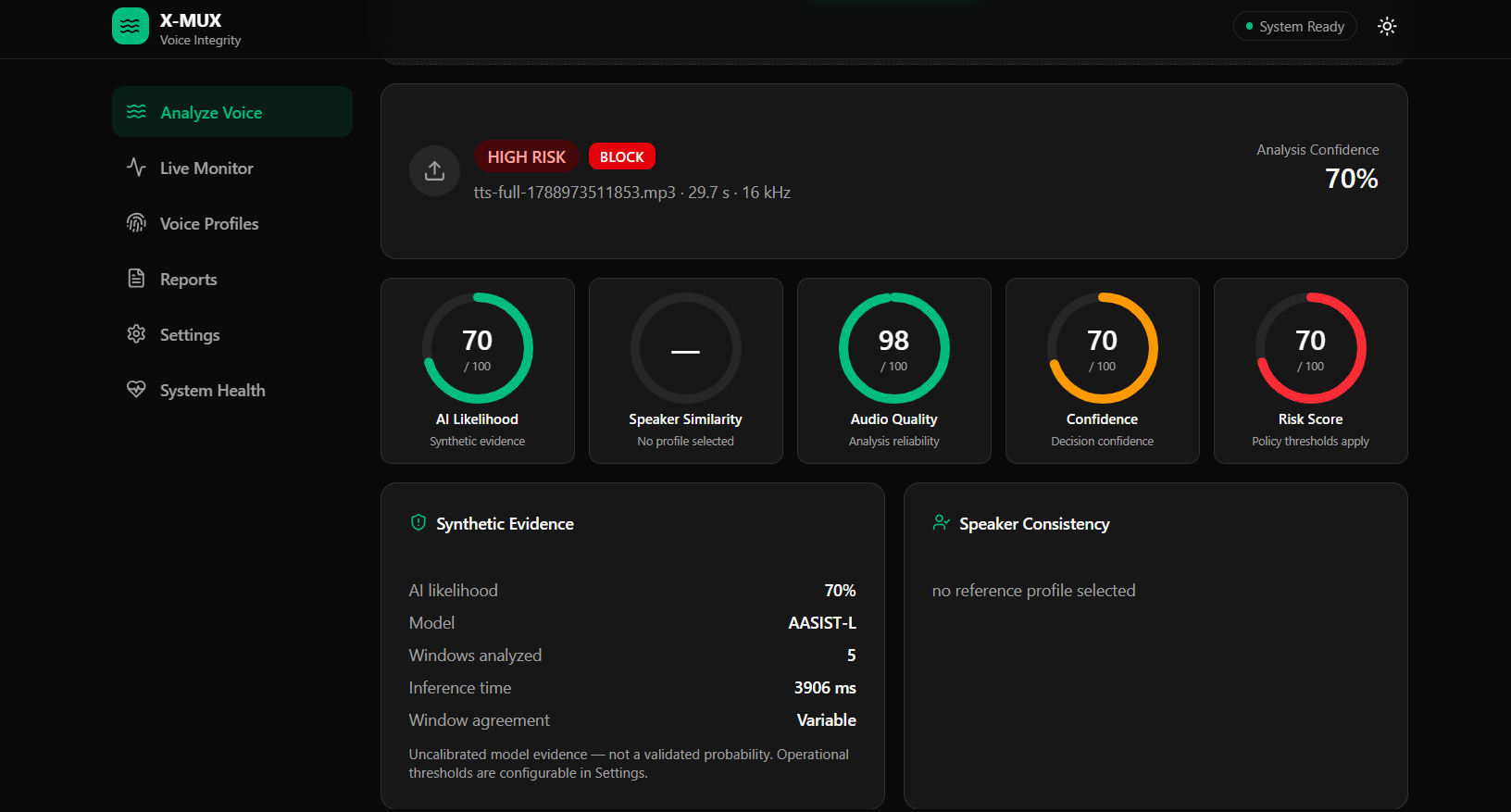
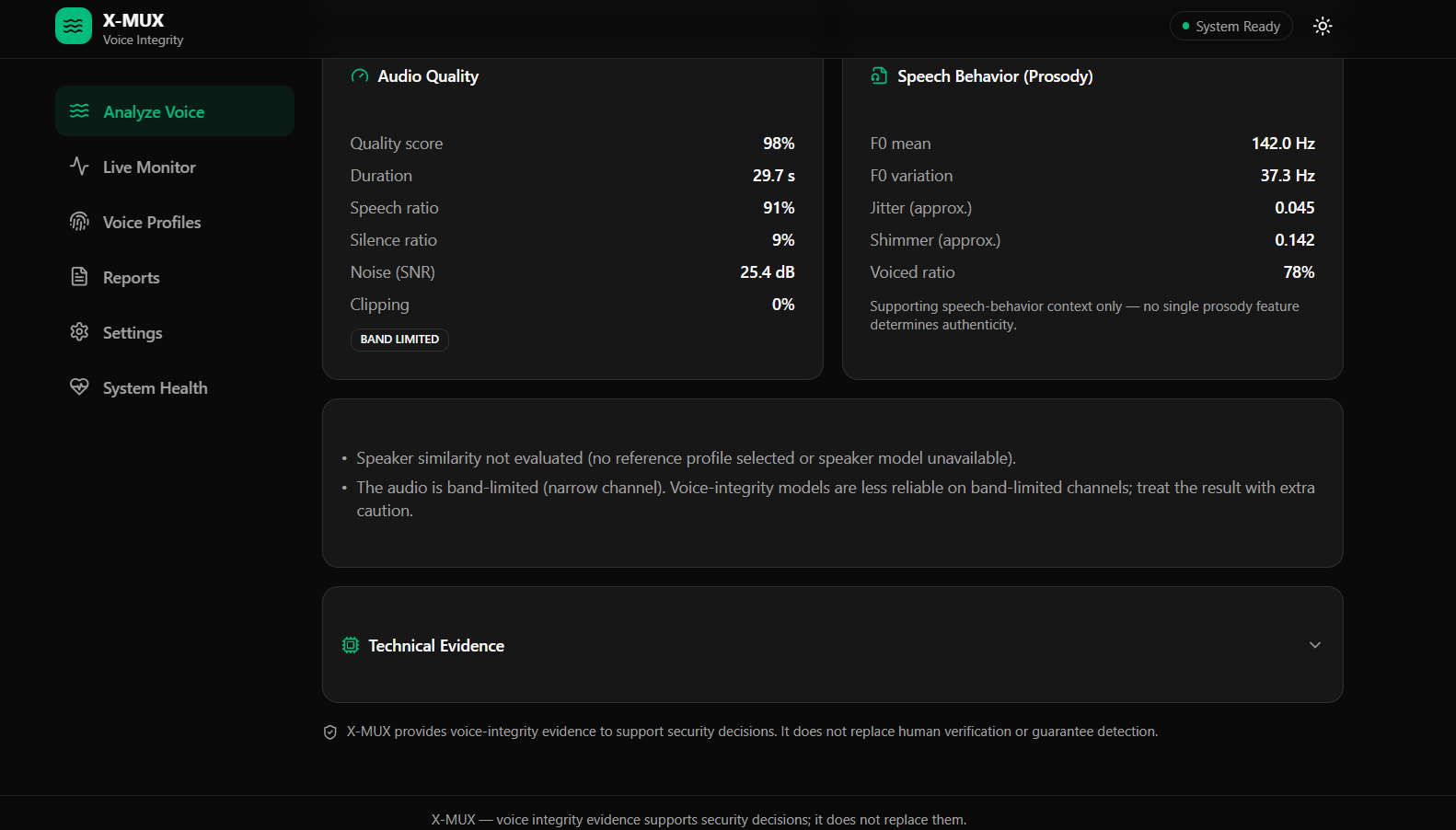
VOICE ANALYSIS
-
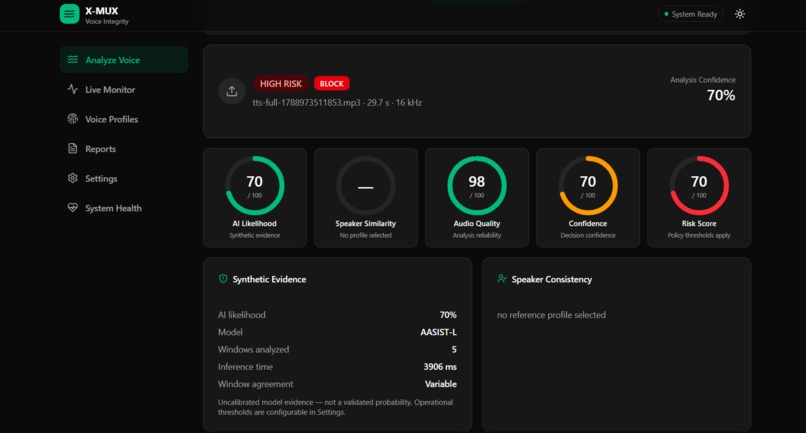
ANALYSIS (1)
-
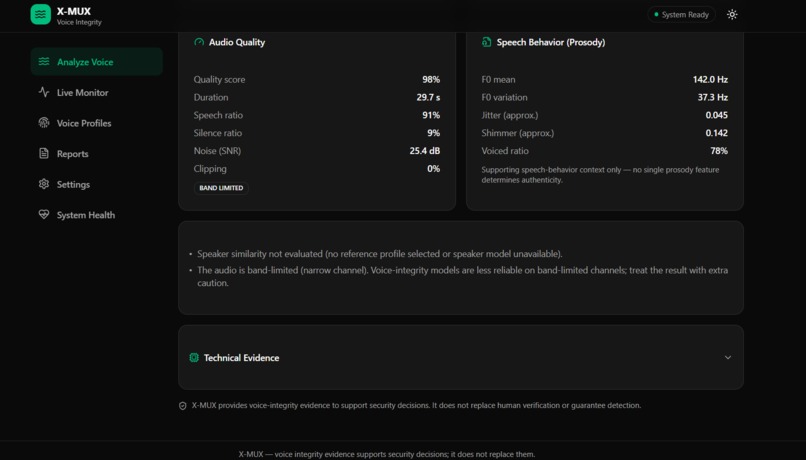
ANALYSIS (2)
-
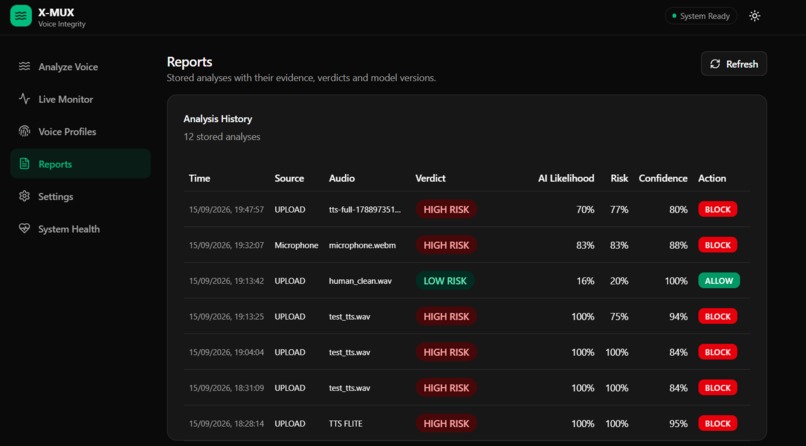
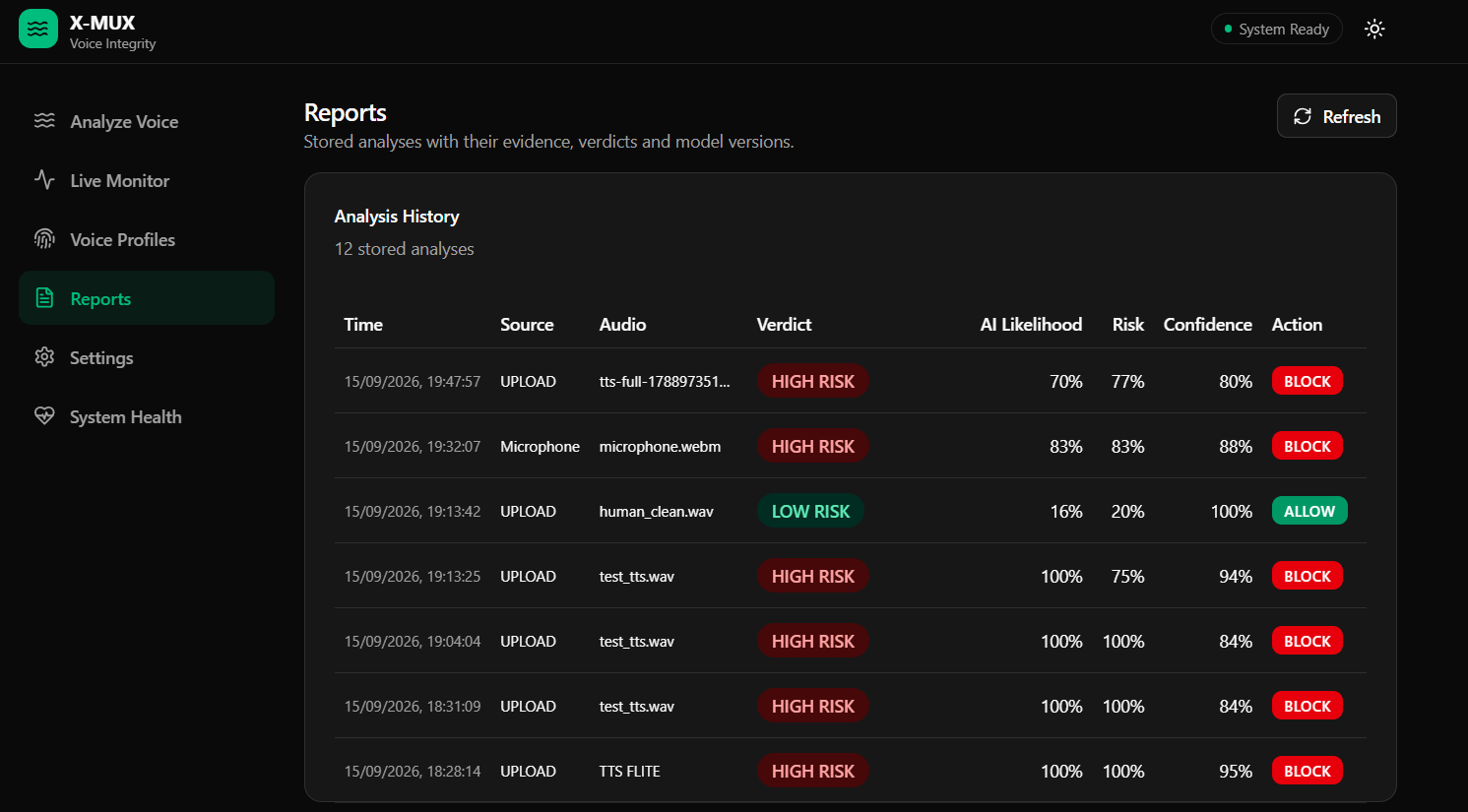
REPORT
-
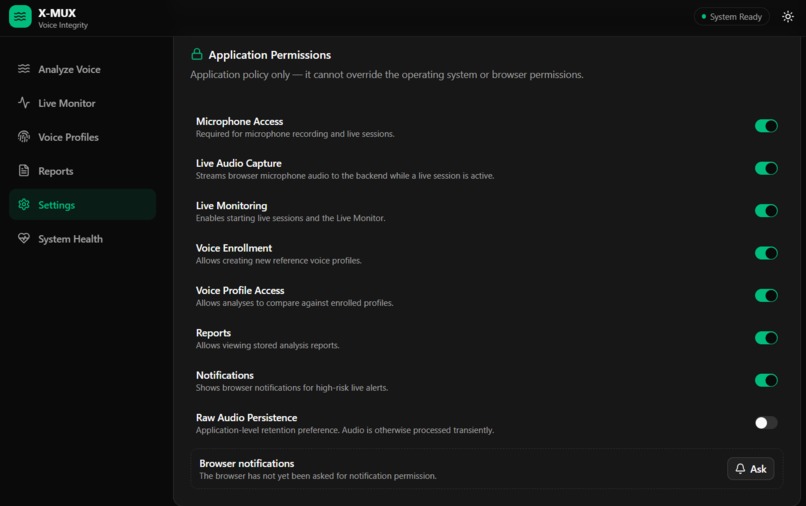
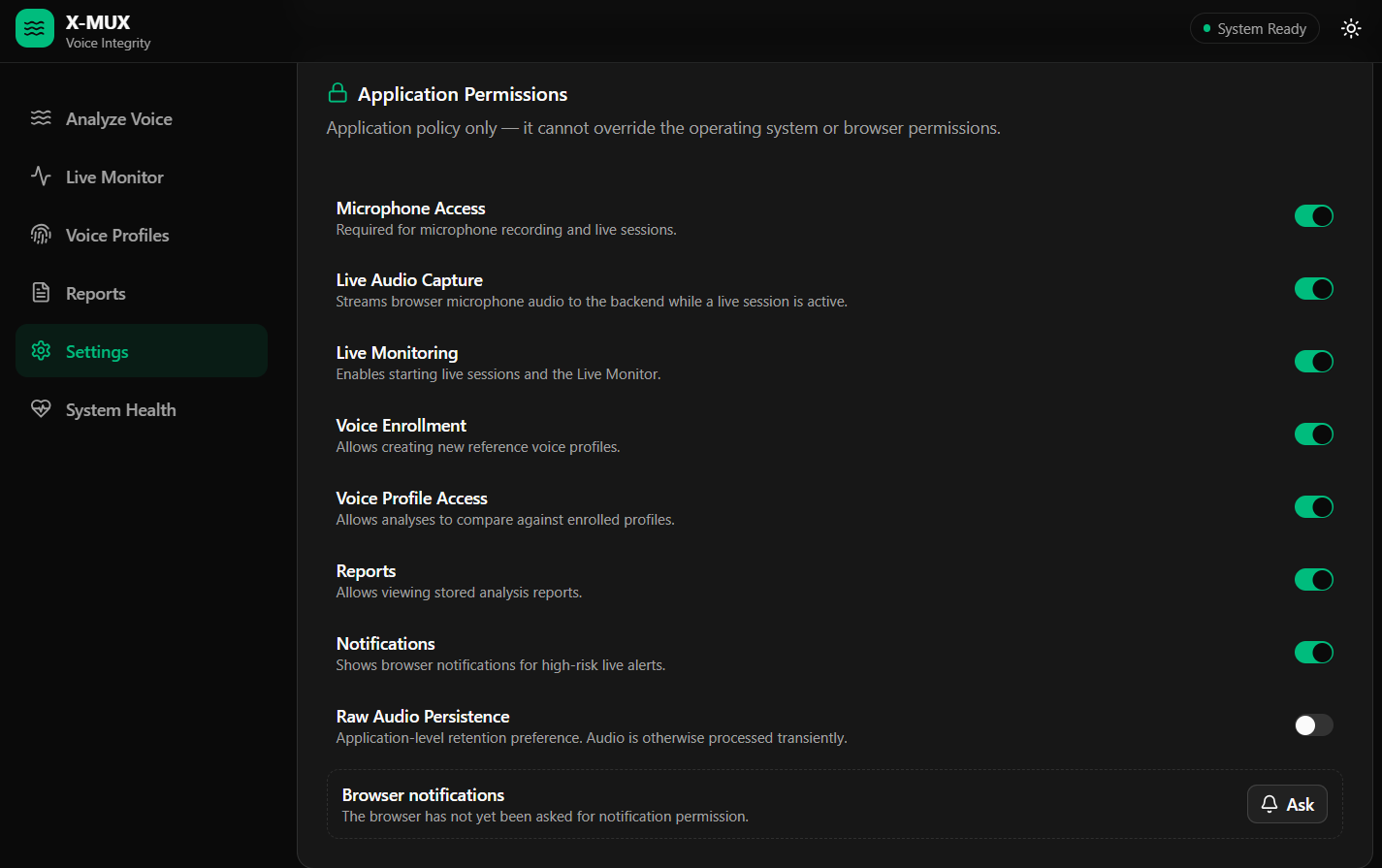
SETTING -->> Application permission
-
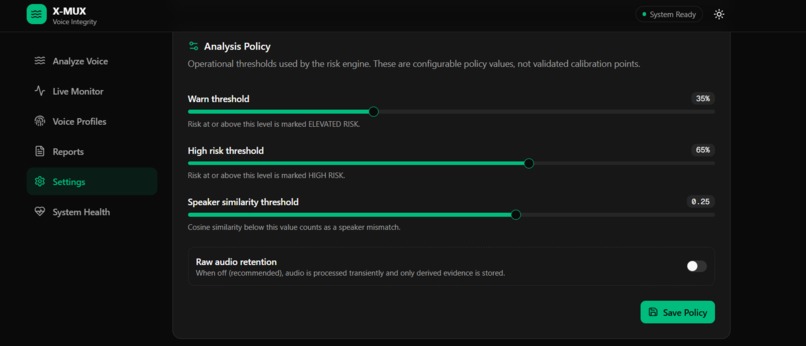
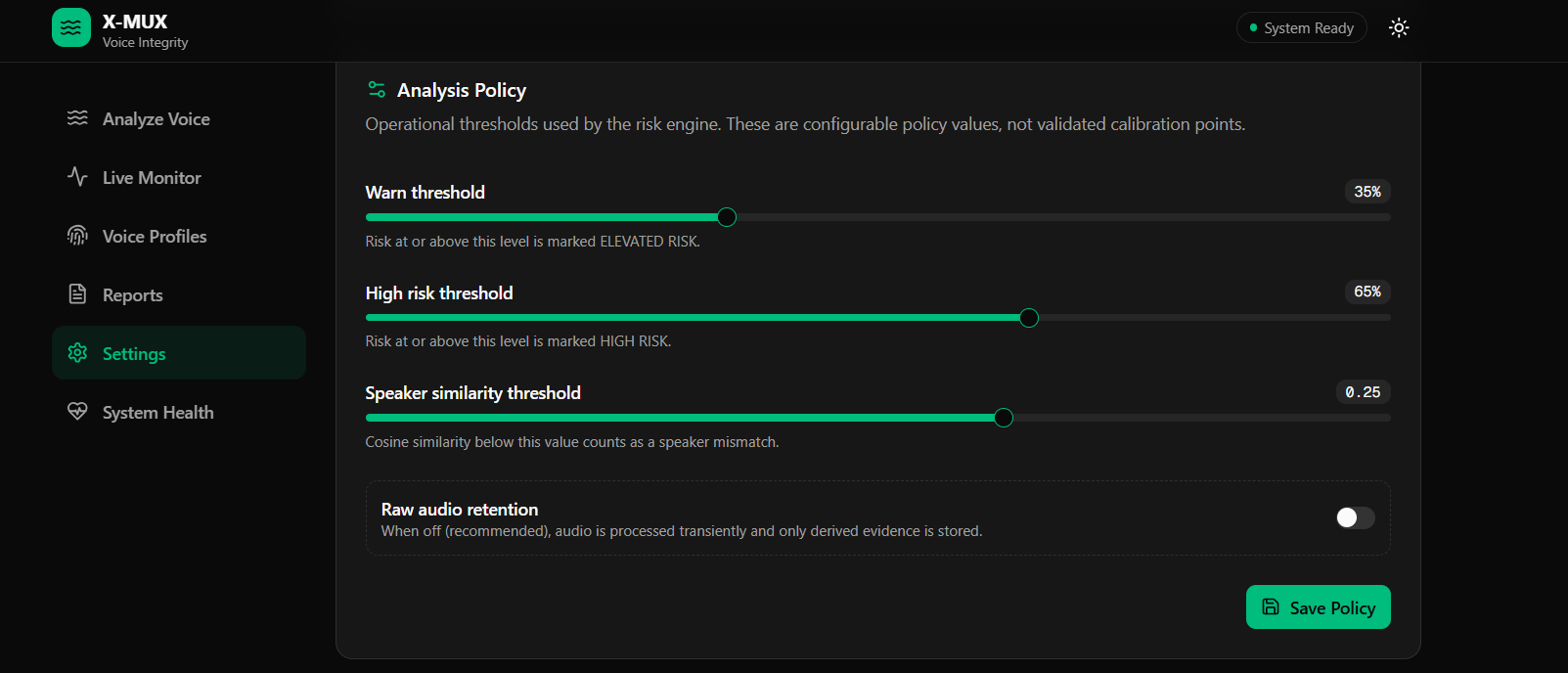
SETTING -->> Analysis policy
-
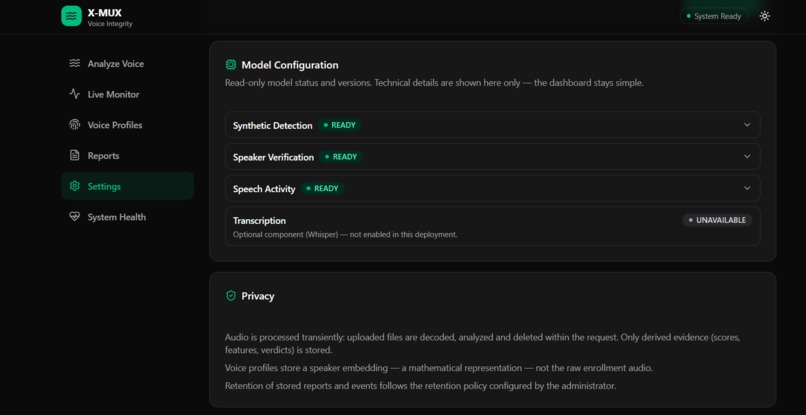
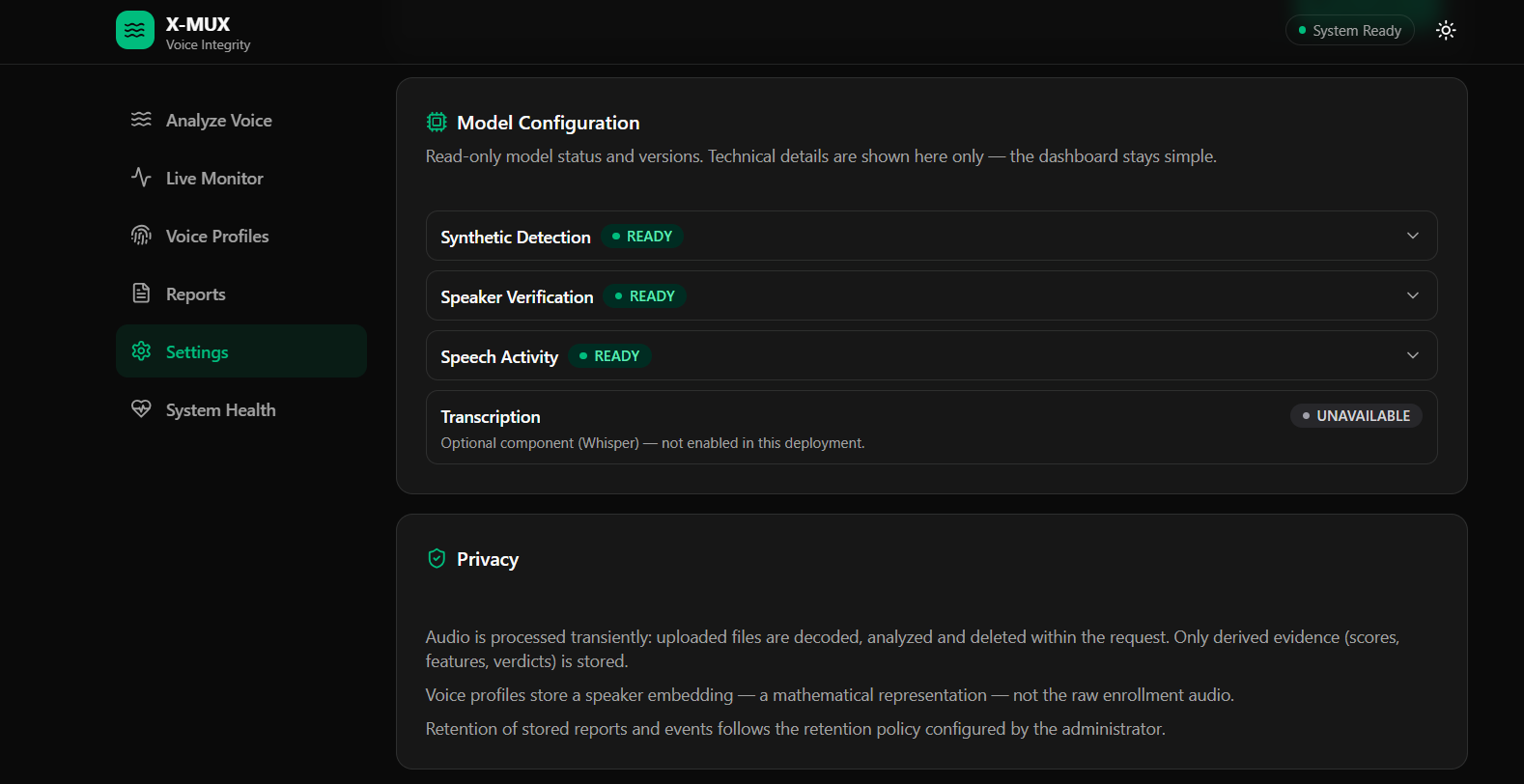
SETTING -->> Modern configuration & Privacy
-
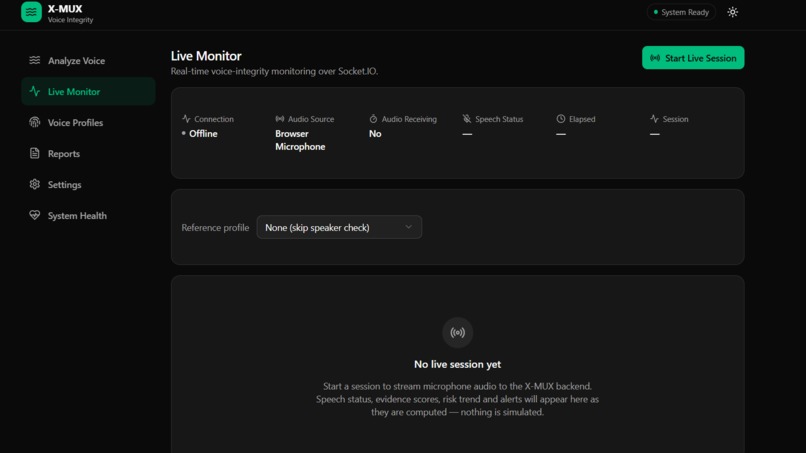
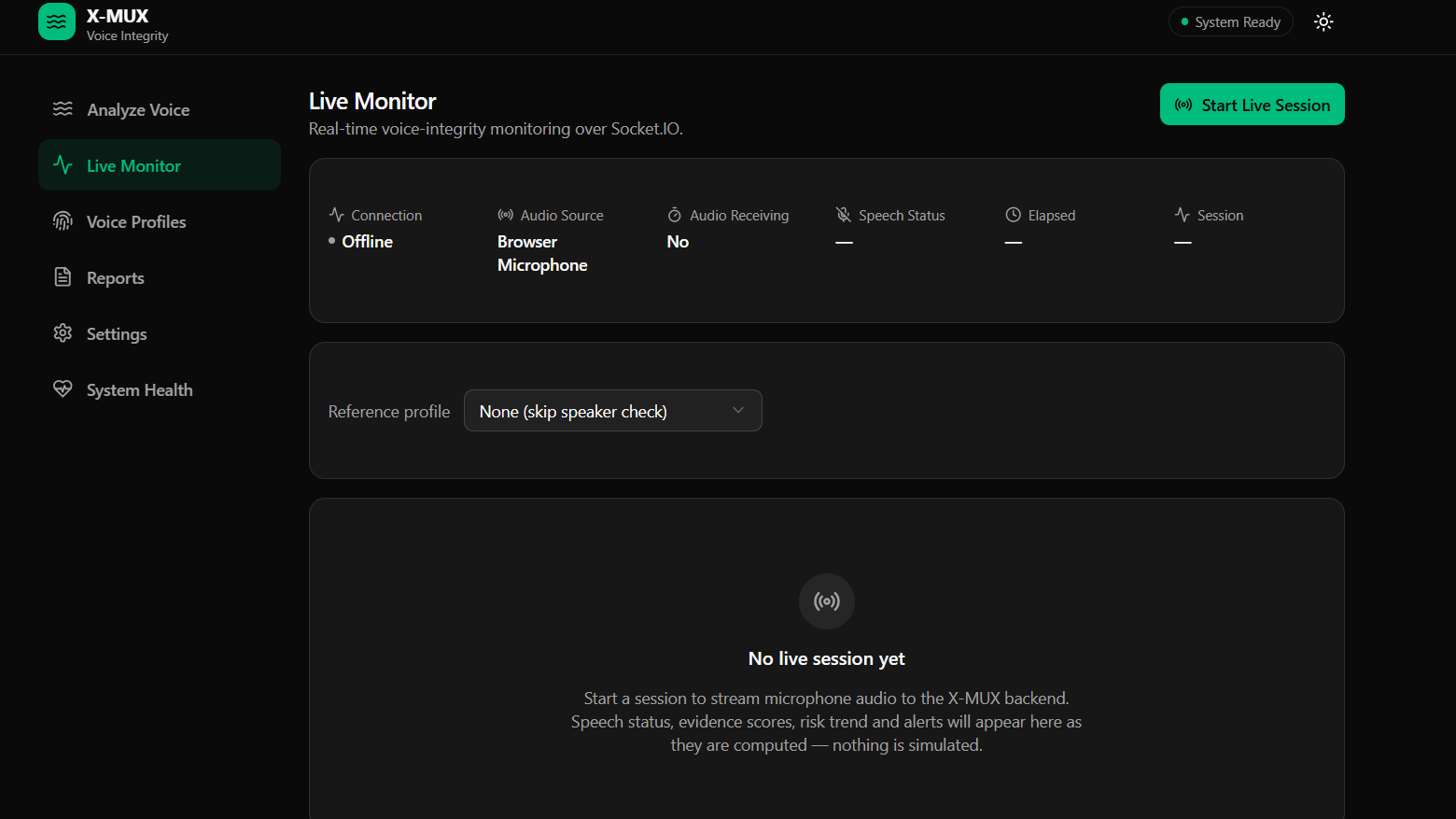
LIVE MONITOR
Project Story
Inspiration
Generative AI has made voice cloning and voice conversion increasingly realistic, creating a growing challenge for voice-based security. We wanted to build a system that does not simply ask “Is this voice real or AI?”, but instead evaluates multiple signals and provides actionable evidence about voice integrity.
This led us to build X-MUX.
What It Does
X-MUX is a real-time voice-integrity and impersonation-risk analysis platform.
It analyzes:
- Synthetic/spoofed speech
- Speaker consistency
- Audio quality
- Digital signal characteristics
- Temporal behavior
The system combines AASIST-L, ECAPA-TDNN, Silero VAD, and DSP-based analysis to generate evolving evidence and classify interactions as:
Genuine · Suspicious · High Risk · Inconclusive · Analysis Failed
It then maps the evidence to recommended actions such as Allow, Warn, Verify, Block, or Escalate.
How We Built It
X-MUX uses a Next.js + React + TypeScript frontend and a Python + FastAPI analysis backend.
The real-time pipeline is:
Audio Stream
→ VAD
→ DSP
→ AASIST-L
→ ECAPA-TDNN
→ Evidence Fusion
→ Temporal Risk
→ Security Dashboard

For the prototype, audio is streamed through a consented browser microphone connection. The backend processes rolling audio windows and continuously updates the risk state.

The architecture is designed so the analysis engine can later receive an authorized media stream from enterprise telephony or contact-center infrastructure.

Challenges We Ran Into

The biggest challenge was that real-world audio is far more complex than clean benchmark data.

Noise, reverberation, compression, clipping, short speech segments, unseen voice-generation systems, and changing audio conditions can all affect detection.

We also had to solve the difference between real-time streaming chunks and the larger windows required by machine-learning models.

Most importantly, we learned that a single model should not determine the final decision. Different models provide different types of evidence, and disagreement must be handled explicitly.

Accomplishments We're Proud Of

We built a complete multi-layer voice-security pipeline rather than relying on a single AI detector.

We are particularly proud of:

Real-time rolling voice analysis
Multi-model evidence fusion
Speaker consistency analysis
DSP-based signal evidence
Temporal risk tracking
Explicit uncertainty handling
Separation of evidence, confidence, risk, and action
Production-oriented frontend/backend architecture

The system is also designed to support a future fine-tuned AASIST-L model without requiring a complete redesign.

What We Learned

We learned that synthetic detection, speaker recognition, voice activity detection, and audio-quality analysis are fundamentally different problems.

We also learned that benchmark performance does not automatically translate to real-world robustness. Generalization, uncertainty, channel variation, and unseen-generation methods must be considered from the beginning.

Most importantly, effective AI security is not only about prediction — it is about evidence, confidence, context, and responsible decision-making.

What's Next for X-MUX

Our next step is to improve robustness through fine-tuning and evaluation across diverse genuine and synthetic speech, multiple voice-generation and conversion systems, realistic channel conditions, and unseen generators.

We also plan to explore:

GPU-optimized inference
ONNX acceleration
Stronger temporal modeling
Better calibration
Mixed human/AI segment detection
Authorized communication-system integrations

Our long-term vision is to evolve X-MUX from a voice detector into a continuous voice-integrity security layer that helps organizations make faster and better-informed decisions.

X-MUX — Voice integrity evidence for better security decisions.
Built With
- aasist-l
- detection
- dsp
- ecapa-tdnn
- fastapi
- librosa
- next.js
- onnx
- python
- pytorch
- react
- runtime
- silero
- speech
- synthetic
- typescript
- vad
- websockets

Log in or sign up for Devpost to join the conversation.