-
-
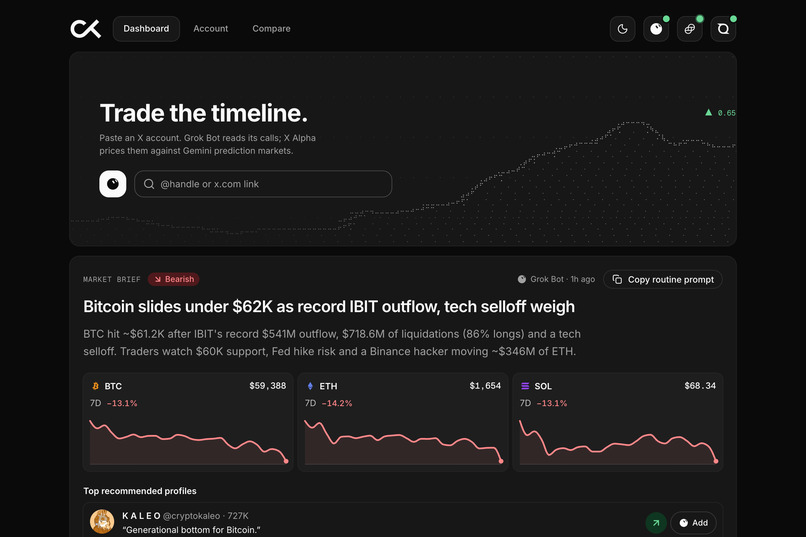
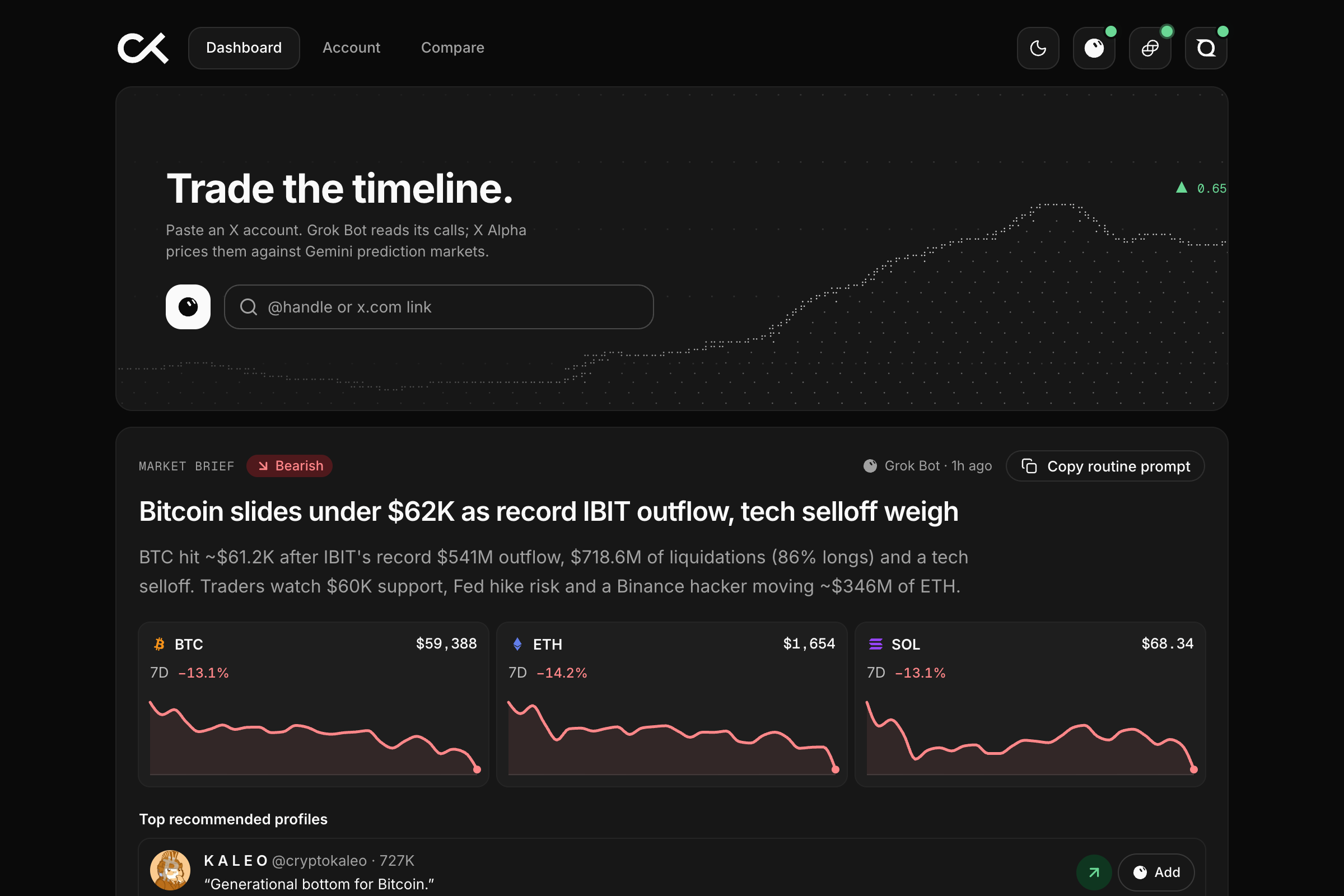
Paste an X account and X Alpha prices its calls against Gemini prediction markets.
-
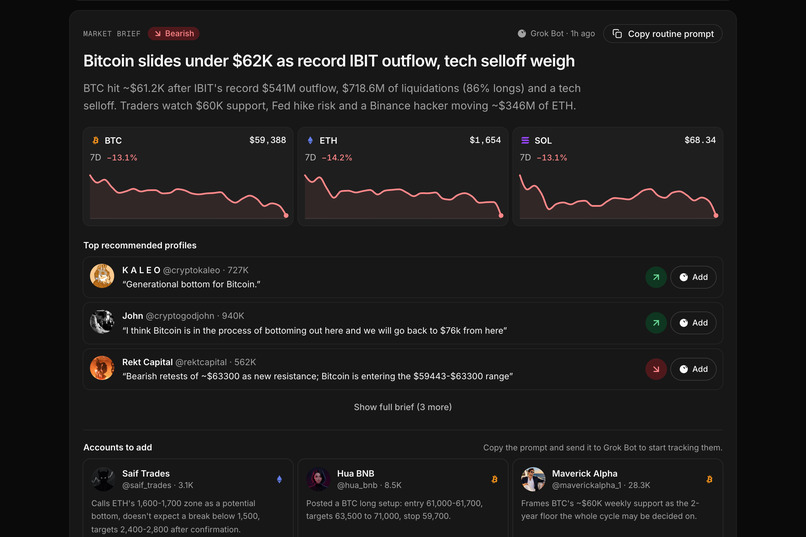
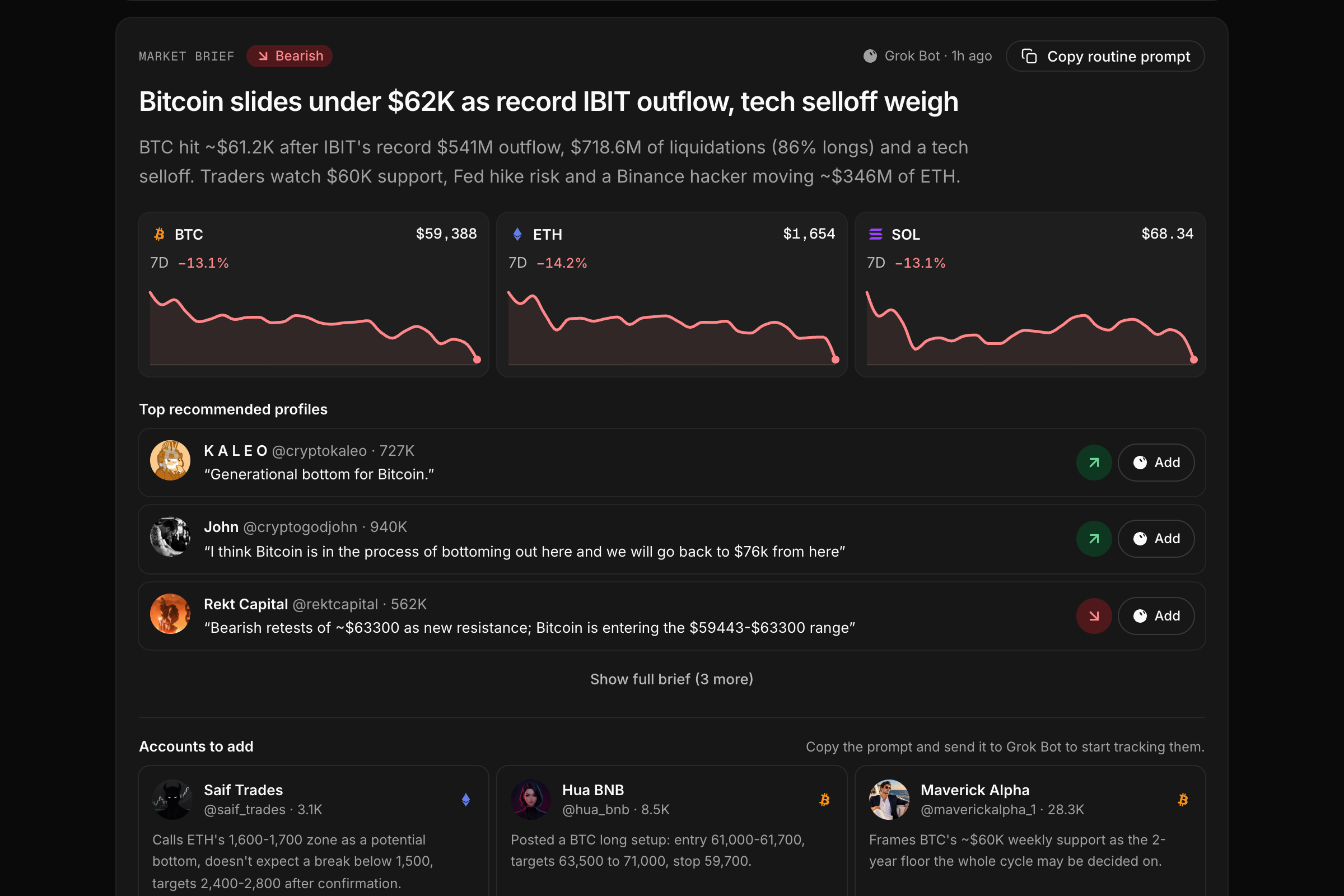
Grok's daily market brief: mood, prices, top voices and new accounts to add.
-
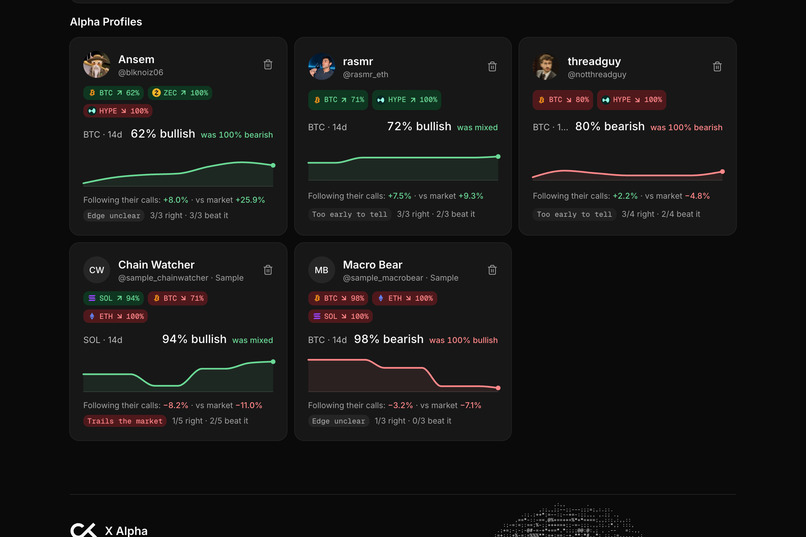
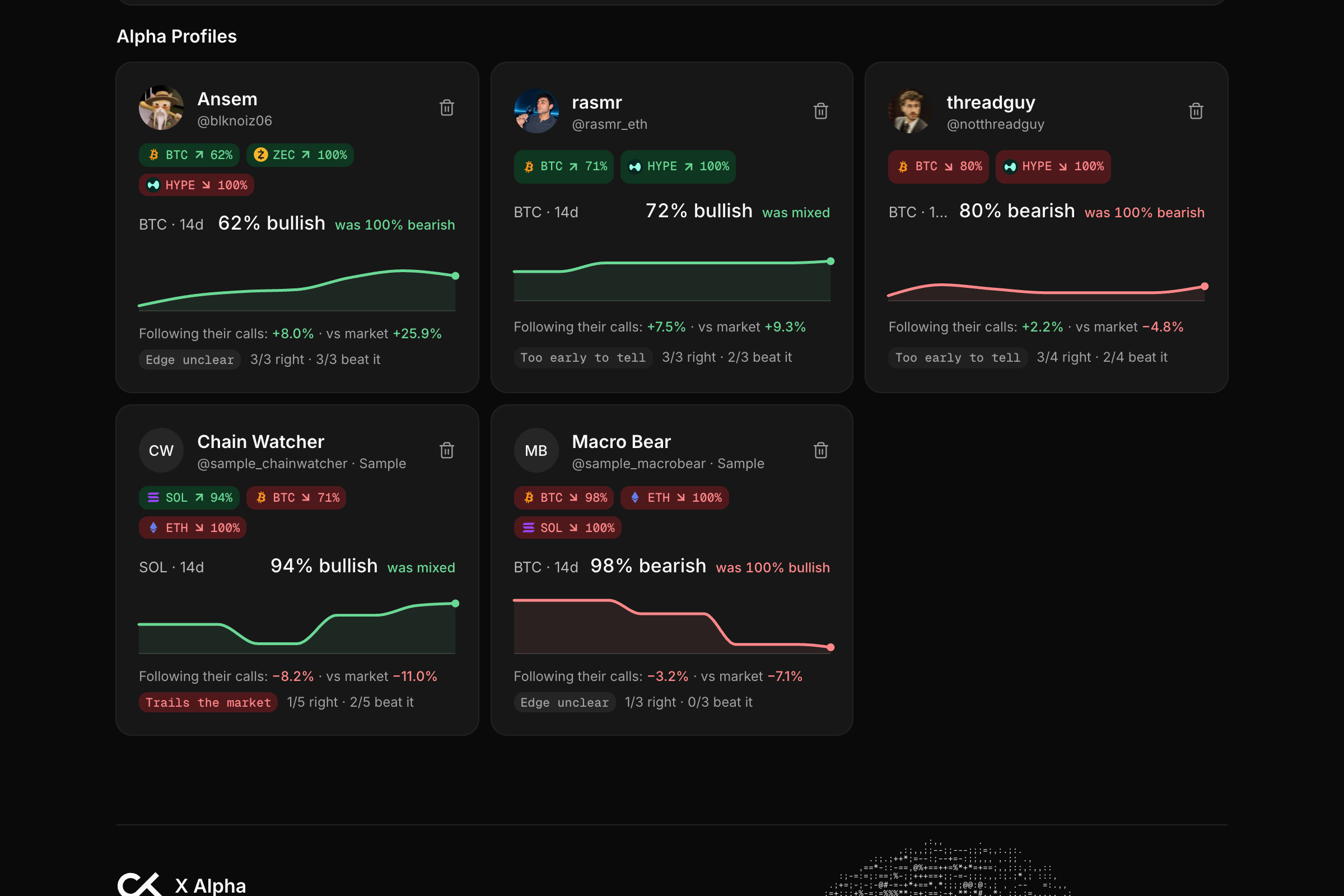
Every account's lean per token, and whether following their calls beat the market.
-
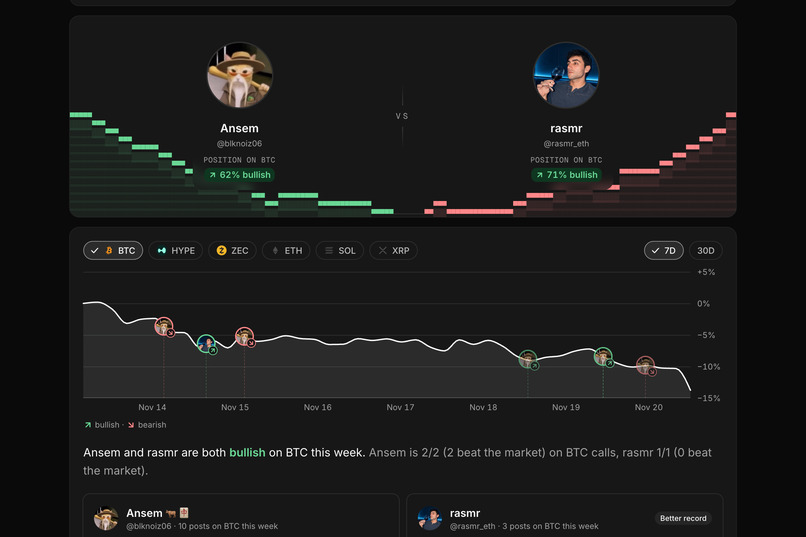
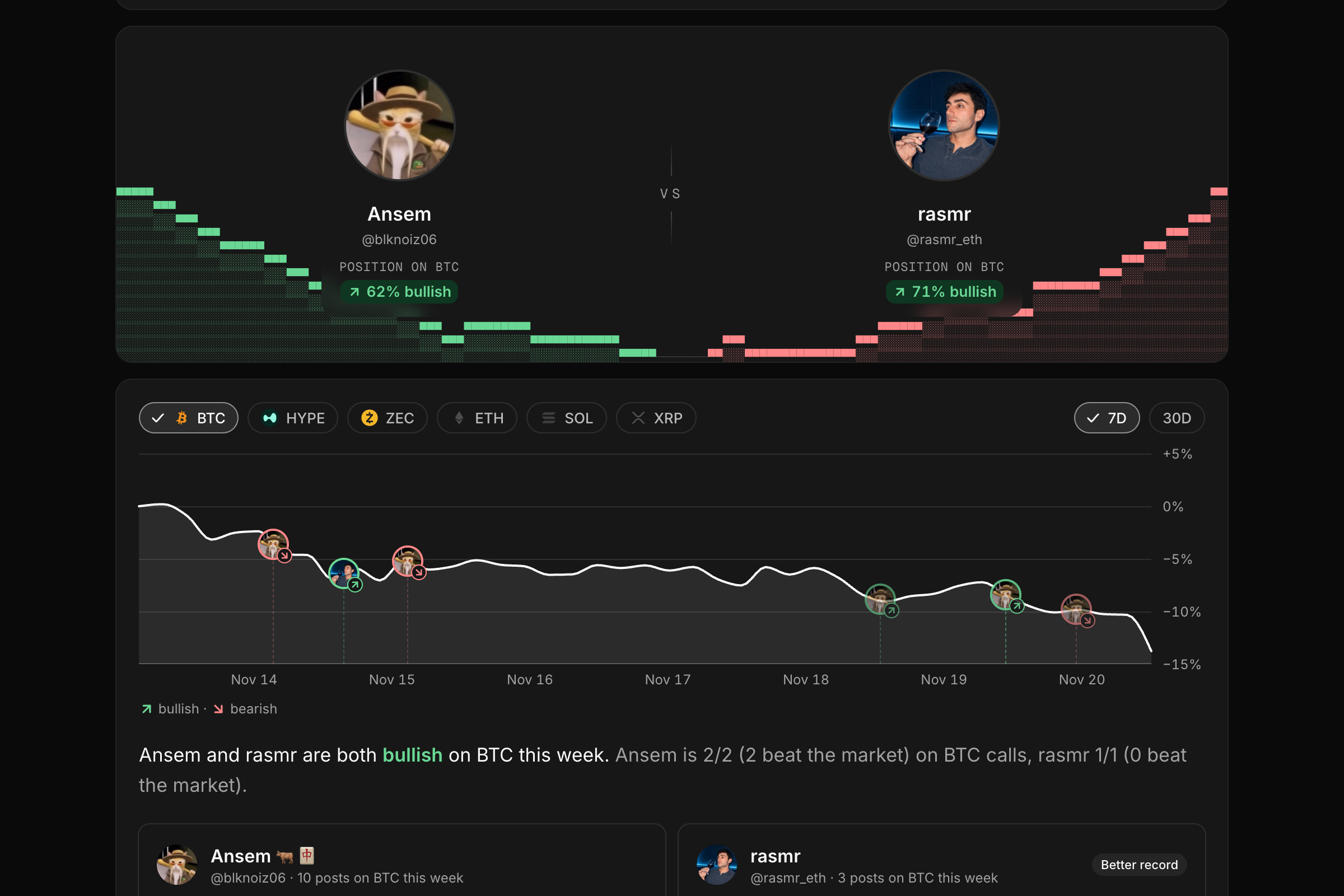
Put two accounts head to head on the same token.
Inspiration
Crypto Twitter is full of confident calls: "SOL to $300," "ETH is topping." Nobody keeps score. You can't easily tell whether an account is usually right, or what trade their view actually implies.
The footer of our site tells the story of Thales of Miletus. People mocked him for being a poor philosopher, so he predicted a big olive harvest and reserved every olive press ahead of time. It's the first recorded option trade. We wanted to do the same with social signal: read the forecast, then find the contract that expresses it.
What it does
X Alpha follows X accounts that post about crypto and turns their posts into something you can measure and trade:
- Reads accounts with Grok. A Grok agent reads an account's last 7 days of posts. It tags each one with a token (BTC, ETH, SOL, XRP, ZEC, HYPE), a stance (bullish, bearish or neutral) and a strength, then sends it all to X Alpha through our MCP server.
- Scores each account's lean per token. We weight each post by strength and give recent posts more weight (half-life of 3 days). That gives a 0–100 lean for this week, compared with last week.
- Keeps a track record. Every bullish or bearish call is checked against Gemini's hourly price history over a 3-day horizon: was it right, and how much did it gain or lose?
- Picks the best contract. For each lean, we look at Gemini's live prediction-market ladders and pick one contract. We start from the account's price target (levels they named, or their usual move) and adjust it by how credible their track record is on that token. Then we score each contract by Kelly growth, so it doesn't just chase long shots. If no contract has a positive edge, we make no pick.
- Checks the call on-chain. QuickNode Streams send large swaps ($10k+) as they happen: SOL on Solana, plus WETH and WBTC on Uniswap. For any call we show whether large wallets were buying or selling in the 12 hours before and 24 hours after the post.
- Writes a daily market brief. On a schedule, Grok writes a brief: overall mood, a headline, a note per coin, top voices, the biggest news, and 2–4 new accounts worth adding.
- Dashboard, Account and Compare views. See every account at a glance, dig into one account's verdict, price chart and contract, or compare two or more accounts side by side.
## How we built it
Frontend: Next.js 16 (App Router), React 19, Tailwind CSS 4, shadcn/Base UI/Radix components, Motion for animation. Custom touches include an ASCII hero and an interactive ASCII portrait of Thales.
Agent layer: A small MCP server at
/mcp(Streamable HTTP, stateless) with 7 tools:save_account_reading,save_market_brief,get_market_brief,get_account_reading,get_market_odds,find_matching_contract,get_onchain_flow. A Grok agent connects to it, reads X, and pushes structured readings. A scheduled Grok task runs the full routine and reports when it will run next. Market data: Gemini's public prediction-markets API for live contract ladders (we work out the market's implied 50% price from them), and Gemini candles for hourly and 15-minute price history. No API key needed. On-chain data: QuickNode Streams with custom JavaScript filters for Solana and Ethereum. They keep only fee-payer swaps of SOL, WETH or WBTC against USDC/USDT above a minimum dollar size, and send them by webhook to/api/streams. Storage and hosting: Vercel with Vercel Blob for readings, briefs and swaps (local JSON files in development). Quant logic: time-decayed stance scoring, a 3-day call track record, price targets pulled from post text, and a credibility-weighted Kelly contract picker. ## Challenges we ran into Making messy opinions tradeable. "Bullish" isn't a strike price. We had to turn a lean into a price target, blend it with the market's odds by the account's past accuracy, and account for how much time a contract has left before it settles. Avoiding long-shot bias. Picking the contract with the biggest raw edge always lands on cheap out-of-the-money contracts. Scoring by Kelly growth and skipping very low-probability contracts fixed that. Reading swaps from raw blocks. Telling a real SOL/stablecoin trade apart from multi-hop routes, wrapped-SOL noise and non-SOL trades took a lot of testing on real blocks. ## Accomplishments that we're proud of A full loop from X posts → AI reading → track record → specific live contract → on-chain check, running on real data. An MCP server that lets an AI agent work as the app's research analyst on a schedule, with no one in the loop. A contract picker grounded in real betting math (Kelly), not just "bullish = buy YES." We worked hard on making it easy to use, not just useful. Prediction markets, track records and on-chain flow are dense data, so we put a lot of time into a clean UI anyone can read at a glance. Each account opens with a plain-language verdict first, then the details. There are clear Dashboard, Account and Compare views, status cards that show how fresh each data source is, light and dark themes, and small touches like the ASCII art. We wanted it to feel like a finished product, not a hackathon prototype. ## What we learned MCP is a clean way to let an agent both write structured data into an app and query it back. Prediction-market ladders hold a lot of information. Working out the market's implied price and comparing it with a person's view makes "who's right" concrete. On-chain flow is noisy. Filtering by size and by who actually made the trade matters more than collecting more data. ## What's next for X Alpha More accounts and tokens, and a longer track record to rank accounts by how accurate their calls are. Placing contracts directly on Gemini (with the user's confirmation). Alerts when a trusted account makes a call and large wallets agree. Native Bitcoin flow instead of using WBTC as a stand-in, and more chains. Backtesting the contract picker against settled markets.

