authenticate.careers
Built with Gemini · Firebase AI Logic Server Prompt Templates · Antigravity
Inspiration
I'm Métis — an Indigenous people of Canada — and part of a community that remains underrepresented in the tech industry. That experience has shaped how I think about hiring, access, and the ways people are seen (or not seen) by the systems they pass through.
Resumes are interesting. They ask you to compress years of learning, growth, and expertise into a page or two — and then hand that compression to software that reads it with no context at all. An ATS (Applicant Tracking System) scores candidates using keyword matching and pattern recognition before a human ever looks at the document. It's possible for someone with deep expertise to be filtered out simply because they described their work differently than expected.
With AI entering the hiring pipeline, that dynamic seems to be shifting further. Some organizations are training models on candidate profiles that may not reflect real people — composites built from idealized keyword sets. It's worth wondering what that means for the candidates who are real.
I built authenticate.careers to explore a different approach.
What It Does
The idea is straightforward: rather than optimizing a resume to say what systems want to hear, what if we helped people understand how their actual qualifications align with a specific role?
The platform attempts to authenticate — not fabricate — a user's credentials against the job posting they're targeting. The hope is that this helps:
- Job seekers invest their time more wisely, and present their real experience in ways that surface clearly.
- Organizations receive structured, honest candidate data that may be easier to evaluate.
Key Features
- Resume Parsing — Upload a PDF or paste text. Gemini converts it into clean, editable Markdown.
- Persona-Driven AI Analysis — Feedback from multiple professional perspectives (organization, Team, ATS optimization), powered by Gemini via Firebase AI Logic server prompt templates.
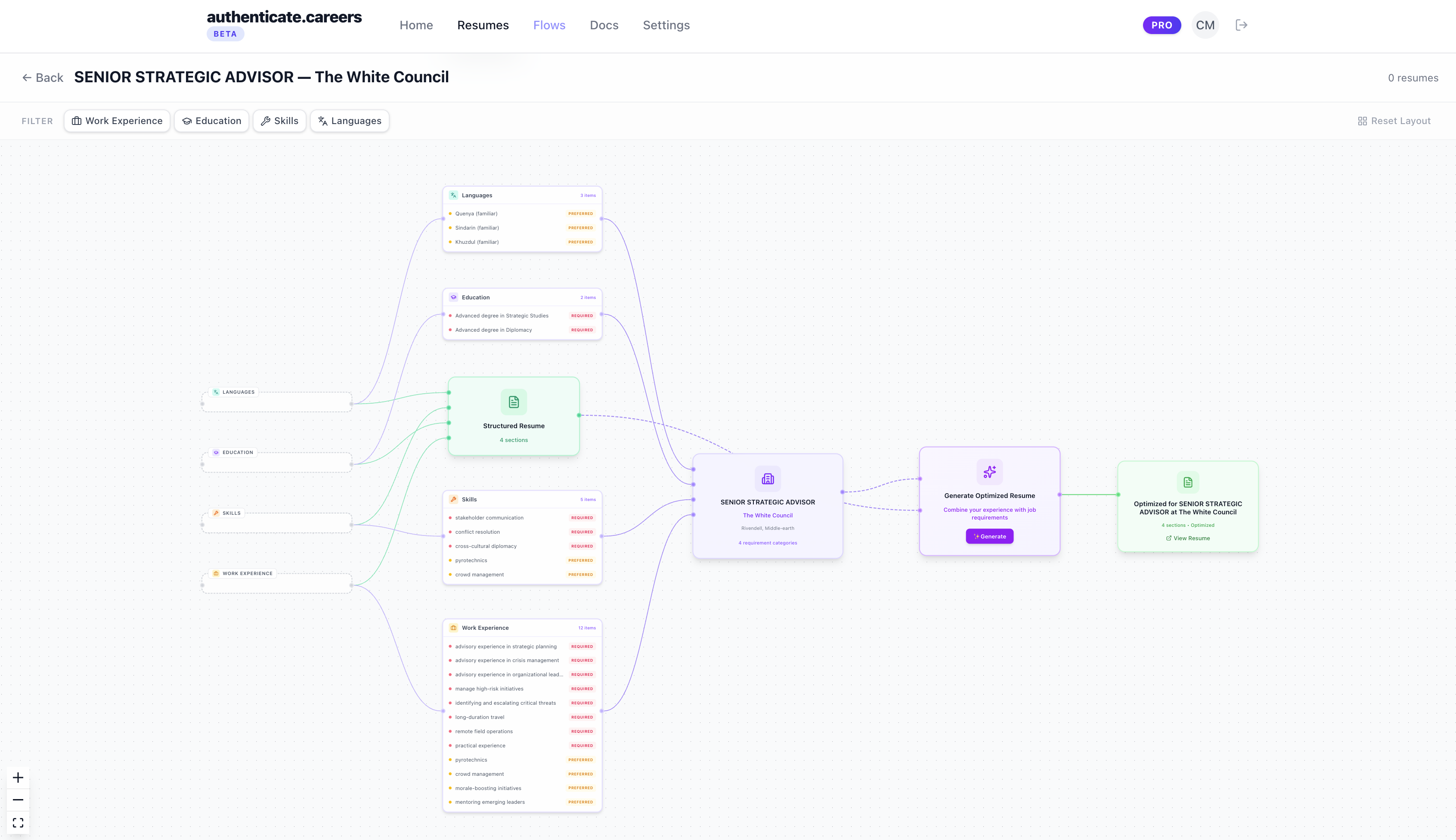
- Node-Based Flow Engine — A React Flow-powered graphing canvas that visualizes how a resume maps to a specific job posting — matches, gaps, and areas worth exploring.
- ATS Optimization — Structured job posting parsing that identifies keyword alignment and generates tailored suggestions.
- Version History — A Git-inspired branching system that tracks every iteration of a resume with full version control.
How I Built It
The project started in Google AI Studio, where I prototyped prompt templates and tested whether Gemini could reliably parse resumes and job postings into structured data. About halfway through, I moved to Antigravity — Google's agentic coding IDE — which allowed me to iterate on the full application through conversation.
This entire project was written through text prompting, visual iteration, and my understanding of Firebase and Google Cloud infrastructure — using Gemini to augment my skills as a developer. Every component, service, and security rule was authored through AI-assisted pair programming.
I started the project on February 6, 2026 — three days before the submission deadline. I had just started a new job, and things are busy, but I didn't want to miss the chance to participate in my first hackathon.
The stack:
- Frontend: React 19 + TypeScript, styled with Tailwind CSS, bundled with Vite
- Graph Engine: React Flow with ELK.js for automated hierarchical layout
- AI/ML: Gemini API via Firebase AI Logic — server-side prompt templates handle resume parsing, persona-based analysis, and structured job posting extraction
- Backend: Firebase Cloud Functions (TypeScript) for secure, server-side Gemini API calls
- Database: Cloud Firestore with a tiered denormalization strategy (Index → Summary → Detail) for performance
- Auth: Firebase Authentication with Google OAuth
- Hosting: Firebase Hosting with custom domain
- Payments: Stripe integration for subscription management
The architecture uses a Git-inspired DAG (Directed Acyclic Graph) for resume version management — each edit creates a new node, allowing users to branch, compare, and restore previous versions.
Challenges
- ATS Data Modeling: Job postings are messy and inconsistent. Coaxing Gemini into reliably extracting structured data from them took significant prompt iteration.
- Graph Layout: Getting the node-based flow canvas to render clearly — without overlapping edges — meant spending time with the ELK.js layout algorithm, tuning port constraints, layer spacing, and node ordering.
- Firestore Security Rules: Balancing granular, field-level security (preventing subscription tier escalation) while still allowing seamless profile creation on first sign-in.
- Three-Day Timeline: Scoping a production-grade application within a hackathon window meant making thoughtful tradeoffs between depth and breadth.
What I Learned
- AI-assisted development works. Building this in three days would not have been feasible without Gemini at every step — architecture, implementation, debugging, and iteration.
- Google AI Studio → Antigravity is a natural workflow. Prototyping prompts in one environment and then building with them in a full agentic IDE felt like the right separation of concerns.
- Firebase AI Logic quietly changes how you think about prompt management. Separating prompt engineering from application code made iteration noticeably faster.
- Gemini's structured output is genuinely impressive for extracting typed data from unstructured content.
- There's a real gap between having the skills and having a resume that communicates those skills to automated systems. That gap is where people fall through.
The Personal Part
I started my own company — Dancing Sky Labs Inc. — a name that's a throwback to my Métis heritage. I set up authenticate.careers under that umbrella and built it as if it were a real-world production application, to the best of my ability. Stripe billing, Firestore security rules, tiered subscriptions, custom domain, and even privacy policy, terms and conditions, and cookie consent management through Termly — all things I'd never done before.
I've always wanted to participate in a Hackathon, so the best I can do is put my code out there and let it speak for itself. My first submission!
So here it is. 🚀


