Inspiration
Modern media production frequently exploits indigenous folklore, traditional cultural expressions (TCEs), and sacred oral narratives without proper consent, attribution, or compliance with customary law. As a human rights activist and computer engineer dedicated to digital inclusion and civic technology through the Wurldcoco Organization, the absence of automated, accessible legal safeguards for marginalized communities sparked the vision for an intelligent IP auditor.
What it does
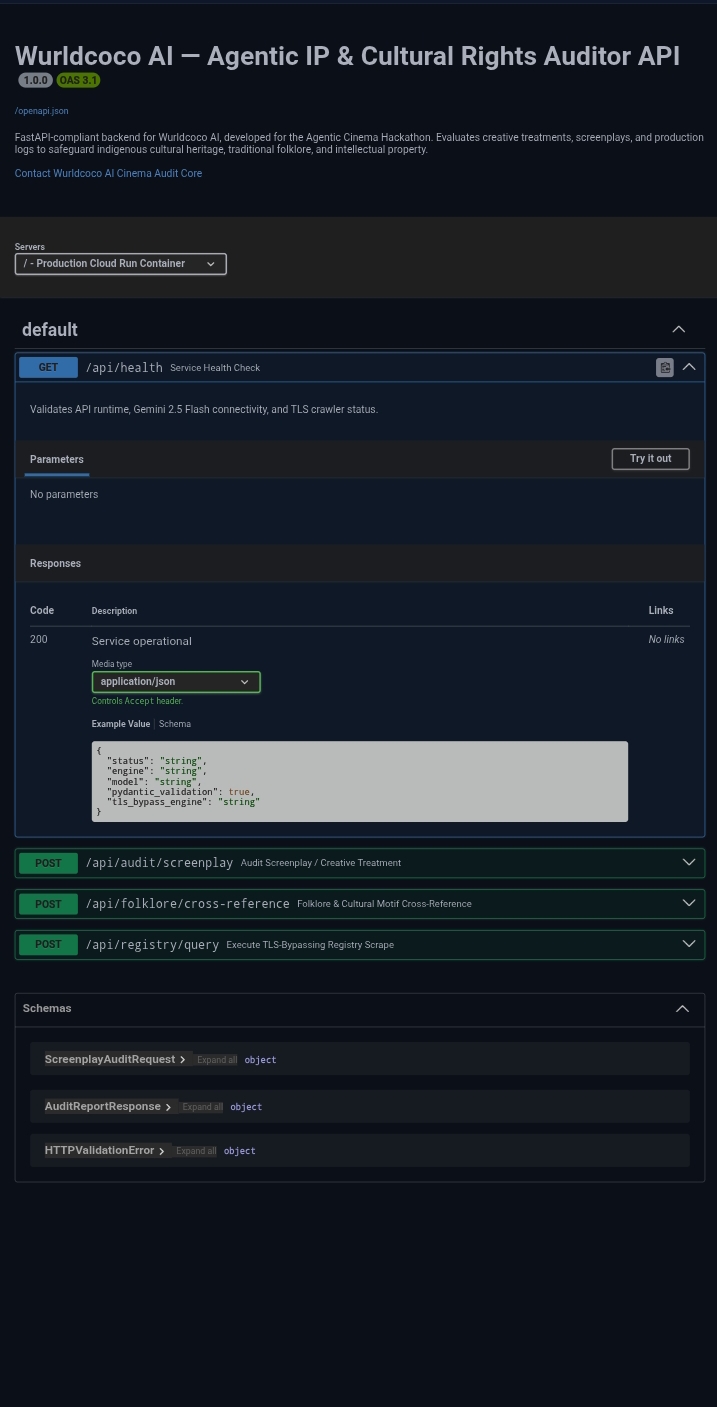
Wurldcoco-AI is an agentic intellectual property and cultural rights auditor API. It evaluates cinematic screenplays, creative treatments, and media payloads against global copyright frameworks, international treaties (such as UNDRIP and the UNESCO 2003 Convention), and indigenous registries. The system identifies cultural appropriation risks, assesses safety indexes, verifies prior informed consent (FPIC) metrics, and generates comprehensive mitigation roadmaps.
How we built it
The platform is powered by an asynchronous FastAPI (Python) backend optimized for high-performance, low-latency execution in resource-constrained environments. The core reasoning engine utilizes Google Gemini (gemini-2.5-flash) for advanced semantic narrative analysis, cross-cultural text matching, and intent decryption. To query protected external copyright registries without anti-bot interruptions, custom curl_ffm modules were integrated to emulate browser TLS signatures (JA3/JA4 and HTTP/2 framing). Rigorous static structural safety and data integrity are enforced across local and production environments using Pydantic (BaseModel).
Challenges we ran into
Navigating anti-bot protections and restrictive TLS fingerprints on institutional registry sites presented a major engineering hurdle, which was resolved by implementing custom curl_ffm session emulation. Balancing deep semantic contextual analysis of indigenous oral histories with deterministic API response latencies required precise prompt engineering and model optimization. Furthermore, standardizing complex customary legal frameworks into programmatic data schemas demanded strict validation layers to maintain an error rate approaching zero (E \to 0).
Accomplishments that we're proud of
Successfully fusing high-performance backend engineering with human rights advocacy by building a fully functional agentic auditor API that bridges technical computing and cultural preservation. Achieving robust, asynchronous cross-referencing between creative screenplays and international legal instruments like the UNESCO 2003 Convention within tight latency bounds.
What we learned
Deepened our technical mastery in advanced prompt orchestration, custom TLS handshake simulation, and asynchronous schema validation under resource-constrained environments. We also gained profound insight into the structural gaps where digital technology intersects with indigenous intellectual property rights.
What's next for Wurldcoco-AI
Expanding the API's registry integrations to encompass regional indigenous intellectual property databases across Africa and the Global South, optimizing edge-ready offline deployment models, and scaling agentic reasoning capabilities for real-time collaborative screenplay editing suites.


Log in or sign up for Devpost to join the conversation.