-
-
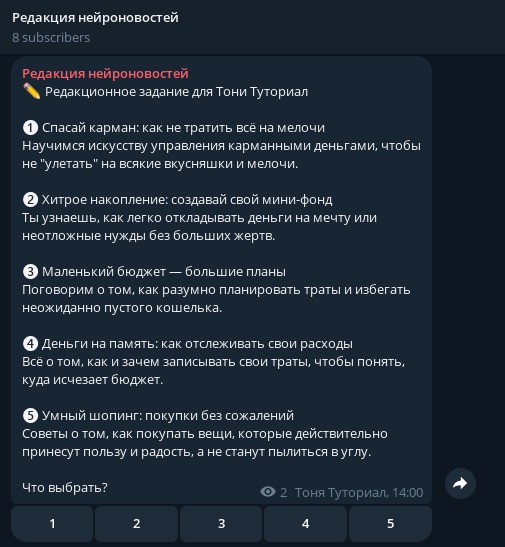
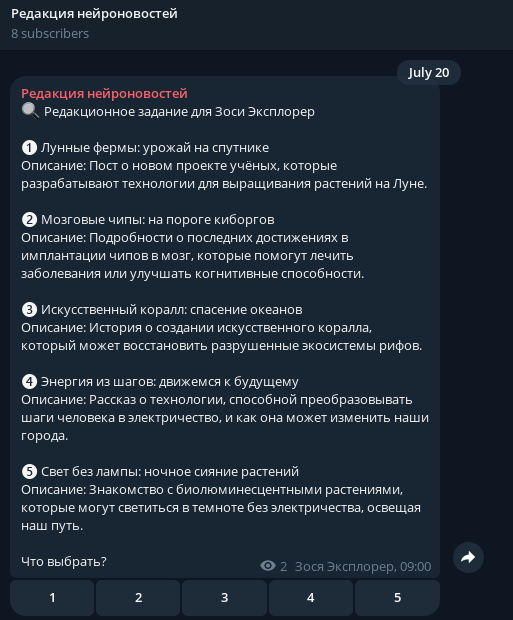
Choose next article's topic - Example
-
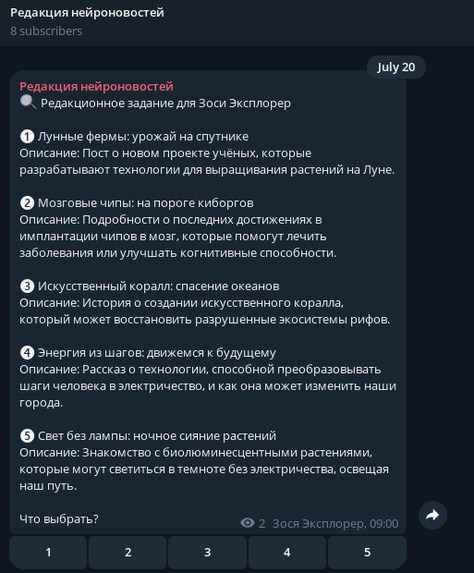
Choose next article's topic - Example
-
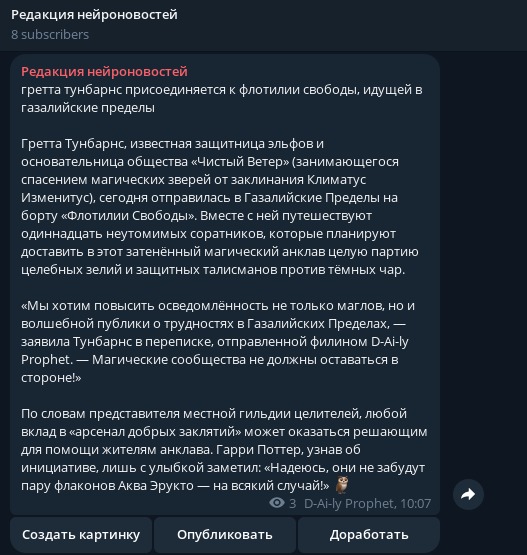
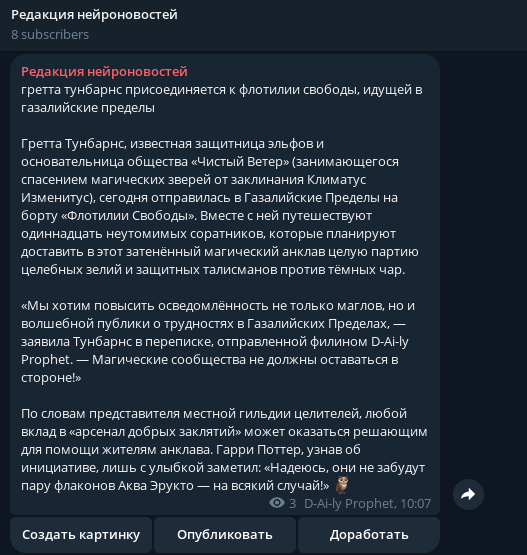
Article to check - Make an image, redo or post
🚀 Inspiration
Traditional news is often too dry or complex for teenagers, while social media feeds are full of misinformation. I wanted to build a solution that delivers engaging, age-appropriate, and factual news to Gen Z. However, I also knew that fully autonomous AI content can be risky. The inspiration for Wunderkind was to create a "Neuro Newsroom": a multi-agent AI system that does the heavy lifting of ideation and drafting, but keeps a human editor firmly in the loop for final approval.
🛠️ How I Built It
The project is a seamless orchestration of three main components:
- The Interface (Telegram): Each AI "author" is a dedicated Telegram bot, providing a familiar, conversational UI for the human editor.
- The Brain (OpenAI API): Powered by GPT-5.6 for text and DALL-E 3 for visuals. Each bot has a highly specialized system prompt (e.g., "Tech Expert", "Nature Enthusiast") tailored to speak to teenagers in an engaging, non-condescending tone.
- The Orchestrator (Make.com): Handles the workflow routing. When the editor requests ideas, Make.com triggers the specific agent to generate 5 topic pitches. Once a topic is selected, Make.com passes the context back to the same agent to write the full article and generate a matching image.
Note: The live demo operates in Russian to authentically serve our primary target audience, showcasing the model's strong multilingual capabilities. However, the architecture is entirely language-agnostic.
🧠 What I Learned
- The power of specialized agents: A single generic prompt is good, but splitting the workload into distinct "persona" agents yields drastically higher quality and more consistent tone.
- Human-in-the-loop is non-negotiable: For media and youth-oriented content, AI should be a co-pilot, not an autopilot. The editor's ability to request revisions is the most critical feature.
- No-code/Low-code scalability: Make.com proved to be an incredibly robust tool for managing state and routing between Telegram and the OpenAI API without building a complex custom backend from scratch.
🚧 Challenges Faced
- Context Management: Ensuring the AI remembered which of the 5 topics the editor selected when it was time to write the full article. Solved by carefully structuring the data payloads in Make.com.
- Tone Calibration: Preventing the AI from sounding either too academic or too "cringe". This required multiple iterations of the system prompts, explicitly defining the "cool older sibling" persona.
Built With
- chatgpt
- make
- telegram

Log in or sign up for Devpost to join the conversation.