-
-
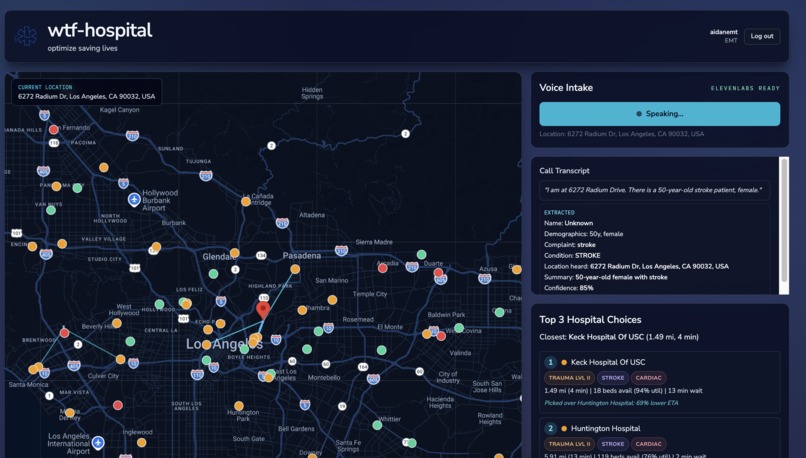
EMT view
-
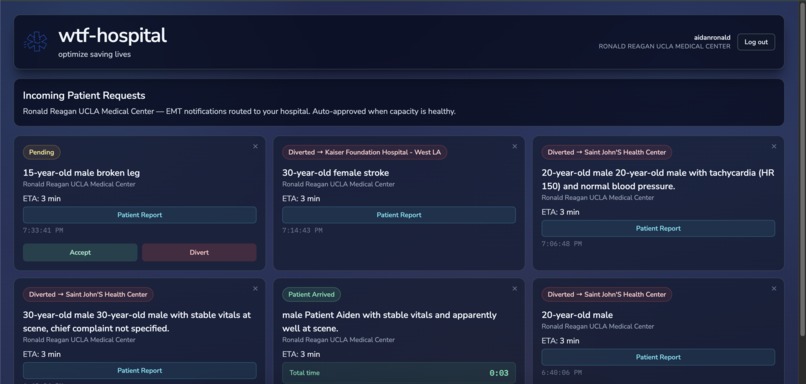
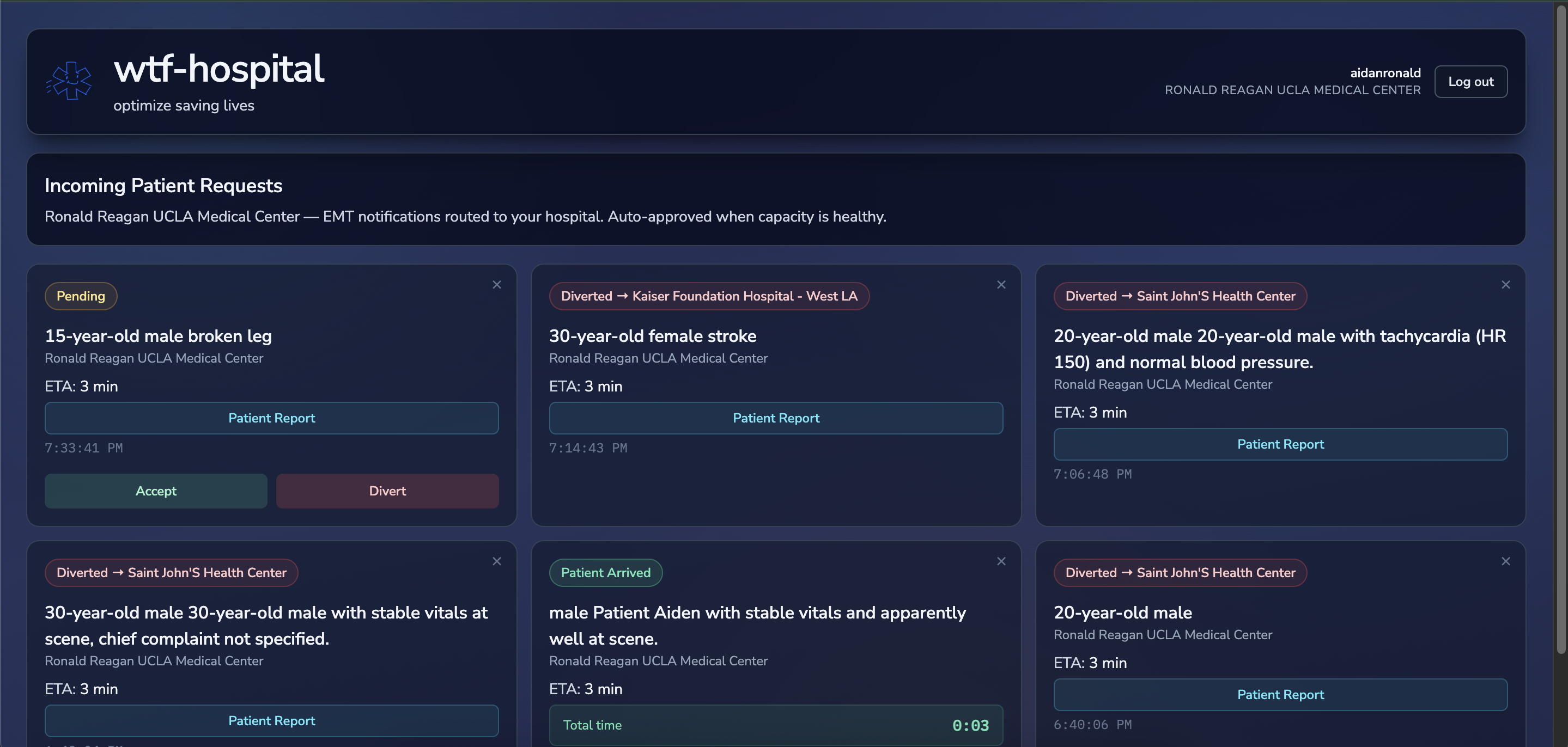
Hospital view
-
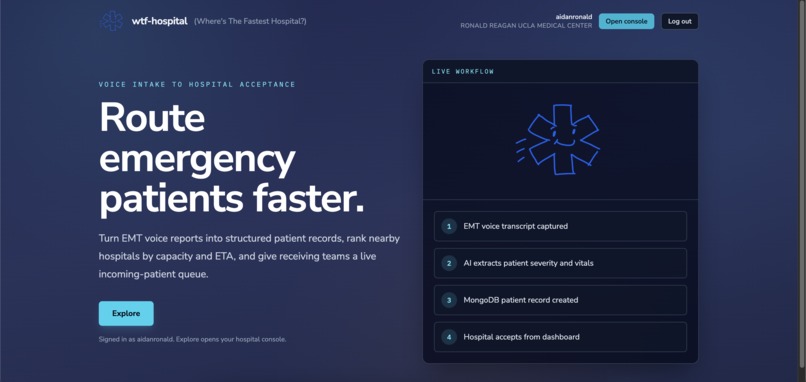
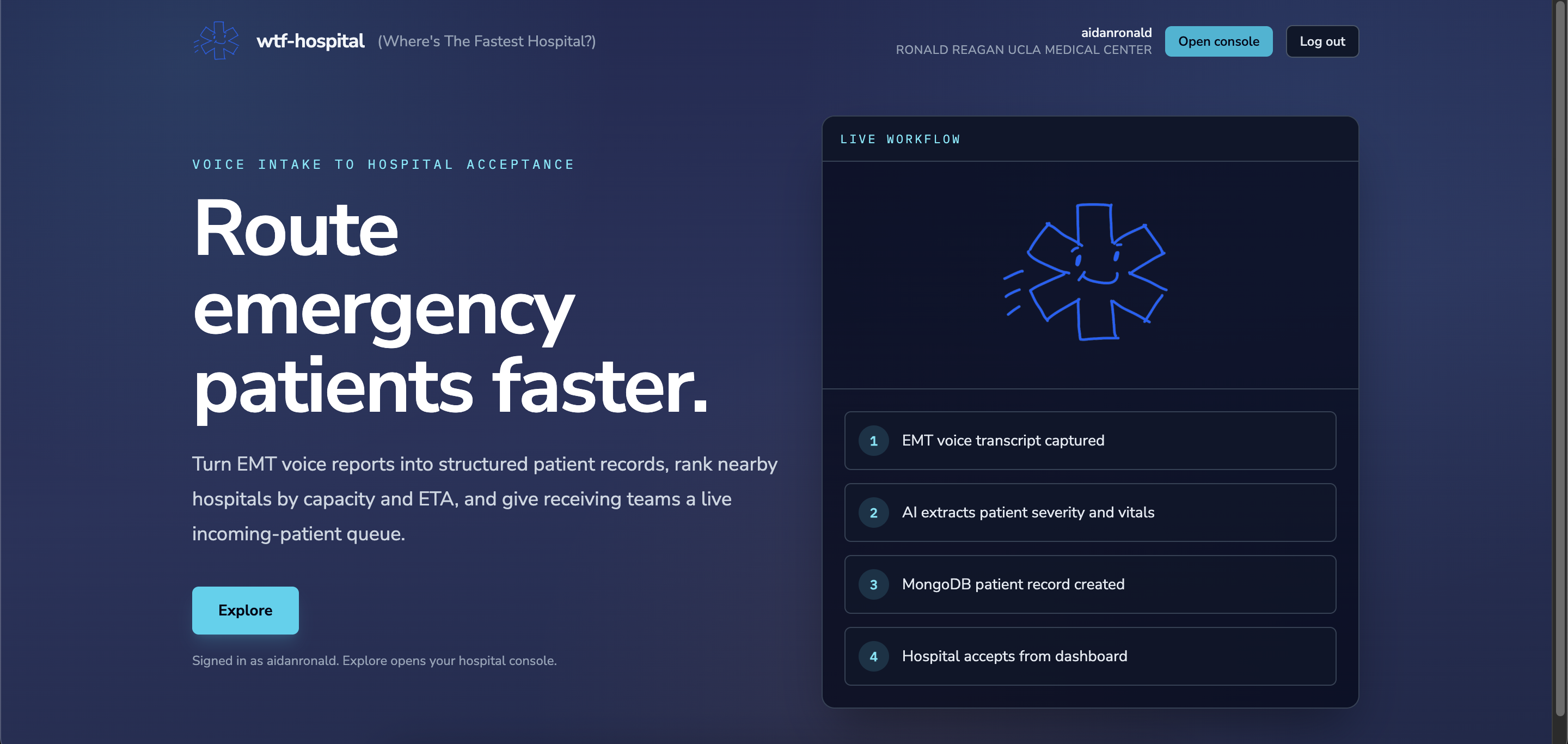
Homepage
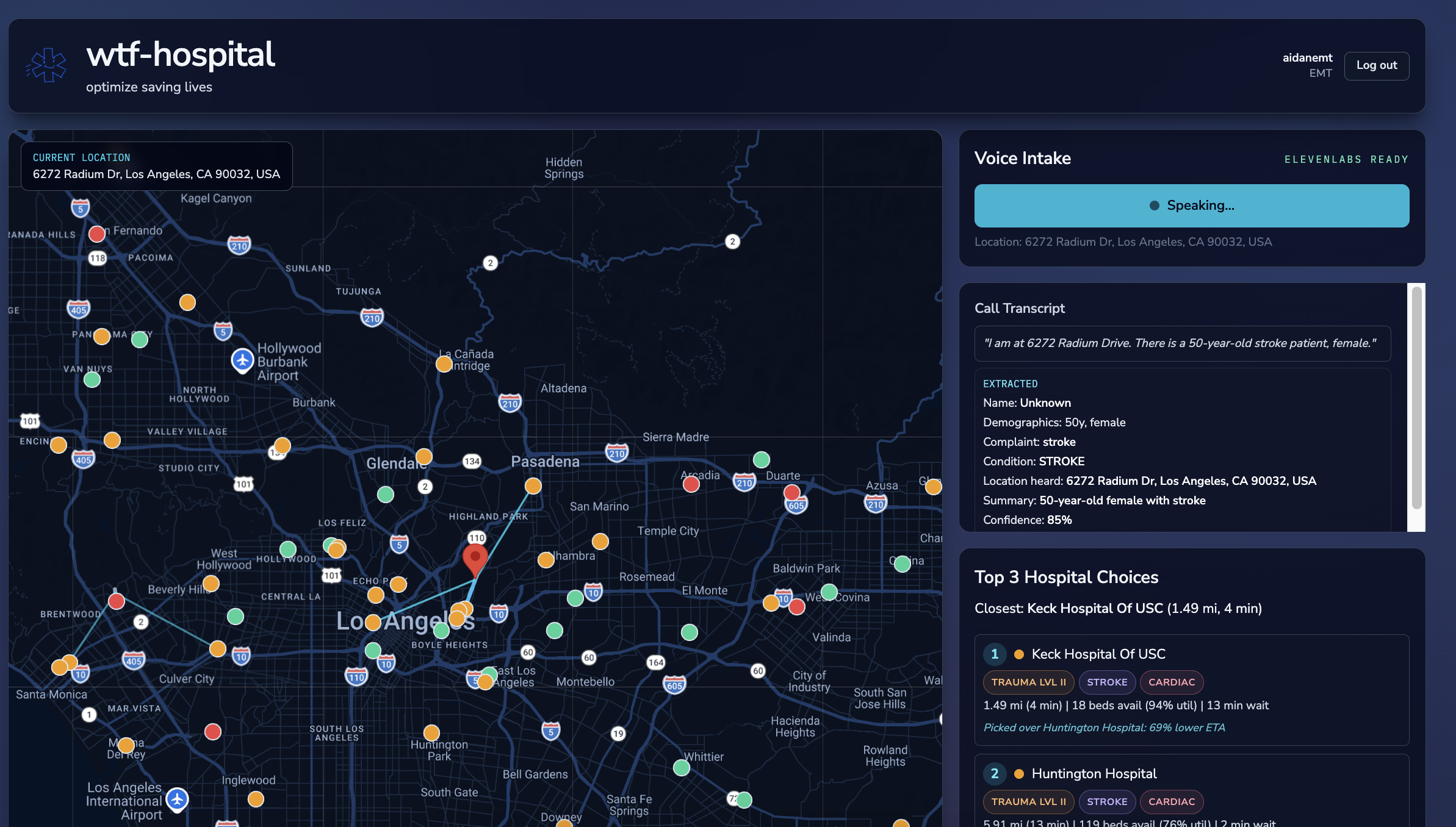
WTF-Hospital
Where's the Fastest Hospital? — a voice-first, hands-off routing and automated dispatch system for EMS.
Inspiration
A few years ago, Jordan's grandmother suffered a stroke. The ambulance took her to the nearest hospital geographically — but when they arrived, the ER was slammed and the neurology team was backed up. Her grandmother spent critical Golden Hour minutes waiting for a bed while a better-equipped facility was just five minutes further away with zero wait time.
That experience exposed a huge flaw in our emergency infrastructure: proximity does not equal speed. In a world of real-time logistics, it is unacceptable for life-saving decisions to be made using static maps and manual radio tags.
We built Where's the Fastest Hospital, also shortened to WTF-hospital, to ensure no other family loses time to a broken communication chain.
What It Does
EMTs currently make 3–5 phone calls to find an open bed. We cut that to zero.
Instead of an EMT manually calling around to find an open ER, they simply speak to the app:
- Voice-to-Data — Parses raw EMT speech into structured medical reports, eliminating manual data entry mid-emergency.
- Intelligent Routing — Calculates the WTF-score (Weighted Time-to-Facility) by combining live traffic with hospital occupancy. Think of it as a GPS that factors in the ER wait time, not just the drive time.
- Automated Handshake — Handles the confirmation chain automatically: requests a bed from the best-fitting hospital, and escalates to the next available one if they don't respond within 60 seconds.
Hospital Logic
Status (green/yellow/red) is determined by utilization — what percentage of hospital beds are full. Estimated wait time is determined by number of open beds, but can be replaced with live hospital data in the future. Hospitals are ranked by a formula that takes both variables into account.
Hospitals at green status auto-accept patients. Hospitals at yellow/red status are given the option to divert patients to the next-best hospital if they are too busy. This models how EMT-hospital handoffs work today.
How We Built It
The backbone of the app is a high-speed pipeline of AI and real-time data:
- Speech Processing — ElevenLabs for near-instant, accurate speech-to-text and professional-grade communication with EMTs. This ensures hands-off communication while EMTs can focus on their patients.
- Medical Intelligence — Claude AI (Anthropic) acts as our "Dispatcher," extracting vitals, demographics, and chief complaints from EMT speech, neatly packaged and sent to hospitals.
- Routing Engine — Google Distance Matrix API for traffic-aware ETAs, HHS Socrata API to analyze hospital bed utilization, and local data to find the best facilities.
- Data Storage — MongoDB Atlas as our primary data store for patient calls and incident logs across hospitals — persistent, scalable, and synced in real time. When data is updated by an EMT, hospitals can immediately access it, and vice versa.
Data Sources
- HHS Healthdata via Socrata API — Federal CMS dataset reporting hospital capacity across the US weekly.
- Google Maps APIs — Locate all valid hospitals, find addresses, and calculate live drive times based on traffic and distance.
- NPPES NPI Registry — Enriches hospital data with insurance acceptance information by provider.
Accomplishments We're Proud Of
We had the core pipeline running within the first 6 hours of the hackathon. That gave us the rest of the weekend to focus on escalation logic — making sure the app doesn't just find a hospital, but chooses the best one using an optimized algorithm and actually secures a confirmation, hands-free.
Challenges
The biggest hurdle was data. Live hospital capacity feeds exist in many states, but access is private and updates can be slow. The integration points are fully built — we just need the data agreements to make it real-world ready.
What We Learned
- The communication bottleneck is real. After talking to actual EMTs, we learned that choosing a hospital involves far more than distance — some facilities specialize in strokes, others may be closer but harder to reach with traffic.
- Latency matters. In emergency tech, a 5-second delay feels like an hour. We learned how to optimize our API calls to keep response times fast enough to matter.
What's Next
- Live Integration — Connect to live hospital bed utilization tracking instead of predicting wait times from historical data.
- Biometric Passthrough — Automatically pull heart rate and SpO2 from the ambulance's monitors directly into the report via Bluetooth, leaving the EMT even more hands-free.
- Offline Mode — A localized model so voice-parsing still works in dead zones and rural areas with poor cellular service. Because all processing would happen on-device, patient data never leaves the ambulance until a secure connection is restored — making this architecture inherently HIPAA-friendly.
Built With
- anthropic
- elevenlabs
- google-maps
- mongodb
- node.js
- socrata-open-data


Log in or sign up for Devpost to join the conversation.