🌌 WrongWorlds
Your wrong answer becomes a world you must investigate, fracture, rebuild, and escape.
🎮 Play Judge Mode • 🌐 Live Website • 💻 GitHub • 🔬 Evidence Archive
💡 Inspiration
Most educational AI systems respond to a misconception by explaining why the learner is wrong.
That helps—but it does not always change the mental model that produced the mistake. A learner may repeat the corrected answer while continuing to reason in exactly the same way.
WrongWorlds began with a different question:
What if a learner could enter a world where their wrong answer was actually true?
Instead of immediately correcting the learner, WrongWorlds transforms the misconception into an explorable reality.
Inside that reality, the learner must:
- 🔍 Investigate the world.
- 🧩 Collect contradictory evidence.
- 💥 Fracture its false laws.
- 🌠 Rebuild a stronger explanation.
- 🚪 Prove that the new reasoning transfers to another context.
The result is the Museum of Possible Realities: an educational game concept where every misconception can become a world with its own rules, evidence, experiments, and escape condition.
🎮 What It Does
WrongWorlds is a five-act illustrated reasoning game.
A learner begins with a belief:
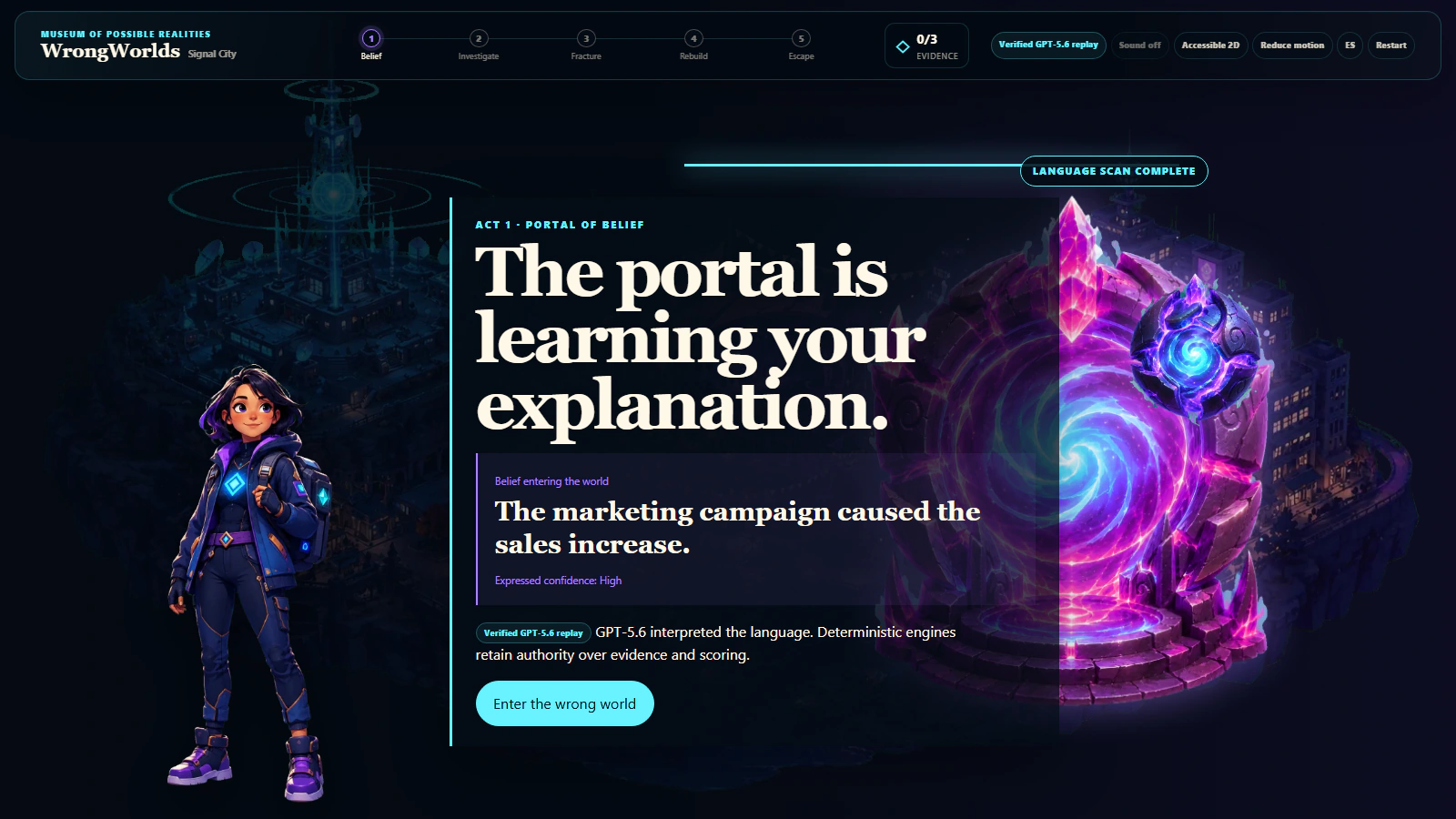
“The marketing campaign caused the sales increase.”
GPT-5.6 interprets the learner’s language and converts it into a structured belief model.
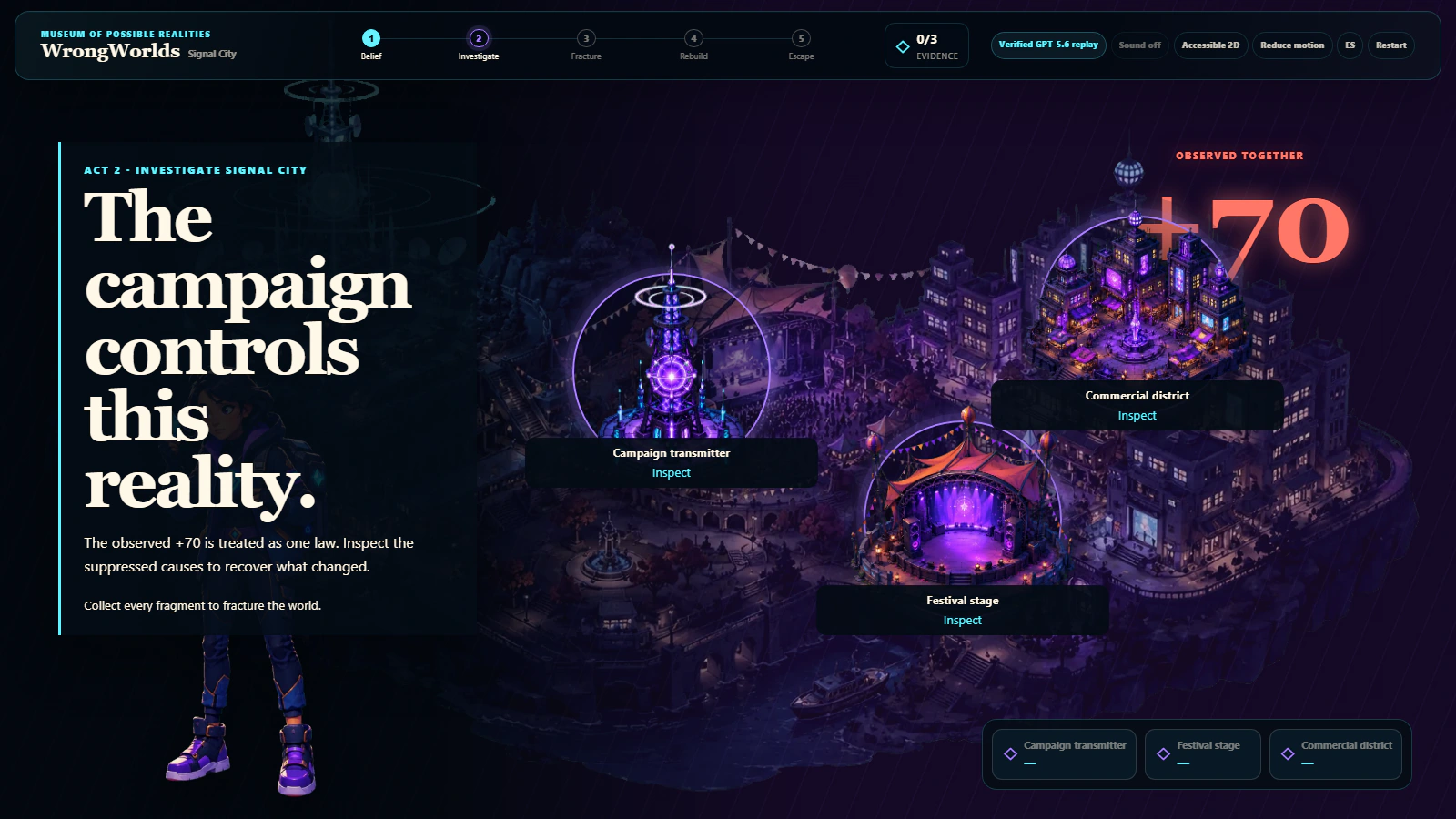
The learner then enters Signal City—a world governed by that explanation.
Rather than receiving the correct answer immediately, the learner must explore what their belief predicts, test competing explanations, and reconstruct the causal model using evidence.
🧭 The Five-Act Experience
| Act | Experience | Learning Purpose |
|---|---|---|
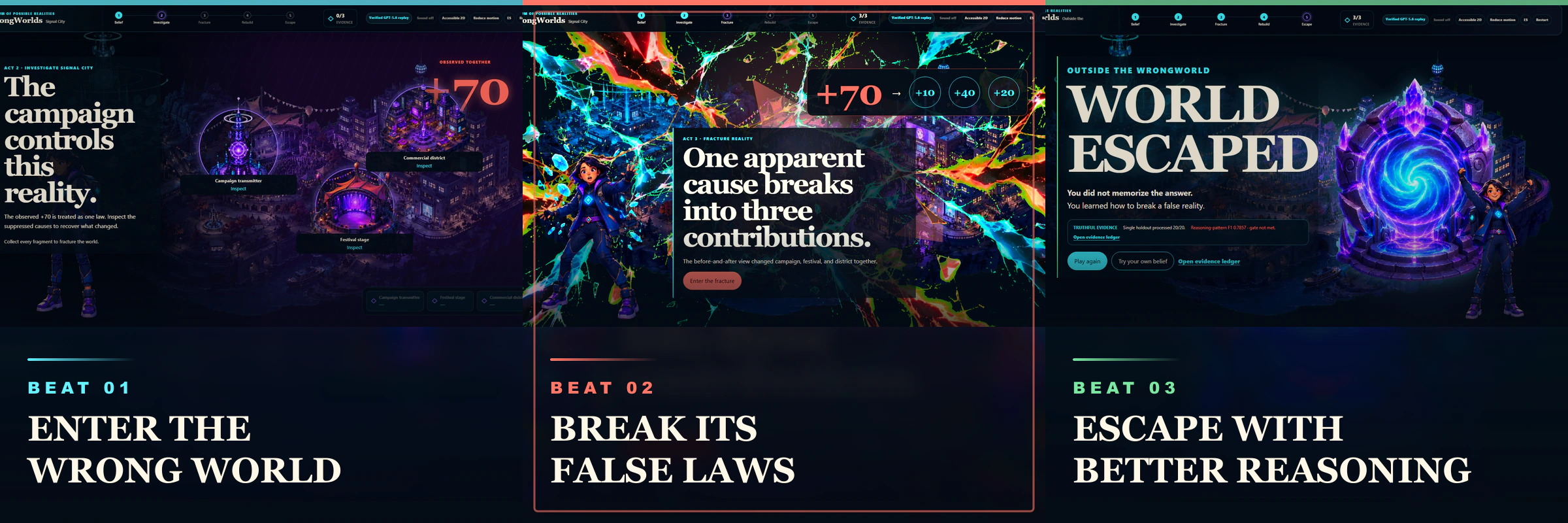
| 1 — Believe 🧠 | The misconception becomes a physical Belief Core and activates a portal. | Make the learner’s mental model visible. |
| 2 — Investigate 🔍 | The learner explores the Campaign Transmitter, Festival Stage, and Commercial District. | Test competing causal explanations. |
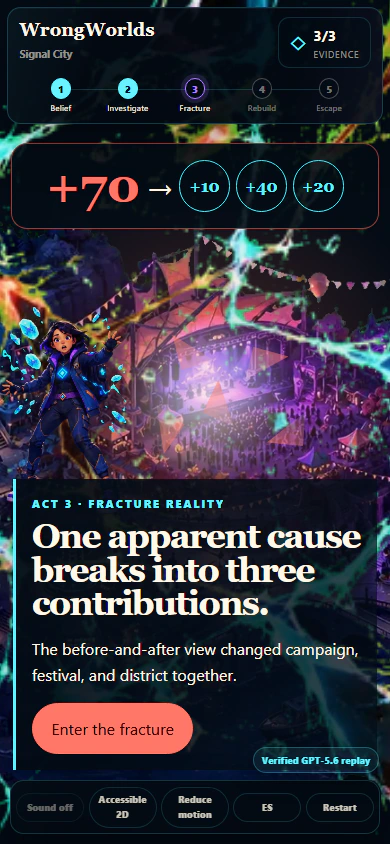
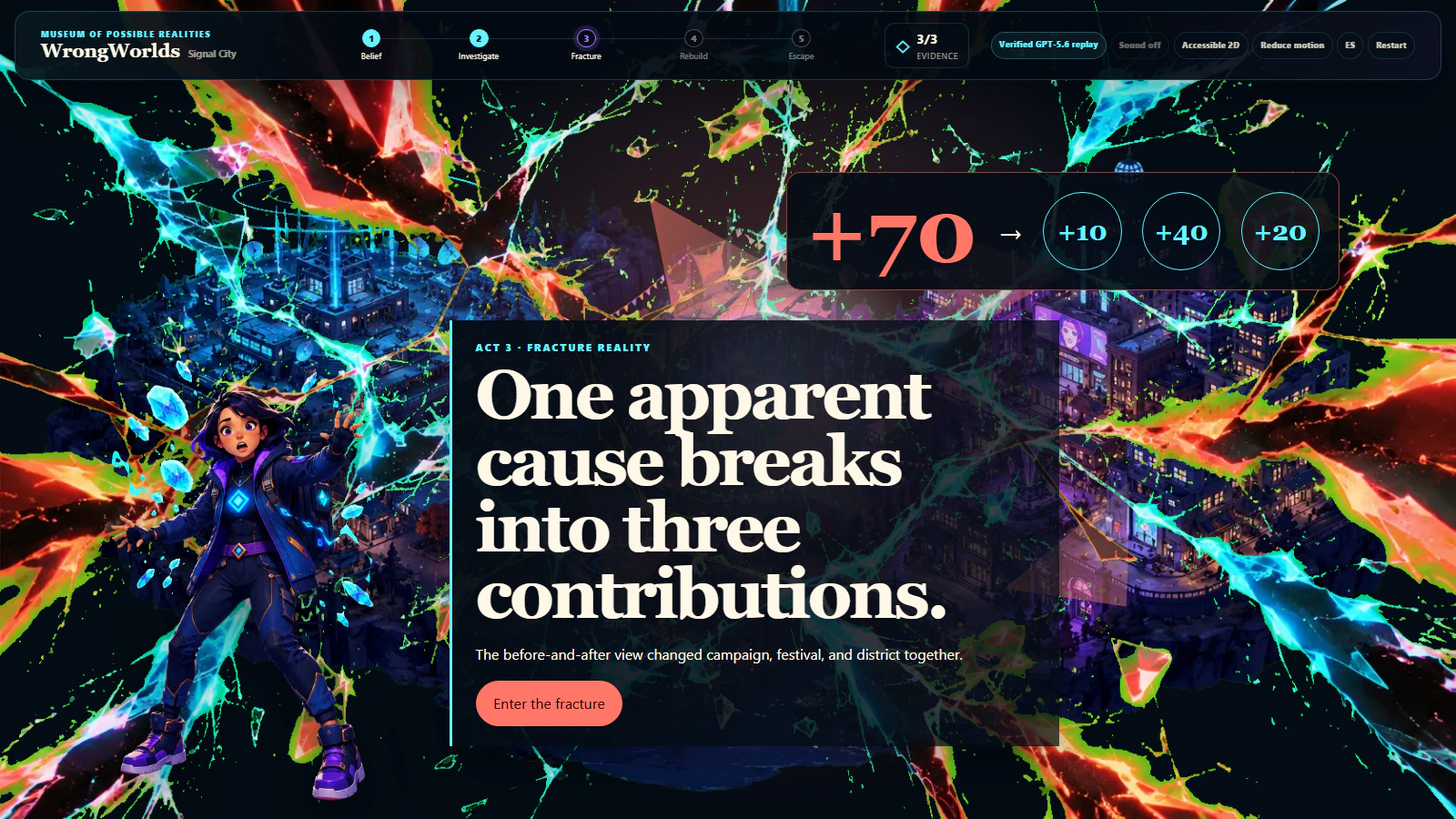
| 3 — Fracture 💥 | The apparent result breaks into multiple contributions. | Reveal that one apparent cause can hide several contributors. |
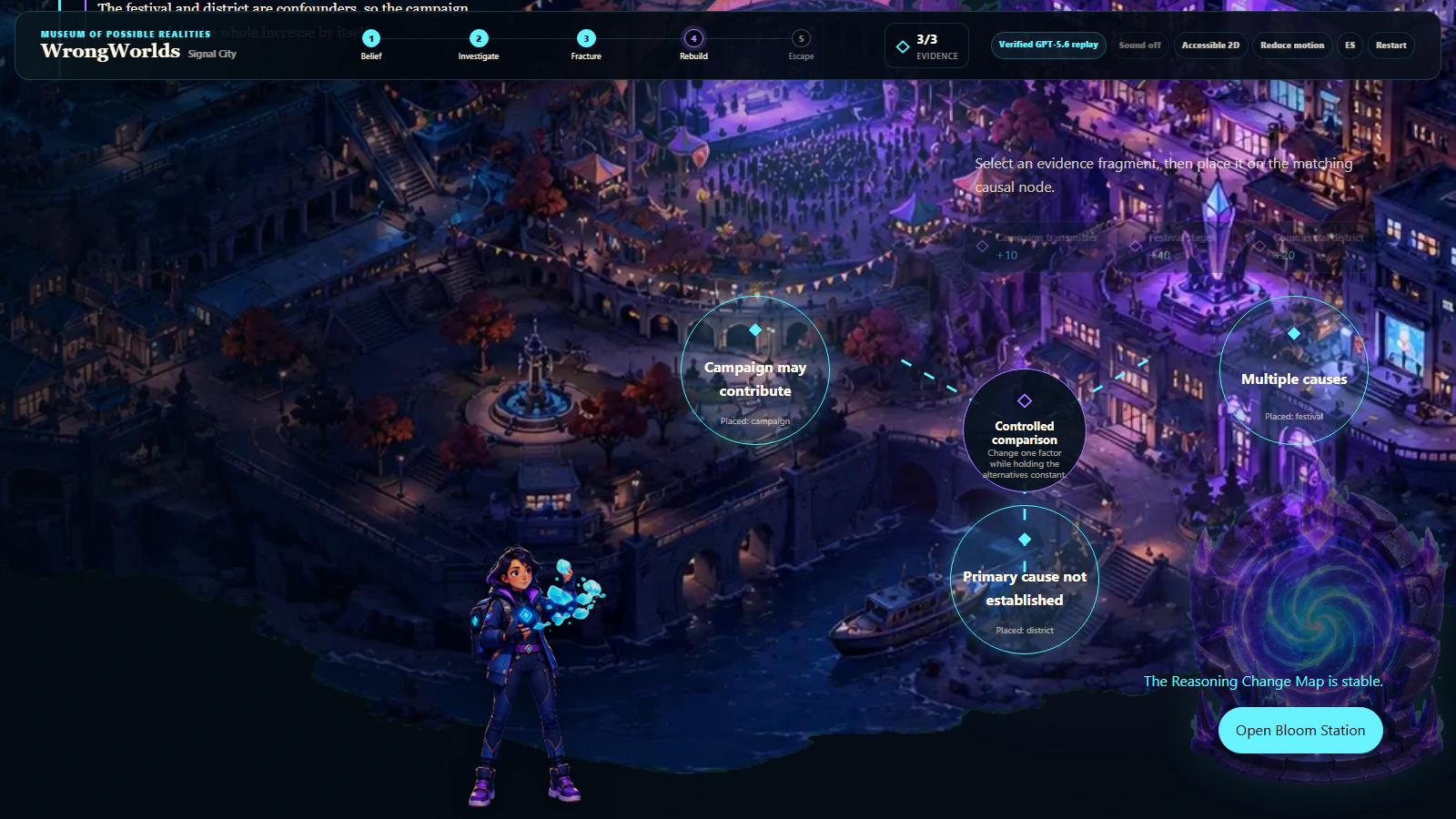
| 4 — Rebuild 🌌 | Evidence becomes a causal constellation through the Reasoning Change Map. | Reconstruct the explanation instead of memorizing a correction. |
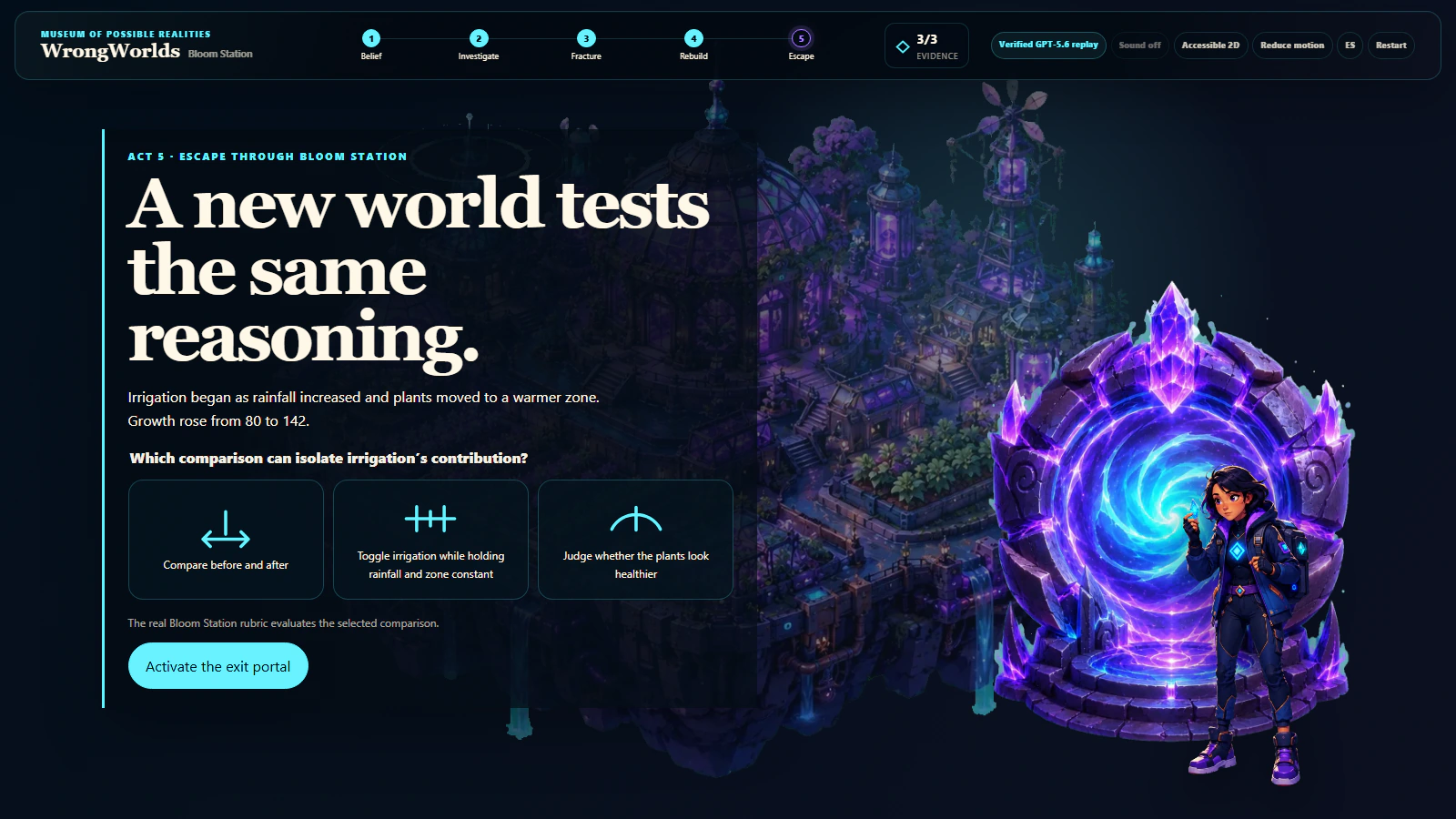
| 5 — Escape 🚪 | Bloom Station presents a different transfer problem. | Verify that the learner can apply the reasoning elsewhere. |
📊 The Central Causal Reveal
$$ +70 = +10_{\text{campaign}} + 40_{\text{festival}} + 20_{\text{district}} $$
The campaign contributed to the increase—but it was not the only cause.
✨ Why It Is Different
WrongWorlds does not treat a misconception as a sentence to correct.
It treats the misconception as a world to test.
The learner must:
- 🌍 Enter the reality created by the belief.
- 👁️ Observe what that belief predicts.
- 🧪 Run controlled comparisons.
- 🧩 Collect evidence.
- 💥 Watch the false reality fracture.
- 🌠 Rebuild a stronger causal model.
- 🚉 Transfer the reasoning to another world.
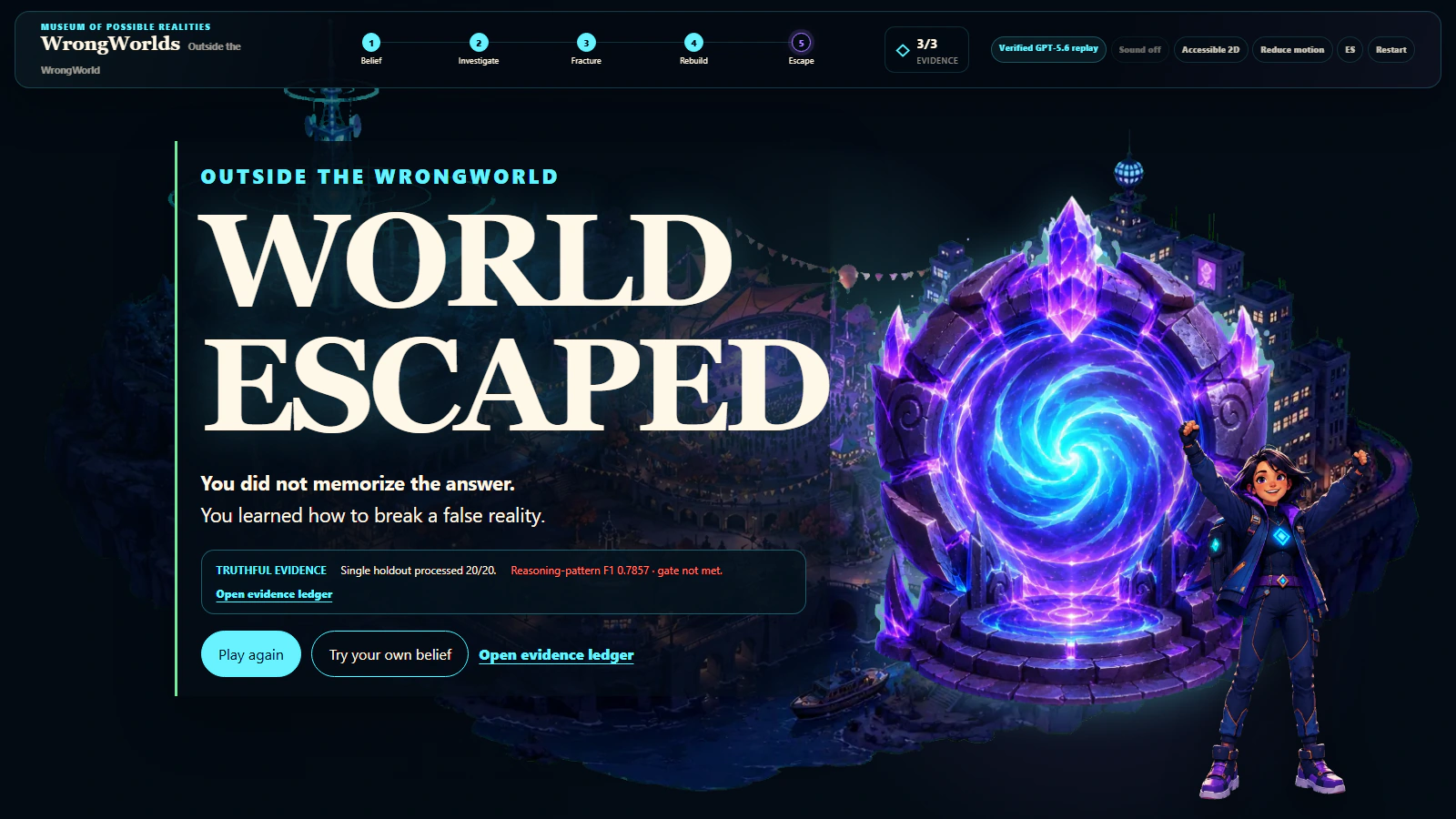
The learner does not escape by receiving the answer. The learner escapes by demonstrating better reasoning.
🏗️ How We Built It
WrongWorlds was built with Codex and GPT-5.6, using a strict separation between:
- 🤖 Generative interpretation
- ⚙️ Deterministic educational authority
This separation allows the system to understand flexible learner language without allowing the model to invent evidence, change simulation outcomes, or manipulate scores.
🤖 GPT-5.6 Interprets Learner Language
GPT-5.6 converts free-form learner language into a structured belief model.
It identifies elements such as:
- The proposed cause.
- The claimed effect.
- The learner’s reasoning patterns.
- Relevant variables.
- Confidence levels.
GPT-5.6 is responsible for understanding what the learner believes—not for deciding whether that belief succeeds inside the simulation.
⚙️ Deterministic Engines Govern the World
GPT-5.6 does not determine:
- Evidence.
- Simulation results.
- State transitions.
- Fracture eligibility.
- Scores.
- Transfer outcomes.
Those responsibilities remain with deterministic TypeScript domain engines controlling:
- 🏙️ Signal City experiments.
- 🧩 Evidence generation.
- 💥 Fracture eligibility.
- 📊 Causal contribution values.
- 🌌 The Reasoning Change Map.
- 🚉 Bloom Station transfer.
- 🏁 Completion and scoring.
🧱 System Architecture
Learner language
      │
      ▼
GPT-5.6 belief interpretation
      │
      ▼
Structured Belief Model
      │
      ├── Signal City experiments
      ├── Evidence fragments
      ├── Fracture eligibility
      ├── Reasoning Change Map
      └── Bloom Station transfer rubric
              │
              ▼
         Escape / scoring
🔐 Core Design Principle
GPT-5.6 interprets the learner. Deterministic systems retain authority over the world.
🤝 Built With Codex
Codex was the primary development partner throughout the project.
It supported:
- 🏛️ Architecture and domain modeling.
- 💻 Implementation.
- 🧪 Automated testing.
- 🔁 Deterministic replay.
- ♿ Accessibility.
- 🎨 Visual integration.
- 🖼️ Asset validation.
- 📝 Documentation.
- 🚀 GitHub and Vercel release workflows.
- 🔐 Evidence integrity checks.
📦 The Final Application Includes
- A complete five-act illustrated Gamefront.
- English and Spanish localization.
- Keyboard navigation.
- Reduced-motion support.
- Accessible 2D parity.
- Responsive mobile layouts.
- Deterministic replay.
- Reproducible judge-facing screenshots.
- A public Evidence Archive.
🧱 Challenges We Ran Into
1. 🧠 Separating Interpretation From Authority
The hardest architectural decision was determining exactly where GPT-5.6 should stop.
We wanted the model to understand natural learner language, but we did not want it to:
- Invent evidence.
- Alter simulation outcomes.
- Influence scoring.
- Change state transitions.
Solving this required explicit contracts between the belief interpreter and the deterministic domain engines.
2. 🎮 Turning an Editorial Prototype Into a Game
The first Judge Mode was technically complete, but it felt more like an educational website than a world a learner could truly enter.
We rebuilt the experience around:
- 👤 A recurring protagonist named Echo.
- 🌍 Two visually distinct worlds.
- 🌀 Portals.
- 🧩 Evidence objects.
- 📍 Causal hotspots.
- 💥 A cinematic reality-fracture moment.
- 🌌 A puzzle-driven rebuilding sequence.
- 🚪 A final escape state.
The visual transformation changed how the experience felt without modifying the underlying causal engine or frozen evaluation artifacts.
3. 🔁 Maintaining Deterministic Replay
The same replay needed to produce the same:
- State.
- Evidence.
- Visuals.
- Screenshots.
- Final result.
Every single time.
The final screenshot pipeline generated byte-identical public assets across repeated runs.
4. 🎨 Cleaning and Integrating Generated Assets
The original game assets contained chroma-key edge contamination.
We created a deterministic cleanup process that:
- Preserved image dimensions.
- Preserved alpha transparency.
- Removed green spill.
- Retained fine hair details.
- Preserved crystals and energy glows.
- Regenerated the public visual package from the real product.
5. ♿ Preserving Accessibility Without Losing the Game Feeling
WrongWorlds supports:
- ⌨️ Keyboard interaction.
- 🧘 Reduced motion.
- 🗺️ Accessible 2D mode.
- 🌎 English and Spanish.
- 🎯 Visible focus states.
- 📱 Mobile layouts.
The challenge was preserving the causal revelation for learners who cannot—or prefer not to—use cinematic motion.
🏆 Accomplishments We Are Proud Of
- ✅ Built a complete five-act educational game experience.
- ✅ Created two visually distinct reasoning worlds.
- ✅ Preserved deterministic authority over evidence and scoring.
- ✅ Implemented three real causal experiments in Signal City.
- ✅ Added transfer assessment through Bloom Station.
- ✅ Built deterministic replay with zero application
POSTrequests. - ✅ Deployed a Git-backed production release on Vercel.
- ✅ Published a public GitHub repository.
- ✅ Published a public Evidence Archive.
- ✅ Added English and Spanish localization.
- ✅ Added mobile, keyboard, and reduced-motion support.
- ✅ Added Accessible 2D parity.
- ✅ Generated reproducible README, Devpost, Open Graph, and video assets.
🧪 Final Verification
| Verification | Result |
|---|---|
| Vitest tests | 143/143 passed ✅ |
| Active Playwright tests | 26/26 passed ✅ |
| Production build | Passed ✅ |
| Public production QA | Passed ✅ |
| Live GPT requests during deterministic replay | 0 ✅ |
| Changes to frozen evidence, prompts, datasets, metrics, or scoring | 0 ✅ |
📚 What We Learned
🧠 A Correction Is Not the Same as a Changed Mental Model
A learner can remember the right answer without understanding why the original reasoning failed.
WrongWorlds makes the misconception:
- Visible.
- Testable.
- Explorable.
- Breakable.
- Rebuildable.
🔄 Transfer Matters
A learner has not fully learned a reasoning pattern if they can only repeat it in the original example.
Bloom Station exists to test whether controlled-comparison reasoning transfers to a completely different context.
🔐 AI Becomes Stronger When Its Authority Is Bounded
GPT-5.6 is valuable because it can interpret the many ways a learner may express a belief.
The deterministic engine is valuable because it guarantees that:
- Evidence remains stable.
- Scores remain reproducible.
- Simulations remain auditable.
- Evaluation remains trustworthy.
The strength of the system comes from giving each component a clearly defined responsibility.
🎨 Visual Design Changes How Technical Work Is Understood
The original implementation already contained the causal engine, but the illustrated Gamefront made the educational concept immediately understandable.
The fracture scene became the clearest expression of the product:
One apparent cause breaking into multiple contributions.
🚀 What Is Next
WrongWorlds currently contains:
- 🏙️ One primary exhibit: Signal City.
- 🚉 One transfer world: Bloom Station.
The Museum of Possible Realities could expand into new exhibits covering:
- 🔬 Science misconceptions.
- ➗ Mathematical reasoning.
- 💰 Economics.
- 📜 History.
- 📊 Statistics.
- ⚙️ Systems thinking.
- 📰 Media literacy.
🔮 Future Work Could Include
- Teacher-authored WrongWorlds.
- Classroom cohorts.
- Learner progress histories.
- Adaptive transfer worlds.
- Controlled educational studies.
- Long-term learning and retention measurement.
⚠️ Current Limitation
The current Evidence Archive is exploratory and is not presented as proof of educational efficacy.
Larger learner studies would be required to measure:
- Long-term learning.
- Retention.
- Reasoning improvement.
- Transfer across contexts.
🎮 Try WrongWorlds
| Resource | Link |
|---|---|
| 🎯 Live Judge Mode | Launch Judge Mode |
| 🌐 Project Website | Visit WrongWorlds |
| 🔬 Evidence Archive | Explore the Evidence |
| 💻 Source Code | View on GitHub |
🛠️ Built With
Codex · GPT-5.6 · TypeScript · React · Next.js · Node.js · Playwright · Vitest · Vercel · GitHub · CSS Modules · HTML5 · WebP · Accessibility · Internationalization · Deterministic Simulation
🌌 Enter the wrong world. Test its laws. Rebuild the truth. Escape with better reasoning.
Built With
- chatgpt
- codex
- react
- typescript
- vercel
- vitest

Log in or sign up for Devpost to join the conversation.