-
-
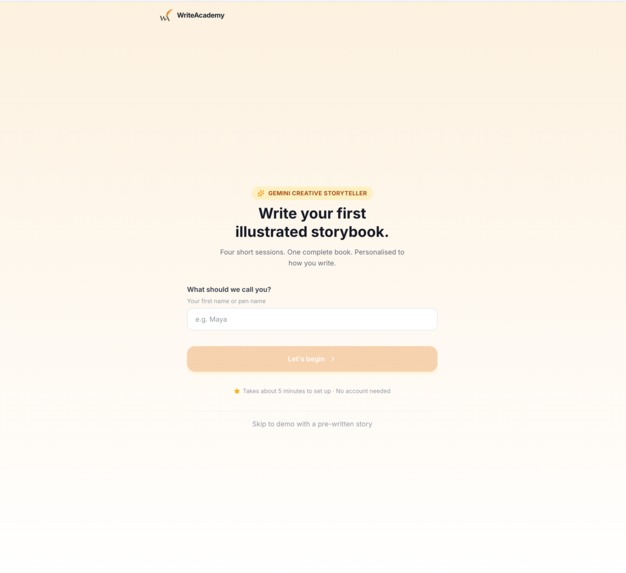
Fast onboarding that calibrates the curriculum to your current level
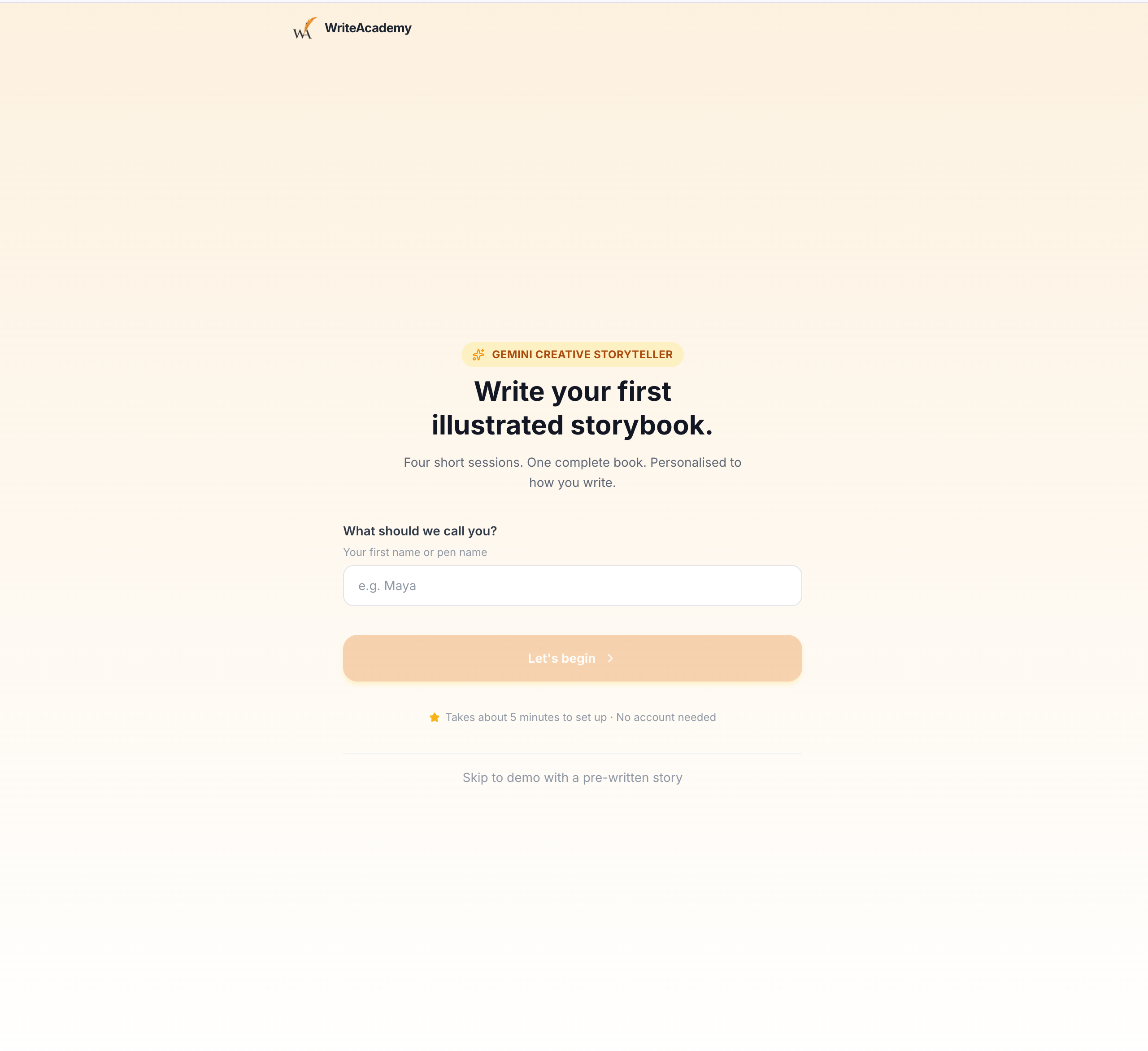
WriteAcademy ITS — About
Inspiration
Two things collided to spark this project.
First, a neighbour told me about Alpha School — a programme where kids complete core subjects in just two hours daily through adaptive AI and mastery-based learning, achieving 2.6x growth over peers. I kept thinking: why doesn't this exist for adults? Especially now, when AI is transforming the workforce and the demand for upskilling has never been higher. There are excellent courses out there, but they take weeks to complete and most people quit by module 3.
Second, I run a learning platform with real courses built by real educators. One of them — "Write Storybooks for Children" — had nine well-structured lessons full of solid pedagogy. But the completion rate was typical of online learning: people started strong and faded. The content was good. The experience wasn't pulling them through.
That's when it clicked: what if the experience wasn't "complete 9 modules about writing techniques" but instead "write your first illustrated storybook this weekend"? Same pedagogy underneath. Completely different motivation on top. And with Gemini's multimodal capabilities — text generation, structured output, image generation, streaming — I could build an Intelligent Tutoring System that adapts to each learner, coaches them in real-time, and illustrates their story as they write it.
What it does
WriteAcademy is an AI-powered Intelligent Tutoring System that sits on top of an existing LMS and transforms a standard writing curriculum into a story-first, Pomodoro-paced experience.
The learner writes and illustrates a 12-page children's storybook across four 25-minute sessions (~2 hours total). Each session follows a three-act structure — Wonder, Build, Reflect — with the Gibbs Reflective Cycle embedded as the pedagogical backbone.
At onboarding, the learner writes a brief story opening. Gemini analyses it across five craft dimensions (sensory detail, character voice, show-don't-tell, story structure, visual thinking) and adapts the curriculum accordingly — compressing or skipping techniques the learner already demonstrates, and providing full instruction where they need it.
During each Build phase, the learner writes three pages of their story with real-time craft coaching from Gemini. Every completed page is instantly illustrated in a consistent art style using a visual bible (character + environment references). After each session, the learner sees their growing storybook in an interactive viewer and receives structured Gibbs feedback — six phases of reflective analysis with specific quotes from their own writing.
The output is a real illustrated storybook, exportable as a PDF. Not a badge. Not a certificate. A book they wrote.
How I built it
The architecture follows the classic four-component ITS model from educational research (Yuan & Hu, 2024):
Domain Model — The Gibbs Reflective Cycle provides the pedagogical framework. Rather than showing learners explicit steps, the six phases are embedded naturally in the three-act session structure (Wonder maps to Description + Feelings, Build maps to Evaluation + Analysis, Reflect maps to Conclusion + Action Plan).
Student Model — Gemini 2.5 Flash analyses the learner's writing sample at onboarding using structured JSON output, rating five craft dimensions. These ratings drive adaptive technique selection: strong skills get compressed or skipped, developing skills get full Gibbs-cycle instruction.
Tutoring Model — Gemini powers four distinct capabilities: (1) session planning with structured output, (2) real-time craft coaching via streaming NDJSON, (3) illustration generation with a dual-image visual bible for style consistency, and (4) structured Gibbs feedback with quotes from the learner's own writing.
Interface Model — A Pomodoro-paced session structure (25 minutes x 4 sessions) with the three-act flow. The storybook viewer with page-turn animations makes the output feel tangible. PDF export completes the loop.
Tech stack: FastAPI backend on Google Cloud Run, Next.js 16 frontend with Tailwind CSS v4, Gemini 2.5 Flash via the Google GenAI SDK, Cloud Storage for illustrations, Secret Manager for API keys. The existing Django LMS provides the curriculum data — nine lessons of pedagogy that Gemini restructures into story-aligned technique modules.
The key architectural decision was keeping the existing LMS as the Domain Model rather than replacing it. The pedagogy was already good — it was created by educators who understand writing craft. What was missing was the adaptive intelligence layer and the motivational structure. Gemini provides both without discarding the human expertise that went into the curriculum.
Challenges I faced
Illustration style consistency was the hardest technical problem. Early attempts produced wildly different art styles from page to page — the fox character would change colour, proportion, and style with every generation. The solution was a visual bible approach: the first illustration establishes the style, and subsequent calls include both the page 1 illustration and the most recent page as reference images, plus explicit character and environment descriptions.
Balancing pedagogy with pace. The Gibbs Reflective Cycle has six phases, and a full cycle per technique would make each session feel like a lecture. The breakthrough was embedding Gibbs within the three-act structure so that reflection happens naturally through the story-building process — the learner is reflecting on their craft without being told "now we're in the Analysis phase."
First-load latency. Gemini image generation takes 15-20 seconds on a cold call. For a product where the emotional peak is seeing your words become an illustration, that wait kills the magic. The mitigation was concurrent generation, aggressive caching, and pre-warming the demo path.
Adaptive curriculum complexity within a hackathon timeline. The full vision includes dynamic technique reordering based on story demands, but that was too complex for the submission window. The MVP implements skip/compress/full at onboarding, which demonstrates the adaptive principle without requiring a complete curriculum graph.
What I learned
The biggest insight was that the output IS the motivation. Every EdTech product I have used measures progress in modules completed or badges earned. WriteAcademy measures progress in pages of your book. That single reframe — from consuming content to producing an artifact — changes the learner's relationship with the material entirely.
I also learned that Gemini's structured output mode is genuinely transformative for ITS architecture. Traditional tutoring systems require hand-built rule engines for the student model and tutoring model. With structured JSON output, Gemini can perform skill assessment, session planning, and adaptive feedback generation in a single call — unifying what would have been three separate system components.
Finally, the Gibbs Reflective Cycle is a remarkably good fit for creative learning when you stop treating it as a visible framework and start treating it as an invisible structure. The learner doesn't need to know they're doing "Analysis" — they just need to be asked "what did that passage do to you?" at the right moment.
What's next
This submission covers one module from one course on our platform. The roadmap:
- Incorporate feedback from the hackathon to refine the adaptive engine and illustration consistency
- Expand to additional courses — the ITS architecture is curriculum-agnostic; any course with structured lessons can be transformed into a story-first or project-first experience
- Apply to professional upskilling through Meander Talent Academy — the same principles (adaptive AI + mastery-based learning + Pomodoro pacing + tangible output) apply to business skills, technical writing, and any domain where practice and reflection drive improvement
- Multi-student support with persistent profiles, progress tracking across courses, and collaborative features
The vision is an AI layer that makes any existing curriculum feel like it was built specifically for you — respecting the pedagogy that educators created while delivering it at the pace and personalisation that modern learners need.
Built With
- django-rest-framework
- fastapi
- framer-motion
- gemini-2.5-flash
- google-cloud
- google-cloud-run
- google-genai-sdk
- google-secret-manager
- lucide
- next.js-16
- pydantic
- python
- tailwind-css-v4
- typescript


Log in or sign up for Devpost to join the conversation.