About Wright Way
Inspiration
We’ve always loved travel — that feeling of watching the world shrink from a window seat never gets old. But one of the most eye-opening parts of this project came from my best friend, who flies planes for a living. He would casually tell stories about North Atlantic crossings and how stressful diversions can get when you’re hundreds of miles from land with very few safe airports. A fuel leak, an unexpected closure, or even a solar storm that knocks out HF radio can turn a routine flight into a high-pressure decision with almost no margin for error.
Those conversations made us realize that dispatchers today often rely on static charts and mental math under extreme time pressure. We wanted to build something that actually helps them see the feasible options clearly and explain their choices confidently.
What it does
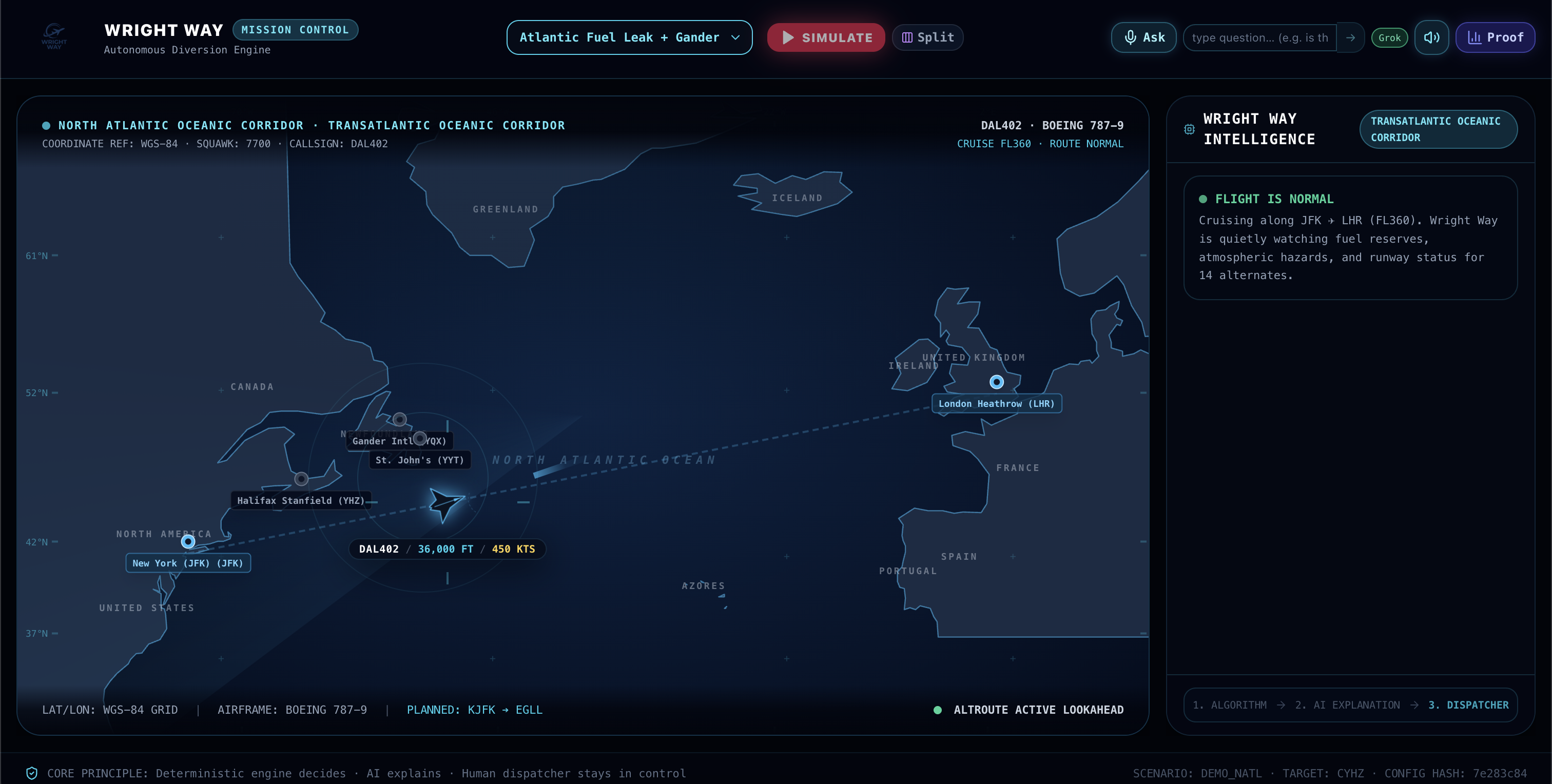
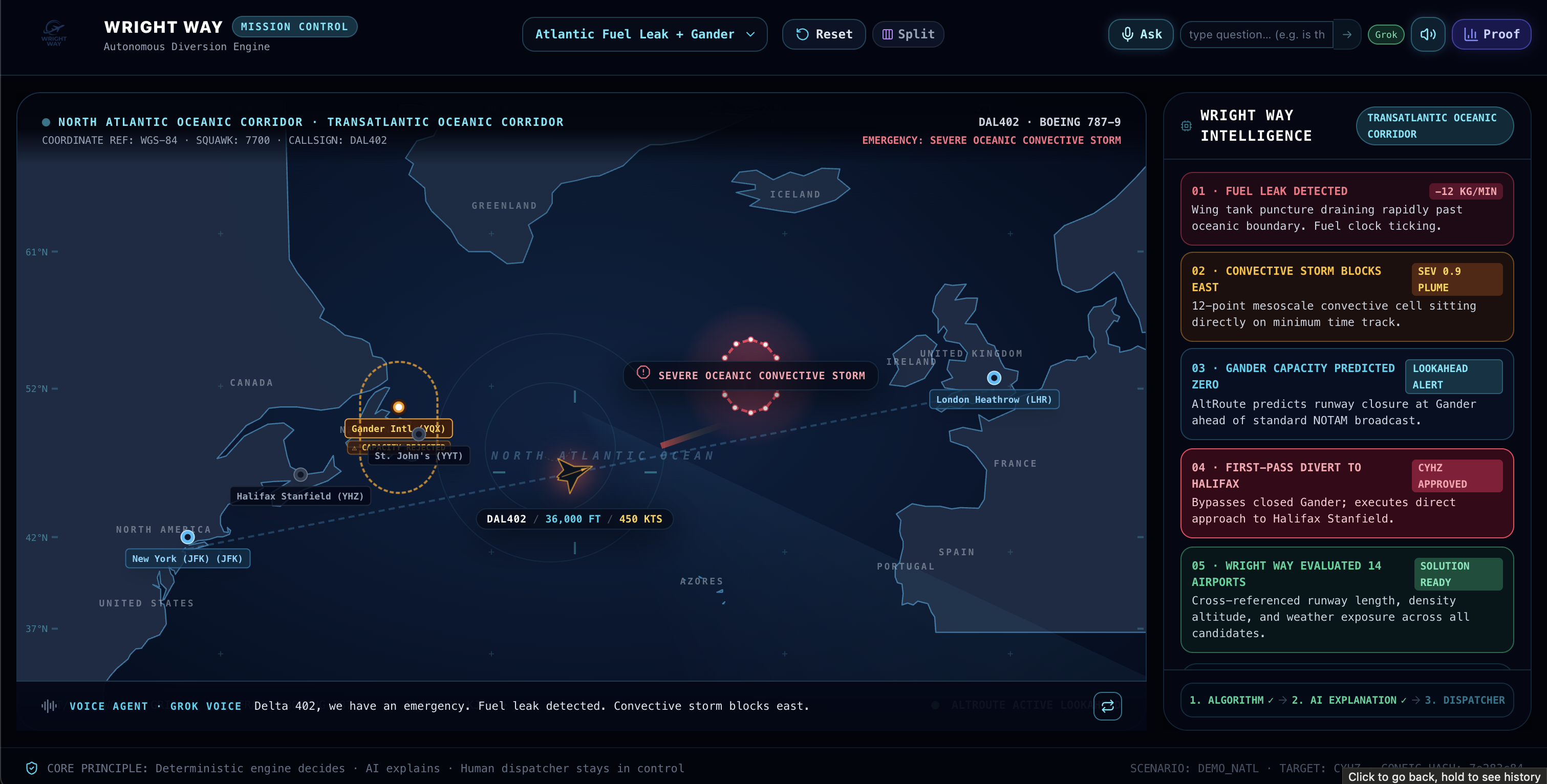
Wright Way is a real-time decision-support console for airline dispatchers on North Atlantic routes (like JFK to LHR). When an emergency hits — fuel leak, airport closure, volcanic ash, icing, or a solar storm — the system instantly:
- Filters out unusable airports
- Ranks the remaining ones into three clear strategies (Lowest Risk, Lowest Fuel, Fastest)
- Shows the situation on a live 2D cinematic radar map
- Uses grounded Grok voice to explain the recommendation in plain language
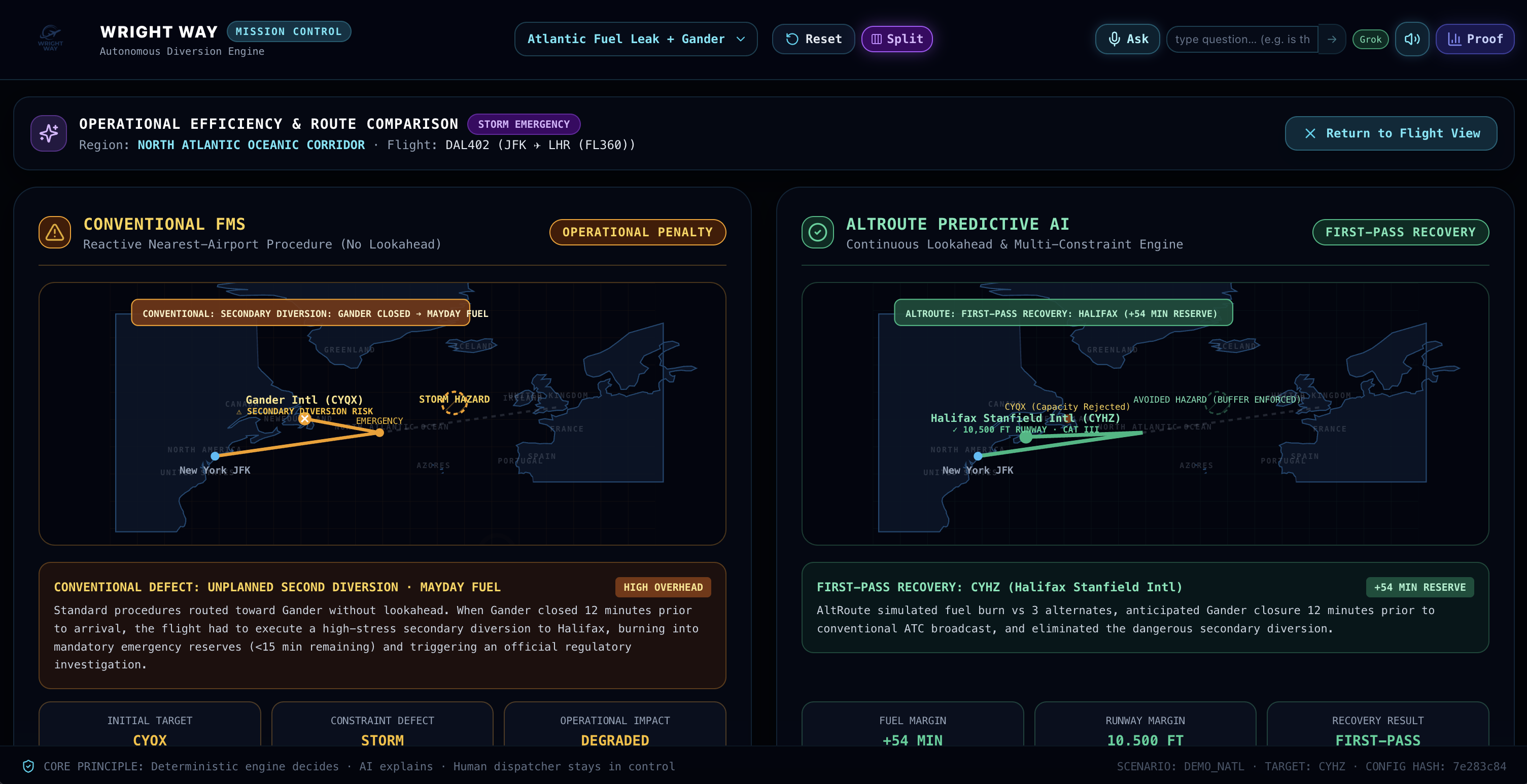
A side-by-side view lets you watch the exact same scenario play out with and without Wright Way, and you can inject your own emergencies in “Build Your Own” mode.
How we built it
We split the work into four strict lanes from day one (engine, simulation, web UI, and voice) so we could work in parallel without merge conflicts. We started with frozen mocks so everyone could build independently.
- The engine is 100% deterministic Python (A* routing with hazard avoidance + Diversion Risk Index scoring and hysteresis).
- The sim layer handles aircraft physics, event timing, baselines, and streams everything over WebSocket.
- The frontend is a tightly constrained React + SVG 2D map that stays fully visible at 100% zoom with no scrolling except inside the right panel.
- The voice layer only uses Grok for phrasing and TTS — every answer is verified against the engine’s actual decision record so it can’t hallucinate.
We pulled real airport data from OurAirports and real space weather from NOAA SWPC.
Challenges we ran into
The biggest challenge was trust. Dispatchers can’t just say “the system said so” — they need to be able to explain their decision to pilots and ATC. This forced us to build a very strict grounding and verification system around Grok. If the model tried to use a number or airport code that wasn’t in the current decision record, we rejected it and fell back to the deterministic answer.
Another major constraint was the UI. We had to fit everything on one screen with no scrolling except inside the intelligence panel. That required constant discipline around layout and information hierarchy.
We also had to balance realism with demo clarity — real oceanic diversions are messy, but the story still needed to be clear and compelling in a live setting.
Accomplishments that we're proud of
- A fully grounded voice layer that can answer “Why not Gander?” using only the facts from the engine.
- A clean side-by-side comparison that visibly shows Wright Way succeeding where conventional planning fails.
- A working “Build Your Own” mode that lets anyone inject live events during the demo.
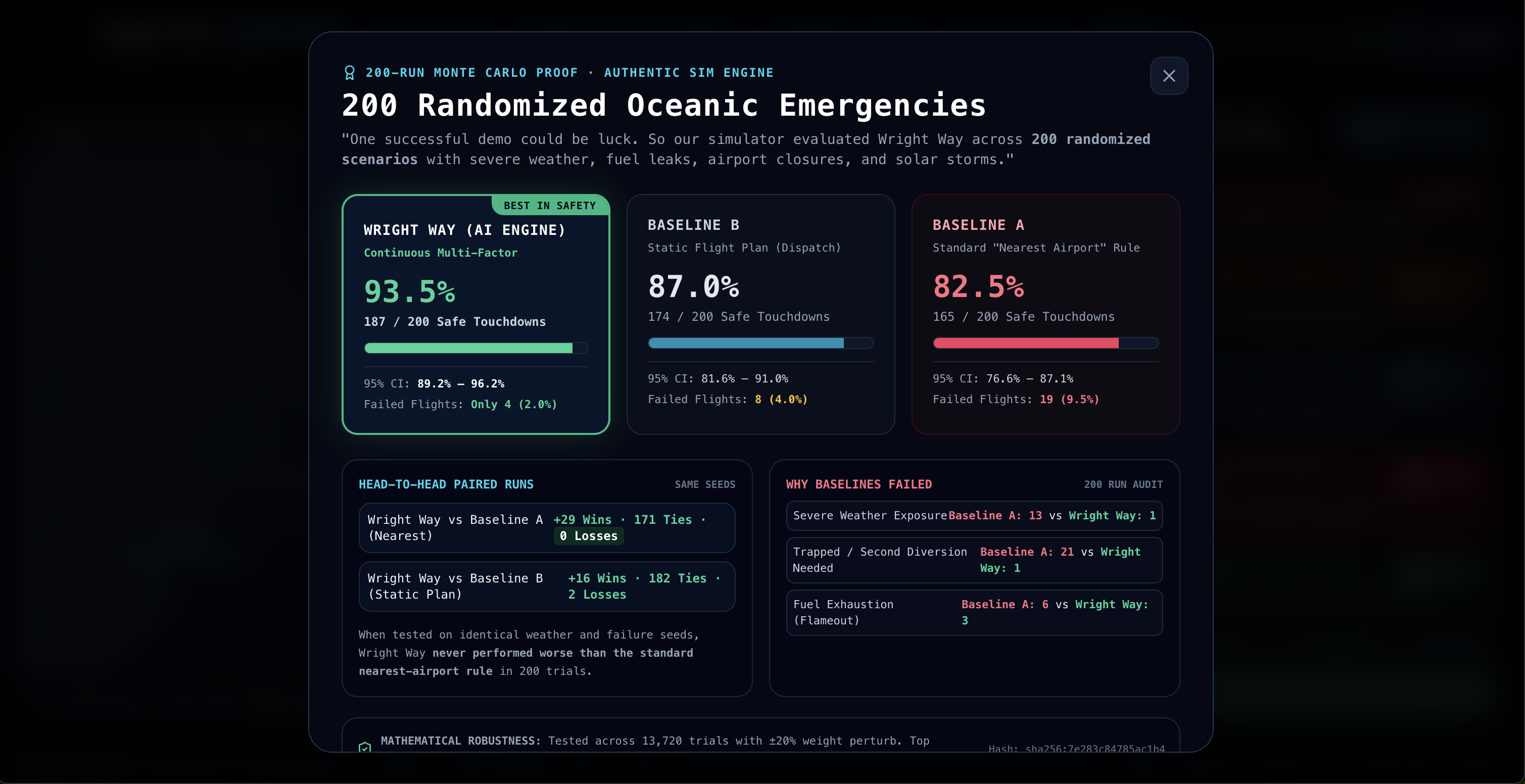
- A 200-run batch scoreboard that gives measurable proof instead of just claims.
- Keeping the entire experience viewport-locked and readable at 100% zoom.
What we learned
We learned that separating decision-making from explanation is incredibly powerful. The engine stays deterministic and auditable, while the AI layer only translates the record into human language.
We also learned how much value comes from simply making the feasible set and the trade-offs visible — sometimes the biggest win is just reducing the cognitive load on the dispatcher.
Most importantly, we learned that “human in the loop” isn’t a buzzword here — it’s the entire point of the system.
What's next for WrightWay
We’d like to add a read-only crew tablet view that speaks the approved plan aloud, generate plain-language passenger updates from the same decision record, and explore cost/payout modeling. Long-term we’d love to get real dispatchers in front of it for feedback and potentially bring in more live space weather and traffic data.


Log in or sign up for Devpost to join the conversation.