Wraith Lord | Endless Vigil - Project Story
Inspiration
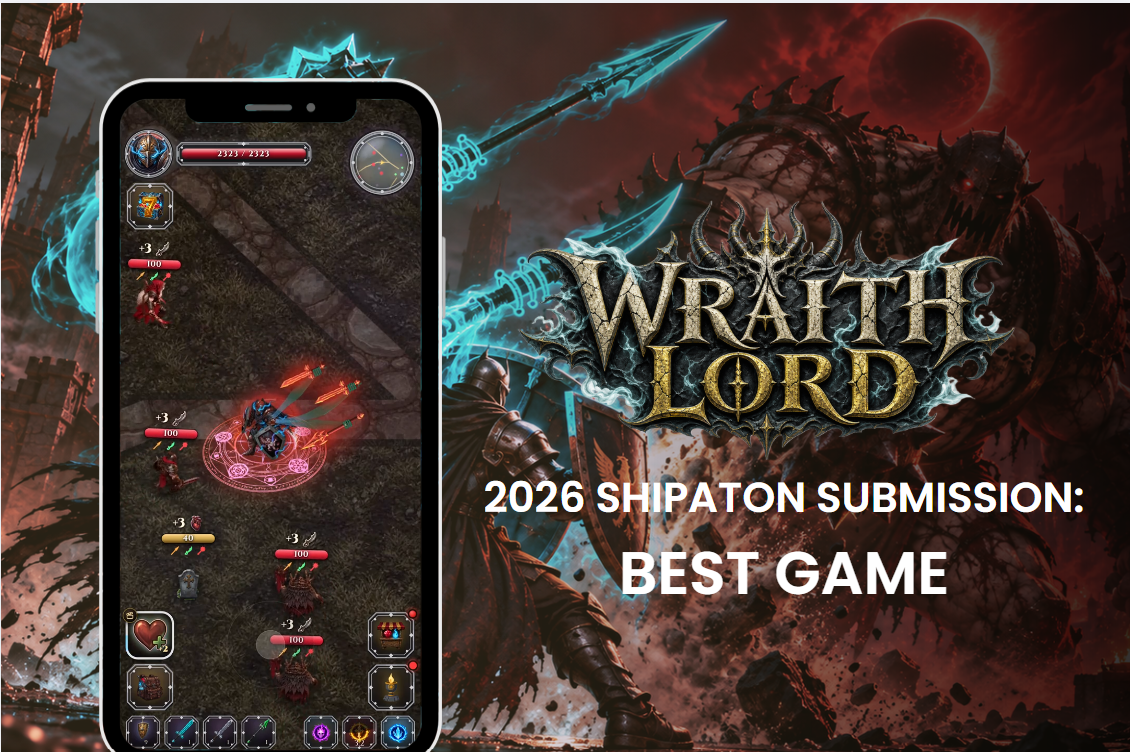
Wraith Lord started as a reaction to Butcher Hero: Hook'n'Chew RPG, specifically its hook-and-consume permanent progression loop. I loved the idea that every kill matters forever, but the hook/grapple mechanic itself never fit the tone I wanted. So I stripped it down to its emotional core (nothing is ever wasted, nothing is ever lost) and rebuilt it as a dark fantasy top down auto-battler. A cursed knight named Aldric crosses into the realm between life and death to fight a war he was already losing, carrying his wife Elowen with him. Not as a ghost, but as a tether who can speak to him across every realm. The "hook" survives only conceptually now, in the way the Wraith Limbs consume and pull from what they kill.
What it does
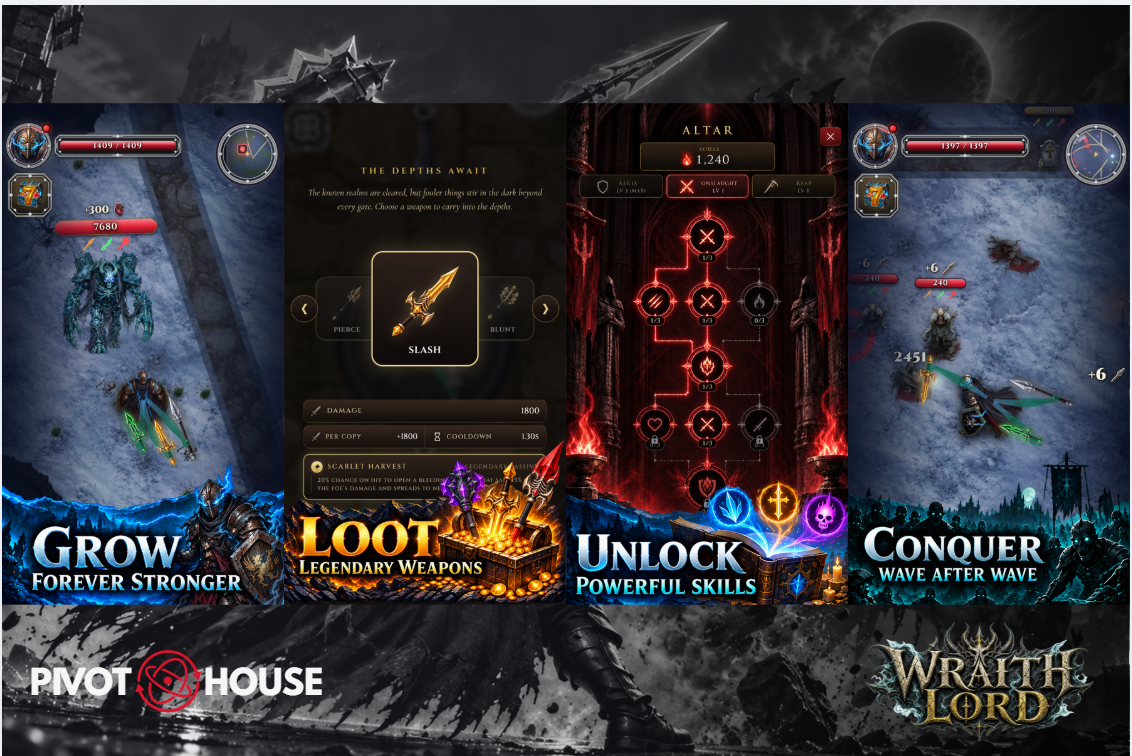
Wraith Lord is a no-fail-state, permanent progression auto-battler. You move, and that's really the only input you have. Your Wraith Limb weapons handle the rest. Every enemy or structure you destroy grants an instant, permanent stat increase. There's no death screen, no run reset, and no lost progress. If you die, you respawn at the Vigil Nexus with a brief invulnerability window and everything you've earned still intact.
Progression branches out in three directions: a weapon system with fixed rarity at acquisition and automatic duplicate copy leveling, a three tree skill system (Aegis for Defense, Onslaught for Offense, Reap for Spectral) with layered passive nodes the player chooses themselves, and a world structure of four elemental realms radiating out from a home hub. Each realm is gated behind fixed boss fights and pays off with totems, skills, and eventually an Altar where a Souls economy unlocks. Monetization is live and real too, a RevenueCat backed Vault with a subscription tier, a Gems currency, and chest/relic systems, not just a mockup for the judges.
How we built it
I'm the sole designer, developer, and director on this one. The entire game core is a single file of vanilla JS/HTML/CSS (game.html), hosted through Lovable (TanStack Start/React/TypeScript/Tailwind) and shipped to Android via Capacitor. RevenueCat handles the paywall, customer center, and IAP plumbing directly against that build.
My workflow was design first, always. Every mechanic gets locked into a living GDD before a single line of code touches it. I used Claude, alongside Claude Code running against the same GitHub repo shared with Lovable, as a standing design partner throughout. It helped me draft systems, stress test balance math, and, maybe most importantly, run full audits of the GDD against the actual shipped code to catch drift between what I thought I'd built and what was really running. Sprites went through a ChatGPT to Grok to SpriteMaster to Lovable pipeline, which kept directional 8-way art production fast enough for a solo dev working against a deadline.
Challenges we ran into
The biggest challenge wasn't really a feature at all, it was documentation drift. Building solo and fast with an AI-assisted stack, the GDD quietly fell out of sync with the live code in a dozen different places. A shield system I thought was still "planned" turned out to already be fully shipped. A weapon rarity table I'd documented as a power multiplier turned out to be flat base damage in code. An entire elemental weapon system was baking elements directly into weapon copies, silently contradicting the swappable socket design I'd already locked in. It took a full line by line audit just to get design and implementation speaking the same language again before I could safely build Phase 2 content on top of either.
On the design side, the hardest problem was making "you can never lose" feel like real tension instead of a lack of stakes. I solved that by leaning hard into horizontal progression, things like weapon variety, map mastery, and build identity across three skill trees, rather than just letting numbers climb forever.
Accomplishments that we're proud of
Getting a real, working RevenueCat integration live is probably the top one. Subscription paywall, customer center, consumable Gems, and a genuine 7-day login ladder, all inside a solo-dev hackathon timeline, and none of it a stub. I'm also proud of shipping all three skill trees in full, with every passive node (Parry, Rampage, Siphon, and every inherent bonus) actually wired into live combat instead of sitting there as UI scaffolding. And catching the elemental system conflict before it shipped broken feels like a real win too. The audit that found it also produced a clean, dependency-ordered roadmap for untangling it.
What we learned
Documentation is only as trustworthy as your last audit against real code, especially when you're moving fast with AI-assisted tooling. Treating the GDD as a living, code-verified contract instead of a wish list changed how I work for the rest of the project. I also learned that a "no fail state" design really only works because of its pacing gates, things like bosses, gate order, and Souls being locked behind the Altar, doing the work a death penalty normally would. Take those away and the game loses its shape entirely.
What's next for Wraith Lord | Endless Vigil
Next up is Phase 2: open-ended depth tiers for all four realms, unlocking simultaneously once the last Phase 1 gate falls, each running its own independent difficulty ladder off the existing art and music. Beyond that, I'm looking at the Elemental Socket system (inverse-affinity, boss-drop, swappable), a per-realm dominant-class stat economy to replace the current uniform Slash drops, full narrative VO implementation for Elowen and Aldric, and a daily boss event with a rotating weapon-class susceptibility schedule players can actually plan around.
Built With
- claude
- lovable

Log in or sign up for Devpost to join the conversation.