-
-
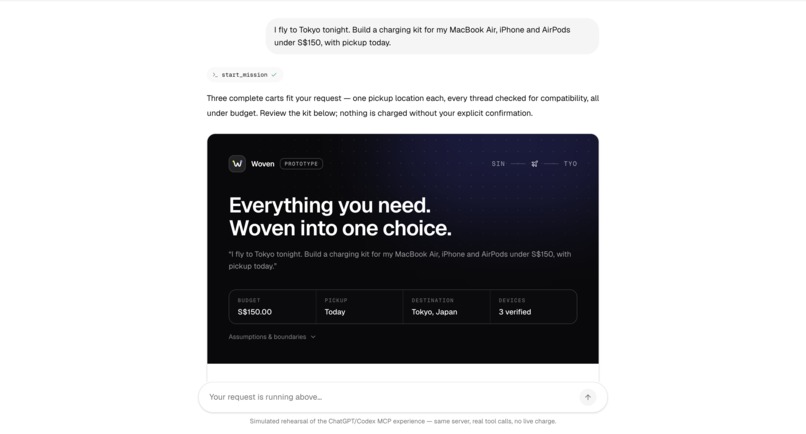
Woven — one mission, two verified compatible carts.
-
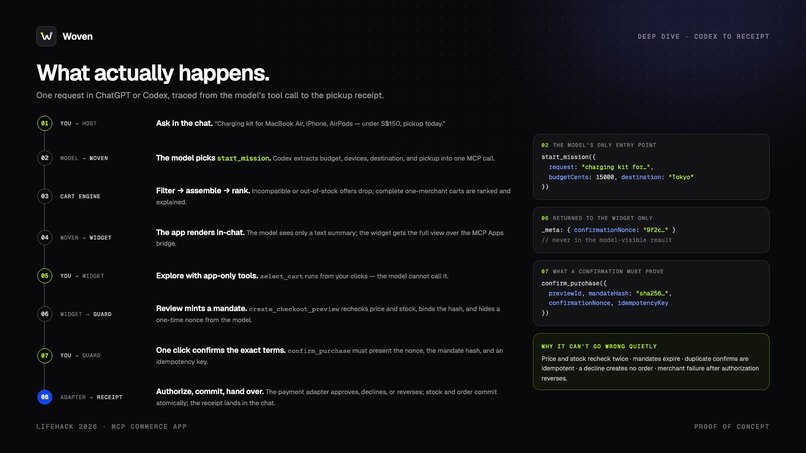
Woven - From model request to user-confirmed pickup receipt.
-
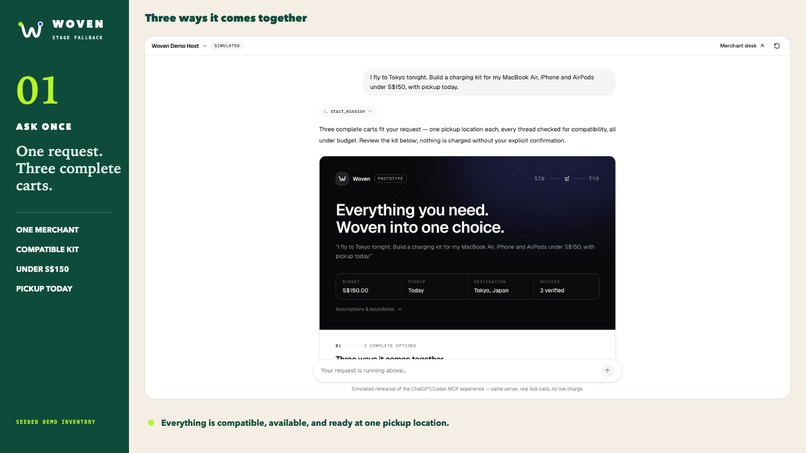
One request, two complete carts.
-
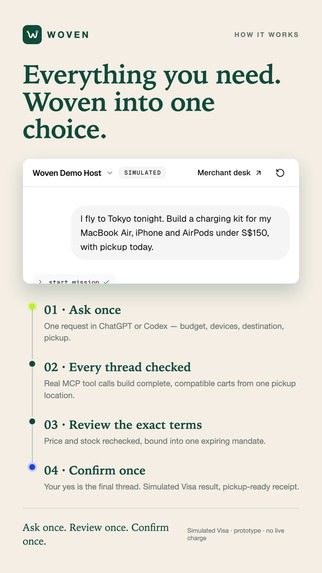
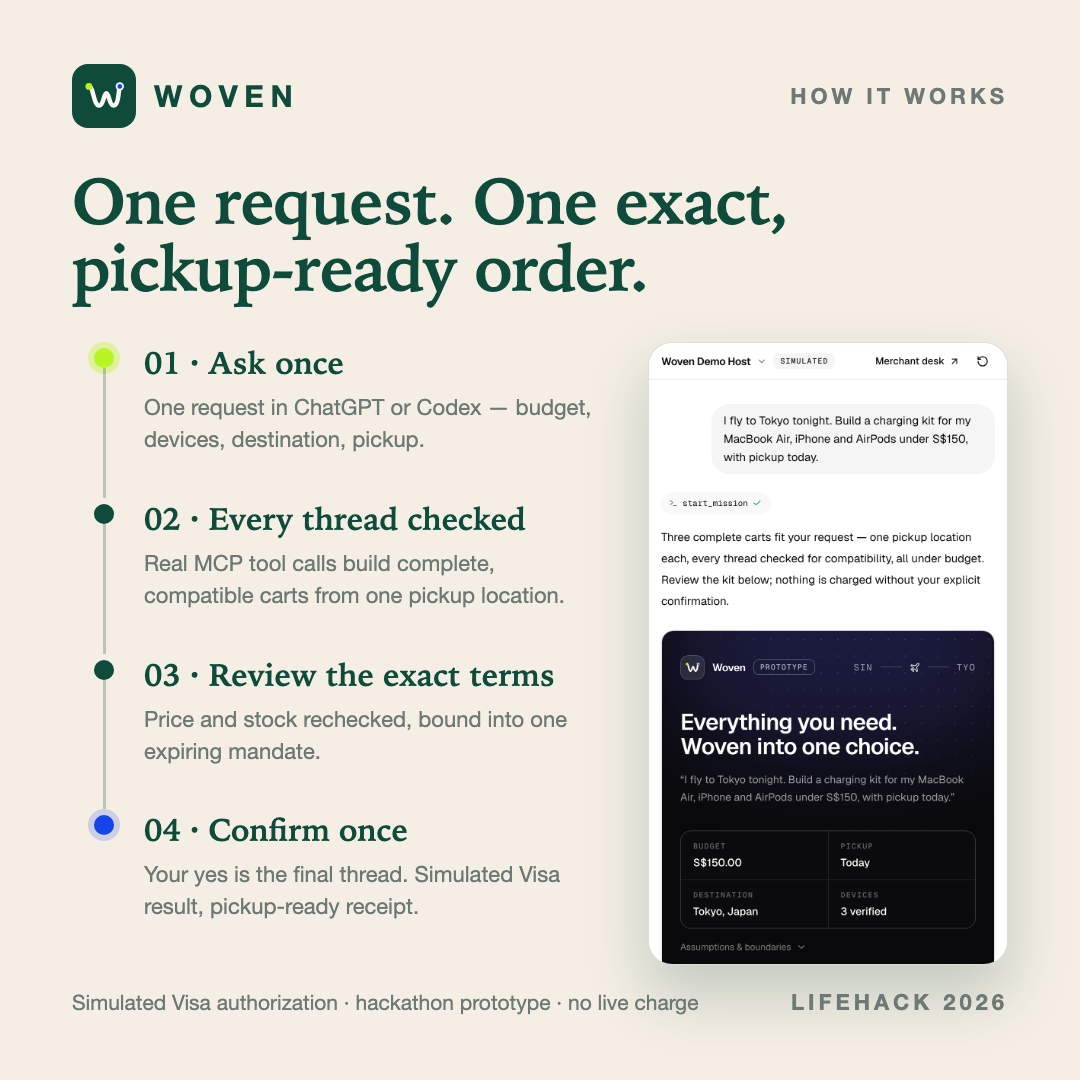
From one request to a pickup-ready order.
-
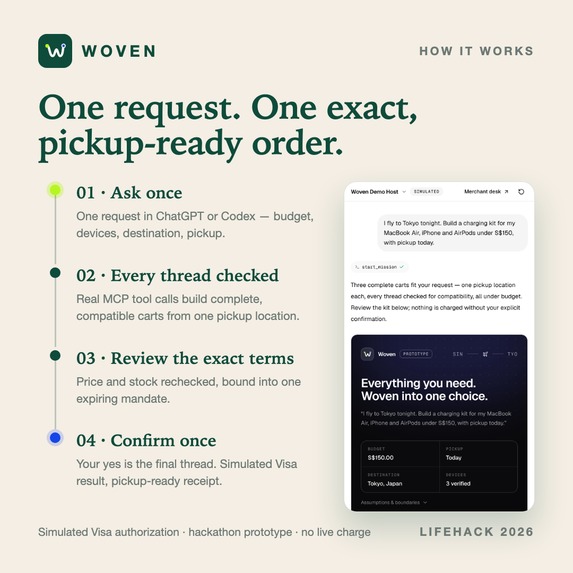
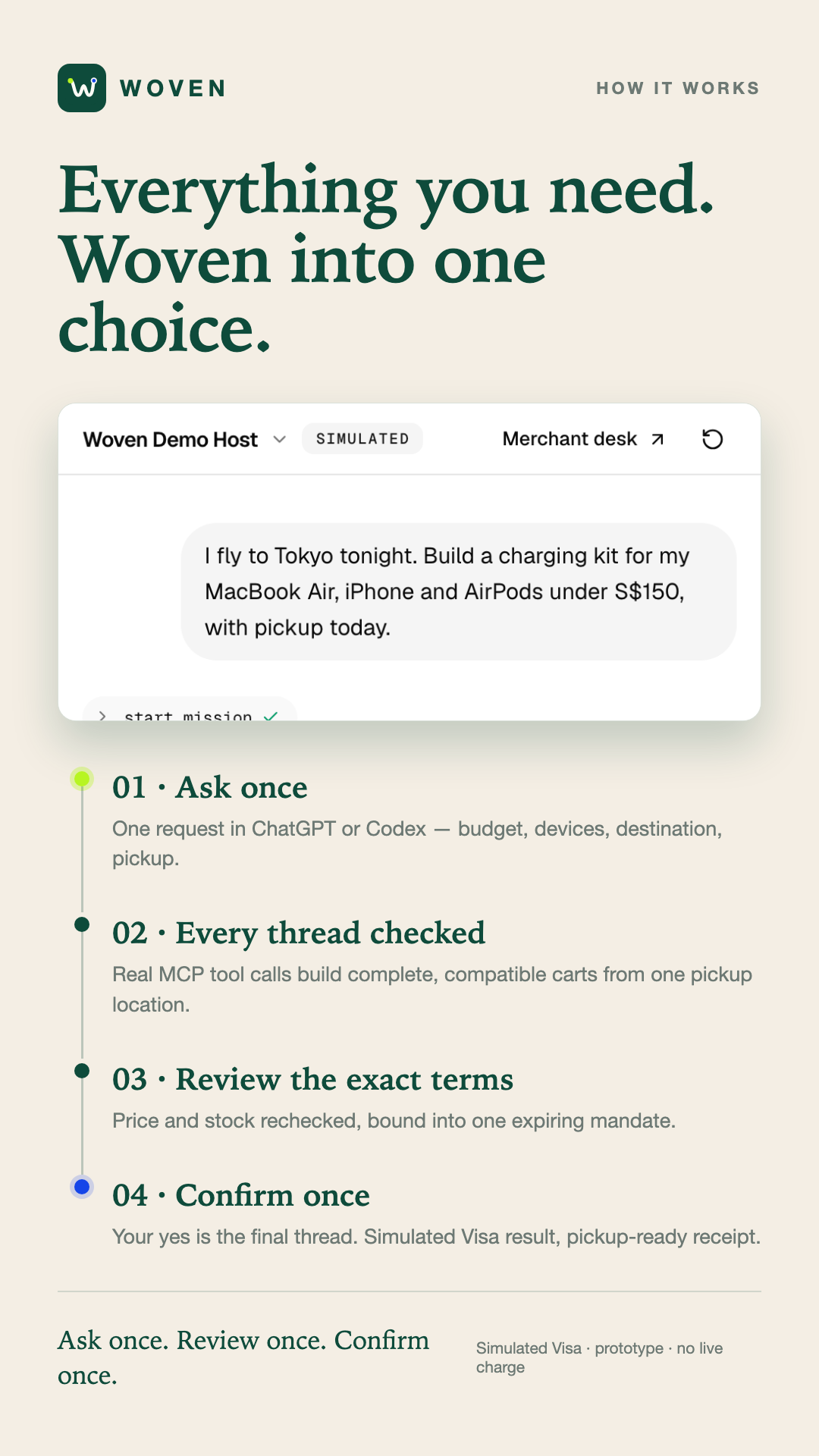
Ask once. Review once. Confirm once.
Why Woven is a strong fit for WebMCP
Shopping agents can recommend individual products, but a real mission still requires quantities, compatibility, budget, current stock, pickup, and consent to work together. Woven turns that multi-step job into a structured collaboration between an agent and the person already using the page.
On the fictional Woven Trail Market storefront, the agent does not guess at buttons or scrape the interface. Seven purpose-built site tools let it start or inspect a mission, rerank the visible cart comparison, select an offered cart, apply only a merchant-approved compatible alternative, refresh current price and stock, and verify an existing simulated receipt.
How it creates a better user experience
The canonical request asks for a rainy-weekend camping kit for two first-time campers that fits in one car boot and is pickup-ready today. Woven Trail Market shows the best two complete carts, each from one merchant and one pickup location, and explains how every quantity and component satisfies the brief. The lead proof is exact: 7 units, 5 categories, 89 L packed, and a 3,000 mm rainfly.
Agent calls update the same React storefront the person can see. When the agent
calls compare_carts, Woven reranks the visible inline kits rather than
returning a disconnected text result. The person can review the
same carts, prices, stock, compatibility proof, alternatives, and selected
state. That removes repeated searching and cart reconstruction without hiding
the decision from the person.
What people and agents can do together now
The agent can translate one outcome-oriented request into bounded, reversible preparation work across product choice, constraints, current catalog facts, and comparison. The person can inspect and steer that work in the same page, then retain sole control of the irreversible step.
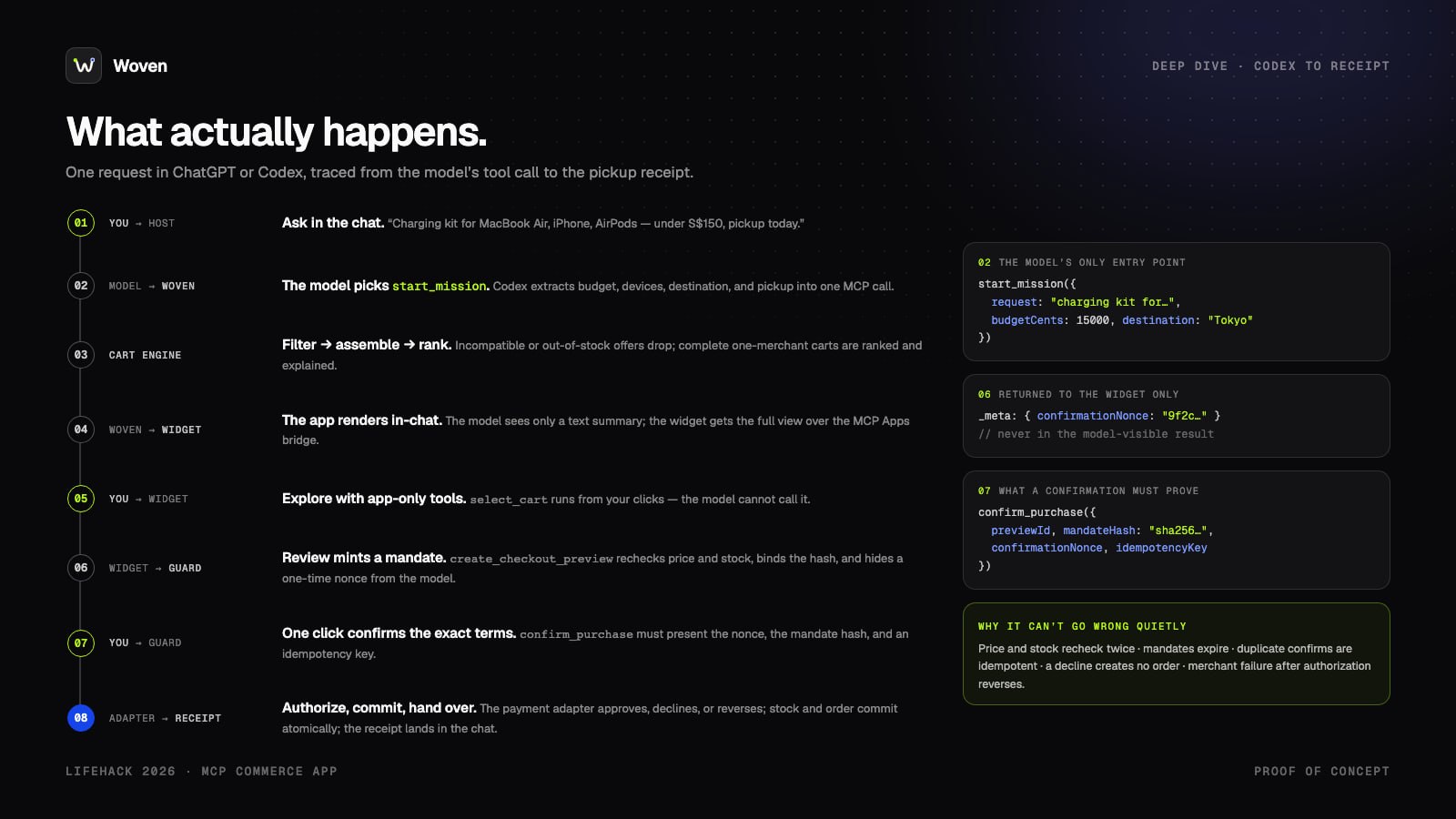
That boundary is intentional. Woven does not register identity verification, checkout preview, confirmation secrets, or purchase authorization as WebMCP tools. The agent may prepare and recommend; the person must complete the clearly labeled demo identity handoff, review exact expiring terms, and directly confirm or continue to a merchant. Inventory, identity, merchants, and payment authorization are simulated, Woven accepts no card credentials, and it cannot make a live charge.
How WebMCP was implemented
The dedicated top-level /webmcp storefront document registers seven imperative tools through
document.modelContext.registerTool: start_mission, get_mission,
compare_carts, select_cart, swap_cart_item, refresh_carts, and
verify_receipt.
Each tool has a closed JSON schema. Read-only operations carry read-only
annotations, content-bearing results are marked untrusted where appropriate,
and every registration is attached to an AbortSignal so navigation removes
the page's tool surface. The server sends Origin-Agent-Cluster: ?1 and
Permissions-Policy: tools=(self).
Human submission, WebMCP, and the existing MCP App enter the same server-owned mission router, deterministic commerce verifier, SQLite state, and checkout controls. The agent cannot mark a cart checkout-eligible. Connected catalog facts may support a cart; cited web research remains research-only. Price, stock, compatibility, identity session, exact amount, nonce, expiry, and idempotency are revalidated at the human confirmation boundary.
Inspiration
Search gives links, but buying still takes work. A first-time camper has to size the shelter, duplicate sleep gear, check rain ratings, fit everything into one car, find one pickup location with stock, and rebuild the cart at checkout. Woven was built around a simple product promise: everything works together.
What it does
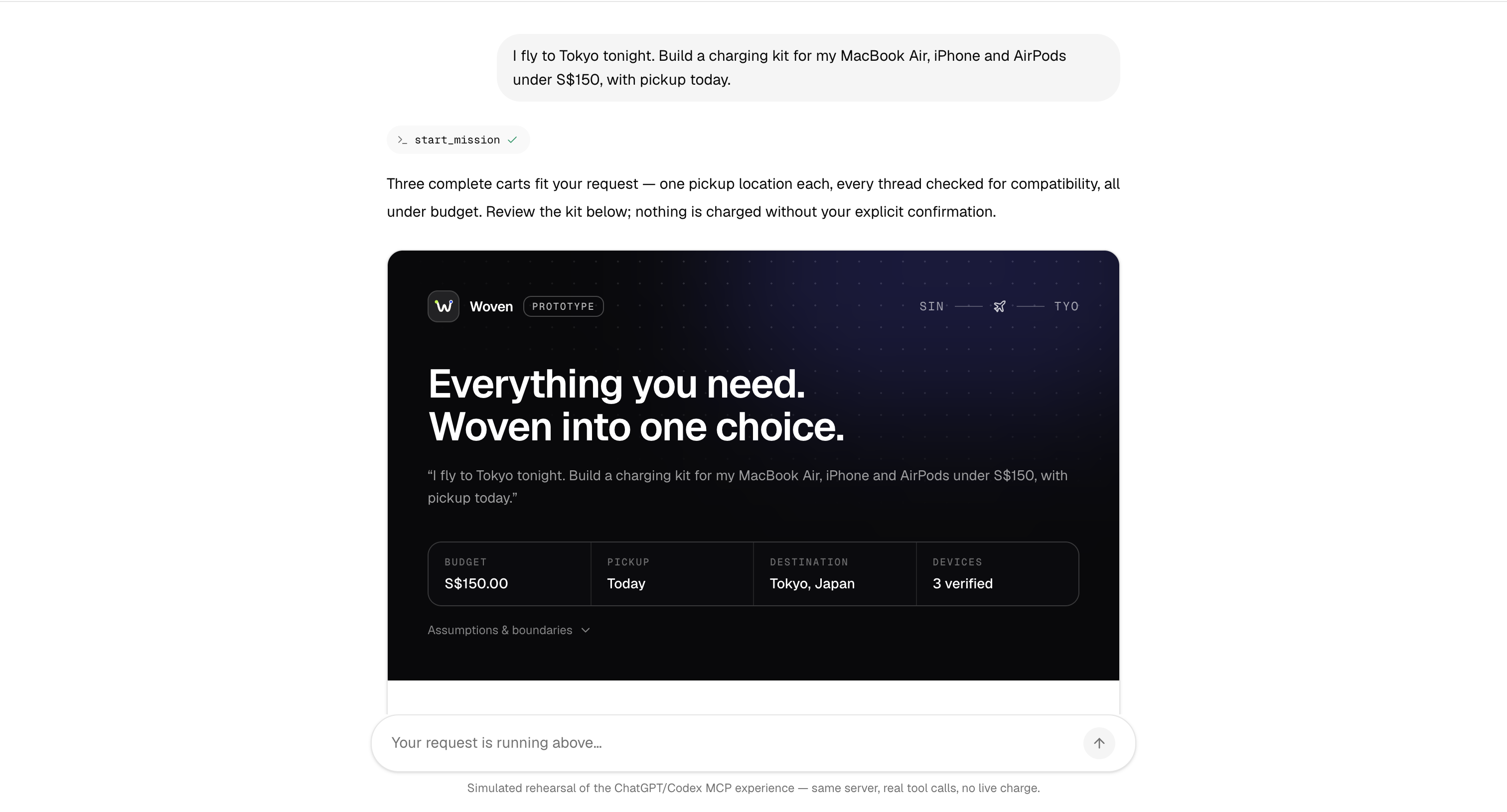
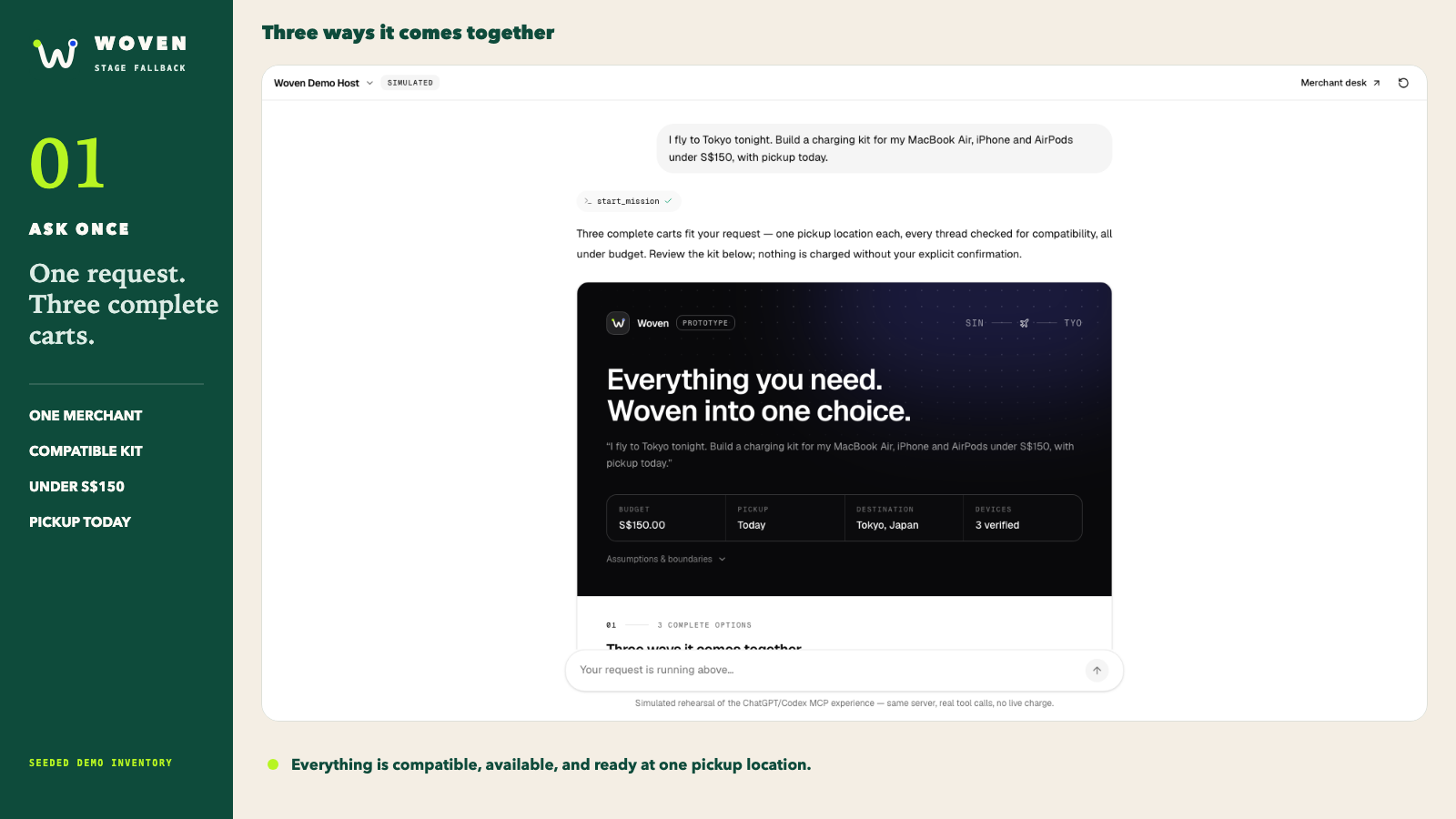
One natural-language mission becomes verified complete carts; the storefront shows the best two in solid comparison cards. The agent and person share a visible storefront state, current selection, merchant-approved alternatives, and refreshable catalog state. The agent can do reversible preparation through WebMCP while identity and exact transaction confirmation stay human-only.
How we built it
Woven is one Node.js and TypeScript service with a dedicated React storefront, seven top-level WebMCP site tools, HTTP and stdio MCP transports, deterministic cart verification, bounded LangGraph.js orchestration for non-camping missions, SQLite persistence, and a simulated payment adapter. Tests assert the exact tool surface, schemas, cleanup lifecycle, shared UI behavior, security headers, and absence of identity or purchase tools.
Challenges
The hardest design decision was deciding what not to expose. Treating a tool call as payment consent would erase the trust boundary. Woven exposes only reversible preparation work and keeps identity, exact terms, secrets, and final confirmation outside the agent's tool surface.
The second challenge was preserving one source of truth across WebMCP, the MCP App, and the browser experience. All surfaces now share the same server routing, validation, persistence, cart rules, and confirmation boundary.
Accomplishments
- Seven browser-discoverable WebMCP tools over a complete product workflow.
- Tool calls update the visible storefront instead of a parallel agent-only state.
- Two visible complete one-merchant kits with exact budget, volume, weather, quantity, stock, pickup, source, and verification proofs.
- One truthful glass activity surface; commerce cards and authorization controls remain solid, and total connector failure never fabricates a result.
- Merchant-approved substitutions, refreshable facts, signed simulated receipts, and deterministic failure behavior.
- Human-only identity and purchase confirmation enforced by the server and omitted from WebMCP.
- Automated tests plus desktop and mobile verification.
What we learned
WebMCP is strongest when the browser is not merely another API client. Its value is shared context: the agent can act through precise tools while the person sees and controls the same product state. Tool omission is also product design; the absence of a purchase tool makes Woven's consent model clearer and safer.
Challenge-period provenance
Woven was created during the challenge period. The challenge opened on 25 August 2026; the first public repository commit is dated 29 August 2026, and the dedicated WebMCP implementation is dated 31 August 2026.
Built With
- chatgpt
- codex
- express.js
- langgraph
- mcp-apps
- model-context-protocol
- node.js
- openai-responses-api
- playwright
- react
- remotion
- shadcn-ui
- sqlite
- tailwind-css
- typescript
- vercel
- vite
- webmcp
- zod


Log in or sign up for Devpost to join the conversation.