Inspiration
During long-duration space missions, even small vision changes can matter.
Astronauts live and work in an environment where access to medical resources is fundamentally different from life on Earth. Vision changes may be captured through crew observations, scheduled examinations, and other mission records, while communication with Earth becomes increasingly delayed as crews travel farther from home.
We became interested in a simple human problem within this highly technical environment:
What happens when an astronaut notices that something feels different, but the first observation does not contain enough information for someone else to understand it?
A note such as “small text looked blurry this morning” may sound clear, but it can leave important questions unanswered: When did it begin? Which eye was affected? Is it still happening? Has it happened before? Did it interfere with mission activities?
On Earth, those questions can often be resolved through another conversation. During deep-space missions, that conversation may not happen immediately.
That led us to one core idea:
Make the record complete before it needs to become a conversation.
We created VisionLog to explore how human-centered interaction and responsible AI could help astronauts document small vision changes, understand how those changes develop over time, and communicate clearer information for medical review.
What it does
VisionLog is a vision-health support system designed for astronauts on long-duration space missions.
Rather than attempting to diagnose an astronaut, VisionLog helps turn small, subjective observations into structured, reviewable information through three connected stages:
Check-In → Analyze → Dashboard
Check-In
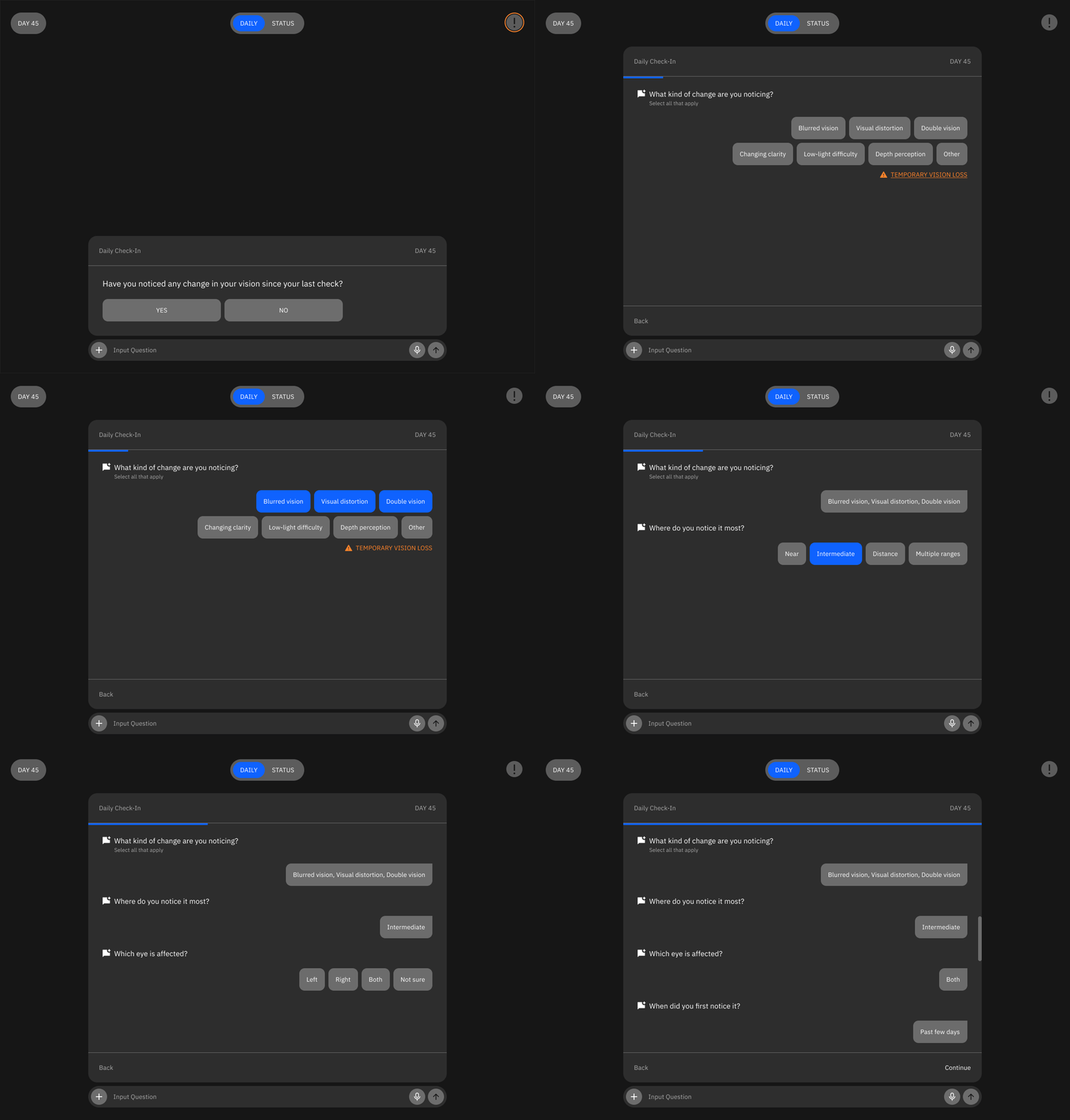
VisionLog provides a structured daily vision check-in designed to be quick when everything feels normal and more thorough when something has changed.
If no change is reported, the check-in can end immediately.
When a change is reported, VisionLog captures details such as:
- Type of vision change
- Affected eye
- Focal distance
- Onset
- Persistence
- Impact on mission activities
- Corrective devices
- Associated symptoms
- Optional notes
As the astronaut responds, each answer becomes part of one structured record.
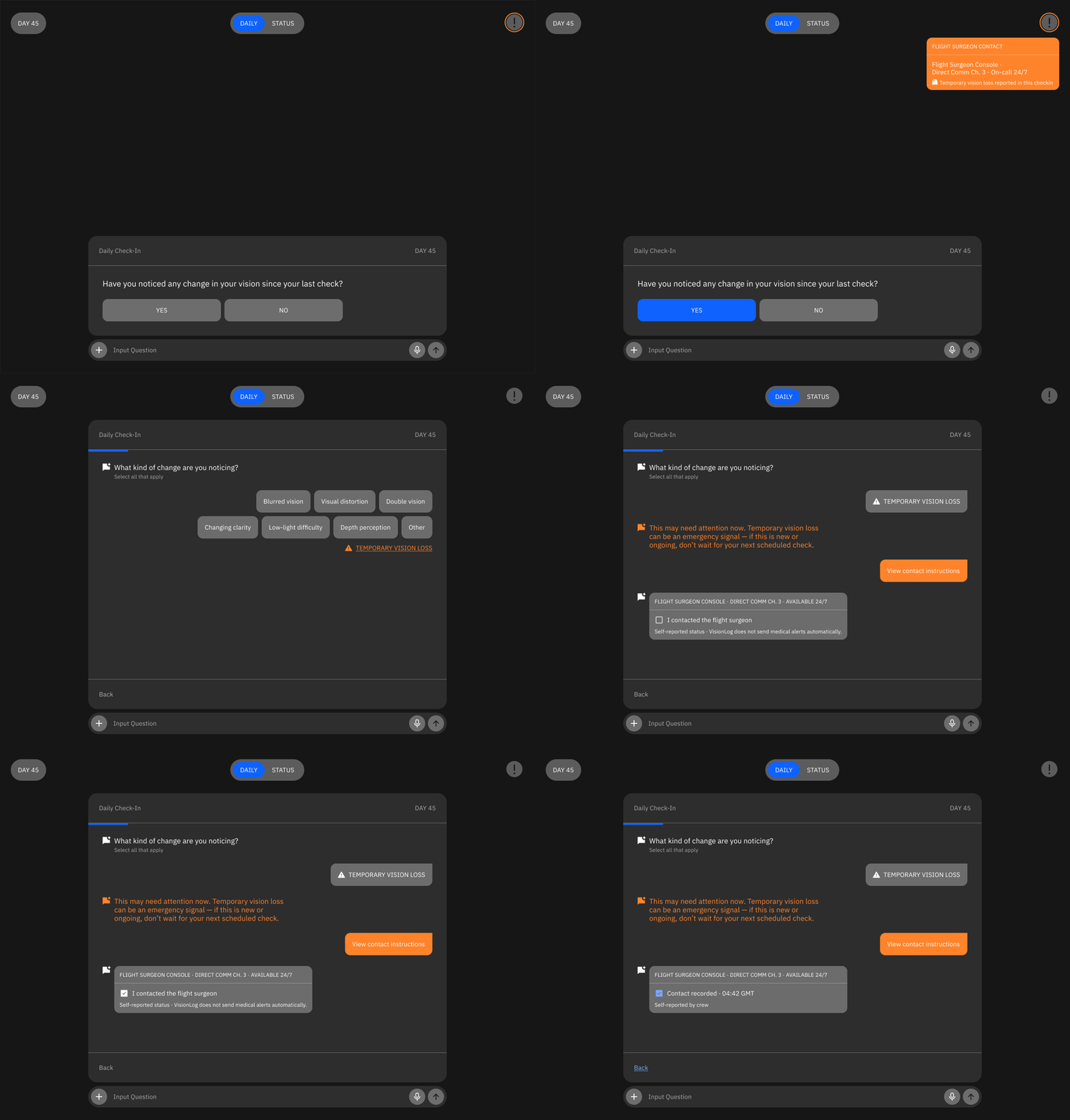
Potential safety signals are evaluated through predefined rules rather than generative AI. When configured criteria are met, the system surfaces the need for human review.
Analyze
A single observation does not always tell the whole story.
Analyze helps place today's observation within the astronaut's longer-term history by bringing together:
- Structured astronaut observations
- Personal preflight baseline and scheduled vision examinations
- Historical ISS environmental measurements from NASA OSDR
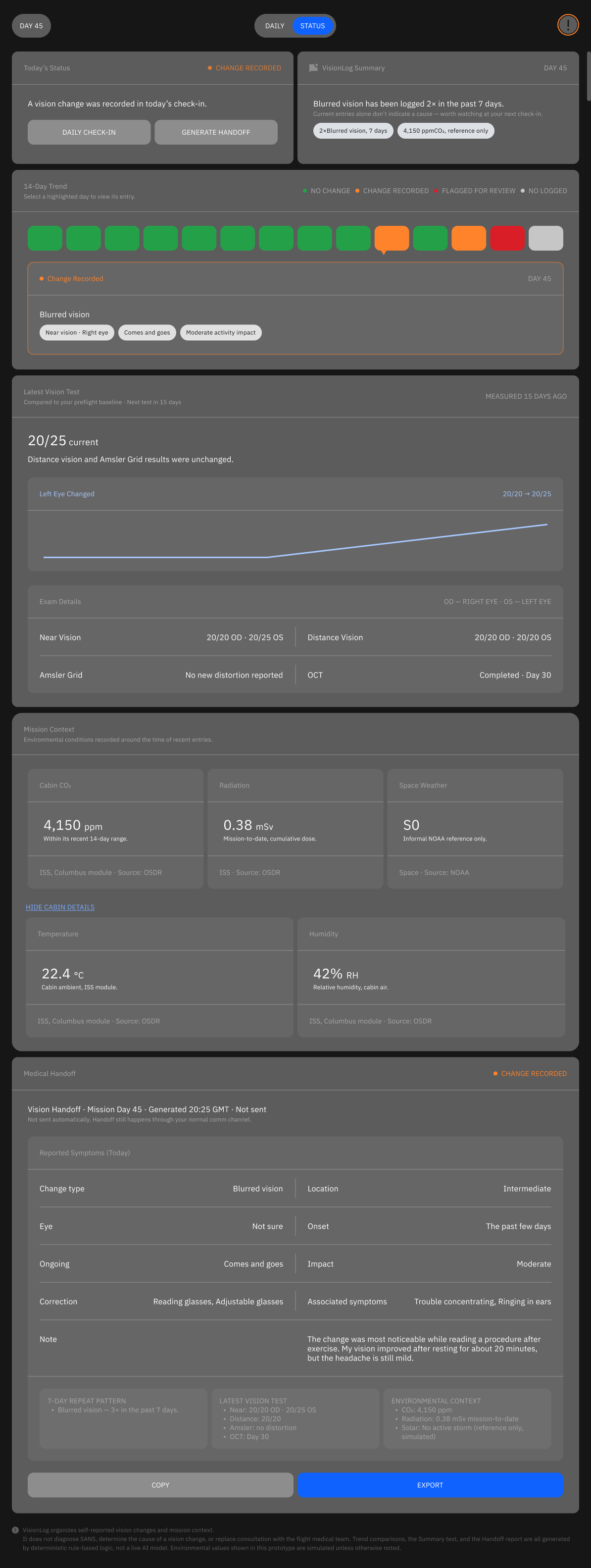
Astronauts can see what changed, what has repeated, and how recent observations compare with their personal baseline.
Environmental measurements such as carbon dioxide, temperature, humidity, and radiation are displayed only as mission context—not as evidence that they caused a medical change.
Dashboard & Medical Handoff
The Dashboard transforms these records into a single review-ready picture.
It brings together current observations, recurring patterns, baseline differences, recent examinations, mission context, risk signals, missing information, and relevant NASA evidence.
Verified information can also be translated into a clearer explanation and organized into a structured medical handoff for human review.
VisionLog does not diagnose medical conditions, recommend treatment, or infer unsupported causal relationships.
The goal is simple:
Help humans communicate better when distance makes communication harder.
AI organizes. Humans decide.
How we built it
We designed VisionLog around an important principle: in a safety-sensitive system, not every decision should be made by AI.
Our prototype uses:
- Next.js + TypeScript for the frontend
- FastAPI + Python for the backend
- IBM Granite for grounded natural-language explanations
- IBM Bob as an AI development partner
- NASA research and OSDR data for scientific evidence and historical mission context
The core workflow is:
Structured Check-In → Deterministic Safety & Completeness Rules → Personal Baseline + Exams + NASA Evidence + Mission Context → Grounded Explanation → Dashboard & Medical Handoff
We deliberately separated safety-critical logic from generative AI.
Risk signals, completeness checks, and baseline comparisons are handled through explicit application logic. Relevant evidence is retrieved separately, and only verified structured information is provided to the language model.
The generative layer is therefore responsible for communication, not medical judgment.
IBM Granite helps translate verified information into understandable language. It does not determine a diagnosis, recommend treatment, or independently establish medical causation.
IBM Bob supported development of the application's initial architecture and project structure and was also used to refine the check-in-to-handoff workflow, review AI safety guardrails, improve completeness logic, and support regression testing.
This architecture allowed us to use AI where it could improve human understanding while keeping safety-sensitive decisions explicit and testable.
Challenges we ran into
Designing for a situation we cannot personally experience
One of our biggest challenges was designing for astronauts without pretending that we fully understand what it is like to receive medical support during a space mission.
Instead of inventing an entirely new medical process, we grounded the prototype in publicly available NASA research on in-flight vision assessment, spaceflight-associated vision changes, environmental monitoring, and medical autonomy.
We treated VisionLog as an exploration of how those existing practices could become easier to interact with and review—not as a replacement for NASA's medical systems.
Deciding where AI should not be used
Another major challenge was determining where AI should stop.
A language model could theoretically be asked to interpret symptoms, determine risk, or suggest what an astronaut should do next.
We intentionally chose not to do that.
Safety-sensitive behavior remains deterministic, while generative AI is limited to explaining information that has already been verified.
This became one of the most important design principles of the project:
AI should reduce information friction without replacing human medical judgment.
Showing context without implying causation
We also wanted astronauts and reviewers to understand the conditions surrounding an observation.
Historical NASA OSDR data can provide environmental context, but displaying environmental measurements next to medical observations creates a serious UX challenge: proximity can easily be mistaken for causality.
We therefore explicitly label environmental information as reference context and prevent the AI layer from presenting correlations as medical causes.
Balancing completeness with human effort
A medical record becomes more useful when it is complete, but asking too many questions creates cognitive burden.
We therefore designed two paths.
When nothing has changed, the check-in can finish quickly. When something has changed, the interaction progressively collects the information needed to create a more complete record.
The goal was not to collect the maximum amount of data.
It was to collect the right information with the least unnecessary effort.
Accomplishments that we're proud of
We are proud that VisionLog developed from a human-centered question into a working end-to-end prototype.
The system demonstrates a connected journey from an astronaut noticing a small change to creating structured information that can later support human medical review.
We are particularly proud of several design decisions:
- A fast check-in path when nothing has changed
- Structured capture when a vision change is reported
- Personal baseline and longitudinal comparison
- Explicit deterministic safety logic
- Clear separation between environmental context and medical causation
- Traceable NASA evidence
- Visible missing information rather than AI-generated assumptions
- Structured medical handoff for human review
Most importantly, we did not design VisionLog around the idea that more AI automatically creates a better product.
We designed it around a different principle:
The most responsible use of AI sometimes begins by defining what AI should not decide.
What we learned
VisionLog taught us that human-centered design becomes even more important when technology is operating far from ordinary human support systems.
In deep space, the problem is not simply whether information exists. The questions are whether the right information was captured, whether another person can understand it, whether its origin can be traced, and whether uncertainty remains visible.
We also learned that a single observation can mean very little without personal and temporal context.
“Blurred vision today” is one piece of information.
Knowing that it is new relative to an astronaut's baseline, has occurred repeatedly during the past week, affects a particular viewing distance, and has a moderate impact on mission activities creates a much more useful record.
Finally, we learned that responsible AI does not necessarily mean giving AI more autonomy.
For VisionLog, we defined the relationship differently:
The astronaut provides the observation.
Space and research data provide the context and evidence.
AI helps organize and explain the information.
Humans make the medical decision.
What's next for VisionLog
VisionLog is currently a prototype, so our most important next step is not adding more AI—it is validation with people who understand the environment.
We would like to work with aerospace medicine and human-factors experts to evaluate whether the check-in structure, safety rules, longitudinal views, and medical handoff align with real astronaut and flight-medical workflows.
Future versions could:
- Connect to mission-specific environmental data feeds
- Support longitudinal records across multiple missions
- Expand integration with baseline and scheduled vision examinations
- Improve evidence retrieval as new space-health research becomes available
- Test the workflow under realistic communication-delay scenarios
- Explore integration with future exploration medical systems
- Study how the interaction should change under stress, fatigue, and limited connectivity
The underlying idea may also extend beyond spaceflight.
VisionLog explores a broader human challenge: How can we help people communicate meaningful health changes when immediate access to an expert is limited?
The same human-centered principles—structured observation, personal baselines, visible uncertainty, responsible AI, and clear human handoff—could eventually inform tools for other remote and resource-constrained environments.
Our goal is not to replace physicians or existing medical systems.
It is to help make small changes easier to document, patterns easier to recognize, and important information easier for another human to understand.
Track vision changes. Stay mission-ready.
Built With
- css
- fastapi
- granite
- nasa
- next.js
- python
- react
- tailwind
- typescript
- watsonx.ai


Log in or sign up for Devpost to join the conversation.