Why I'm building this
I'm a solo founder in Egypt, and I'm not a designer. I opened a print-on-demand shop on Fourthwall the way millions of people do, and it sat there with no sales. The shop was easy. The decisions were hard: what to make, for whom, and who should see the ad. Every one of them was a guess, and the ad spend is where the guesses cost money.
I built wovain for people like me: anyone who wants to sell apparel and has no researcher, no designer and no media buyer. The goal is a profitable product within an hour of starting, made with the playbook an experienced seller would use. A few friends who are graphic and fashion designers tried early versions, and their feedback shaped the product.
The problem
Printify reports more than 8 million sign-ups and about 2 million merchants. Most of the people who sign up never become merchants, and the ones who do still have to guess.
The math is unforgiving. A $29 tee on Fourthwall leaves about $16 after the blank and card fees, so an ad can cost at most $16 per sale before the shop loses money. The median Meta cost per purchase for apparel is about $37. A seller who guesses at the median loses about $20 on every shirt they sell. Better ad buttons won't fix that. The fix is making something a specific audience already wants and showing it to that audience.
Big brands have the same problem at a larger scale. They forecast what each audience will want, produce in bulk months ahead, and discount or write off what doesn't sell.
The insight
Taste can be measured before anything is made. Qloo's taste graph knows what an audience loves across music, film, TV, brands and places, which of those things are rising with them, how old they are and where they live.
An LLM alone only sounds right. Ask one what dark academia fans want on a shirt and it says "gothic library arches", which matches nothing anyone measured. We tested this. On 8 seed audiences, LLM-only themes were grounded in measured taste 0 times out of 8. With Qloo, 6 of the 8 seeds matched real taste data, with an average of 34 style cues and taste from 2.6 other domains per seed.
So wovain lets Qloo make the decisions that cost money, and the agent does the work around them.
What wovain does today
You open wovain with no idea and no brand. The agent:
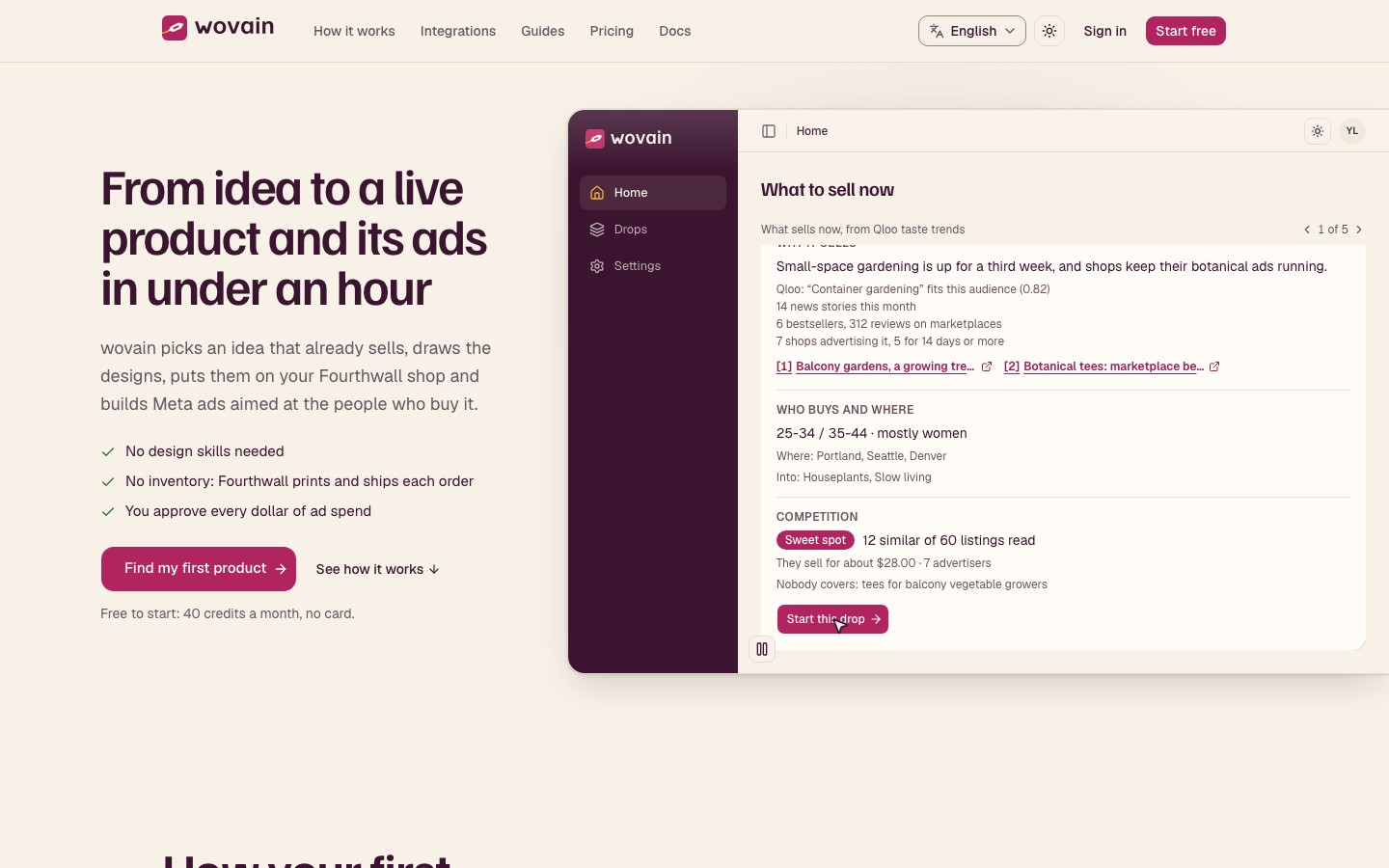
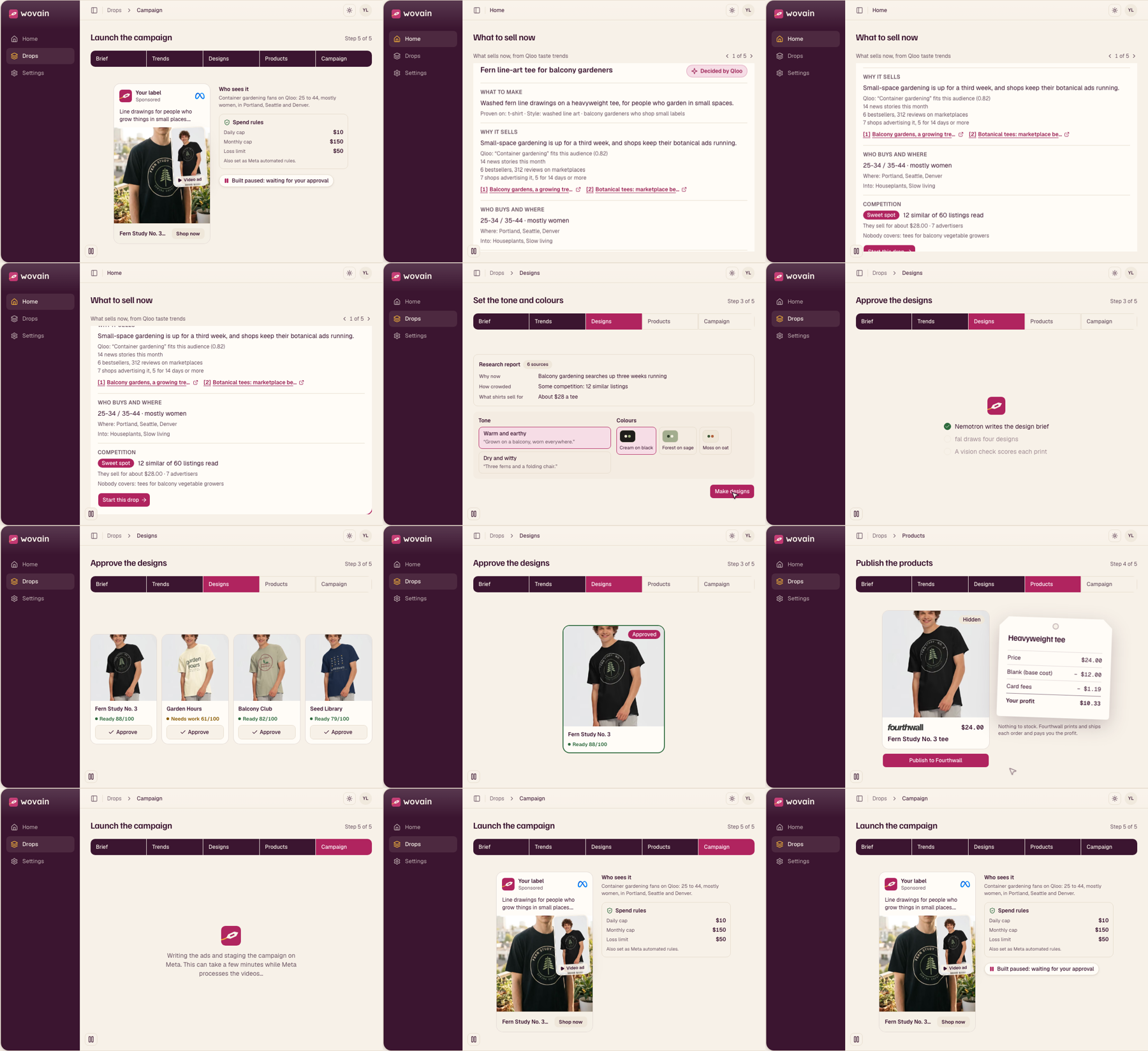
- Finds what to sell. It starts from a Qloo audience an apparel shop can sell to (Street Fashion, Vintage Apparel, Sneakerheads and 24 more). It asks Qloo which artists and TV shows are rising among those fans, and turns the tags they share into a theme.
- Checks that it sells. It looks for proof of demand: shops running Meta ads for 14 to 30+ days, marketplace bestsellers, and how crowded the market is. Ideas without Qloo evidence or without proof of demand are dropped, never shown.
- Shows who buys and where. Qloo's age and gender affinity, the audiences that like the idea most, the fashion brands they already buy, and their cities.
- Designs it. Qloo's tags pick the style of the capsule, and what the fans also love becomes the design cues. A vision judge checks the drawn art on the shirt before you see it.
- Lists it. Your approved design goes to your Fourthwall shop at a price that keeps your margin.
- Stages the ads. The ads are aimed at the same Qloo audience: ages, genders and Meta interests. They start only behind daily and monthly spend caps and a loss limit you set, and losing ads are stopped automatically.
You approve every product and every dollar of ad spend. Everything else runs on its own.
How Qloo runs the core
One Qloo audience flows through the whole drop. All calls go to https://hackathon.api.qloo.com from packages/core/src/qloo.ts.
- What is rising:
/v2/insightsfor artists and TV shows withsignal.demographics.audiencesandbias.trends=high(drop-directions.ts). - The theme and its style cues:
/v2/insightswithfilter.type=urn:tagon those rising entities. - Briefs and saved ideas resolved to entities and tag IDs:
/searchand/v2/tags. - Design cues from what fans also love: cross-domain affinities for brands, movies and TV shows.
- Who buys:
urn:demographicssets the ad set's ages and genders. 27 apparel audiences are scored withsignal.demographics.audiences.urn:entity:localityfinds the cities. Theurn:tag:genre:brand:fashionbrands show where the buyers already shop.
Take Qloo away and the product stops:
- a Qloo failure ends the run, with no LLM fallback;
- a brief Qloo can't place stops and keeps the user's credits;
- an idea without Qloo evidence is never shown;
- the ads lose their targeting.
Code does the ranking, not the model: Qloo affinity x proof of demand x how open the market is, with a Wilson lower bound so thin evidence can't outrank a proven idea. The model only writes titles and briefs. A grounding check rejects any claim it can't trace back to the evidence.
Where this goes: apparel on demand for big companies
Solo sellers are where we start. The company we're building is apparel on demand for brands, labels and entertainment companies with fan audiences.
A brand that can measure what each audience segment loves doesn't have to forecast and overproduce. It can run many small drops, one per segment, region or cultural moment. It holds no inventory, because every piece is made when someone orders it, and the ads go to the people Qloo says want it. Qloo makes that possible at company scale, because it answers "what does this segment love right now?" for every segment at once.
Print-on-demand was a $10.8 billion market in 2025, growing about 24% a year (Grand View Research). The bigger prize is the share of branded apparel that is made today on a guess.
Why now
Four things became possible at the same time:
- Image models now draw print-ready art from a brief.
- Print-on-demand makes and ships a single piece, so there's no minimum order.
- Ads platforms expose agent-ready APIs. Meta has an official Ads MCP, which wovain uses to build campaigns.
- Qloo opened its taste graph to agents.
A year ago one person couldn't have wired all four together. I built wovain in 12 days.
The moat
The models are rented, and every competitor can rent the same ones. The data we keep is our own.
Every drop stores the Qloo tag IDs and audience it came from next to what actually happened: listed, sold or retired. wovain already uses each seller's own outcomes to rank their next ideas. Across thousands of sellers, that becomes a map of which taste signals turn into sales for which audiences. An LLM-only competitor never gets that data, and every drop we run makes the next one better.
Business model
- Credits for the agent's work. A drop (research, three designs, ad copy) costs about 18 credits, and running one costs us about $0.45.
- Free: 40 credits a month.
- Studio: $29 a month for 300 credits.
- Label: $79 a month for 1,000 credits.
- Credit pack: 100 credits for $15.
- Gross margin is about 75% at typical use.
- A managed ad-spend band per plan. This is the most monthly Meta spend wovain's guardrails will run for you: $150 on Free, $1,500 on Studio, $7,500 on Label. We never take a percentage of ad spend, because that fee grows whether the spend makes money or not.
- Later, for large sellers: an opt-in share of verified net profit, once attribution is proven.
The path runs from creators to brands. Creators on Fourthwall come first, because they already have fans. Shopify, Printful and Printify follow and roughly quadruple the market we can serve. Brand workspaces come after that.
Traction, honestly
- Built fast: I built wovain in 12 days, from Oct 19 to Oct 30, with an agent-driven workflow. That's 891 commits and 214 merged pull requests, with tests that cover every provider.
- First live product: today wovain took one of its own Home ideas through to a product published live on a real Fourthwall shop, then staged that product's Meta campaign, paused, ready for the seller to launch.
- Bugs found in the real run: the run surfaced seven bugs that only show up with real accounts, and all were fixed the same day.
- Early testers: a few graphic and fashion designers from my network have tried wovain and given feedback that shaped the product.
- Earlier submissions: wovain was also entered in Nebius x NVIDIA's hackathon this week, where the same agent runs on NVIDIA Nemotron.
Beyond those testers, there are no users yet, no paying users and no revenue. Only the Free plan is offered, because paid plans need a commercial Qloo licence.
The next milestone is the number that decides this company: the profitable-drop rate. It is the share of guarded ad tests that earn more than they spend. The plan:
- Week 1 after the hackathon: the first live campaign.
- Then 10 sellers running real drops.
- Then the first drop that sells at a cost per sale below the $16 break-even.
The ask
The $25k turns a working agent into a company that can charge money:
- Incorporate, then pass Meta's Business Verification and App Review, so every seller (not just test users) can connect an ad account.
- Sign a commercial Qloo licence so paid plans can open.
- Fund guarded ad tests with the first 10 to 20 sellers, to measure the profitable-drop rate on real money.
- Build the Shopify and Printify connector and the first brand pilot.
I'm looking for an investor who wants to own the taste layer of on-demand apparel before the big brands build their own.
Built With
- fal
- fourthwall
- google-cloud-run
- inngest
- mastra
- meta-marketing-api
- nebius
- next.js
- nvidia-nemotron
- postgresql
- pulumi
- qloo
- tavily
- typescript

Log in or sign up for Devpost to join the conversation.