Inspiration
This project was inspired by real-world work in clinical AI systems at Penn Medicine.
A major challenge in healthcare is that critical deterioration often happens between patient visits. In conditions like diabetic foot ulcers, infections progress silently, and by the time they are detected, patients often require hospitalization or even amputation.
We wanted to explore how AI could provide continuous, interpretable monitoring — not to replace doctors, but to give them earlier, more actionable signals.
What it does
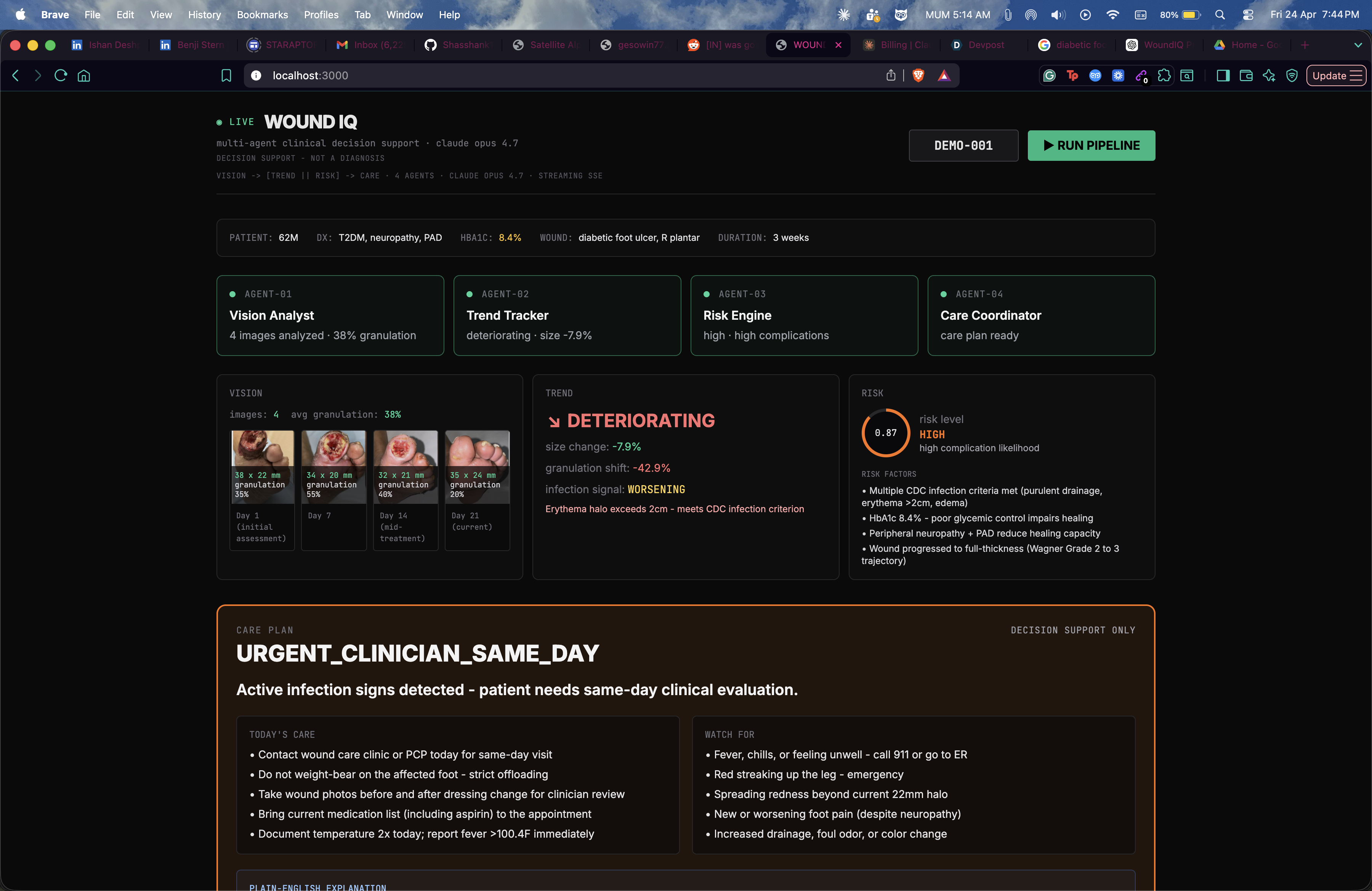
WoundIQ is a multi-agent AI system that analyzes wound images over time to detect early signs of infection and deterioration.
It takes a sequence of wound images and processes them through four specialized agents:
- Vision Analyst extracts clinical features from each image
- Trend Analyzer evaluates healing progression over time
- Risk Engine combines image signals with patient context to assess infection probability
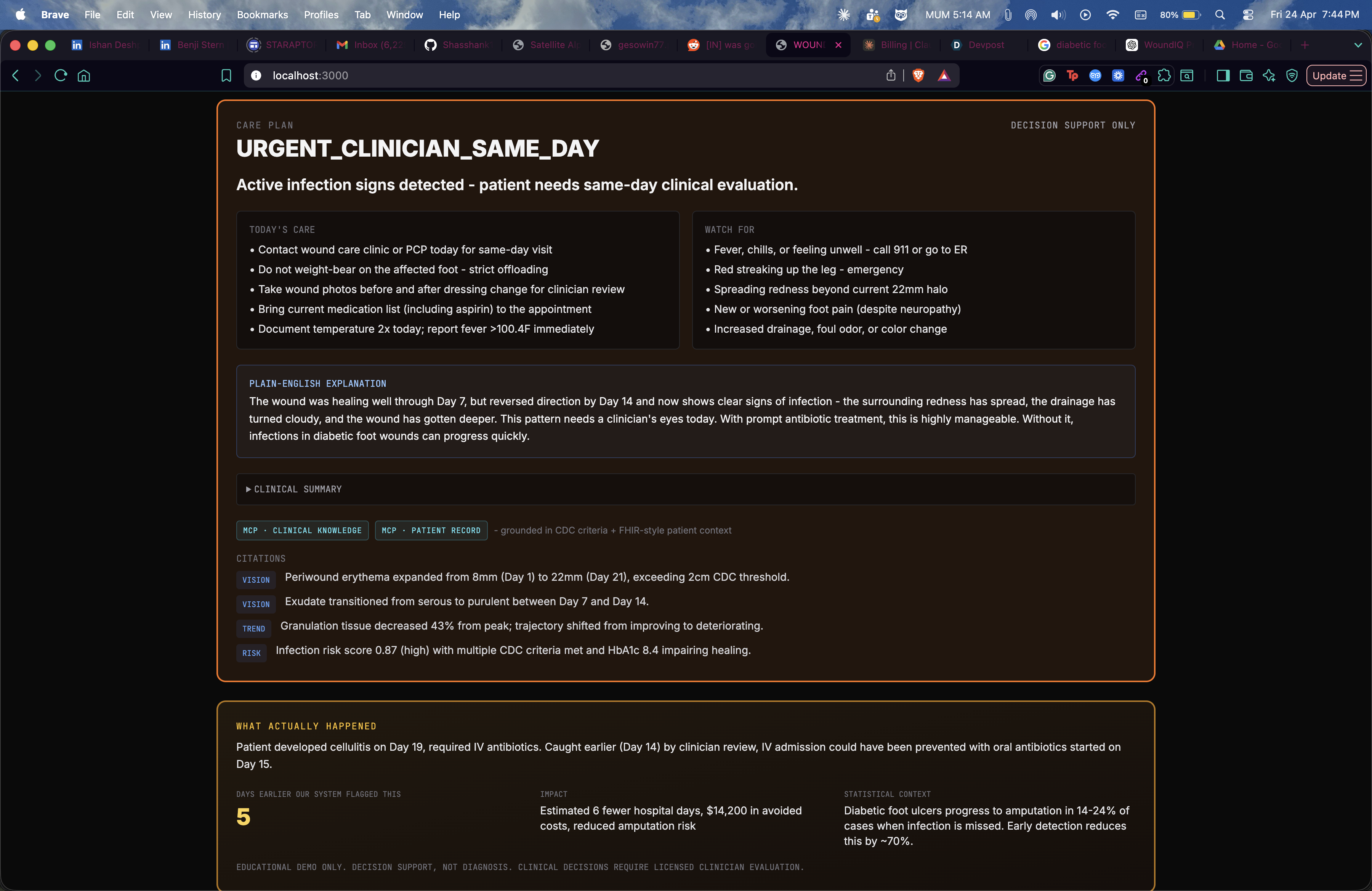
- Care Coordinator generates actionable, citation-backed care recommendations
The system flags high-risk cases earlier, helping clinicians intervene before complications escalate.
How we built it
WoundIQ is built using a multi-agent architecture powered by Claude.
The pipeline follows a dependency-aware execution flow:
Vision → (Trend ∥ Risk) → Care
- Claude handles multimodal reasoning across images and structured context
- Agents are modular and communicate via structured outputs
- Trend and Risk run in parallel to reduce latency
- Outputs are cached for deterministic demo performance
- The frontend is built in React and visualizes agent execution in real time
- Streaming responses simulate live inference
This design mirrors production AI systems with a focus on interpretability and composability.
Challenges we ran into
- Making outputs feel clinically realistic instead of generic AI responses
- Designing clear separation of responsibilities across agents
- Representing temporal progression in an intuitive way
- Balancing real-time behavior with demo reliability
- Sourcing believable medical progression data
Accomplishments that we're proud of
- Built a working 4-agent AI system with parallel execution
- Created a realistic clinical use case with measurable impact
- Delivered explainable outputs with citation-backed reasoning
- Designed a clean, intuitive UI that shows system reasoning clearly
- Shipped a full end-to-end prototype under tight time constraints
What we learned
- How to design and orchestrate multi-agent AI systems
- The importance of explainability in healthcare applications
- How to structure AI outputs for decision support
- Tradeoffs between performance, reliability, and realism
- How to communicate complex systems effectively
What's next for WoundIQ
- Integrate real-time patient data via FHIR APIs
- Expand to additional wound types and conditions
- Incorporate patient-reported signals like pain and temperature
- Replace cached outputs with live clinical knowledge retrieval
- Deploy as a clinician-facing monitoring dashboard
Our long-term goal is to enable earlier intervention and reduce preventable complications in chronic care.

Log in or sign up for Devpost to join the conversation.