-
-
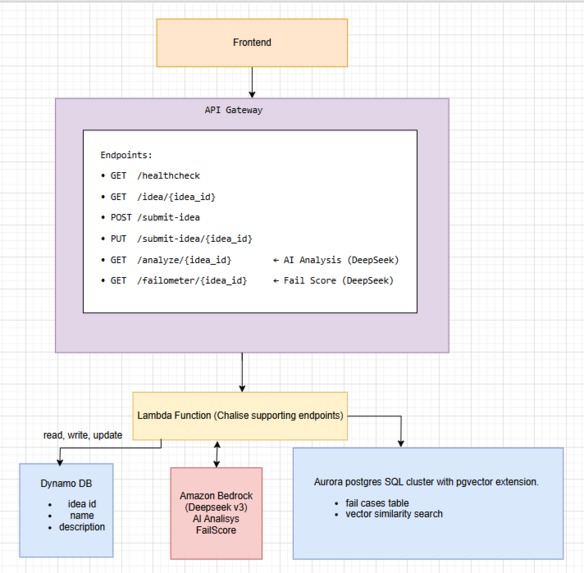
Architecture Diagram
Inspiration
We were inspired by the absurd optimism of startup culture — pitch decks full of buzzwords, AI promises, and hockey-stick graphs. What if we built a tool that didn’t just analyze business ideas, but predicted their glorious collapse? Business FailChecker was born to simulate failure with precision, humor, and backend rigor. It’s a love letter to vaporware, pivot fatigue, and the chaos of entrepreneurial ambition.
What It Does
Business FailChecker is a backend-powered web app that lets users submit startup ideas and receive structured, AI-assisted feedback on their likelihood of failure. It provides a playful but technically rigorous interface for exploring business viability through semantic analysis and similarity-based diagnostics.
Users can:
- Submit a business idea via a form (
POST /submit-idea) - Retrieve and update ideas (
GET /idea/{idea_id},PUT /submit-idea/{idea_id}) - Analyze the idea using a mocked agent response (
GET /analyze/{idea_id}) - View a failometer score that estimates risk based on idea traits and similar failed ventures (
GET /failometer/{idea_id})
The backend stores ideas in DynamoDB and enriches them with similarity data using a vector service. Fail scores are calculated using a custom AI module that considers both the idea’s content and its semantic proximity to known failure patterns.
The frontend is built with Angular and includes:
- A landing page
- A form for submitting and editing ideas
- Analysis and failometer views, each resolved via backend endpoints
This structure allows users to iteratively refine their ideas and explore how small changes affect their predicted risk — all while embracing the humor and chaos of startup culture.
How We Built It
- Backend: Python services deployed via Chalice, with modular architecture and reproducible workflows
- Infrastructure: Lambda functions wired to RDS PostgreSQL using VPC subnets, security groups, and Secrets Manager
- AI Layer: Bedrock DeepSeek model used to evaluate business ideas and generate failure narratives augmented with postgres db with vector database plugin.
- Frontend: A playful UI that lets users submit ideas and receive satirical feedback
Challenges We Ran Into
- VPC networking: Configuring Lambda to access RDS while still reaching Bedrock in
us-east-1required subnet routing, NAT access, and SG diplomacy - 504 debugging: Diagnosing timeouts taught us the importance of inbound rules and ENI permissions
- Multi-region latency: Calling Bedrock from
eu-north-1introduced delays, which we masked with humor and caching
Accomplishments That We're Proud Of
- Built a modular backend with clean repo hygiene and reproducible deployment
- Designed a satirical failure simulator that’s technically sound and emotionally cathartic
- Created a system that’s agentic, absurd, and extensible — ready for meme generation and user customization
What We Learned
- How to wire up Lambda-to-RDS connectivity using VPC, subnets, and IAM
- How to integrate Bedrock DeepSeek for semantic evaluation across regions
- How to structure a backend that balances satire with technical rigor
- That failure, when well-structured, is hilarious — and deeply educational
What’s Next for Business FailChecker
- AI-powered idea refinement: Users will get real-time suggestions to improve weak ideas based on failometer feedback.
- Meme generation: Titan + image synthesis will create satirical startup memes based on your idea’s failure traits.
- User login and idea catalog: Save, track, and revisit your startup attempts — both glorious and disastrous.
- Expanded failure modes: Incorporate user-submitted collapse scenarios and edge cases to enrich the analysis.
- Leaderboard of spectacular failures: Celebrate the most creative implosions with a public wall of fame.
- WebSocket integration for real-time agentic feedback

Log in or sign up for Devpost to join the conversation.