Inspiration
We all have moments when we ask ourselves: Should I go? Should I text them? Should I take a break? Is this actually worth it?
The problem is that the answer depends on more than the question itself. Your energy, mood, schedule, recent activities, and past experiences all matter.
We wanted to build something that understands that context instead of making users explain everything every time they need advice.
That idea became Worth It — an AI-powered decision companion that learns from your daily context and helps you decide what is actually worth your time and energy.
What it does
Worth It creates a personalized experience around the user's daily life.
When a user first joins, they complete a short 8-question onboarding survey that gives Worth It an initial understanding of their personality and social preferences.
From there, the app brings together several features:
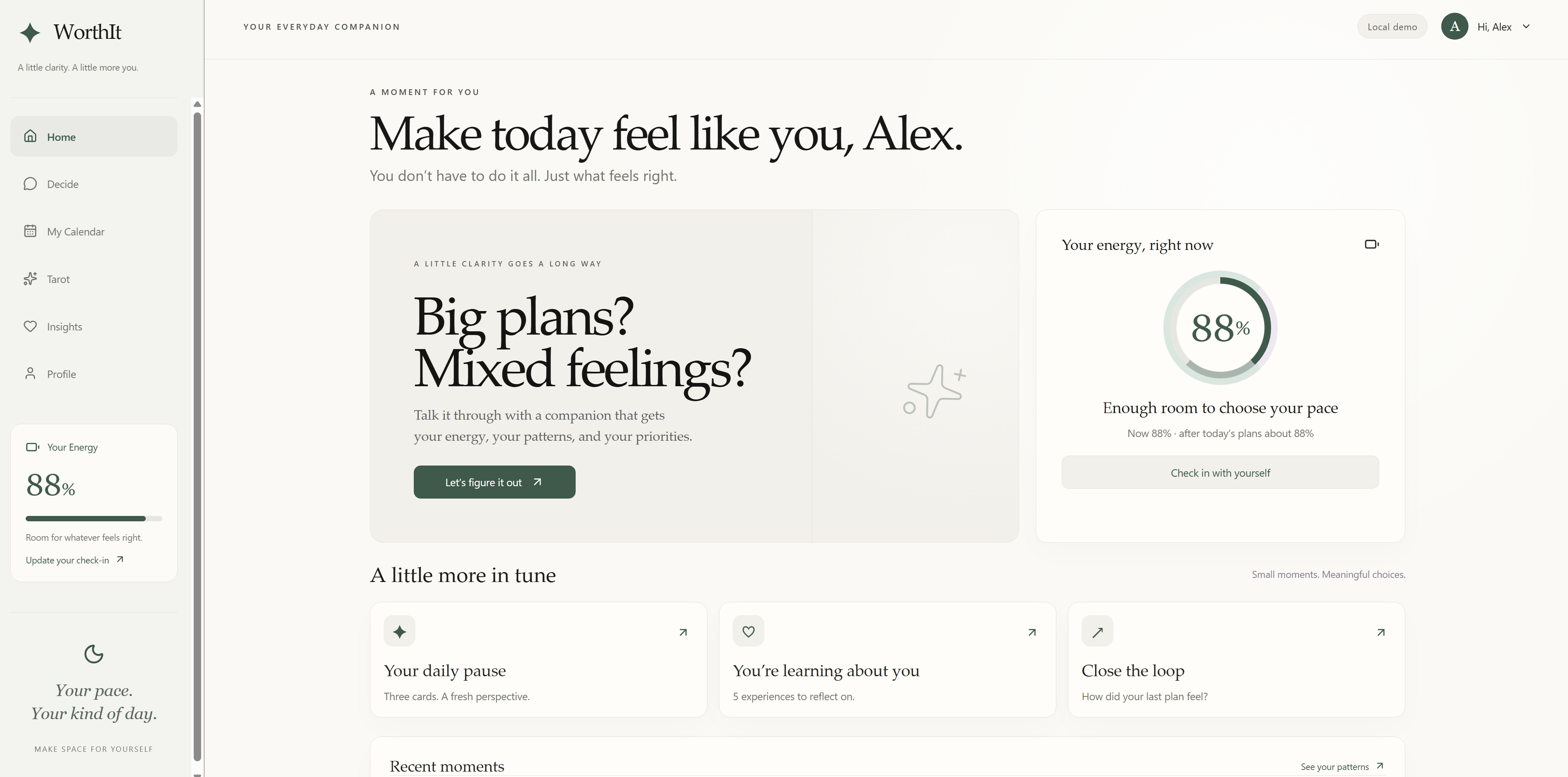
- Adaptive Social Battery estimates the user's current social energy based on their activities and personal context.
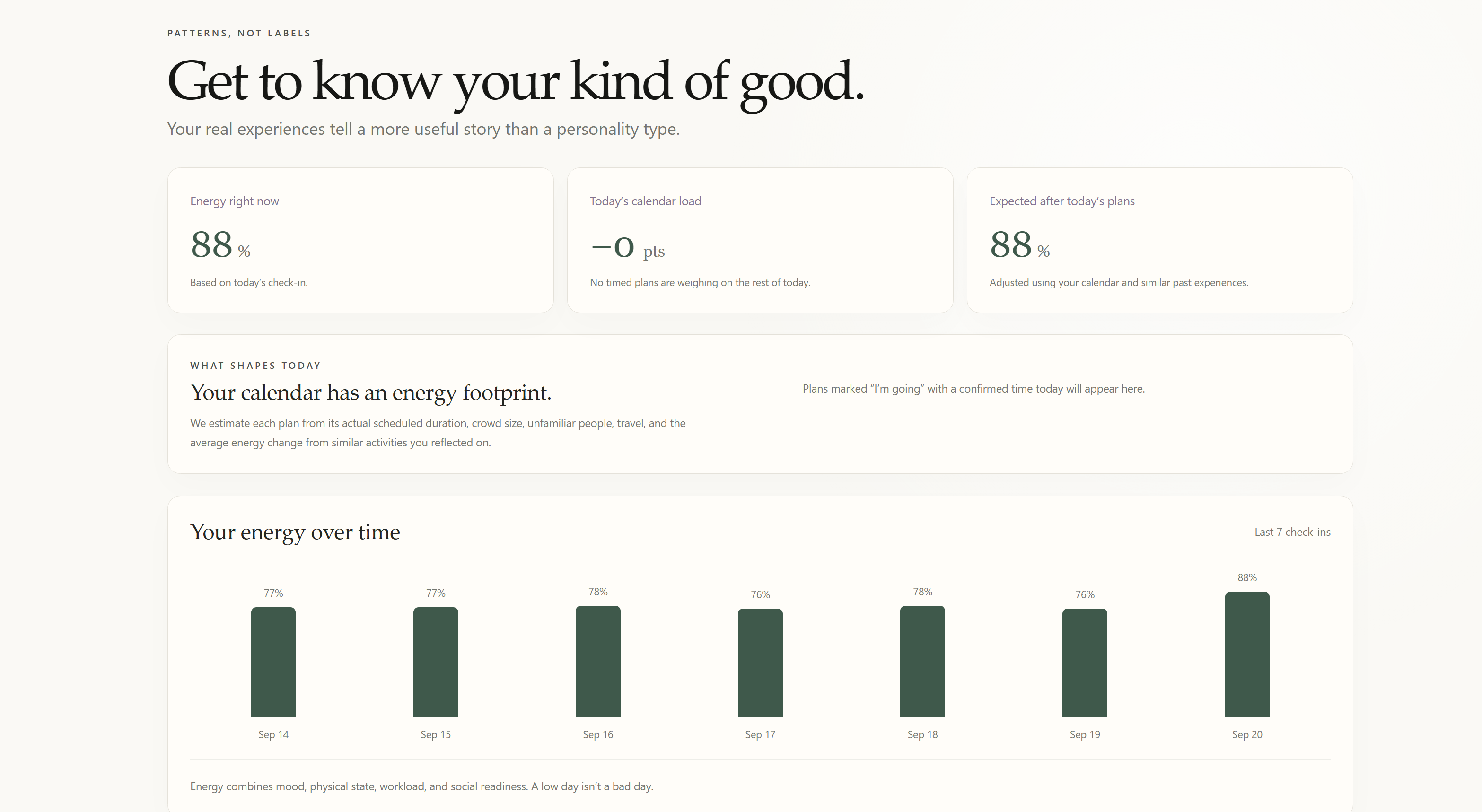
- Calendar & Energy Forecasting helps users understand how upcoming activities may affect their energy.
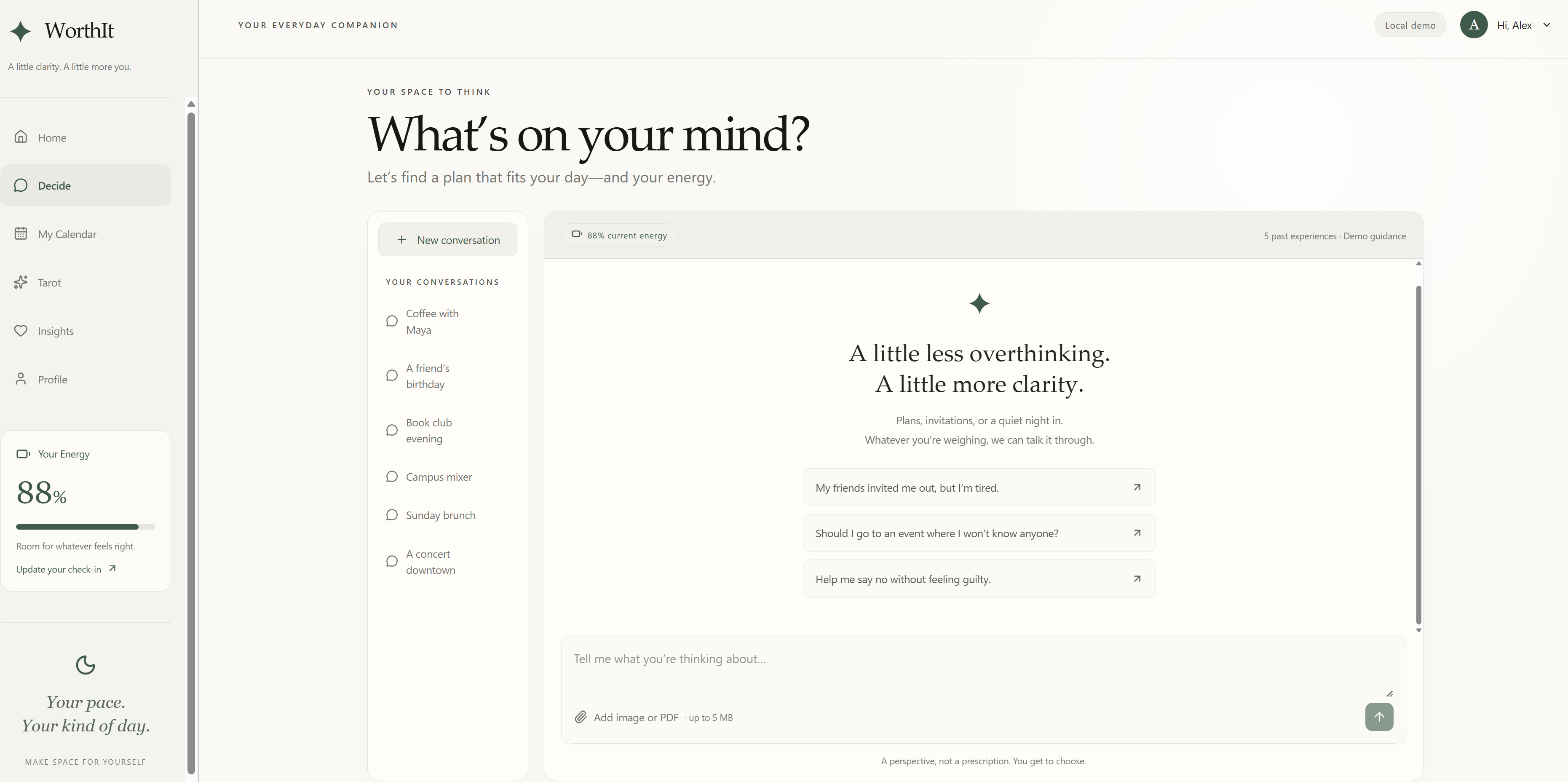
- What Should I Do? is our AI decision companion. Users can describe a situation and receive guidance based on their personal context instead of just the latest prompt.
- Multimodal Input allows users to provide additional context through text, images, and PDFs.
- Outcomes & Insights use previous experiences as context for future decisions.
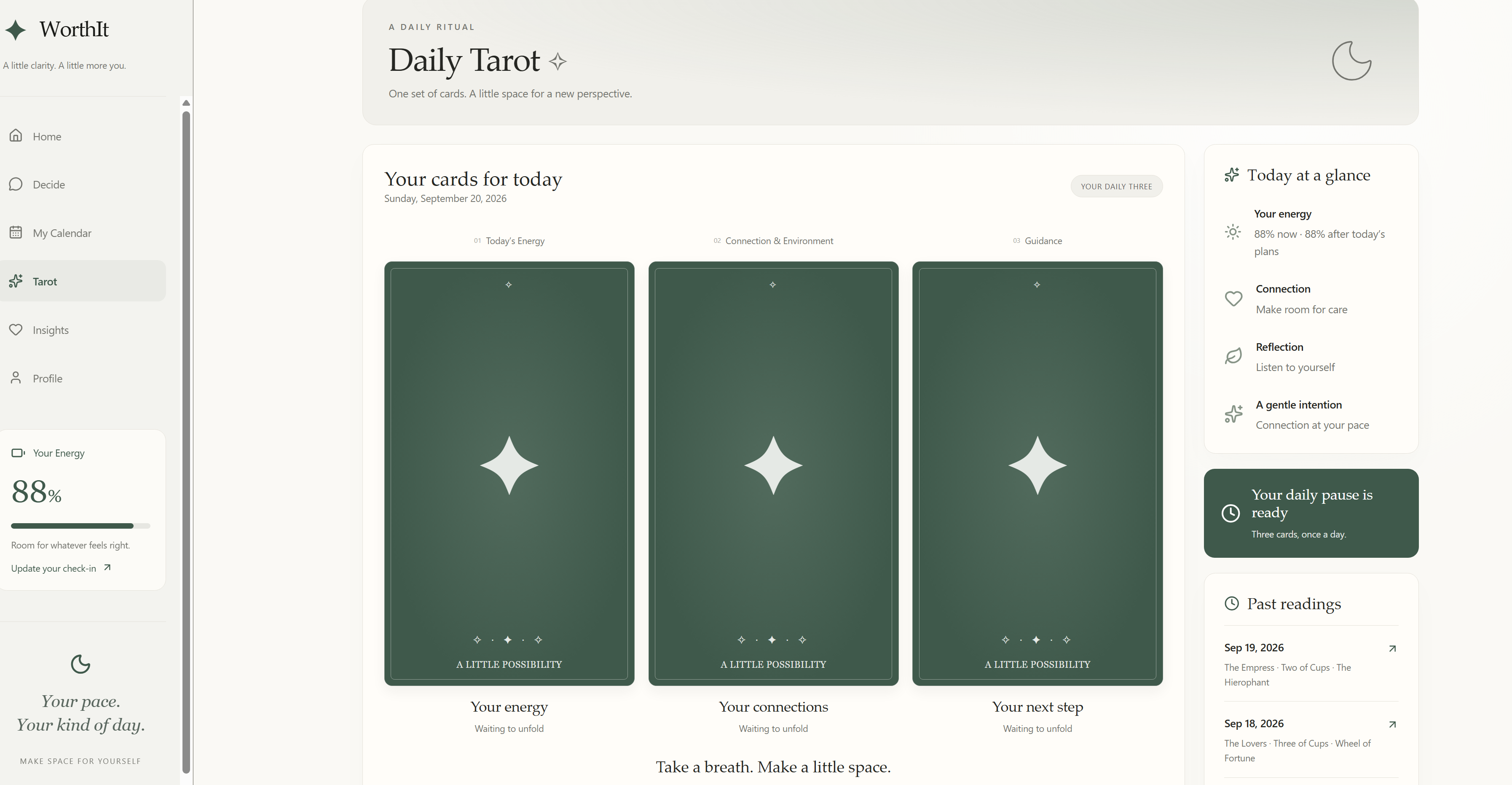
- Daily Tarot provides a fun three-card experience for daily reflection.
Together, these features turn Worth It into more than a chatbot. It becomes a personalized system that can understand what has been happening in your life before helping you decide what to do next.
How we built it
Worth It is built as a full-stack web application using Next.js, React, TypeScript, and PostgreSQL.
For our AI system, we integrated NVIDIA Nemotron 3 Nano Omni 30B A3B through NVIDIA NIM. Our inference environment runs using NVIDIA Brev on an NVIDIA L40S GPU.
The core idea behind our AI architecture is context.
Instead of sending only:
"Should I go?"
Worth It can provide the model with relevant information about the user, such as their recent activities, current social energy, personal preferences, and other available context.
This allows the model to reason about the situation with a much better understanding of the user.
Challenges we ran into
One of our biggest challenges was context management.
Giving the AI too little information results in generic answers, but giving it everything creates unnecessary noise. We had to think carefully about what information was actually relevant to each decision.
We also faced the cold-start problem. Worth It becomes more useful as it learns from a user's history, but a brand-new user has no history yet. Our onboarding process helps establish an initial baseline so the application can begin providing personalized experiences immediately.
Another major challenge was integrating our web application with GPU-hosted AI inference. Connecting the frontend, backend, database, user context, and NVIDIA-powered model into one working system required us to solve problems across multiple parts of the stack within a limited hackathon timeframe.
What we learned
One of our biggest lessons was that building an AI product is about much more than adding a chatbot.
The model matters, but context matters just as much.
We learned how to structure user information, connect a full-stack application with GPU-based AI inference, work with NVIDIA's AI ecosystem, and design an experience where AI becomes part of the application rather than the entire application.
Most importantly, we learned how quickly an idea can evolve when a team continuously builds, tests, and improves it.
What's next
We want Worth It to become increasingly personalized over time.
Future versions could identify longer-term patterns in mood and social energy, improve energy forecasting, learn more from previous decisions and outcomes, and give users greater control over what information the AI remembers and uses.
We also want to expand integrations with calendars and other sources of daily context so Worth It can understand a user's day with less manual input.
Our goal is simple: when you're stuck between choices, Worth It should already understand enough context to help you answer one question:
Is it worth it?
Built With
- conda
- nemetron
- next.js
- node.js
- npm
- postgresql
- react
- typescript


Log in or sign up for Devpost to join the conversation.