-
-
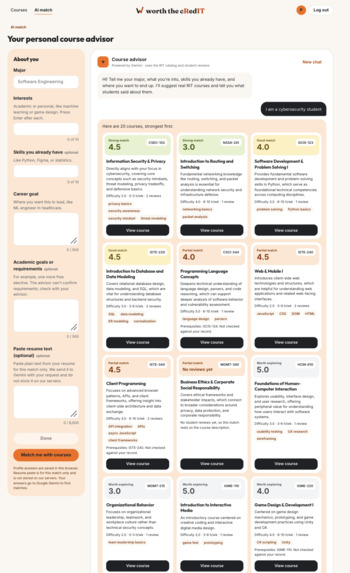
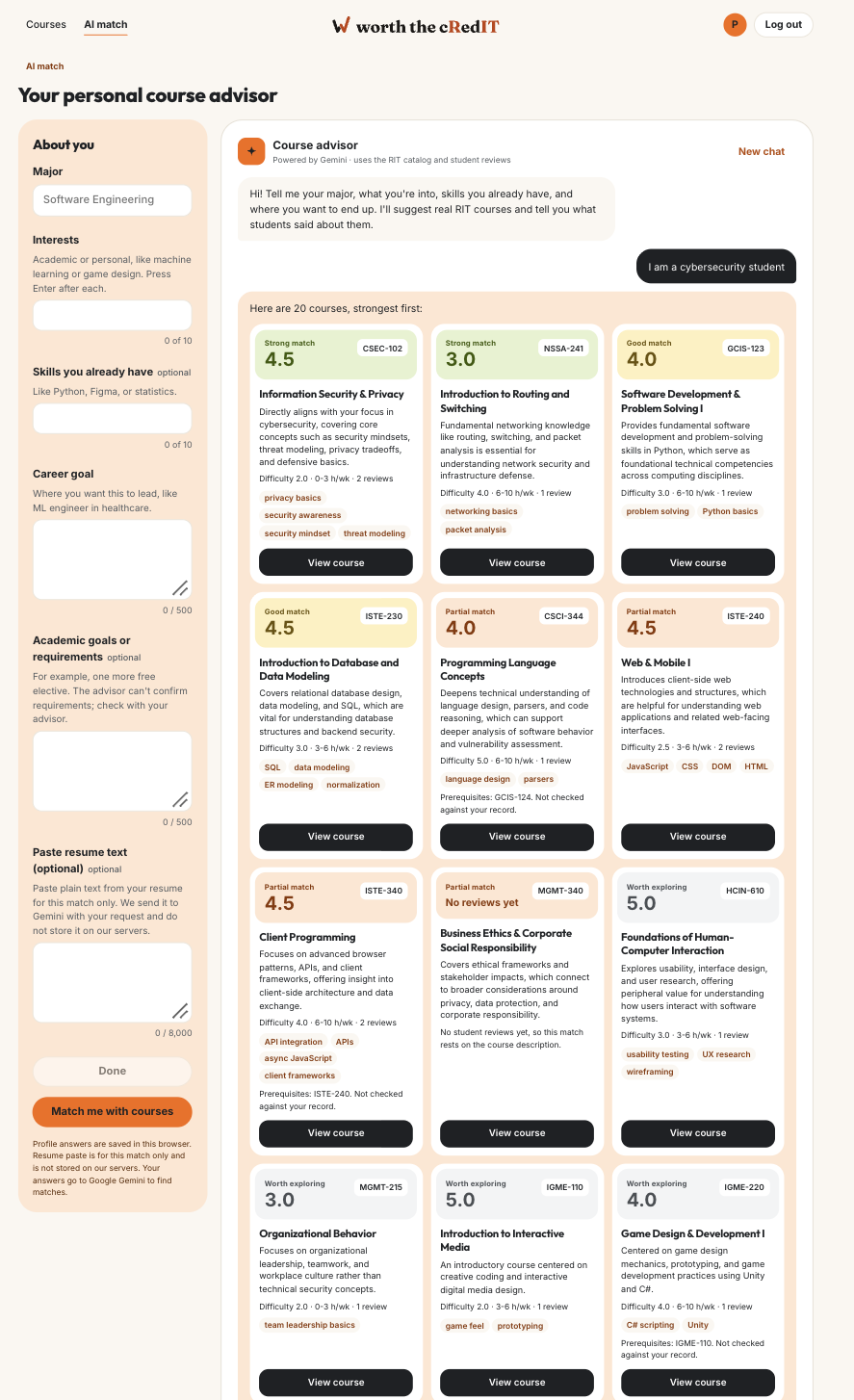
Displays the AI Advisor suggesting a student using their major.
-
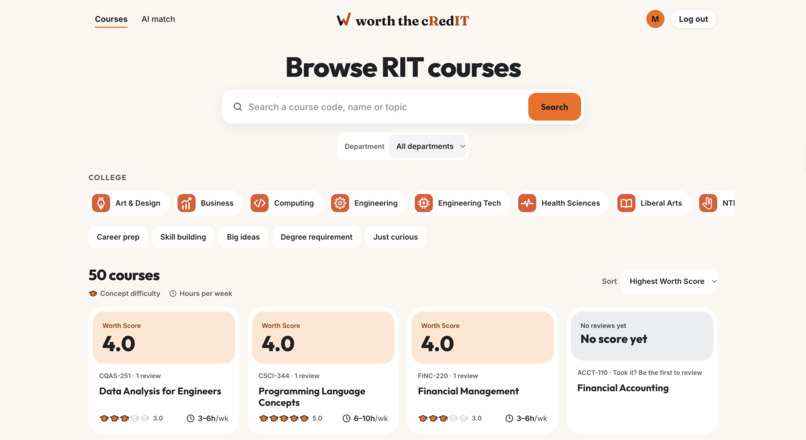
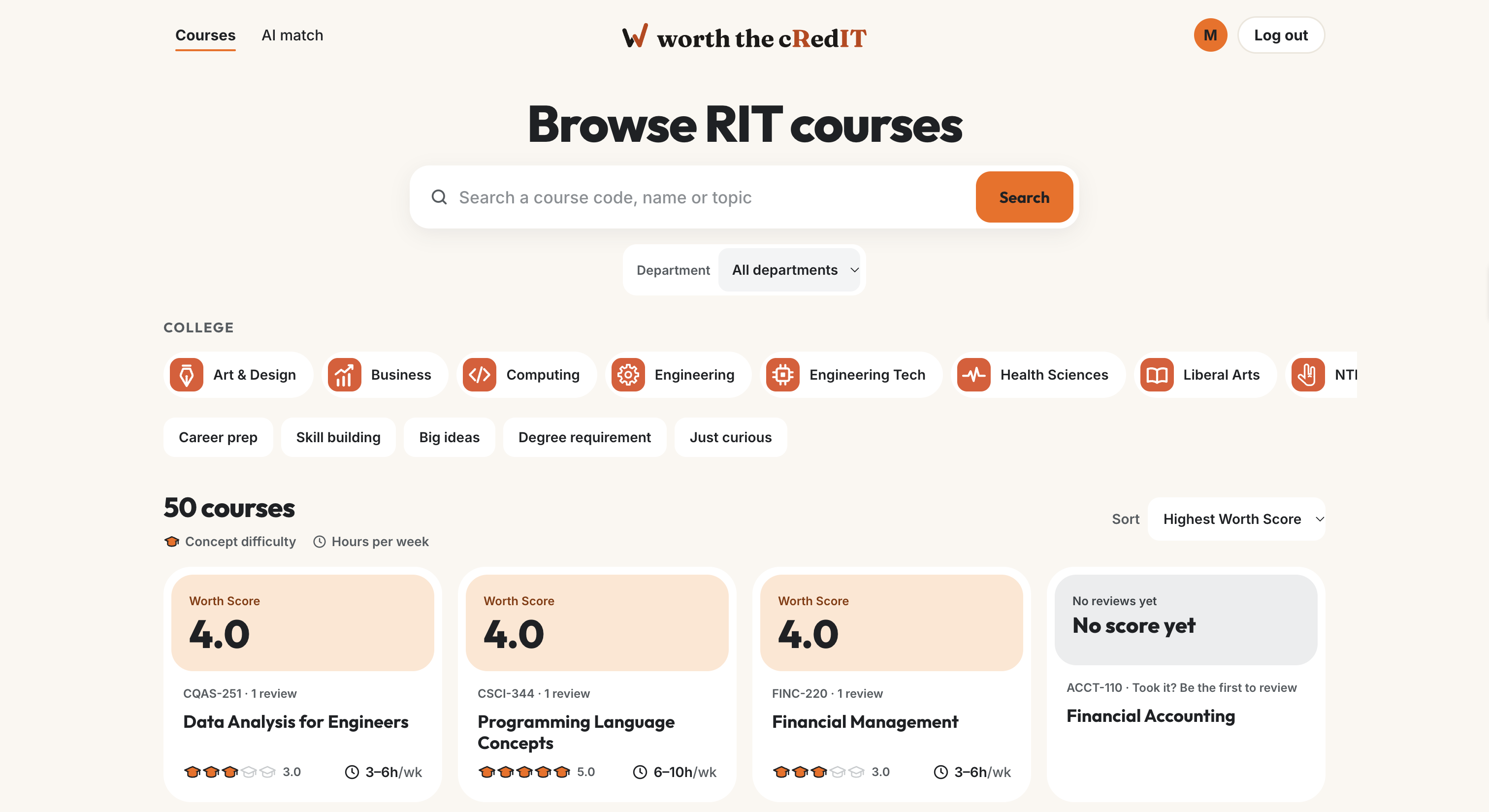
Displays the search system and how courses are sorted.
-
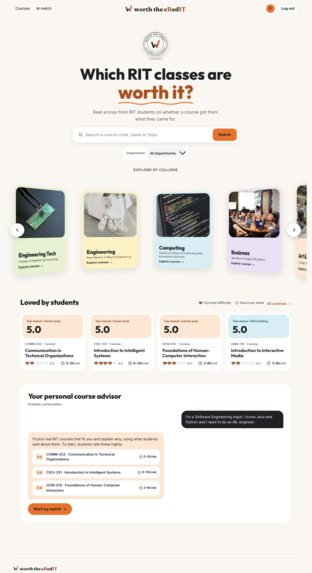
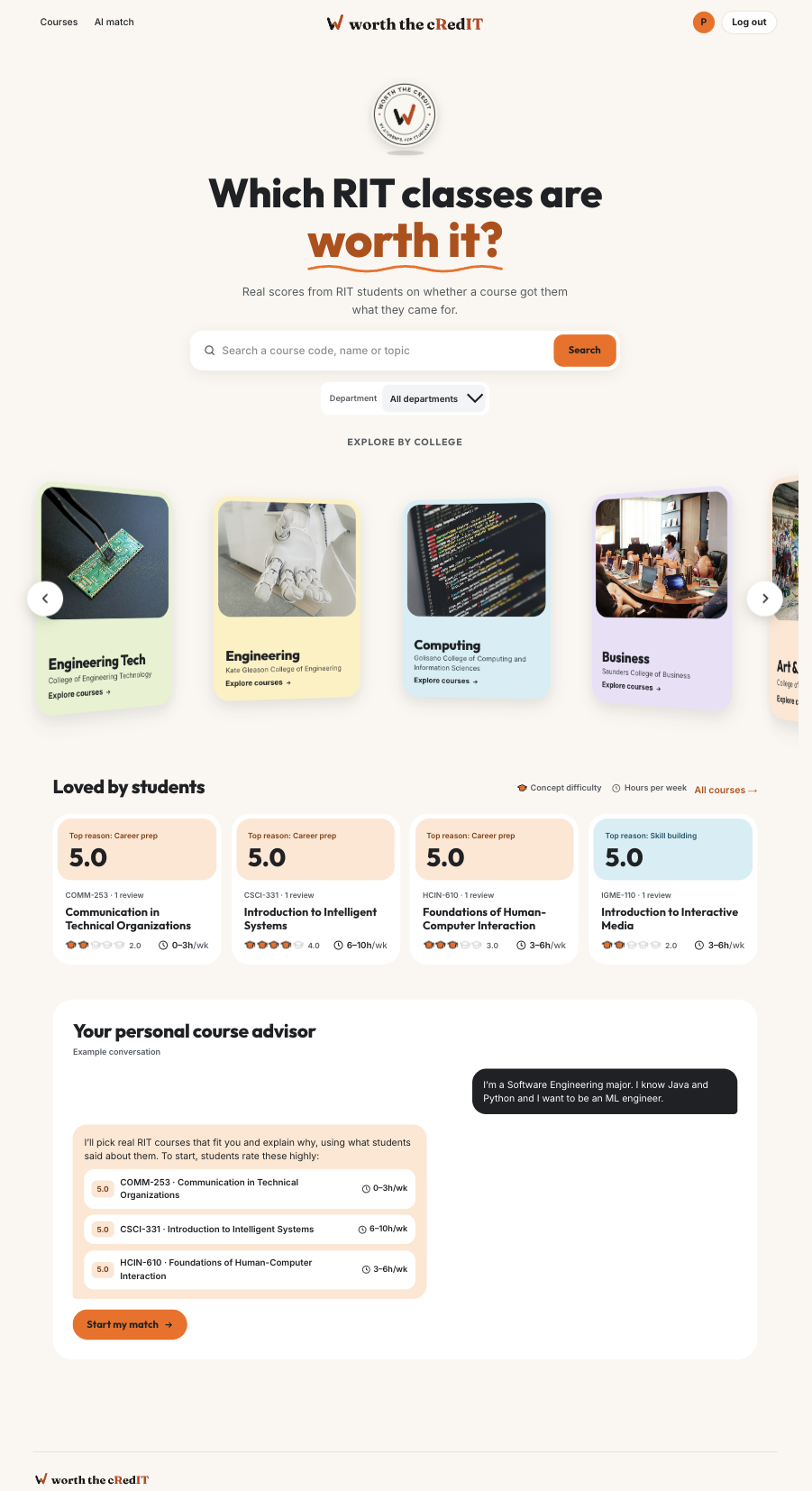
This is the main Dashboard upon a users arrival.
-
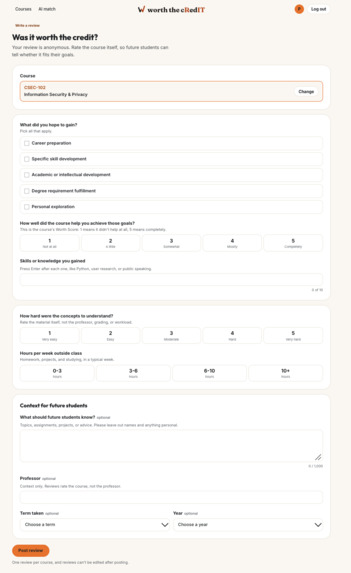
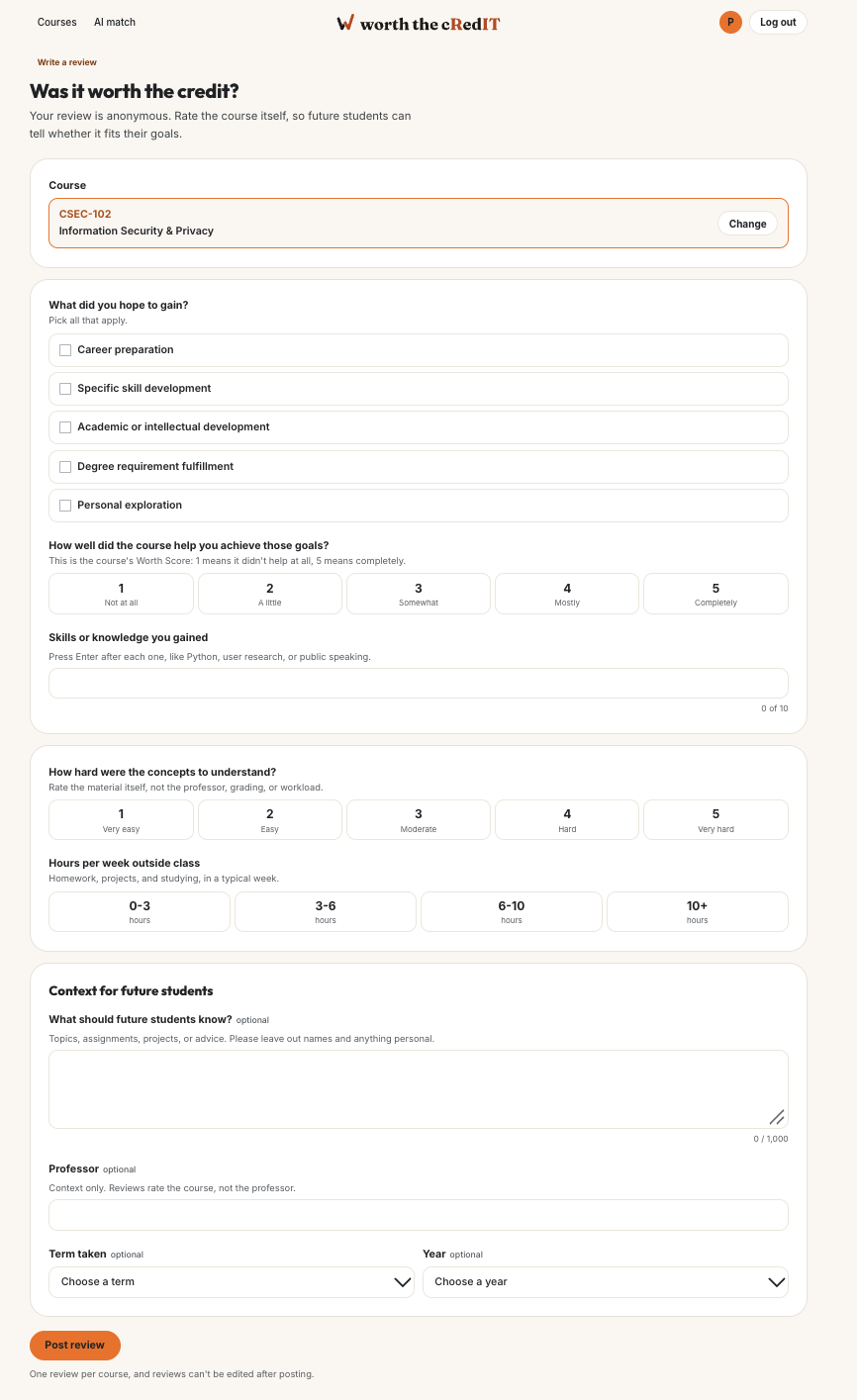
This is the form students write their reviews for the courses.
-
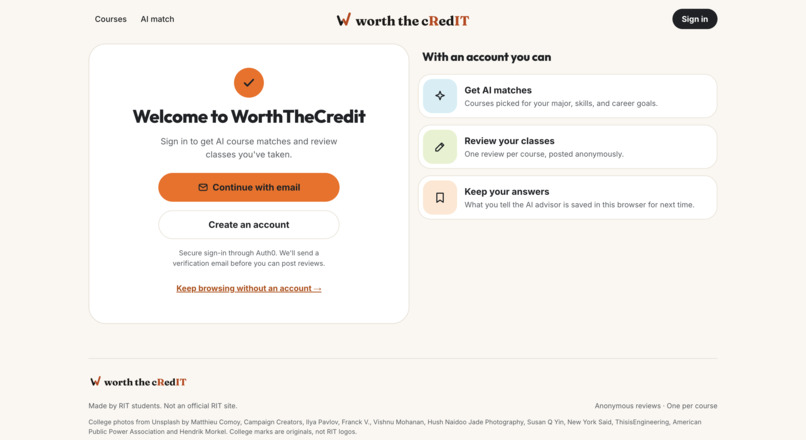
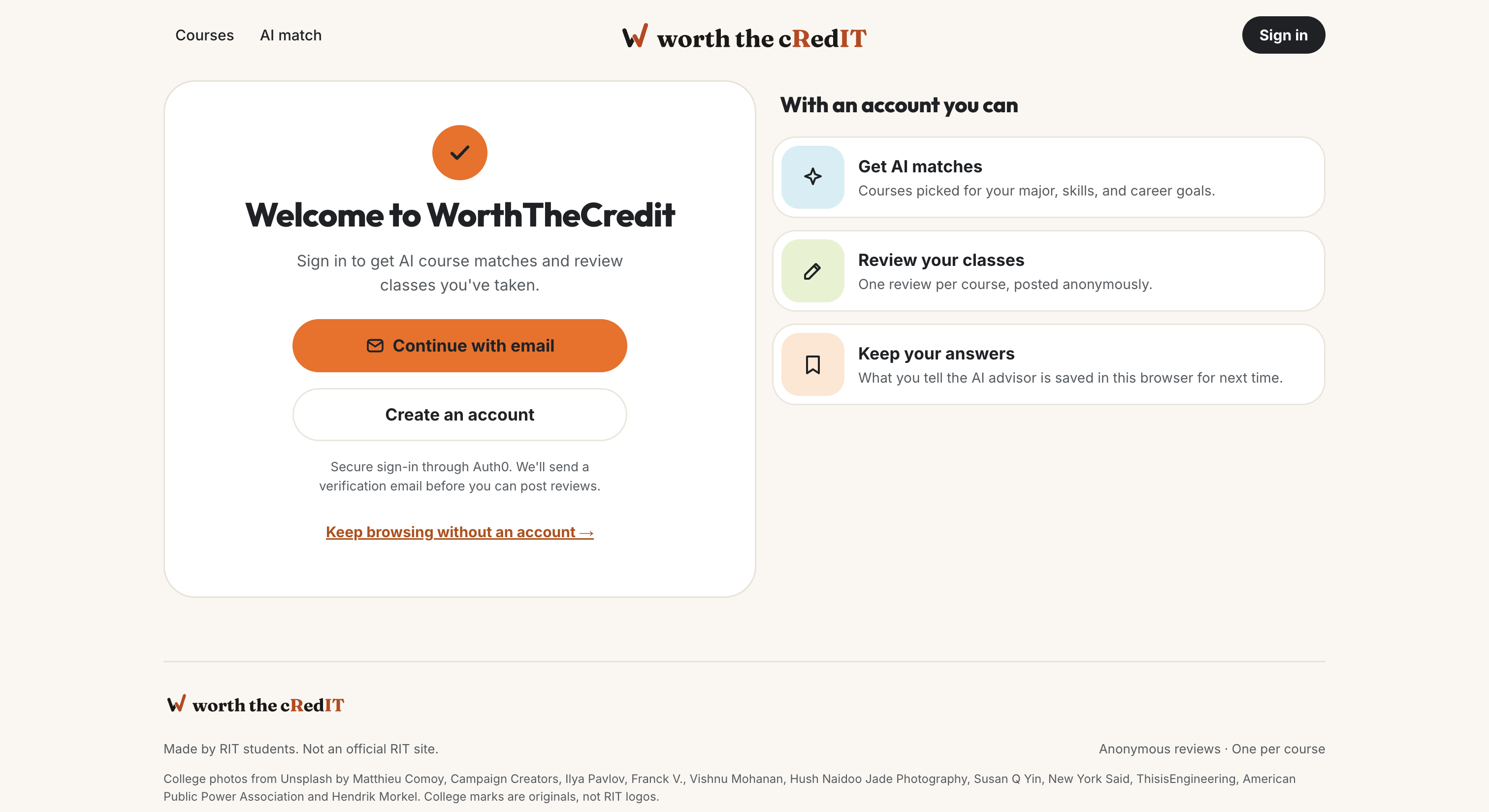
This is the login/sign in page.
-
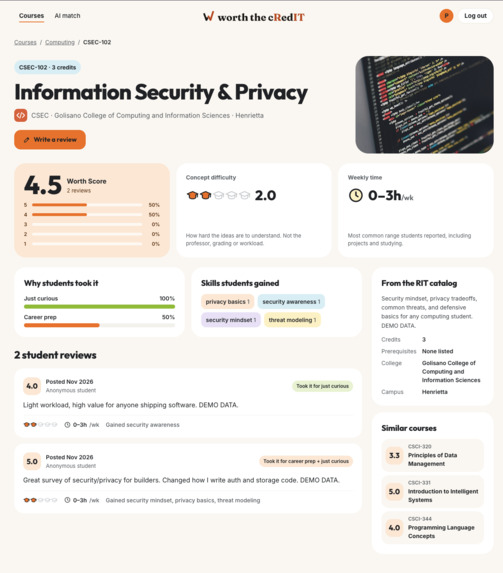
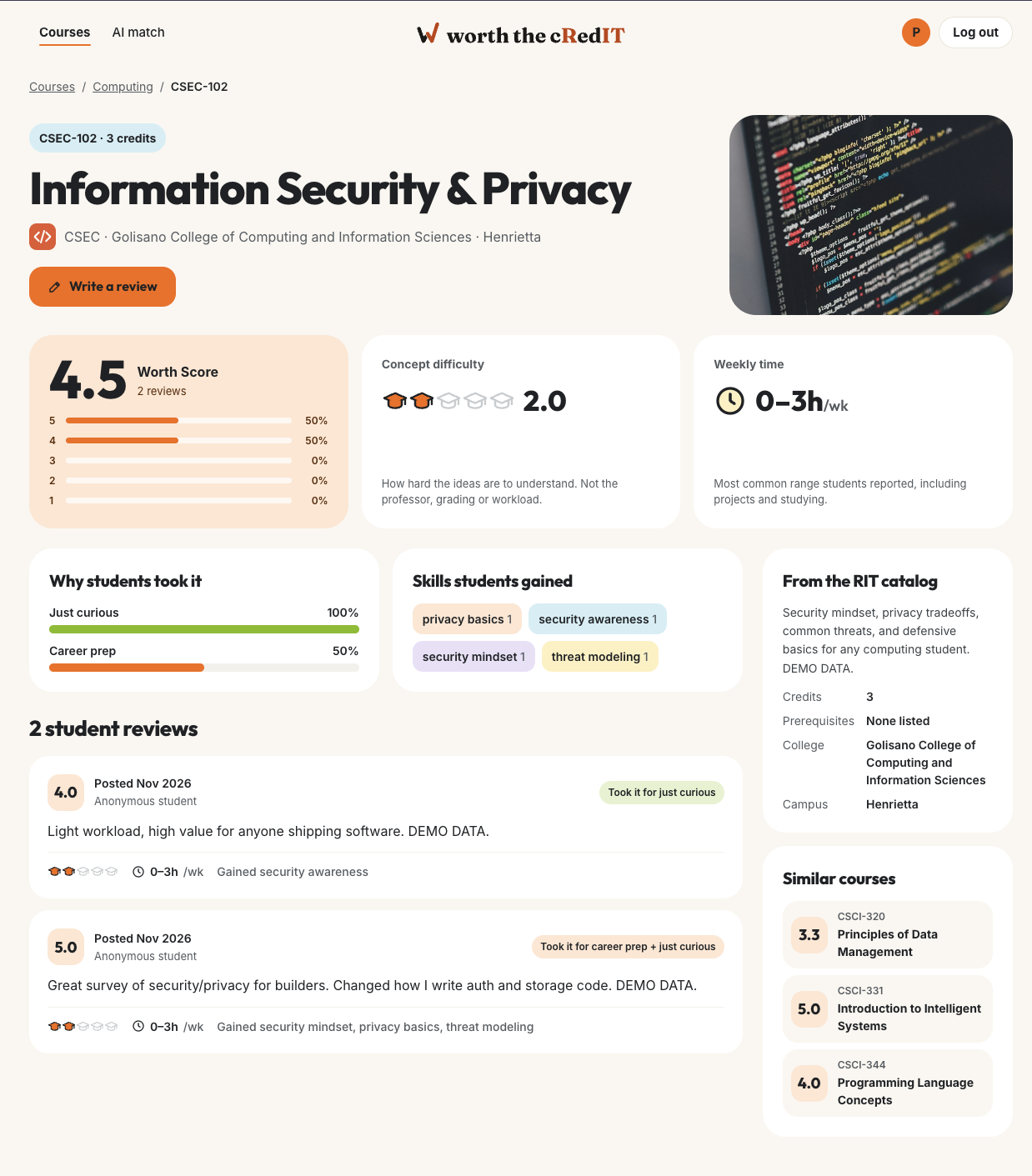
Display what happens when you click on a specific course.
-
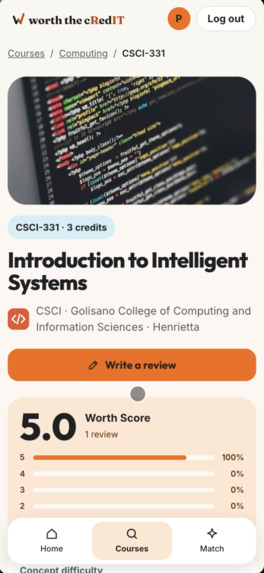
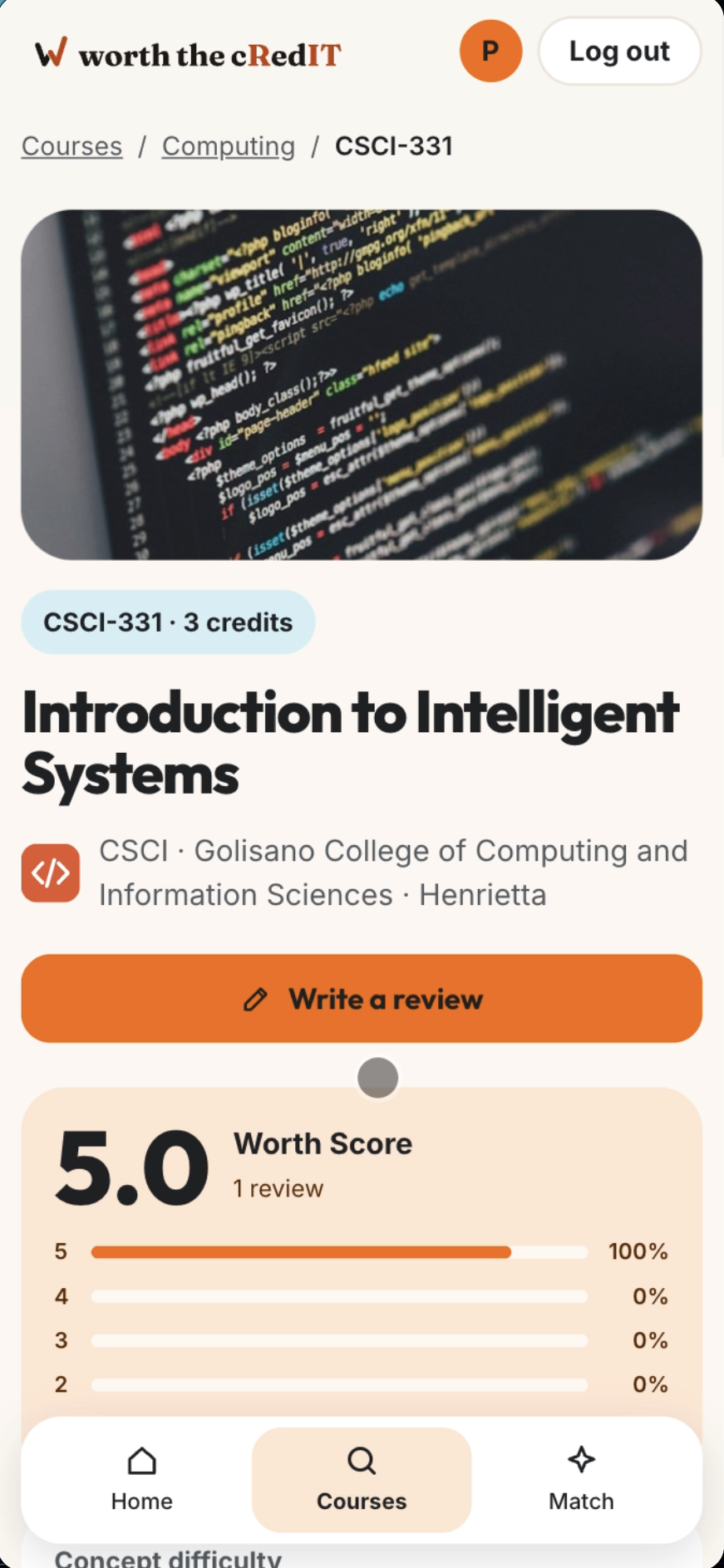
Mobile view of Courses
-

Mobile View of Dashboard
-
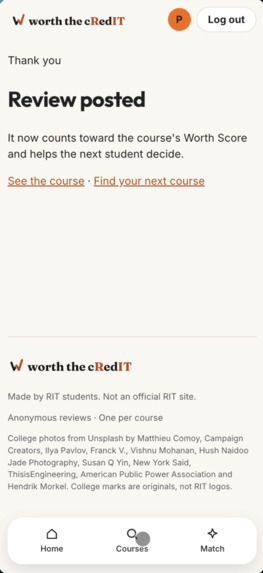
Mobile view of successfully posting a review


Worth The Credit
Inspiration
When choosing a professor, students have platforms like Rate My Professors to help them make informed decisions. But what about choosing the actual course?
We realized that while students can easily find out whether a professor is good, it's much harder to determine whether a course is worth taking. How difficult is the material? How much time will it take compared to other classes? Will the content align with their interests, help them build relevant skills, or contribute to their career goals?
For most of us, answering these questions meant asking friends, talking to classmates, or digging through Reddit posts from years ago. Even then, someone's experience with a course might not reflect what another student hopes to get out of it.
That inspired us to build Worth The Credit, a platform that helps RIT students evaluate courses based on their content, workload, and relevance to their personal and professional goals rather than just who teaches them.
What it does
Worth The Credit combines crowdsourced course reviews with AI-powered recommendations to help students make better academic decisions.
Students can explore a catalog of 50 demo RIT courses, view course information such as credits and prerequisites, and read anonymous reviews from other students.
Rather than simply rating whether a course was easy or enjoyable, each review focuses on its actual value. Students can share their goals for taking the class, the skills they gained, the difficulty of the concepts, and the average weekly time commitment.
Each review also includes a Worth Score from 1 to 5, representing how valuable the course was to that student. The Community Worth Score is calculated by averaging these ratings, while difficulty and weekly workload remain separate measurements. Courses without reviews do not receive a score, and each student can submit only one review per course.
We also wanted to go beyond traditional course reviews by making the experience personalized.
Students can enter their major, interests, existing skills, and academic or career goals. They can also optionally provide resume text to help tailor recommendations. Our AI recommendation system then matches students with courses and explains why each one may be relevant to their goals.
Each recommendation receives a match label of Strong, Good, Partial, or Worth exploring, giving students additional context when deciding which electives to take.
How we built it
We developed Worth The Credit as a full-stack web application using several technologies:
- Frontend: React, Vite, and TypeScript for the user interface and course discovery experience.
- Backend: Python and FastAPI to handle application logic, reviews, course retrieval, and recommendations.
- Database: PostgreSQL hosted on Tiger Data to store courses, users, and reviews.
- Authentication: Auth0 for user sign-in and email verification.
- AI: Google's Gemini API, using
gemini-flash-latest, to generate personalized course recommendations and explanations. - Deployment: Vercel for hosting the frontend and Vultr for deploying the FastAPI backend.
Our backend retrieves available courses from PostgreSQL and sends the relevant catalog information alongside a student's preferences to Gemini. The model ranks courses and generates explanations based on how well they align with the student's interests, skills, and goals.
One important design decision was to keep the AI responsible for recommendations, not the underlying course facts. FastAPI validates that every recommended course exists in the provided catalog and rejects Worth Scores invented by the model.
We also calculate Community Worth Scores directly through SQL averages rather than relying on AI-generated values. Resume text is used only for the recommendation request and is not stored.
For deployment, we hosted our React frontend on Vercel and our FastAPI backend on Vultr, allowing us to separate the user-facing application from the API and its server-side operations. Our backend connects to PostgreSQL on Tiger Data and integrates with Auth0 and Gemini to support the platform's core functionality.
Throughout development, we documented AI-generated code contributions in docs/ai-contributions.md to maintain transparency about how AI assisted our development process.
Challenges and what we learned
One of our biggest challenges was sourcing reliable course data.
Initially, we explored available course APIs to retrieve RIT course information. However, the APIs we found either weren't functioning as expected or didn't provide the information we needed. We also couldn't simply scrape RIT's website and store the data because of university policies governing that information.
Instead of letting this prevent us from building the project, we created a documented proof of concept using a catalog of 50 demo courses. This allowed us to demonstrate the platform's functionality while respecting the university's data restrictions.
Another challenge was ensuring our AI recommendation system remained accurate. Large language models can generate convincing explanations, but we didn't want Gemini recommending nonexistent courses or inventing course ratings. We addressed this by using FastAPI to validate the model's output against our database and keeping course ratings under the application's control.
We also encountered several technical integration issues. A newer Gemini API key rejected requests to gemini-2.5-flash, which led us to use gemini-flash-latest. Auth0's key verification also failed on macOS until we configured Python to use certificates from certifi. Additionally, we had to ensure email verification requirements were enforced consistently between Auth0 and our backend.
Deploying the application also gave us experience working with multiple cloud platforms. By hosting our frontend on Vercel, our backend on Vultr, and our database on Tiger Data, we had to ensure the separate components could communicate correctly outside our local development environments.
These challenges taught us a lot about integrating external services, handling unreliable data sources, validating AI-generated responses, deploying full-stack applications, and designing an application with data integrity and user privacy in mind.
More importantly, we learned that building a useful AI application isn't just about connecting to a language model. It's about ensuring the model works with reliable information and produces results users can actually trust.
What's next
Our long-term goal is to make Worth The Credit a practical resource for RIT students.
While our current version demonstrates the platform using mock course data, we'd love the opportunity to work with RIT to receive approval for an official or otherwise authorized course data integration. That would allow us to replace the demonstration catalog with verified course information and expand the platform's usefulness.
We also hope to grow the community review system so that students can share their experiences and help future students make more informed decisions.
Ultimately, we want students to choose courses not just because they need the credits, but because they understand what they'll get out of them.
Because every credit should be worth something.
Built With
- alembic
- auth0
- fastapi
- google-gemini-api
- postgresql
- pydantic
- pytest
- python
- react
- react-router
- sqlalchemy
- tiger-data
- typescript
- vite
- vultr
- zod

