-
-
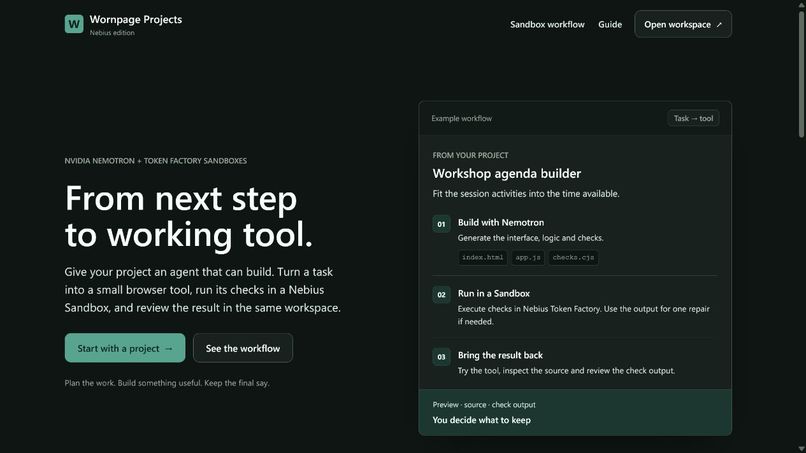
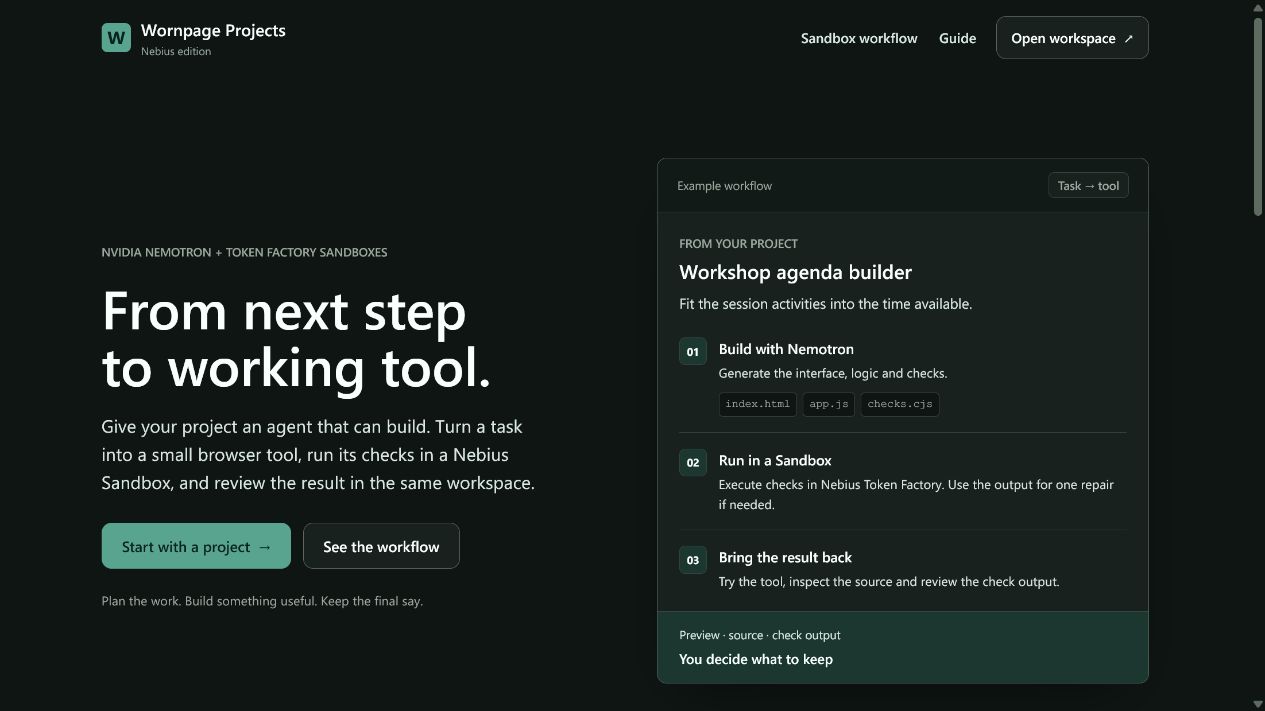
Hosted landing page explaining the task-to-tool Sandbox workflow. The illustrated run is an example.
Public access — October 2, 2026
The MIT source repository and manual preview are now public. The preview supports browser-local project creation, task editing, blockers, evidence and human approval. AI guidance and Sandbox execution are disabled, so it cannot start new model or Sandbox runs. Live AI access for judges remains a separate configuration and spending decision.
The v0.1.0 source release includes setup instructions and dependency notices. Both source CI suites and the published preview checks passed. No new model or Sandbox calls were used for this release; the video and retained results below describe earlier real runs.
Inspiration
A project plan should lead to something useful. Wornpage Projects brings the brief, tasks, dependencies and evidence into one workspace. The Nebius edition takes that further: a next step can become a small browser tool that a person can inspect and use.
What it does
Start with a brief or an editable example project. Use Nebius to propose tasks and dependencies, suggest a useful next step, adapt the plan when circumstances change, or compare supplied evidence with completion criteria. Review and approve each proposed change before it is saved.
The implemented Build tool workflow connects an existing task to code generation and Sandbox execution. NVIDIA Nemotron generates the interface, JavaScript logic and model-authored checks. Nebius Token Factory Sandboxes run the checks, with one repair allowed if needed. The result returns to the task for an isolated preview, source inspection, check-output review and an explicit decision about saving evidence. A run never automatically marks the task done or publishes its output.
How we built it
The frontend uses Svelte 5, TypeScript and public Wornpage UI components. Project data is stored in the browser, with workspace backup and restore. A separate Cloudflare Worker serves the app and calls NVIDIA models through Nebius Token Factory; provider credentials stay on the server.
Nemotron Nano is configured for routine next-step guidance. Nemotron Super is configured for planning, evidence review and tool generation. The execution path uses persistent run records, exact task inputs, a maximum of two model calls, two 30-second Sandbox executions and one repair. Generated previews isolate tool code from the project workspace.
Challenges we addressed
The difficult part is preserving context and human control as work moves between a task, a model proposal and generated code. The app keeps unsaved editors mounted across views, refuses stale task changes, separates model-authored checks from independent evidence, and treats interrupted or uncertain runs explicitly. Run limits and the data being sent are shown before authorization.
What we are proud of
The standalone edition now connects planning, task guidance, tool building and review in one coherent workflow. Its MIT-licensed source includes setup instructions, pinned dependencies, and documentation of the prior-work boundary. It does not require the private Projects backend.
What we learned
A useful project agent needs a precise task and a clear definition of done. More autonomy is helpful when the execution scope, recorded evidence and final human decision remain easy to understand.
New work for this hackathon
The earlier WebMCP edition supplied the browser workspace, public components and approval pattern. This edition adds the Token Factory integration, project planning and revision proposals, task guidance, evidence review, usage controls and the Sandbox execution workflow. The earlier challenge repository and deployment remain separate.
Earlier checkpoint — September 28, 2026
The hosted app and MIT-licensed source are public. Two live Nemotron Nano responses have been observed through Token Factory, including a changed proposal after a hypothetical release update. Those proposals remained unsaved for human review.
Sandbox access is now enabled. A real isolated Node 24 diagnostic completed successfully in Nebius with networking disabled. The current tool-building example is a release-packet checker: it should identify missing health evidence, rollback notes and reviewer approval while keeping the final release decision with a person.
The first four attempts stopped before Sandbox, including an unnecessary style-block requirement that we removed. The fifth attempt returned three files and reached a real Sandbox syntax check. Incomplete JavaScript caused exit 1 before tool logic or assertions could run; the single repair then failed the worker-handler contract. Review retains the original files, Sandbox output, and complete totals of 3,284 input and 1,905 output tokens across two model calls.
Clearer source-generation guidance and automatic saved-run reads after an uncertain start are now deployed. Their effect on a fresh run remains unverified. Script/resource restrictions, preview sanitization, CSP and Worker isolation remain in place. The first complete generated tool and interactive preview are still outstanding.
The new Release-packet checker example provides two concrete synthetic inputs: an incomplete packet should show three gaps, and a corrected packet should show zero gaps and Ready for human review. Those are saved requirements, not observed generated-tool results.
Updated demonstration — October 2, 2026
The embedded video now shows the actual local application in a continuous keyboard walkthrough recorded on October 1. It inspects a retained Nemotron Super-generated release-packet checker, the first failed Sandbox check, and the successful repair. The repair passed fourteen model-authored assertions and all six control events. Separate local checks exercised twenty-four packet cases at two widths.
The footage demonstrates three gaps for an incomplete packet, zero gaps for a corrected packet, editing that clears the previous readiness result, malformed-input handling, and generated-source inspection. Saving evidence remains a separate human action and the task stays open. English captions explain the silent recording; no new model or Sandbox execution was used to record or publish it.
The saved tool still declares Plain text, and its original JSON-loader coverage remains 0/2. This is an earlier retained successful checker. The video remains evidence of that earlier result.
Newer verified result — October 2, 2026
A subsequent browser-tool.v2 JSON-checker run passed its bounded local evaluation after one repair. The successful Sandbox check recorded 28 model-authored assertions, 6/6 control events, 2/2 declared JSON example loaders, and 2/2 post-output edits. The unchanged generated files then passed 24 frozen packet cases at two widths (48/48), with 66/66 total independent browser observations. The retained file digest matches both the successful check and the independent report.
The authenticated local application showed three gaps for the incomplete example, zero for the corrected example, and an input error in place of a stale readiness result. Saving run evidence succeeded after a bounded multiline-evidence validation fix; the exported task remained active and retained its earlier evidence. One successful bounded run establishes this result, while broader model reliability remains to be evaluated. This newer result is documented separately from the embedded October 1 recording. The source and hosted routes were private at that local checkpoint. The recording itself does not establish live hosted AI access; current manual-preview access is described above. The workflow illustration remains an example.
Built With
- nebius
- svelte
- typescript

Log in or sign up for Devpost to join the conversation.