Inspiration
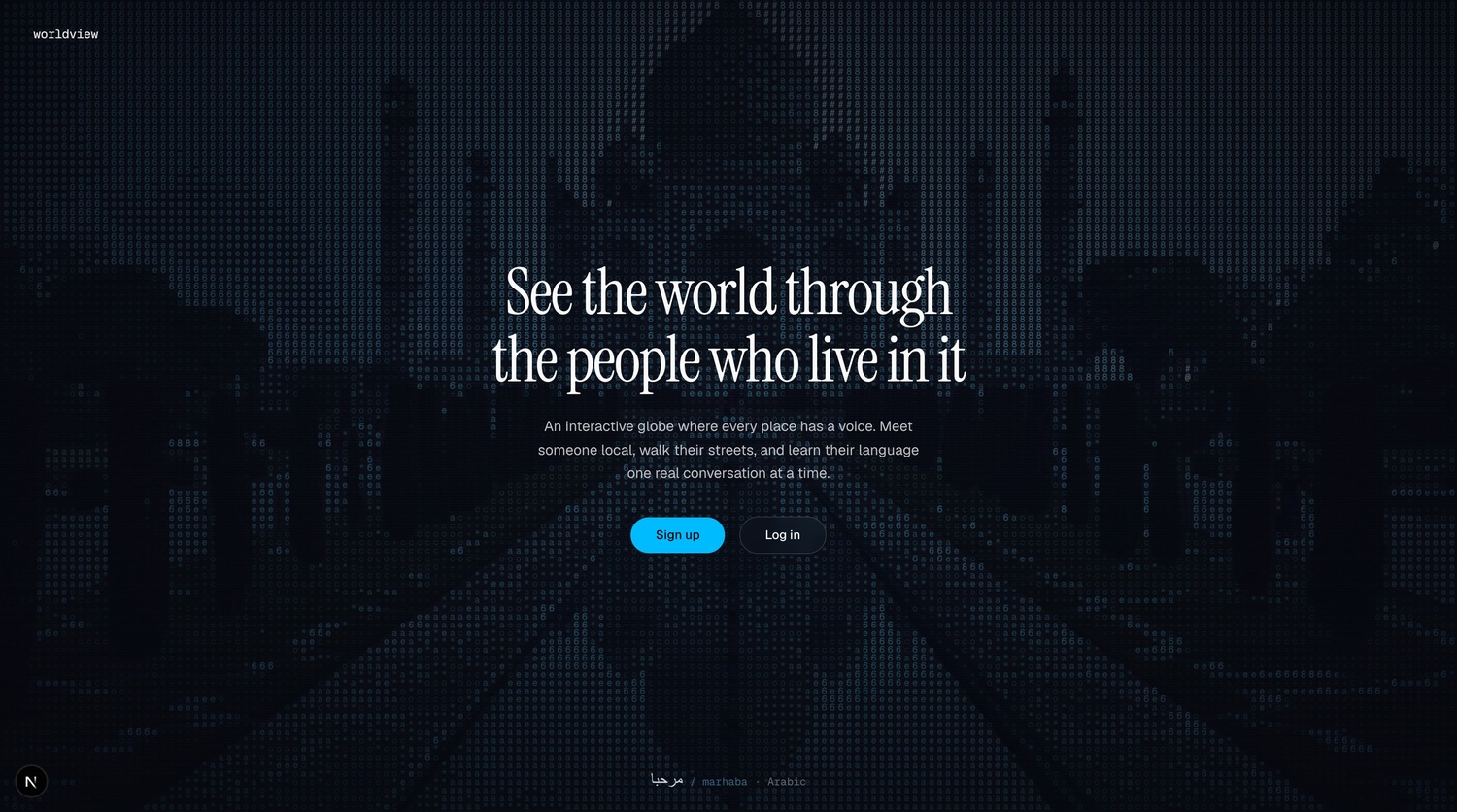
Most apps that claim to teach you the world hand you flashcards. You memorize words, tap through streaks, and still land somewhere with no sense of how people actually live, what they celebrate, or why a place feels the way it does.
We wanted the opposite of a flashcard. Something closer to being handed off to a local who says "come with me" and just walks you through their day: a market at noon, a kitchen at dinner, a walk home past a holiday you've never heard of.
And underneath that, a bigger idea. Culture isn't a set of isolated countries. A spice in a Moroccan market carries a trade route. A Brazilian rhythm carries West African roots. A single Toronto street carries a dozen languages at once. We wanted a globe that showed the world as a network of exchange, not a quiz with borders. WorldView started there: what if exploring the world meant living a life inside it, and every life you visited showed you how connected the world already is?
What it does
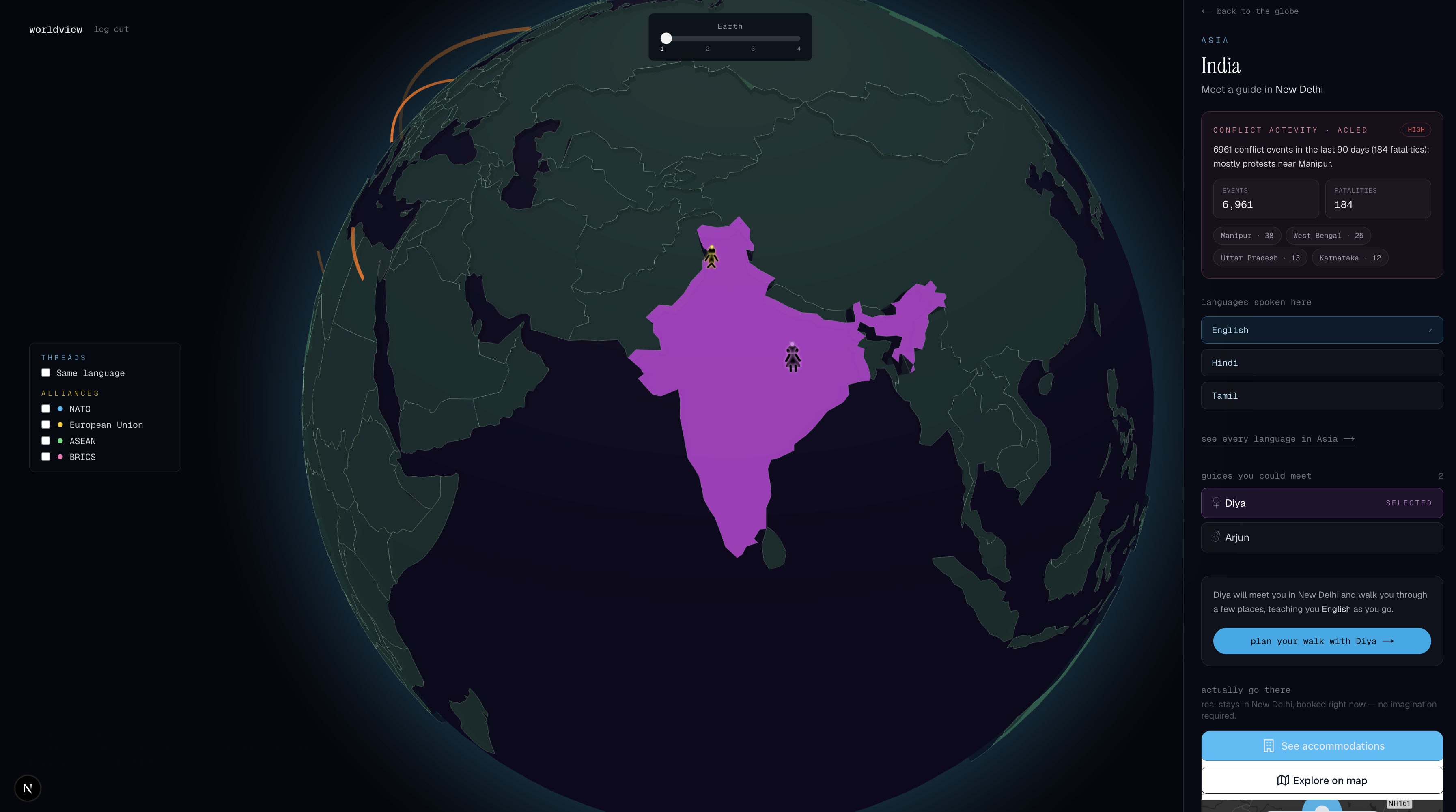
WorldView is an interactive globe you explore by living inside it.
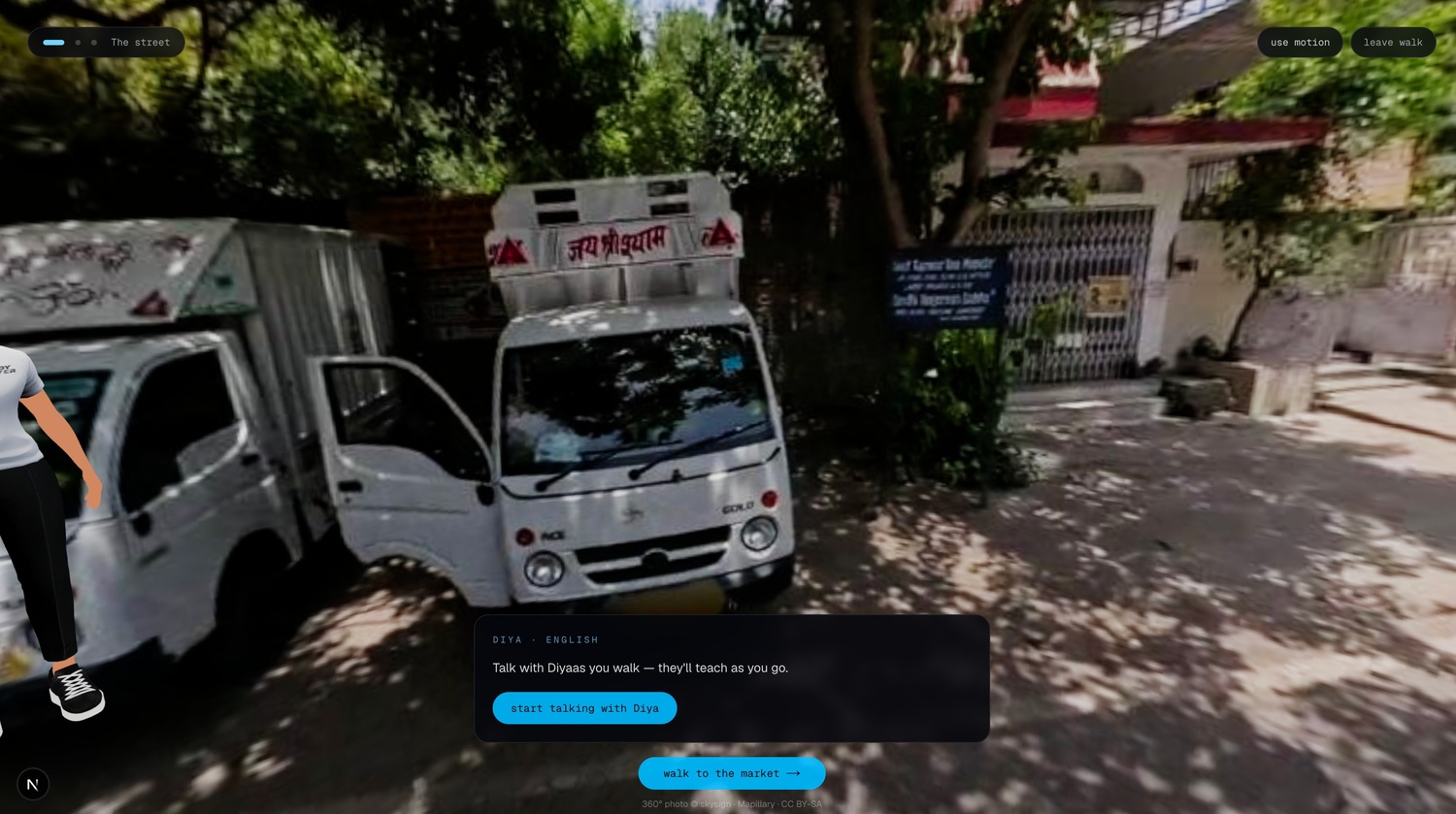
You spin the globe and click a country. Instead of a lesson, you meet a character from that region, a guide who is always moving, always walking, and takes you through their actual world: a market, their home, a school, a walk through the neighbourhood. You experience the place the way someone who lives there does, and you pick up the language and customs in context, tied to where you're standing rather than a list of vocab.
The characters speak through ElevenLabs' multilingual agent, so they sound native, warm, and natural. They drive a real back-and-forth: you talk with them out loud, and the conversation keeps moving as you go, so you're inside a living scene instead of tapping through prompts.
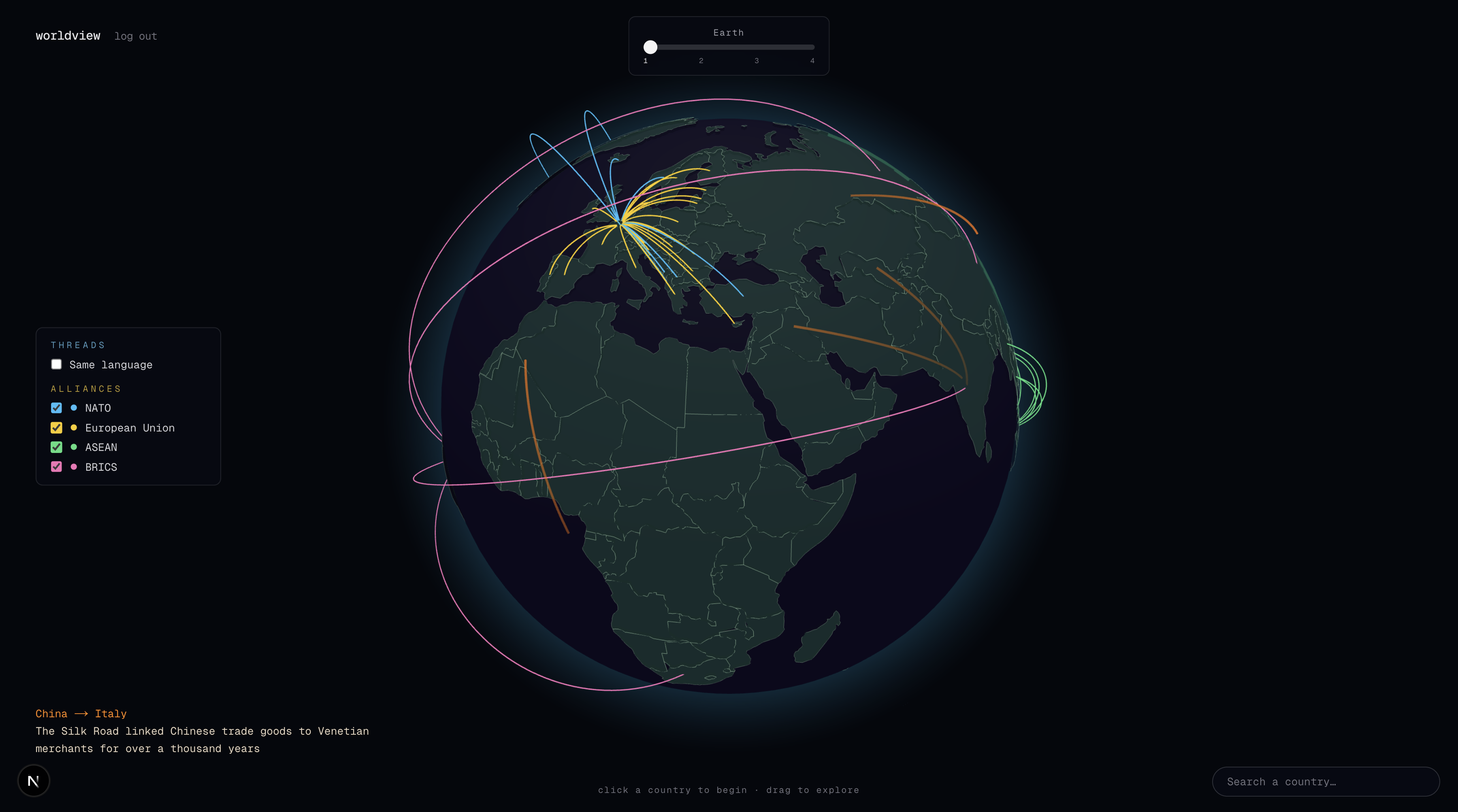
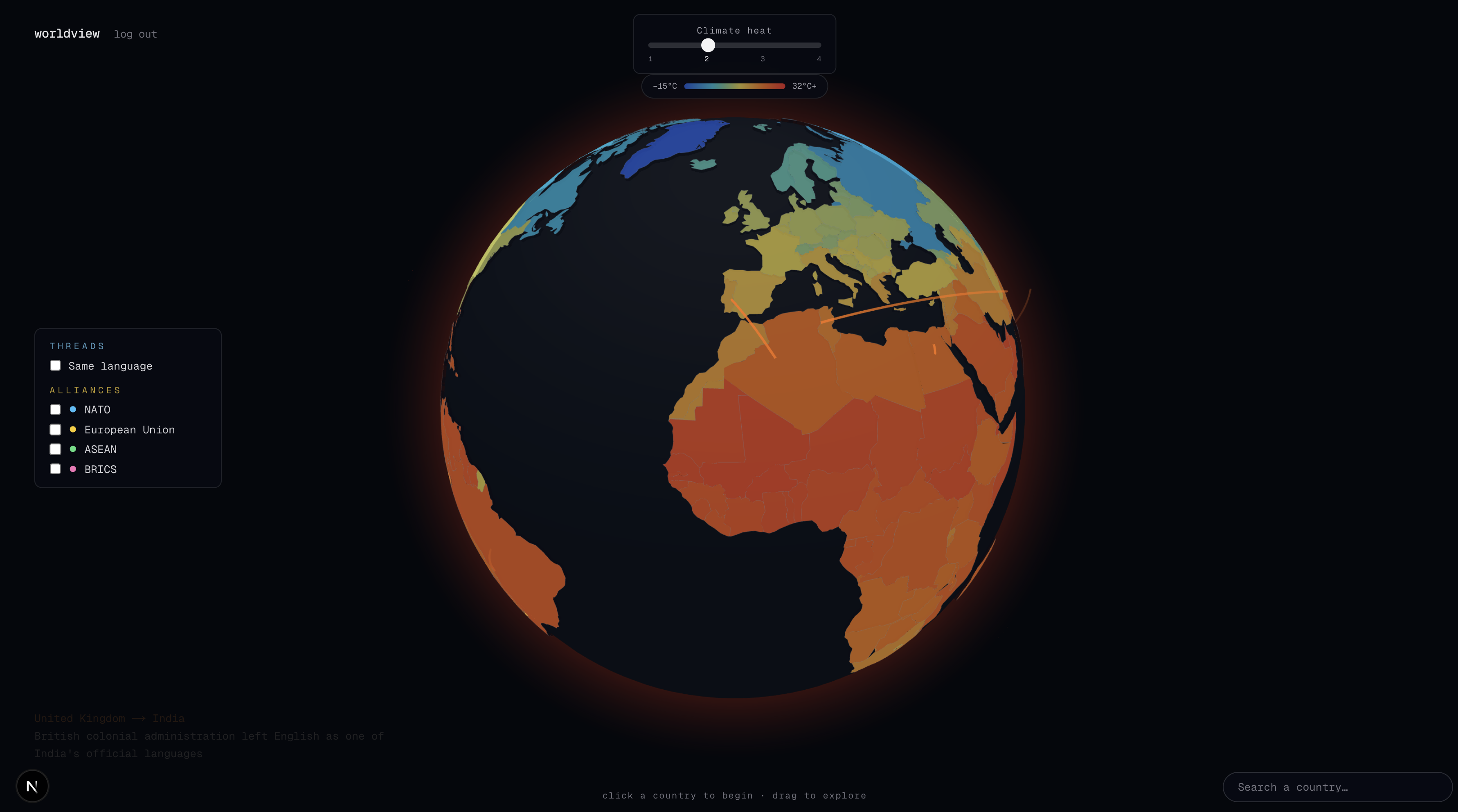
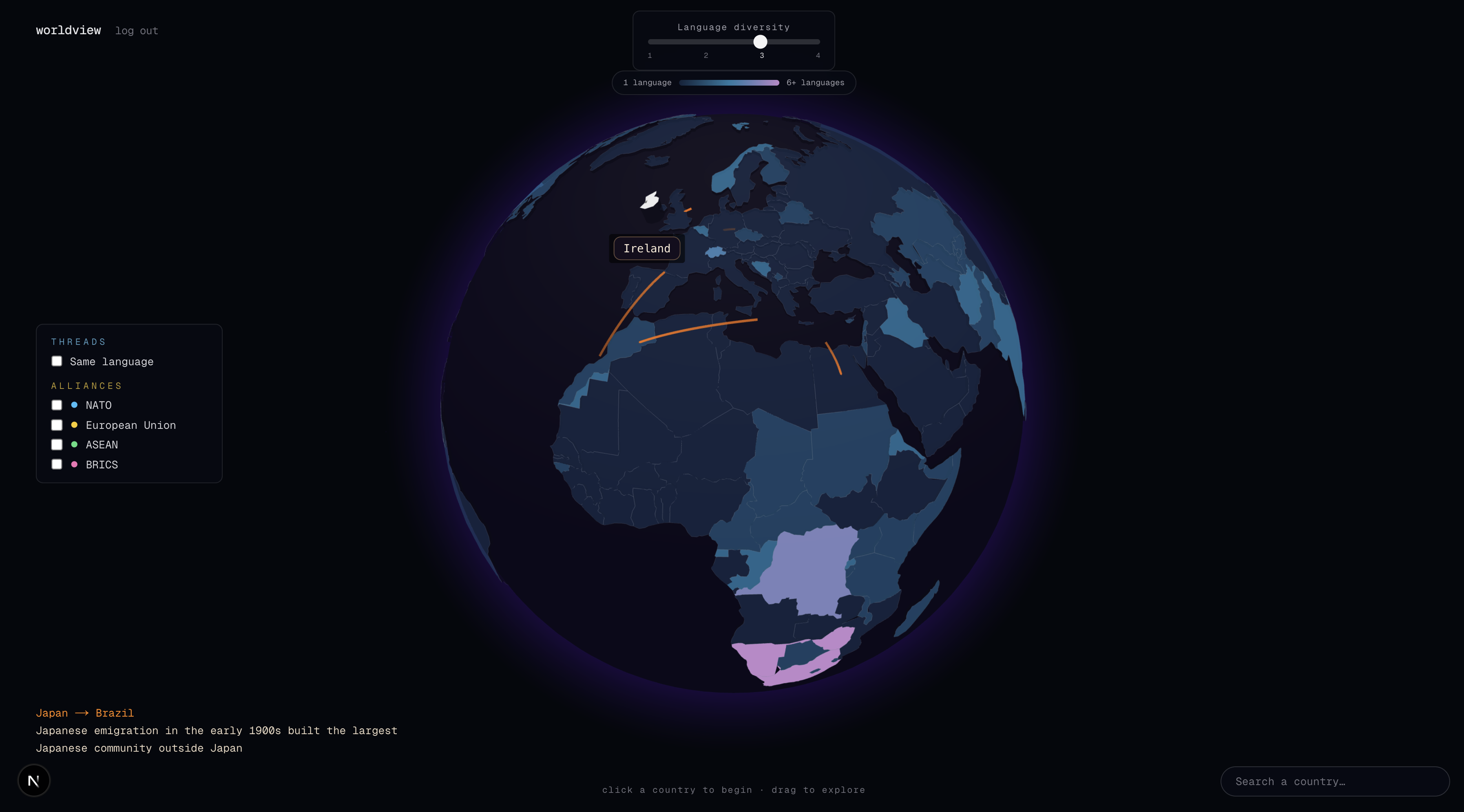
The globe itself is a live data layer. On top of the map we visualize:
- Trade alliances between countries, so you can see who's economically tied to whom
- Shared language links, connecting every country that speaks the same language across the globe
- A live weather map, showing real conditions country by country
- Language diversity, highlighting how many languages live inside a single region
The environment inside each journey reacts to you too. It shifts based on time of day and timezone, regional holidays and traditions, your age, interests, and level, the choices you make at the market, home, school, or out in nature, and your earlier conversations, held through the session so your guide keeps track of where you've been.
Auth0 acts as your checkpoints. Progress unlocks the next stage of a culture, because WorldView is about exploring, not grinding a game.
And when a place pulls you in, you can stay. Every country has a hotels section where you can browse and book a real stay, turning "I'd love to go here" into an actual trip you can plan on the spot.
While you explore, objects and traditions open visual connections to other parts of the world. A spice reveals its trade route. A rhythm traces back to its origins. The globe draws these as animated paths, turning it into a living map of cultural exchange.
How we built it
The globe and frontend. WorldView is a Next.js + TypeScript app. The core is an interactive WebGL globe you can spin, zoom, and click, with each country wired to its own guided experience. On top of the base globe we layer multiple live data overlays: trade alliances, shared-language networks, a country-by-country weather map, and language diversity, each rendered as its own visual layer so users can read the world through whichever lens they want. The animated connection paths between regions are drawn on the same surface so cultural and linguistic links render as live arcs across the globe.
ElevenLabs multilingual agent. Every character is voiced through ElevenLabs. This is what makes a guide feel like a person instead of a menu. They deliver dialogue at a pace and tone you can follow, listen as you speak back, and drive the conversational loop as you move through each location.
Hotels and booking. Each country connects to a hotels section where users can browse stays and book a trip to the place they've been exploring, closing the gap between discovering a culture and actually going.
Auth0. We use Auth0 for authentication and as the gating system for progression. Each user's identity anchors their journey, and clearing a stage unlocks the next level of that culture.
Session state. We track user state through the session: profile, proficiency, interests, choices made, and earlier conversations. That's what lets a guide keep track of you and lets the world adapt as you move through a journey instead of resetting scene to scene.
Challenges we ran into
Getting a character to feel alive was harder than getting one to talk. A voice on its own reads as a menu. Syncing ElevenLabs audio to a guide who is constantly moving through a scene, and keeping the conversation responsive to your choices, took real work to make it feel like following a person rather than triggering clips.
Layering the globe was another one. Trade alliances, shared-language networks, a live weather map, and language diversity are four very different kinds of data, and getting them all to render cleanly on the same 3D surface without turning into visual noise took a lot of iteration on how each layer looks and when it shows.
Making the world genuinely adapt was the biggest scope challenge. Time of day, timezone, holidays, age, interests, proficiency, and past choices all feed into what you see. Wiring all of that into our state model and having the environment respond coherently, without it feeling random, was a real test.
And the cultural connection paths pushed both the design and the globe rendering. Mapping a spice to a trade route or a rhythm to its origins in a way that's accurate and visually clean, then animating it across a 3D globe, was a satisfying thing to finally get right.
Accomplishments that we're proud of
- A globe you explore by living in it. Clicking a country drops you into a guided, moving journey through real places, not a static lesson.
- A globe that's also a live data map. Trade alliances, shared-language networks, real-time weather, and language diversity all render as readable layers on the same interactive globe.
- Characters that actually feel present, voiced natively through ElevenLabs, guiding you conversationally through markets, homes, and streets.
- From exploring to landing. The hotels section lets you go from discovering a culture to booking a real trip there without leaving the app.
- A world that adapts to the person, with time, place, age, interests, level, and history all shaping the journey, backed by state we carry through the session.
What we learned
We learned that context is the actual product. The moment a place is attached to a person, a reason, and a lived moment, it sticks in a way flashcards never manage. Building around lived experience instead of vocab lists changed every design decision we made.
We learned a lot about layering data on a globe. Turning trade, language, weather, and diversity into overlays that are readable rather than cluttered taught us that visualization is as much about restraint as it is about data.
We learned that adaptivity is mostly state management. "The world responds to you" sounds like magic and is really a careful state model plus disciplined logic about what changes when. Getting that foundation right early was worth it.
And we learned that culture genuinely is a network. Once we started mapping connections between regions, we kept finding more, which reinforced that showing the world as interconnected wasn't just a nice visual, it was true.
What's next for WorldView
- More regions and deeper journeys, with richer locations and more guides per culture
- Expanding the globe's data layers, adding more lenses like migration, cuisine, and music alongside trade and language
- Growing the connection graph so more objects, foods, and traditions reveal their links across the globe
- Community-contributed cultures, letting people add the markets, holidays, and neighbourhoods they know firsthand
- Full VR support, so instead of clicking into a market you can actually stand in one and walk alongside your guide
- Deeper travel integration, connecting the hotels section to flights and full trip planning so a journey on the globe becomes a real one
Built With
- auth0
- computer-vision
- elevenlabs
- python
- sentence-transformers
- typescript

Log in or sign up for Devpost to join the conversation.