-
-

See who is affected if the bridge is removed.
-
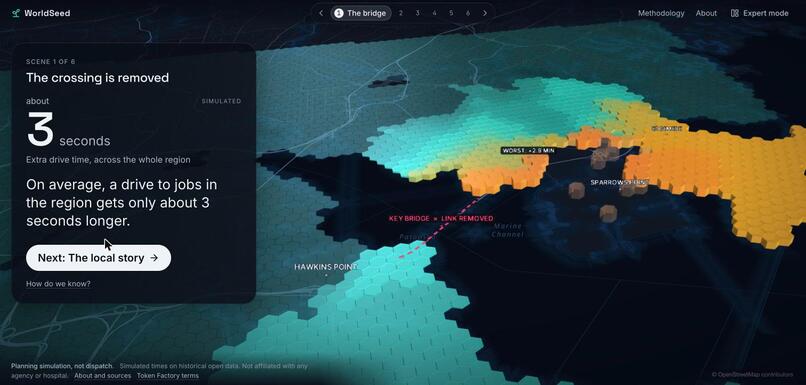
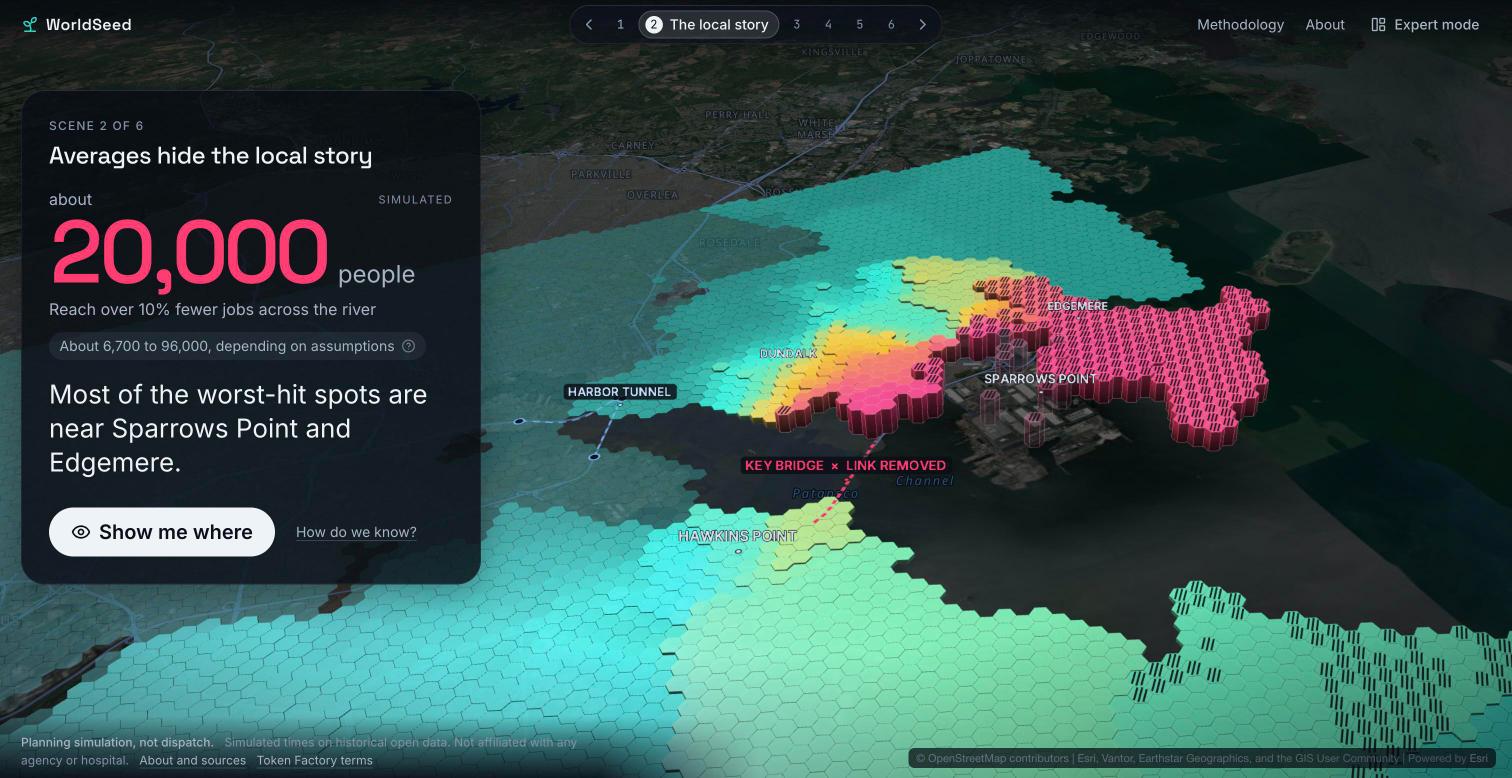
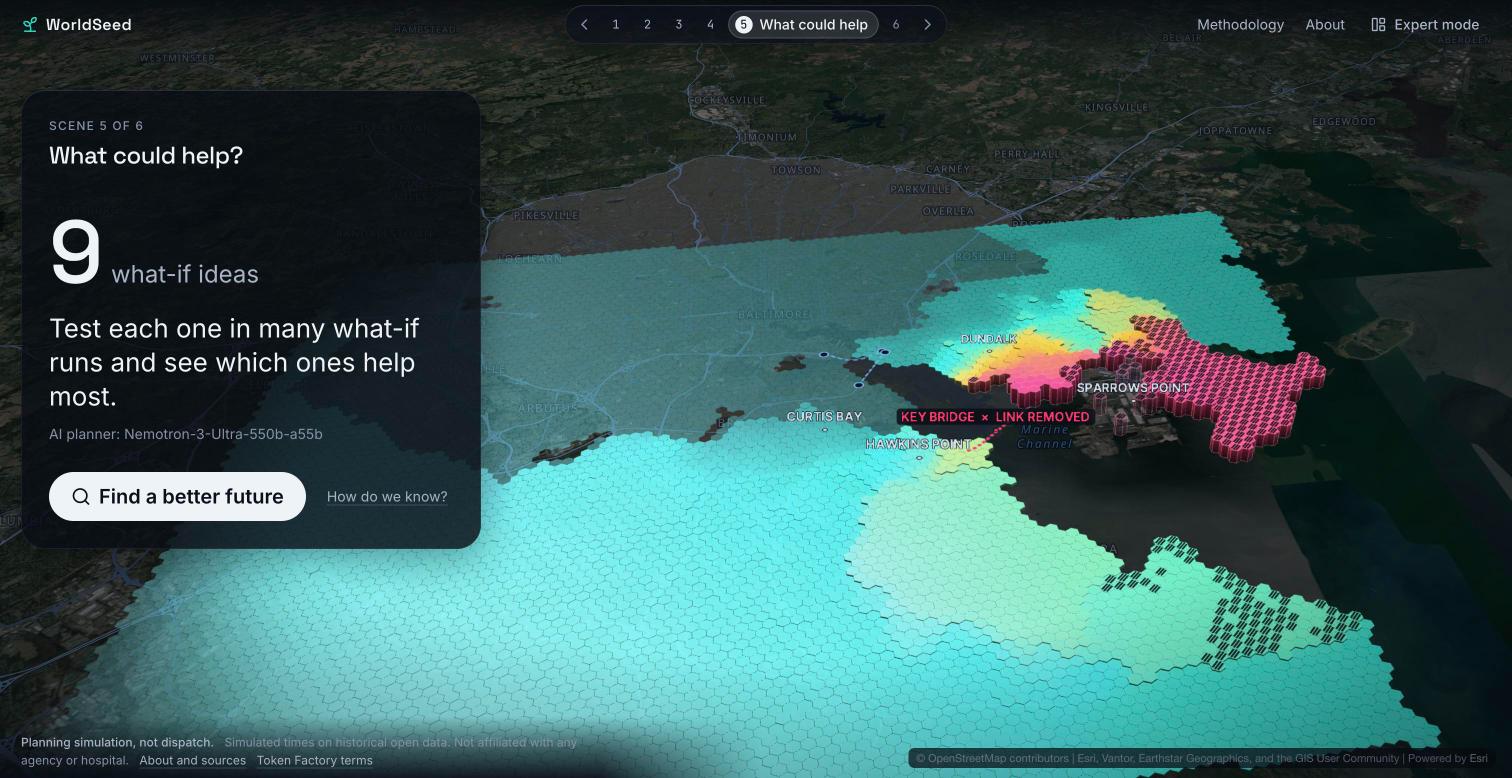
Cross harbor job access after the Key Bridge is removed, by hex.
-
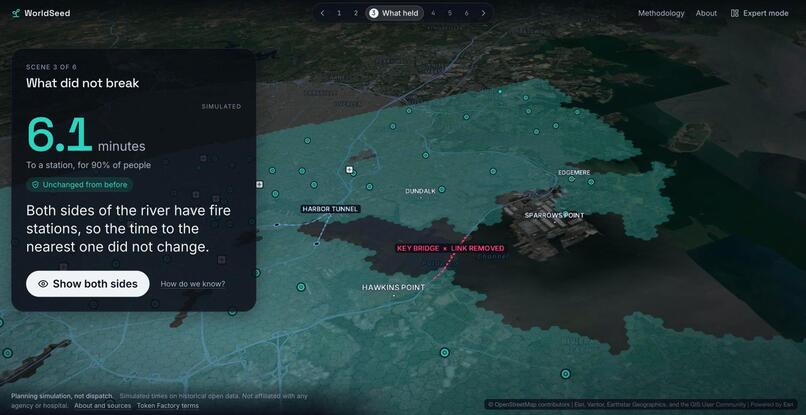
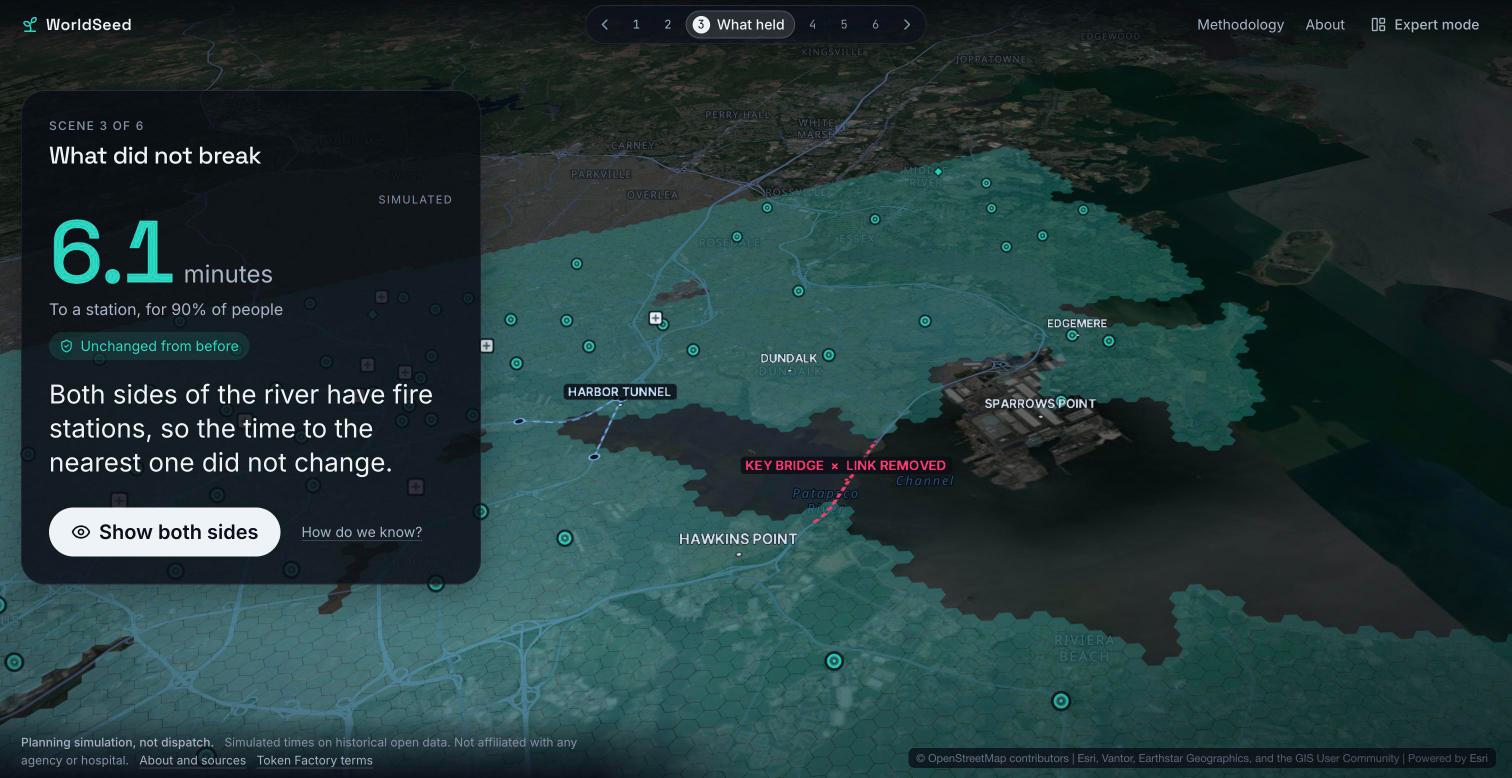
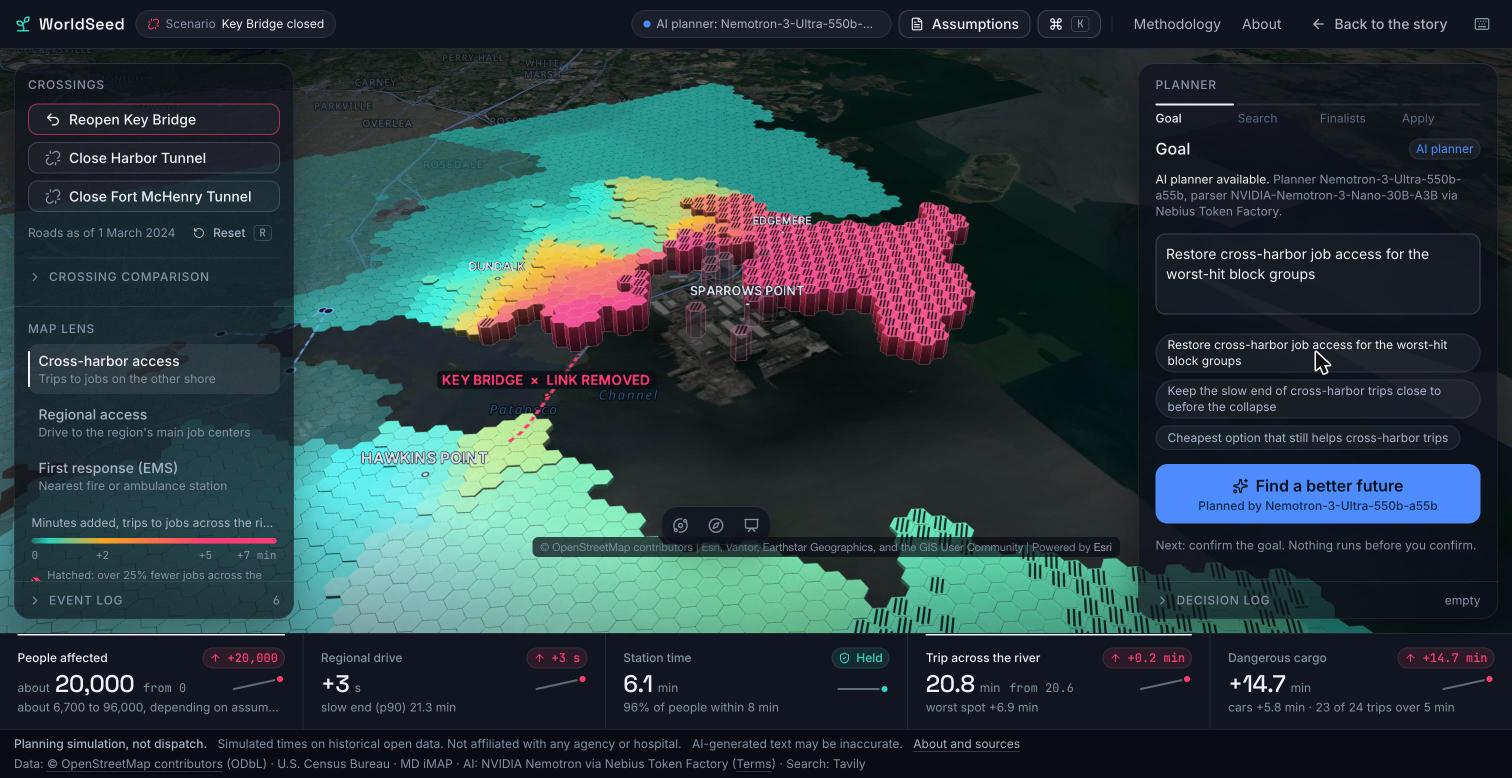
First response time barely changes: both shores keep their own fire and EMS stations.
-
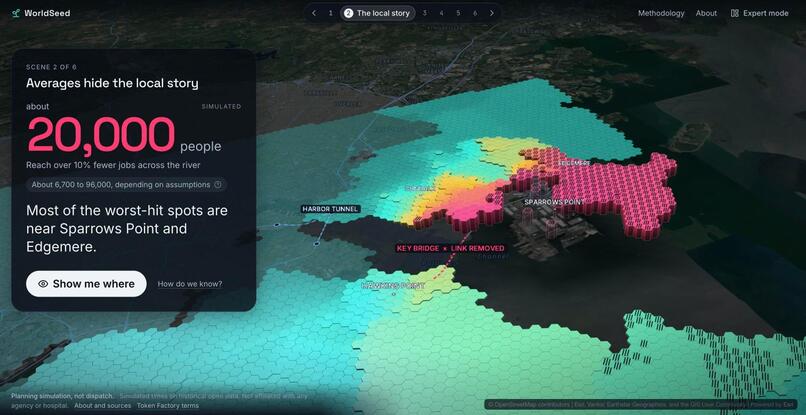
About 20,000 people lose over 10% of cross harbor jobs, the local story a region wide average hides.
-
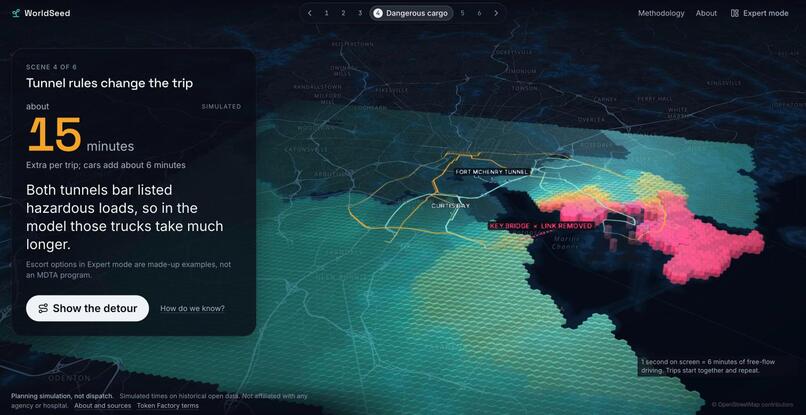
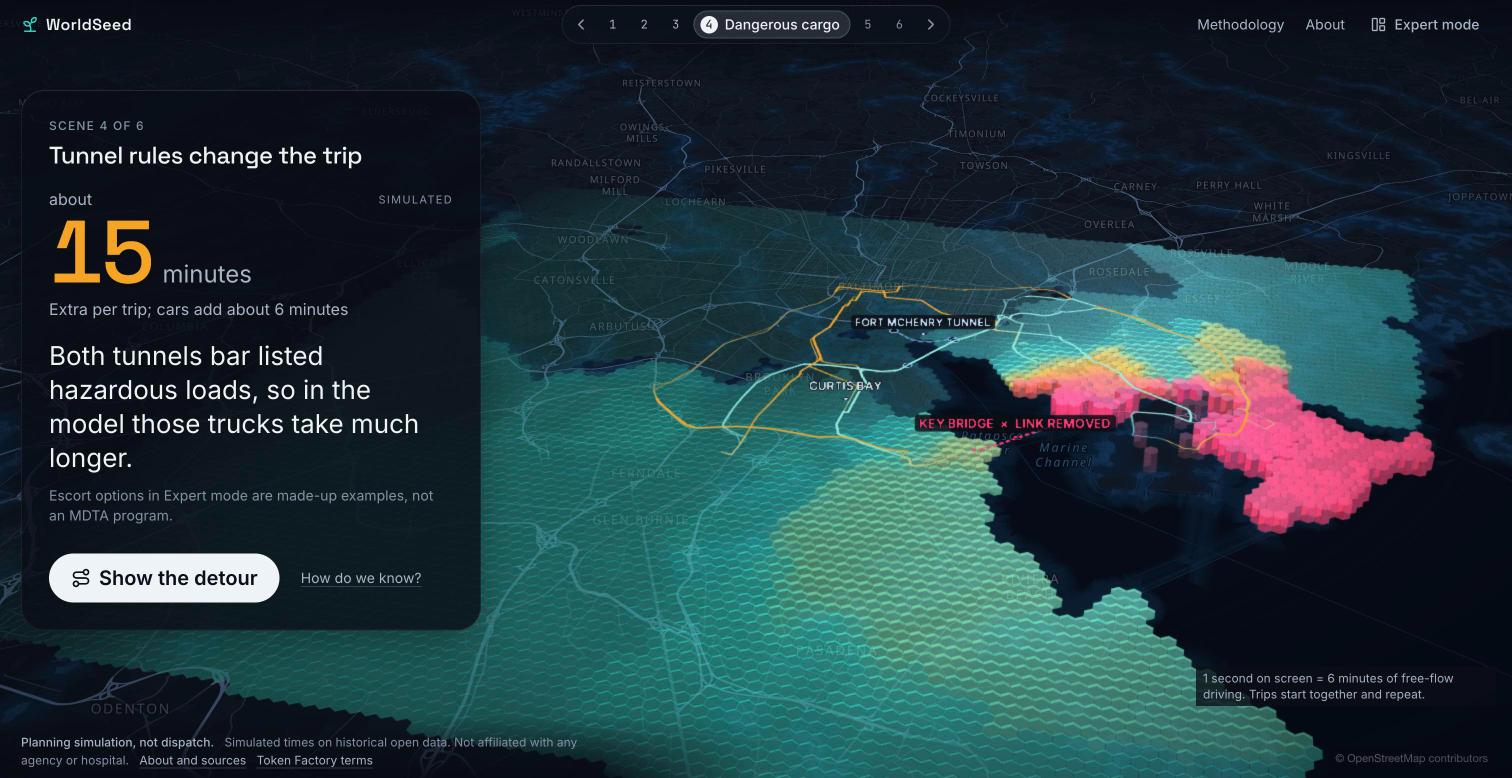
Hazmat trucks lose about 15 minutes to the tunnel detour rule, cars about 6.
-
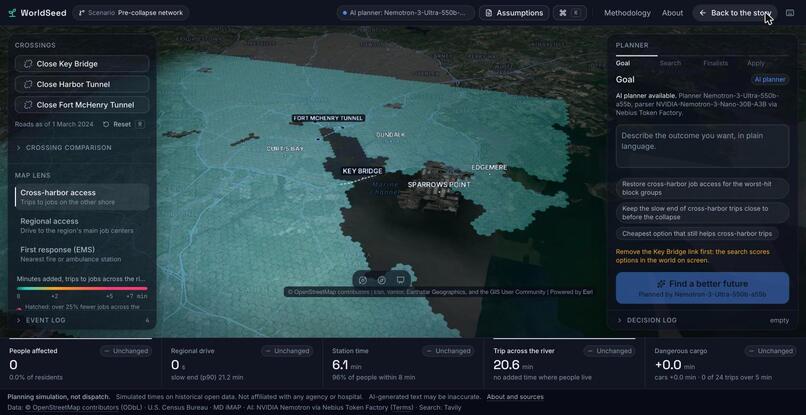
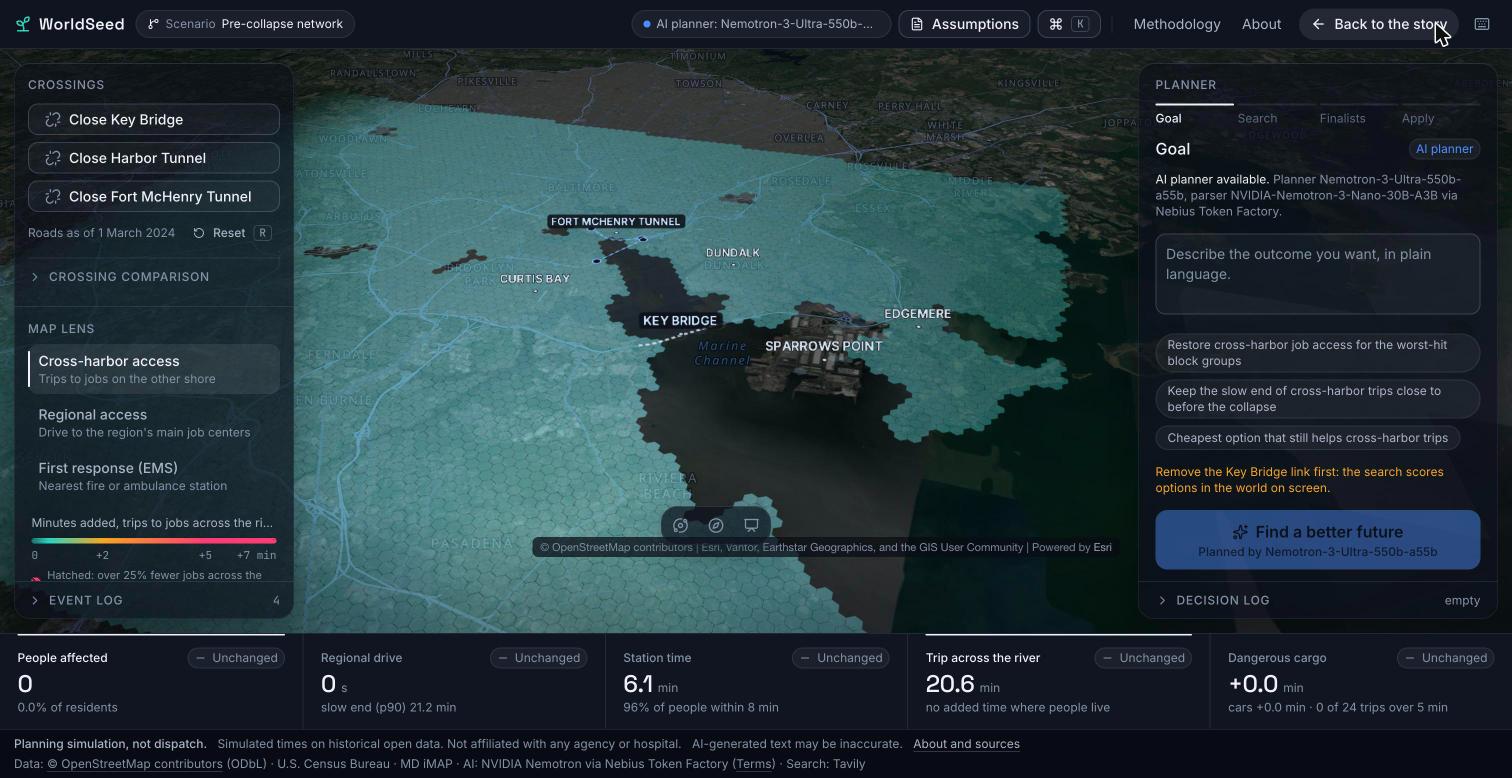
Expert mode: crossings, map lenses and the planner panel, with every live metric on screen.
-
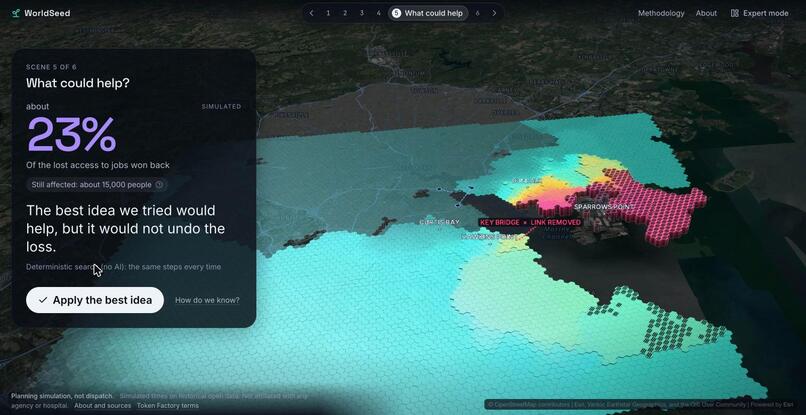
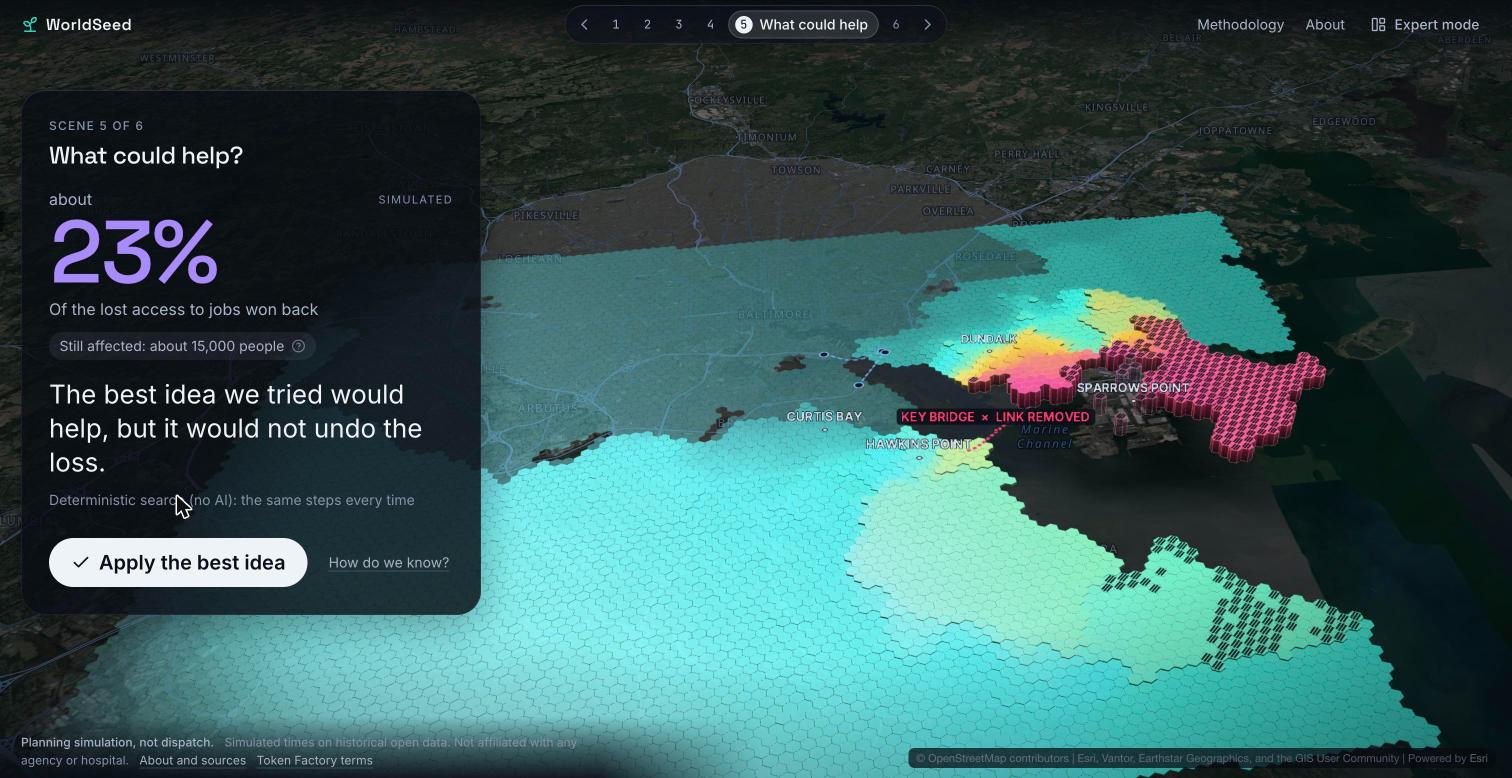
The best idea found recovers about 23% of the lost access. It helps, it does not undo the loss.
-
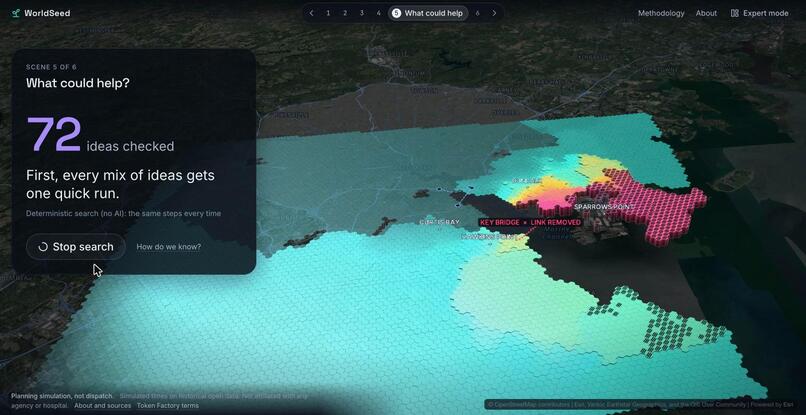
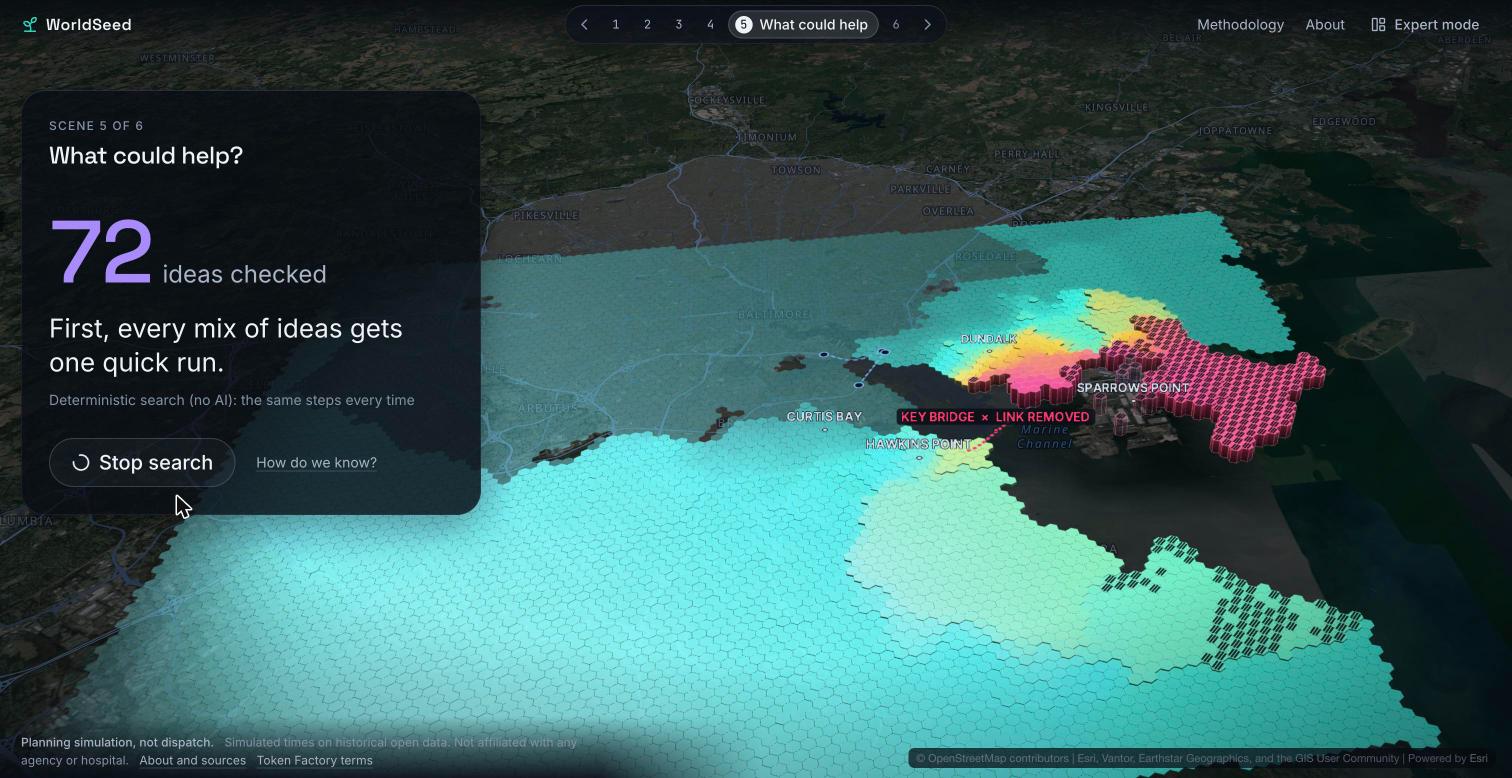
A deterministic search scores every option against many simulated futures.
-
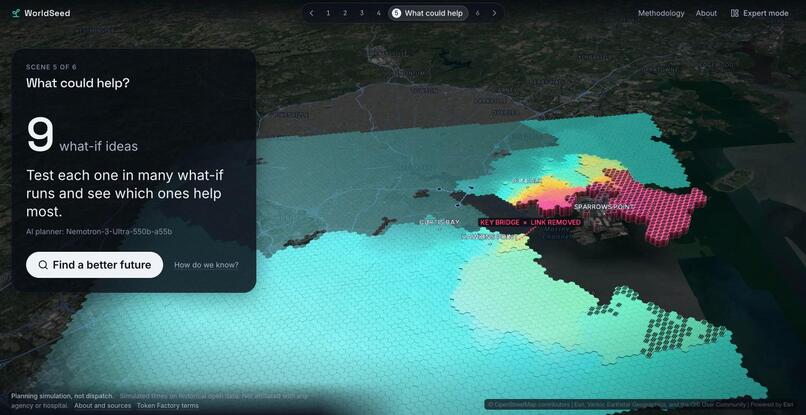
The AI planner turns a goal into candidate interventions to test, never a number.
-
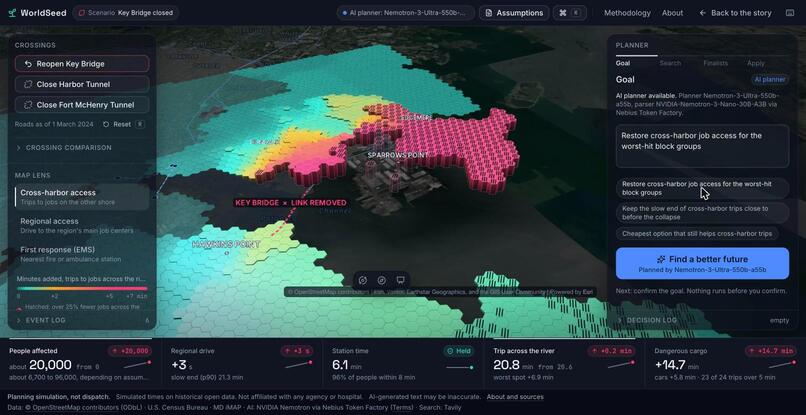
A plain language goal becomes a structured mission the simulator can score, the 20,000 figure always shown with its 6,700 to 96,000 range.

In memory of the six construction workers who died when the Francis Scott Key Bridge collapsed on March 26, 2024. WorldSeed is a research and education prototype for infrastructure planning. It is not a dispatch, triage or operational system, and it is not affiliated with or endorsed by any agency. In an emergency, call 911.
Inspiration
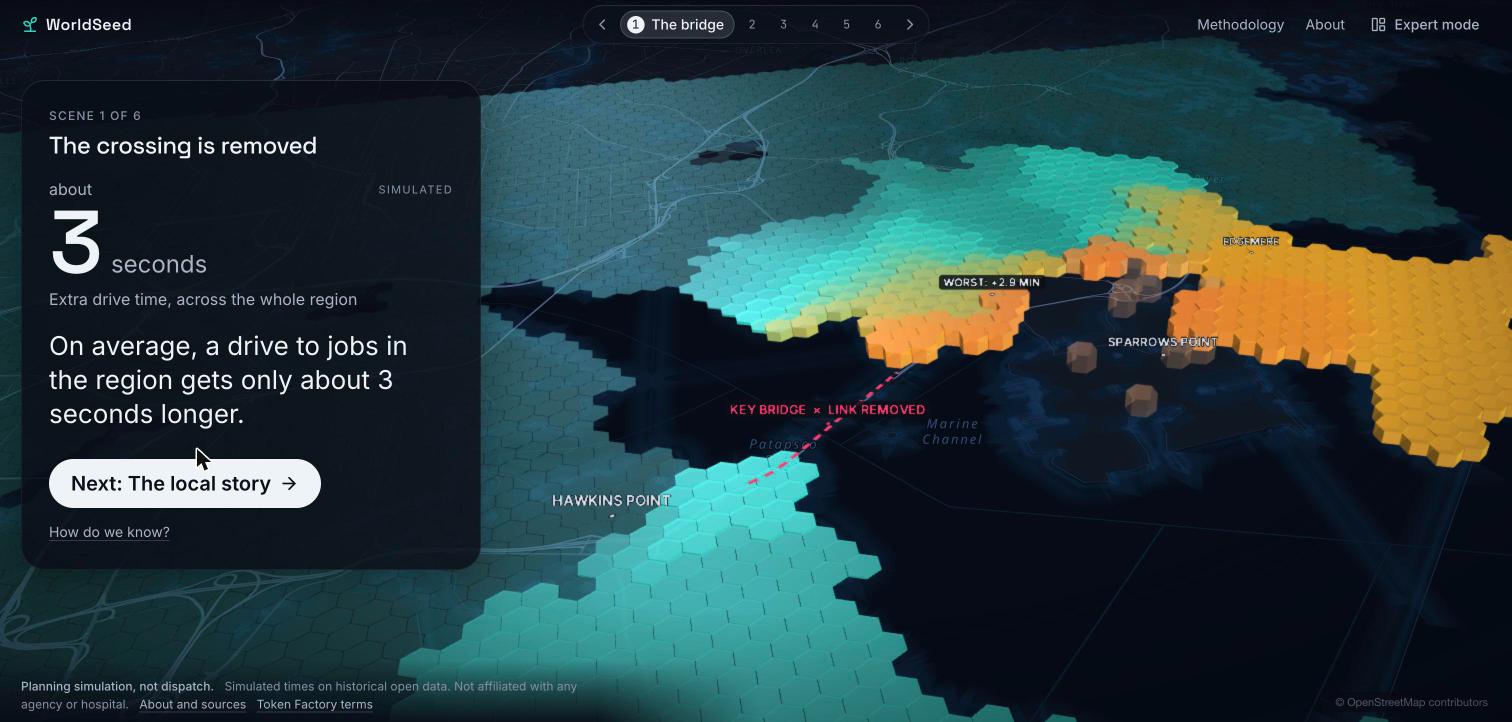
We expected first response time to spike when we removed the Key Bridge from the map. It did not move at all, because both shores already have their own fire and EMS stations. That flat result forced us to stop guessing and start simulating. Our regional lens says losing the Key Bridge costs about 3 seconds on the average drive to a job. That number is true, and it is the wrong place to look. Underneath it, about 20,000 people (6,700 to 96,000, depending on assumptions), mostly on the Sparrows Point and Edgemere peninsula, lose more than 10% of the jobs they can reach across the harbor within 30 minutes, up to 77% in the eight hardest hit block groups. We wanted a tool that shows the average and the local story side by side, and that reports what held too, because "the thing you feared did not happen" is a finding, not a null result.
We also wanted an AI system that cannot fake a result. Most hackathon agents either compute nothing, a model free associating about traffic, or hide their computation behind a black box score. We built the opposite: a simulator that is the only place a number can ever come from, and a model whose entire job is to choose from options that simulator can check.
What it does
WorldSeed is a counterfactual infrastructure planning simulator built on the real, historical Baltimore road network from the week before the Key Bridge collapsed. Remove a crossing, and three lenses move together so no single number can hide another:
- First response held. Simulated time from the nearest fire or EMS station barely changes, because both shores already have their own stations.
- Regional access barely moved. About 3 seconds on the average drive to the region's job centers.
- Cross-harbor access broke, locally. About 20,000 residents on the peninsula lose more than 10% of the jobs they can reach across the harbor (6,700 to 96,000, depending on assumptions); the eight hardest hit block groups lose 27% to 77%; about 4,900 lose more than half.
- Hazmat trucks lose the most minutes. Vehicles carrying MDTA listed hazardous materials are barred from both harbor tunnels; with the bridge gone, they take the western I-695 arc instead, about 15 minutes more on average against about 6 for a car, across 24 cross-harbor trips.
On top of that simulator sits a planner you can talk to in plain language. Give it a goal and NVIDIA Nemotron, running on Nebius Token Factory, turns that open ended request into a structured mission: a search over a catalog of concrete interventions that the browser side simulator scores across many futures. A second Nemotron model, the critic, picks one stress test from a closed, enumerable set, specifically to try to break whatever the planner just proposed, and the simulator is forced to rescore every leading option under that exact stress. The model can never state a metric. Every number a visitor sees comes from the simulator, not from the model's own words.
How we built it
A build time Python pipeline fetches dated OpenStreetMap history, Census ACS, TIGER and LODES data, and Maryland iMAP facility locations, builds the road graph and hex grid, and writes a committed, hashed snapshot so every result is reproducible from the same inputs. A browser side TypeScript simulator, running in Web Workers so hosting stays free, is the only source of every computed number, and it is tested hex by hex against an independent Python reference. A deterministic two stage search (screen every eligible bundle once, then run paired stress futures on the top 12) works with zero AI dependency and is checked against an exhaustive audit of all 129 eligible bundles. Next.js route handlers hold the only keys, build every prompt from server side templates, and accept nothing but schema validated structured input; there is no generic model proxy anywhere in the app. Four Nemotron roles, planner, critic, parser and extractor, resolve at runtime from the account's live /models list, so the interface always shows exactly which model ran.
Why you can trust the numbers
The cross-harbor lens, and its 20, 30 and 40 minute sensitivity bands, were defined before anyone looked at the results. We then tried hard to break our own finding: 51 sensitivity variants across speeds, tunnel congestion, time budget, shore boundary and snap time, plus 15 null closure controls far from the bridge, of which 12 of 15 passed the rule we set in advance (the three that did not are a known modeling artifact, a single stranded dead end hex, not a flaw in the finding). The browser simulator matches an independent Python reference hex by hex, and ranks 0.98 by Spearman correlation against the public OSRM router over about 5,000 origin destination pairs.
The architecture is the pitch
The non obvious part is not that the model never outputs a number. That is a constraint. The idea is that Nemotron's real job is the one piece a brute force search genuinely cannot do: turning an open ended, plain language goal into the structured mission a search can run on. There is no catalog of English sentences to enumerate, so no amount of brute force replaces that step. The critic adds a second, smaller check on top of that: it picks one stress test from a closed set, specifically to try to break the leading bundle, so nothing survives on an untested assumption, and the thing attacking the model's bundle is itself deterministic and auditable. The model cannot game its way to a good looking answer.
We checked that idea without any AI in the loop at all. A deterministic two stage search, screen every eligible bundle once, then paired stress futures on the top 12, finds the rank 1 bundle out of all 129 eligible combinations in our exhaustive audit (frontend/lib/agent/exhaustive.ts). That is not evidence the AI is unnecessary. It is how we calibrated the AI while the catalog was still small enough to brute force at all, and it is the harness that lets us trust the planner before a real catalog grows past a few hundred options, the point where exhaustive search stops being possible and Nemotron becomes the only way to search the space at all.
As of October 24, 2026, this is not a design on paper. The real Nebius Token Factory API is live and verified, wired into the deployed site's production environment behind a shared rate limit store, and real missions have run end to end through the app's own routes (parse, then plan, then critique, then finalize), both locally and against the live site itself. That is proof the catalog only validator holds against a real model's real mistakes, not just fake provider tests. The deployed demo runs the AI path live today, and falls back to the deterministic path, clearly labeled "not AI," only if the AI is unavailable, its output is rejected, or the daily budget is spent.
Challenges we ran into
Rebuilding the story after a flat result. Once first response stopped being the hero metric we expected, we had to go find the real finding instead of forcing the one we wanted. Keeping a model away from numbers structurally, not by prompting it nicely: the catalog it sees carries no effect sizes, its output schema has no field for a number, and its "why" is a pick from eight fixed rationale kinds that the application renders as a sentence. Verifying a real API against a plan built entirely from public documentation: every model ID we guessed from the docs back in September resolved correctly on the very first live /models call, and ten real missions through the app's own routes then confirmed the rest of the plumbing, the validator, the catalog only constraint, the fallback path, holds against a real model's real behavior. And tone: this project is built on a real loss. The bridge appears only as a removed link on a map; nothing about the collapse is animated; no one is named.
Accomplishments that we're proud of
A finding we did not tune, that survived a 51 variant attempt to break it. A search architecture where the exhaustive audit, no AI, rank 1 of 129, is also the proof that the AI search policy sitting on top of it has nothing to hide behind. A real Token Factory account, verified live at the API level (model resolution, structured output, streaming) six days before the deadline, wired into the deployed site's production environment, with real missions run both locally and through the live site itself. A public demo that needs no login and costs nothing to run, because the core simulation runs in the visitor's own browser.
What we learned
The most useful thing a simulator can do is tell you where the problem is not. Constraining a model to choose from a catalog a simulator can check turned out to be a stronger agent story than asking the model for an analysis, not a weaker one: the same audit that proves the search works without AI is the audit that keeps the AI honest once it is switched on. A head count can be just as assumption sensitive as a regional average is misleading; report the range, and lead with the measures that stay stable.
What's next
Compare model output quantitatively against published post collapse observations. Screen crossings beyond the three already shipped (Key Bridge, Harbor Tunnel, Fort McHenry Tunnel); the data pipeline is already configurable to a new bounding box.
WorldSeed is a research and educational prototype for exploring counterfactual infrastructure planning scenarios. It is not an emergency dispatch, triage, routing or operational decision system, and it is not route guidance: it is an offline, retrospective simulation on a historical road network, not connected to any traffic management, navigation or hazardous materials compliance system. All figures are simulated from historical open data at free flow speeds and are not measurements or predictions. Numbers, results and finalist cards are produced by the application from simulator results and catalog data. AI written text appears only in the decision log: a labeled rationale choice, and an optional raw reasoning section shown without human review, which may be wrong or inappropriate and is not the view of WorldSeed. Not affiliated with or endorsed by any agency, hospital, the Maryland Transportation Authority (MDTA), the State of Maryland, the U.S. Census Bureau, the NTSB or the OpenStreetMap Foundation. In an emergency, call 911.
Credits: Map data (c) OpenStreetMap contributors (ODbL). Basemap: OpenFreeMap, (c) OpenMapTiles. Satellite imagery: Esri, Vantor, Earthstar Geographics, and the GIS User Community. Powered by Esri. Census data: U.S. Census Bureau (ACS via Census Reporter; TIGER/Line; LEHD LODES). Facility locations: MD iMAP, State of Maryland. Hazmat tunnel rule: Maryland Transportation Authority. Reported commute: Capital News Service (Charlotte Kanner and Mira Beinart, via Baltimore Fishbowl). AI: NVIDIA Nemotron on Nebius Token Factory. Search: Tavily.
Built With
- d3.js
- deck.gl
- esri
- framer-motion
- geopandas
- h3
- maplibre
- nebius
- nemotron
- networkx
- next.js
- numpy
- openfreemap
- pandas
- python
- react
- scikit-learn
- scipy
- shapely
- tavily
- typescript
- vercel
- webworkers
- zod
- zustand

Log in or sign up for Devpost to join the conversation.