-
-
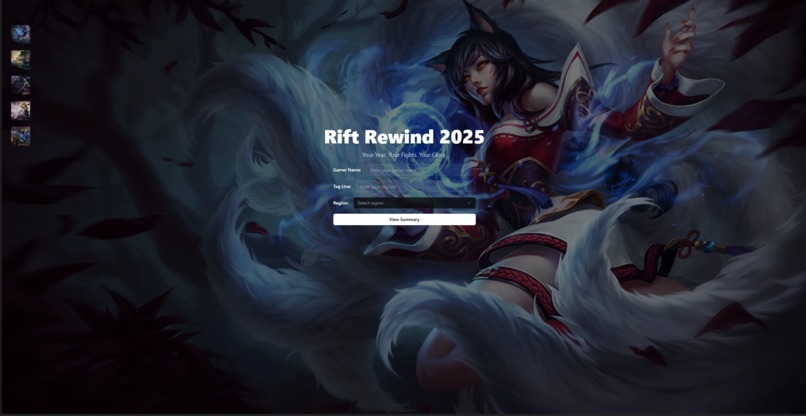
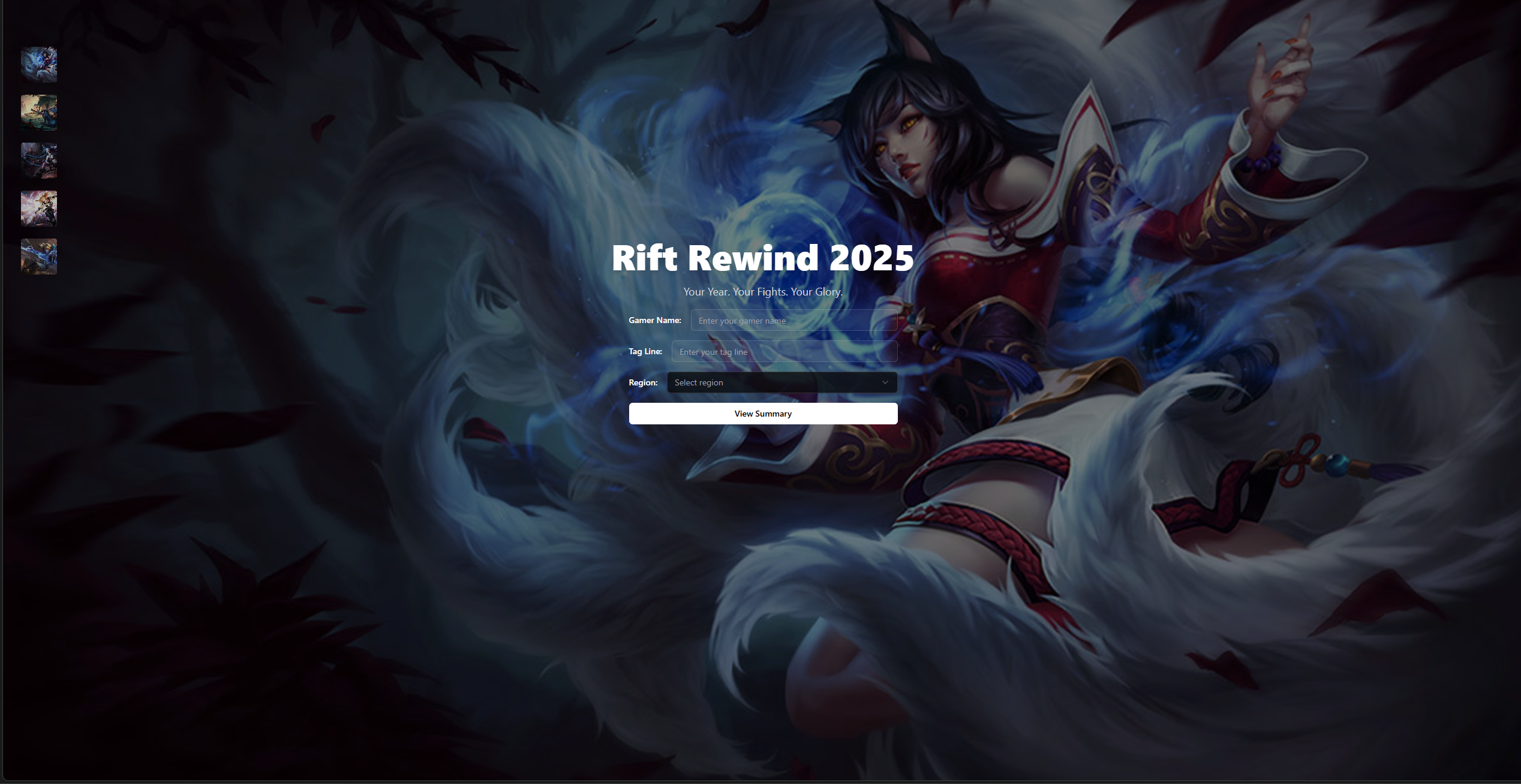
Landing Page
-
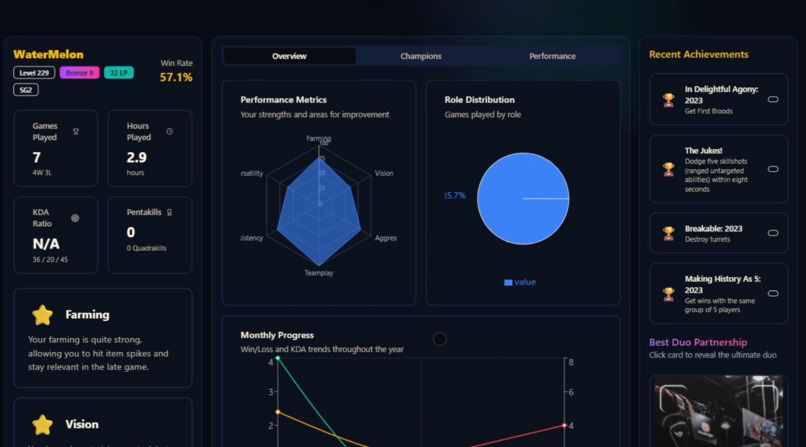
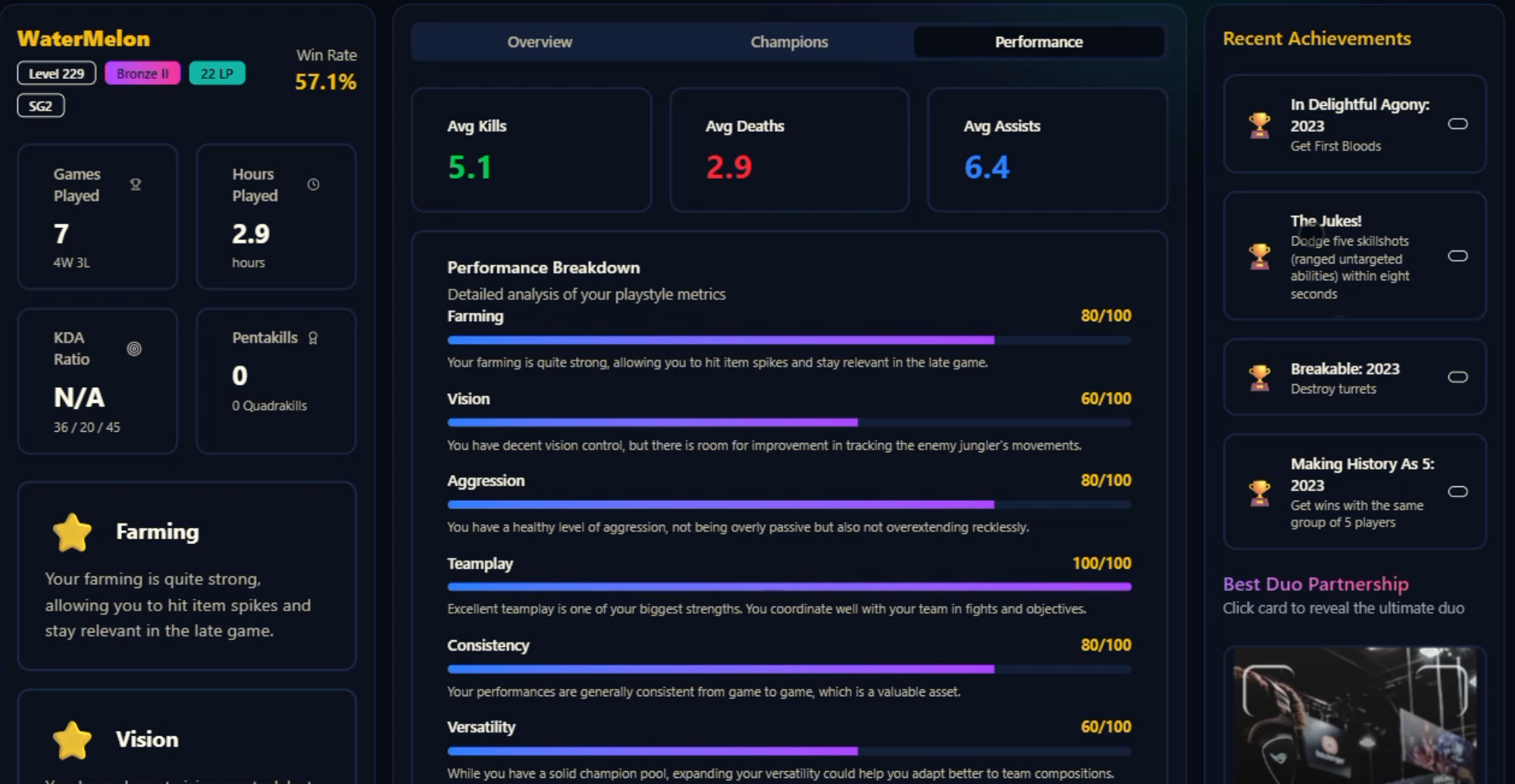
Year End Summary
-
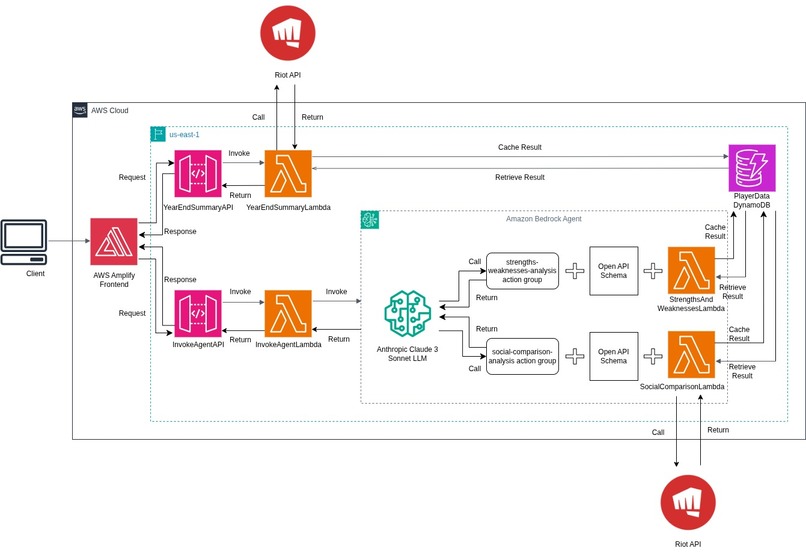
System Architechture Design
-
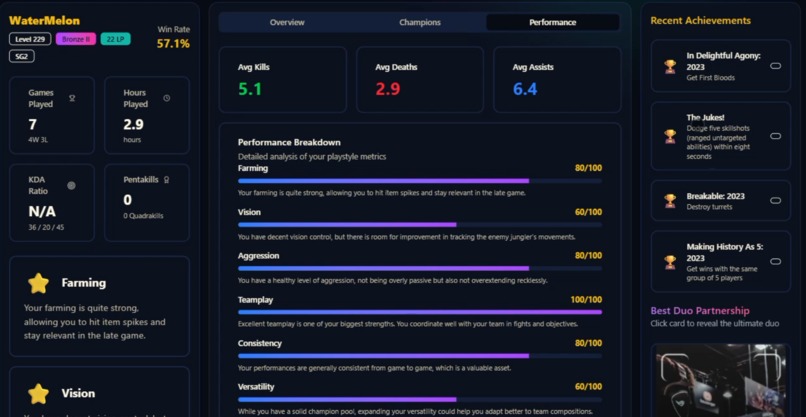
AI Powered Strengths and Weaknesses

Inspiration
League of Legends players often receive vague advice like “farm better” or “ward more,” but lack personalized, data-driven insights. We wanted to build a coaching AI that actually understands your gameplay — not just stats — and provides actionable advice based on your match history, strengths, and social synergies. This project was inspired by:
- Amazon Bedrock’s new agentic AI stack
- Gaming Dashboard Design
- Valorant 2024 Year End Review Review
- Our desire to make coaching accessible, measurable, and fun through social comparisons.
How the Coaching Agent Works
The coaching agent provides insights by performing a detailed, real-time analysis of a player's recent performance and computing all scores on demand.
1. Strengths & Weaknesses Analysis
This analysis is handled by the StrengthAndWeaknessesLambda. When a user requests an analysis, the process is as follows:
- Data Collection: The function queries the Riot API for a player's 20 most recent matches.
- Raw Metrics: It processes these matches to calculate aggregate and average statistics, such as KDA (Kills/Deaths/Assists), CS (Creep Score), gold, damage dealt, vision score, and win rate.
- Scoring Logic: These raw metrics are then normalized against a set of predefined benchmarks to generate six key scores on a 0-100 scale:
- Farming: Scored based on average CS and gold per game.
- Vision: Scored based on average vision score per game.
- Aggression: A combined score of KDA and average damage per game.
- Teamplay: A combined score of win rate and assist-to-kill ratio.
- Consistency: Calculated from the standard deviation of a player's "impact score" (Kills + Assists - Deaths) across their games. A lower deviation results in a higher consistency score.
- Versatility: A combined score based on the number of unique champions played and the player's average champion mastery score.
2. Social Comparison & Synergy Analysis
This analysis is handled by the SocialComparisonLambda and uses the 6-score profiles generated above.
- Playstyle Archetype: The agent first determines a player's primary "playstyle archetype" (e.g.,
Carry/Farmer,Aggressor/Slayer,Support/Team Player) by identifying their single highest score. A priority list is used to break any ties. - Synergy Check: It then checks if the two players' archetypes form a "complementary pair" as defined in its logic (e.g., a
Carry/Farmerpairs well with aSupport/Team Player). - Playstyle Similarity: Finally, it calculates a cosine similarity score. This treats the two players' 6-point score profiles as vectors and calculates the angular similarity between them, resulting in a percentage (0-100%) that represents how similar their overall playstyles are.
Project Architecture

Here is the technical breakdown of the project components shown in the diagram.
1. Data Layer
- Riot API: The primary data source, used to retrieve real-time player account, match history, mastery, and champion data.
- AWS DynamoDB: A NoSQL database used as a cache. It stores the computed results of player analyses (like the 6-score profile) to reduce redundant Riot API calls, minimize latency, and stay within API rate limits.
2. Computation Layer
- AWS Lambda Functions: Serverless functions that contain the core business logic.
StrengthAndWeaknessesLambda: Invoked to perform the detailed performance analysis described above, fetching data from the Riot API and calculating the six key scores.SocialComparisonLambda: Invoked to compare two players. It retrieves their cached profiles (or computes them) and runs the playstyle archetype, synergy, and similarity logic.YearEndSummaryLambda: Generates an annual performance summary for a player, similar to a "Spotify Wrapped" for League of Legends.
3. AI Reasoning Layer
- Amazon Bedrock Agents: This is the "brain" of the conversational interface, powered by the Anthropic Claude 3 Sonnet model. Its job is to understand natural language requests from the user.
- Action Groups: These are the crucial connectors that allow the Bedrock Agent to be functional. They map the user's intent to a specific computational task.
- When the agent understands a user's request (e.g., "How well do I play with my friend?"), it calls the appropriate action group (e.g., the
social-comparison-analysisgroup). - This action group then invokes the corresponding
SocialComparisonLambdafunction, passes it the required parameters (like the player names), and receives the resulting JSON report. - The Bedrock Agent then formats this JSON data into a helpful, easy-to-read natural language response for the user.
- When the agent understands a user's request (e.g., "How well do I play with my friend?"), it calls the appropriate action group (e.g., the
4. Frontend
A lightweight React dashboard, hosted and deployed using AWS Amplify, visualizes:
- Performance Radar Chart
- Role Distribution Pie Chart
- Duo Synergy Matrix
- Archetype Badges
Challenges we ran into
Challenge 1: Regional Routing Complexity Problem: Riot API uses different routing values for account vs. match endpoints (e.g., "sea" vs "asia" for SG2 servers). Solution: Implemented dual-layer routing:
REGION_TO_PLATFORMS = {
    'americas': ['na1', 'br1', 'la1', 'la2', 'oc1'],
    'asia': ['kr', 'jp1'],
    'sea': ['sg2', 'ph2', 'th2', 'tw2', 'vn2']
}
The system tries each platform within a region until a valid response is received.
Challenge 2: Rate Limiting Problem: Riot API has strict rate limits (20 requests/second, 100 requests/2 minutes). Solution: Implemented exponential backoff with retry-after header parsing:
def request_with_retry(url, max_retries=3):
    for attempt in range(max_retries):
        if response.status_code == 429:
            retry_after = int(response.headers.get("Retry-After", 1))
            time.sleep(retry_after)
Challenge 3: Champion Name Normalization Problem: API returns champion names with inconsistent formatting (e.g., "Nunu & Willump" vs "Nunu"). Solution: Created normalized lookup dictionaries:
NORMALIZED_ID_MAP = {
    _normalize_champion_name(name): champ_id
    for name, champ_id in champion_id_map.items()
}
_ID_ALIAS_SOURCE = {
    "nunuwillump": "nunu",
    "renataglasc": "renata",
    "wukong": "monkeyking",
}
Challenge 4: Caching Strategy Problem: Repeated analysis requests were slow and hit API limits. Solution: Implemented DynamoDB-based caching with composite keys:
Accomplishments that we're proud of
Built a fully functional AI coach that converses naturally using AWS Bedrock. Integrated real-world match data pipelines end-to-end (Riot → AWS → Agent). Created an interpretable scoring system that transforms raw metrics into human-readable insights. Achieved sub-3 second response times for cached analyses. Seamlessly connected AI reasoning + gameplay analytics + social insight.
What we learned
- How to architect a serverless multi-agent pipeline using AWS Bedrock, DynamoDB, and Lambda.
- How embedding-based retrieval (RAG) enables contextual game knowledge.
- Importance of normalizing esports data schemas across multiple APIs.
- How to balance game analytics with natural language explanation — a bridge between data science and coaching.
What's next for Worlds 2026 Ticket Winner
- Deepening AWS Integration: explore more possibilities with AWS services such as Bedrock, Lambda, OpenSearch, and SageMaker to enhance scalability, latency handling, and model performance.
- Riot Production API Access: request access to Riot’s production API to overcome current rate-limit constraints and enable full-scale player analytics at competitive reliability levels.
- Unified Data Pipeline: consolidate and optimize all API calls across Riot endpoints into a single, orchestrated data flow to significantly reduce redundant requests and improve efficiency.
- Web Dashboard Expansion: enhance player experience with interactive coaching timelines, match replay integration, and voice-based insights powered by Bedrock Agents.
- Open Beta at Worlds 2026: launch a community leaderboard for global testing, with winners receiving exclusive Worlds 2026 tickets.
Built With
- amazon-web-services
- api
- bedrock
- database
- nosql

Log in or sign up for Devpost to join the conversation.